

Wenn ein Aluminium-Strukturbauteil auf T6 wärmebehandelt werden muss, scheidet Hochdruckguss (HPDC) aus. Die durch das Einspritzverfahren entstehende Porosität unter der Oberfläche führt beim Lösungsglühen zu Blasenbildung, sodass das Bauteil ausfällt, bevor es sein mechanisches Potenzial erreicht.
Der Schwerkraftkokillenguss schließt genau diese Lücke: porenarme Gussteile, serienreife Maßhaltigkeit und vollständige Wärmebehandlung bei mittleren Stückzahlen.
Unter Yijin-Lösung, produzieren wir Kokillengussteile aus Aluminium-, Zink-, Magnesium- und Kupferlegierungen mit Wärmebehandlung, CNC-Bearbeitung und CMM-Prüfung aus einer Hand.
Dieser Leitfaden schlüsselt jede Kostenvariable, jeden Prozessschritt und jede Auswahlentscheidung auf, damit Sie Ihr Projekt genau kalkulieren und das richtige Verfahren mit Sicherheit wählen können.
Was ist Kokillenguss?
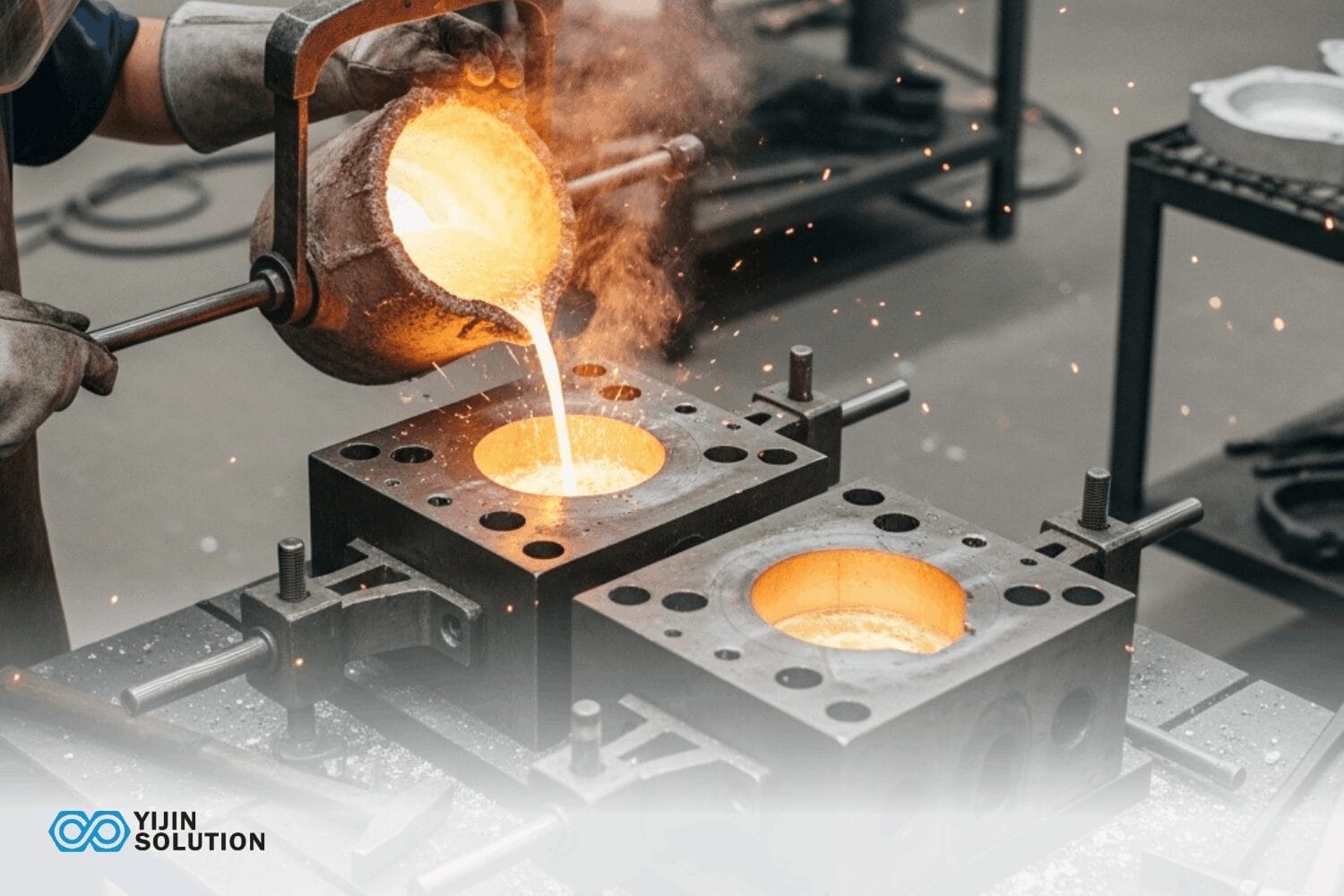
Kokillenguss, auch bekannt als Schwerkraftguss, ist ein Verfahren, bei dem geschmolzenes Nichteisenmetall allein durch den Schwerkraftdruck in eine wiederverwendbare Stahlkokille gegossen wird. Es wird kein externer Einspritzdruck ausgeübt. Die Kokille wird geöffnet, sobald der Guss erstarrt ist, und der Zyklus wiederholt sich.
Das Fehlen von Einspritzdruck ist der Unterschied zwischen GDC und HPDC. Die langsame, schwerkraftgetriebene Formfüllung reduziert Turbulenzen und Lufteinschlüsse und erzeugt ein dichteres Gussgefüge mit geringerer Porosität. Dieses Gefüge ist stabil genug für eine Lösungsglühung und Auslagerung ohne Blasenbildung. Das ist ein entscheidender Vorteil für Strukturanwendungen.
Der Kokillenguss-Prozess — Schritt für Schritt
Während Legierung, Bauteilgeometrie und Formkomplexität die spezifischen Parameter beeinflussen, folgt GDC über alle Varianten hinweg einer einheitlichen 11-Schritt-Sequenz. Die Erstarrungs- und Speiserauslegung sowie die Wärmebehandlungsschritte sind die qualitätskritischen Unterscheidungsmerkmale, die GDC von HPDC abheben.
| Schritt | Name | Was passiert | Wichtiger Qualitätshebel |
|---|---|---|---|
| 1 | Werkzeugvorbereitung | Vorheizen beider Formhälften auf Betriebstemperatur, typischerweise 150–250 °C für Aluminium. Trennmittel auftragen, um Metallanhaftung zu verhindern und den Temperaturgradienten zu regulieren. | Gleichmäßigkeit der Formtemperatur |
| 2 | Kernsetzen | Sand- oder Metallkerne einlegen, um Innenhohlräume und Hinterschneidungen zu formen, die die Dauerform nicht erzeugen kann. Kernsitz prüfen und Oberflächen abziehen. | Maßhaltigkeit und Passung der Kernmaße |
| 3 | Formspannen | Formhälften schließen und verriegeln. Es wird kein hydraulischer Einspritzdruck aufgebracht. Die Form widersteht nur dem statischen ferrostatischen Druck des flüssigen Metallkopfs. | Ausrichtung des Werkzeugs und Verriegelungsintegrität |
| 4 | Metallschmelze und Vorbereitung | Die Legierung in einem Herd- oder elektrischen Widerstandsofen schmelzen. Die Schmelze über rotierende Entgasung und Flussmittel entgasen und vor dem Gießen Temperatur- und Wasserstoffwerte messen. | Schmelzereinheit und Wasserstoffgehalt |
| 5 | Gießen | Gießpfanne oder automatisches Gießsystem füllt den Formhohlraum über einen Anguss von oben oder von der Seite. | Gießgeschwindigkeit und Turbulenzkontrolle |
| 6 | Verfestigung | Das Metall erstarrt unter Schwerkraft ohne externen Druck. Speiser versorgen die Schmelze, um die volumetrische Schwindung auszugleichen. Gesteuert durch die Formtemperatur und die Speisergeometrie. | Speiserauslegung und thermischer Gradient |
| 7 | Werkzeugöffnung und Ausstoßen | Öffnen Sie die Formhälften, sobald das Gussteil die Entformungstemperatur erreicht. Entformen Sie über Auswerferstifte oder manuelle Entnahme. Entfernen Sie Sandkerne, wo verwendet. | Entformungstemperatur-Fenster |
| 8 | Entgraten | Angüsse, Steiger und Grat durch Sägen, Knipsen oder Schleifen entfernen. Rückläufe werden wieder eingeschmolzen. | Ausbeute und Rücklaufquote |
| 9 | Wärmebehandlung | Für strukturelle Anwendungen: Lösungsglühen, auch bekannt als T4, oder Lösungsglühen und Auslagern, bekannt als T6/T7, um die vollen mechanischen Eigenschaften zu entwickeln. | Wärmebehandlungsspezifikation |
| 10 | Inspektion | Dimensionsprüfung mittels CMM oder Koordinatenmessung. Sicht- und Farbeindringprüfung. Röntgen-NDT für kritische Strukturgussteile. Erstmusterprüfung, oder FAI, gegen Zeichnungsangaben. | Erstmusterprüfung, CMM und Röntgenprüfung |
| 11 | Sekundäre Operationen | CNC-Bearbeitung eng tolerierter Merkmale wie Bohrungen, Passflächen und Gewinde. Oberflächenbehandlungen aufbringen. Druckprüfung, wo spezifiziert. | Toleranzkette und Oberflächenspezifikation |
Verfahrensvarianten des Kokillengusses
Standard-Kokillenguss: Ober- und Seitenguss
Das geschmolzene Metall wird von oben oder über einen seitlichen Anguss in die Form gegossen. Dies ist die gebräuchlichste GDC-Variante für Aluminium- und Kupferlegierungen und der kostengünstigste Einstieg in die GDC-Familie.
Kippguss/Rotationskokillenguss
Die Form wird beim Gießen gedreht oder gekippt, damit das Metall in einer kontrollierten, laminaren Strömung in den Hohlraum gelangt und die Turbulenzen und Oxidverschleppungen vermieden werden, die beim Gießen von oben auftreten.
Tilt-Pour erzeugt Gussstücke mit der geringsten Porosität und der höchsten Konsistenz in der GDC-Familie und ist damit das bevorzugte Verfahren für sicherheitskritische automobiltechnische Strukturgussteile wie Achsschenkel, Querlenker und Hilfsrahmenknoten.
Schwerkraftdruckguss mit Sandkernen
Wo die innere Geometrie nicht durch das Dauerwerkzeug geformt werden kann, wie bei Sackkanälen und komplexen Innenkanälen, werden vor jedem Schuss entfernbare Sandkerne eingelegt. Sandkerne verursachen Kosten von 1–10 £ pro Kern und Zyklus und führen zu Maßabweichungen an der Kern-Schnittstelle, ermöglichen aber eine geometrische Komplexität, die ein kernloses Werkzeug einfach nicht liefern kann.
Schwerkraftgießen vs. HPDC vs. Sandguss — Prozessvergleich
Die Verfahrensauswahl für Nichteisen-Strukturgussteile hängt von drei Variablen ab: den geforderten mechanischen Eigenschaften, dem Jahresvolumen und den geometrischen Einschränkungen. Die folgende Tabelle ist eine Entscheidungshilfe, nicht nur eine Datenmatrix.
| Attribut | Schwerkraftkokillenguss (GDC) | Hochdruckguss (HPDC) | Sandgießen |
|---|---|---|---|
| Prozess | Gravitationsfüllung in eine dauerhafte Stahlkokille | Hochdruckinjektion, etwa 10–175 MPa in gehärtete Form | Gravitationsfüllung in Einweg-Sandform |
| Werkzeugkosten | Mittel — 8.000–40.000 $ | Hoch — 15.000–120.000 $+ | Niedrig — 500–5.000 $, das entspricht den Formkosten |
| Werkzeugbau-Lieferzeit | 8–14 Wochen | 12–20 Wochen | 2–6 Wochen |
| Lautstärke Sweet Spot | 1.000–50.000 Teile/Jahr | 50.000–500.000+ Teile/Jahr | 1–5.000 Teile/Jahr |
| Zykluszeit | 2–5 Minuten | 15–60 Sekunden | 15–60 Minuten |
| Min. Wandstärke | 3–5 mm für Al | ~1,0 mm bei Al | 3–6 mm |
| Maßgenauigkeit | ±0,3–0,5 mm im Gusszustand | ±0,1–0,2 mm im Gusszustand | ±0,5–1,5 mm |
| Oberflächenbehandlung | 3–6 µm | 1–3 µm | 6–25 µm |
| Porositätsgrad | Niedrig — langsames Füllen reduziert eingeschlossene Luft | Höher – schnelles Einspritzen schließt Luft ein | Niedrig bis mittel |
| Wärmebehandelbar? | Ja — T4, T6, T7 sind alle möglich | Nein — Porositätsblasen beim Wärmebehandeln | Ja |
| Mechanische Eigenschaften | Gut — dichte Struktur, wärmebehandelbar | Mittel — nur Gusszustandseigenschaften | Gut – warmbehandelbar, isotrop |
| Am besten für | Strukturelle, mittelvolumige, wärmebehandelbare Teile | Großserie, dünnwandige, sichtbare Teile | Kleinserien, große oder Prototypenteile |
Nennen Sie uns Ihr Jahresvolumen, Ihre Legierung und die wichtigsten mechanischen Anforderungen. Wir bestätigen, welches Gussverfahren die besten Kosten pro Teil für Ihre Anwendung liefert.
Welche Legierungen werden beim Kokillenguss verwendet?
| Legierungsfamilie | Gemeinsame Noten | Wichtige Eigenschaften | Wärmebehandelbar | Typische GDC-Anwendungen |
|---|---|---|---|---|
| Aluminium | LM6, LM25, A356, A357, 319 | Ausgezeichnetes Festigkeits-Gewichts-Verhältnis, Korrosionsbeständigkeit, Wärmeleitfähigkeit | Ja, im Fall von LM25/A356 bis T6 | Motorkomponenten, Fahrwerksteile, Strukturhalter, Gehäuse |
| Aluminium-Silizium | LM6, LM24, ADC12 | Hohe Fließfähigkeit, gute Gießbarkeit, geringere mechanische Eigenschaften als A356 | Begrenzt | Dekorteile, Abdeckungen, dünnwandige nicht tragende Gussteile |
| Magnesium | AZ91D, AM60B | Leichtestes Strukturmetall, hervorragende spezifische Festigkeit, gute Schwingungsdämpfung | Ja | Automobil-Innenraumstrukturen, Luftfahrt-Halter, Gehäuse für Handheld-Geräte |
| Kupfer/Messing | CuZn37, CuSn5, LG2 | Höchste Festigkeit und Verschleißfestigkeit, gute thermische und elektrische Leitfähigkeit | Begrenzt | Sanitärarmaturen, Elektrokomponenten, Marinebeschläge, Buchsen |
| Zink | Zamak 3, Zamak 5, ZA-8, ZA-12 | Hohe Fließfähigkeit, exzellente Detailauflösung, niedrige Gießtemperatur | Nein | Beschläge, dekorative Komponenten, hochdetaillierte Funktionsteile |
Wenn Sie uns Ihre Legierungsanforderung und die Zielwerte der mechanischen Eigenschaften nennen, bestätigen wir Prozessroute, Wärmebehandlungsspezifikation und erreichbare Toleranz.
Typische Anwendungen des Kokillengießens

Nachfolgend finden Sie einige bemerkenswerte Anwendungen von GDC in verschiedenen Branchen:
Automobilindustrie
Dabei handelt es sich um Fahrwerkskomponenten wie Achsschenkel, Querlenker, Dreieckslenker und Radnaben – zentrale GDC-Anwendungen.
Luft- und Raumfahrt und Verteidigung
GDC ist ein zentrales Verfahren bei der Fertigung von Hydraulikblöcken, Avionikgehäusen, Strukturhaltern und Aktorgehäusen. Diese Teile werden üblicherweise in A357-T6 oder Aluminium der 2024er-Serie.
Industrielle Ausrüstung
Industrielle Bauteile wie Pumpengehäuse, Verdichterkörper, Getriebe-Endschilde und Ventilgehäuse profitieren von GDC. Denn bei diesen Teilen sind Druckdichtheit und Maßwiederholbarkeit wichtiger als die optische Oberfläche.
Medizinische Ausrüstung
Instrumentengehäuse, Strukturrahmen für Bildgebungssysteme und Komponenten für chirurgische Roboterarme erfordern Nichteisen-, warmbehandelbare und maßstabile Gussteile. Das macht den Schwerkraftkokillenguss zur logischen Wahl für diese Teile.
Marine- und Öl-/Gas-Bereich
Kupferlegierung GDC in LG2 oder CuSn-Bronze bietet Seewasser-Korrosionsbeständigkeit und Verschleißleistung, die Aluminiumalternativen einfach nicht erreichen.
Kostenanalyse beim Kokillenguss
Die Kosten für GDC sind multivariabel und stückzahlabhängig. Es gibt keinen einzelnen “Preis pro Teil”, ohne Legierung, Geometrie, Stückzahl, Wärmebehandlungsanforderung und Nachbearbeitungsschritte anzugeben. Die folgenden Tabellen schlüsseln dies systematisch auf, damit Sie Ihr Projekt genau kalkulieren können.
Hinweis: Die angegebenen Kosten sind Richtwerte für den Markt in Großbritannien/Europa. Kontaktieren Sie Yijin Solution für aktuelle Preise für Ihr Projekt.
Kostenaufschlüsselung beim Druckguss
Die Stückkosten beim Kokillenguss setzen sich aus zwei Komponenten zusammen: der einmaligen Werkzeuginvestition und den wiederkehrenden Kosten pro Teil, die in jedem Zyklus anfallen. Beide zu verstehen und zu wissen, wie sie mit der Stückzahl zusammenspielen, unterscheidet eine genaue Kostenmodellierung von bloßem Raten.
| Kostenelement | Typischer Bereich | Wichtigster Kostenfaktor | Anmerkungen |
|---|---|---|---|
| Werkzeugbau | 8.000–40.000 $ | Komplexität, Kerne und Schieber, Formnestzahl | Einmalige Kapitalkosten, amortisiert über das Produktionsvolumen. Mehrfachwerkzeuge erhöhen die Anschaffungskosten, senken aber die Stückkosten bei hoher Stückzahl. |
| Sandkerne | 1–10 $ pro Kern | Kernkomplexität und Stückzahl pro Guss | Erforderlich, wenn das Werkzeug keine innere Geometrie formen kann. Mindestanzahl der Kerne in der DFM-Phase angeben. |
| Wartung und Reparatur der Form | 500–5.000 $/Jahr | Werkzeugmaterial, Schusszahl, Abrasivität der Legierung | GDC-Formen halten 50.000–150.000 Schuss – länger als HPDC aufgrund geringerer thermischer Belastung. Planen Sie Intervalle für die vorbeugende Wartung ein. |
| Legierung/Werkstoff | 1,50–6,00 $/kg | Legierungsspezifikation, LME-Preis, Rücklaufquote | Aluminiumlegierungen: ca. 1,80–2,50 £/kg. Erlöse werden recycelt zurückgeführt – materialsparendes Design senkt die Materialkosten. |
| Arbeit | 5–25 $ pro Teil | Zykluszeit, Gießverfahren | Die Automatisierung des Gießens und der Einsatz von Besäumschneidwerkzeugen reduziert den Arbeitsaufwand bei hohen Stückzahlen erheblich. |
| Wärmebehandlung | 0,50–3,00 $/kg | Behandlungsspezifikation für T4 vs. T6, Losgröße, Ofenauslastung | Die T6-Wärmebehandlung ist teurer als T4. Große Stückzahlen verbessern die Kosten pro Teil. |
| CNC-Bearbeitung | Teilespezifisch | Anzahl der CTF-Merkmale, Toleranzen, erforderliches Rüsten | CNC-Bearbeitung bereits in der DFM-Phase einplanen – eng tolerierte Merkmale an GDC-Gussteilen verursachen erhebliche Stückkosten, wenn sie nicht frühzeitig berücksichtigt werden. |
| Oberflächenbehandlung | 0,50–4,00 $/Teil | Verfahrensart, insbesondere Eloxieren vs. Pulverbeschichten vs. Chromatieren, Bauteilgröße, Maskierungskomplexität | Maskierungsanforderungen in der Zeichnung angeben, um Kostenüberraschungen zu vermeiden. |
| Prüfung und ZfP | 1–15 $/Teil | Visuelle Prüfung vs. CMM vs. Röntgenprüfung, Erstmuster vs. Serie | Die Röntgenprüfung (NDT) verursacht erhebliche Kosten pro Teil – legen Sie sie nur fest, wo sie strukturell gerechtfertigt ist. |
Wie sich die Stückzahl auf die Stückkosten beim Kokillenguss auswirkt
Die Werkzeugkosten amortisieren sich bei kleinen bis mittleren Stückzahlen als dominanter Kostenfaktor. Der Wechsel vom Sandguss zur wirtschaftlichen GDC-Fertigung erfolgt bei einfachen Teilen typischerweise bei 500–1.000 Teilen pro Jahr. Unterhalb dieser Schwelle ist der geringere Werkzeugaufwand des Sandgusses meist die bessere finanzielle Entscheidung.
| Jahresvolumen | Werkzeugkosten/Teil (amortisiert) | Geschätzte Stückkosten (Al, einfaches Teil) | Prozessempfehlung |
|---|---|---|---|
| < 500 | > 50 $ | 60–150 $+ | Sandguss oder Feinguss ist in der Regel wirtschaftlicher, sofern keine engen Toleranzen oder eine Wärmebehandlung zwingend erforderlich sind |
| 500–2,000 | 15–50 $ | 25–80 $ | GDC wird wirtschaftlich – die Investition in Werkzeuge beginnt sich zu amortisieren. Ideal für Strukturprototypen, die in die Kleinserie übergehen. |
| 2,000–10,000 | 5–15 $ | 12–35 $ | GDC im optimalen Bereich. Vollständige Amortisation der Werkzeuge, gleichbleibende Qualität und Wärmebehandlung liefern starken Mehrwert. |
| 10,000–50,000 | 1–5 $ | 6–20 $ | GDC ist bei diesem Volumen sehr wirtschaftlich. Erwägen Sie Mehrfachformen, um die Zykluskosten zu senken. |
| > 50.000 | < 1 $ | 3–10 $ | Prüfen Sie HPDC, wenn Wandstärke und Geometrie es zulassen — eine schnellere Zykluszeit senkt die Stückkosten bei hohem Volumen weiter. |
Konstruktion für Kokillenguss — Wichtige DFM-Regeln
Die Entscheidungen in der DFM-Phase bestimmen den Großteil Ihrer endgültigen Teilekosten und das Qualitätsergebnis. Die folgende Tabelle übersetzt jeden Designparameter in seine Kosten- oder Qualitätsfolge, damit Sie nicht nur verstehen, was die Regel ist, sondern auch, was schiefgeht, wenn sie ignoriert wird.
| DFM-Parameter | Richtlinie (Aluminium-GDC) | Warum es wichtig ist |
|---|---|---|
| Minimale Wandstärke | 3,0–4,0 mm | Dünnere Wandstärken erhöhen das Risiko von Kaltlauf; abrupte Wandstärkenübergänge verursachen Schwindungsporosität |
| Entwurfswinkel | 1–3° auf allen Flächen parallel zur Entformungsrichtung | Erforderlich an allen vertikalen Flächen, um sauberes Auswerfen ohne Reißen zu ermöglichen |
| Verrundungsradien | Mindestens R2 mm an allen Innenkanten | Scharfe Ecken bündeln die Wärmespannung, lassen das Werkzeug reißen und begünstigen Schwindungsporosität |
| Unterschneidet | Minimieren — jede Hinterschneidung erfordert einen Kern oder Schieber | Jede Hinterdrehung verursacht zusätzliche Werkzeugkosten, längere Taktzeiten und eine mögliche Leckagestelle |
| Kerne in Bezug auf die interne Geometrie | Wo die Geometrie es zulässt, druckgegossene Formen gegenüber Sandkernen bevorzugen | Sandkerne erhöhen die Kosten pro Zyklus und die Maßabweichung |
| Positionierung von Steigern/Speisern | Speiser über den dicksten Querschnitten anordnen; gerichtete Erstarrung sicherstellen | Schlechte Speiserplatzierung ist die Hauptursache für Schrumpfporosität bei GDC |
| Trennungslinie | Optische und funktionale Auswirkungen abstimmen, bevor der Stahl geschnitten wird | Grat an der Trennebene ist unvermeidbar — zulässige Grathöhe in der Zeichnung angeben |
| CTF-Merkmalszugabe | +0,3–0,8 mm Aufmaß an eng tolerierten Merkmalen für CNC belassen | Nicht versuchen, <±0,15 mm im Gusszustand einzuhalten |
Unter Yijin-Lösung, deckt unsere DFM-Analyse die Kernzahl, die Speiserplatzierungsstrategie, die Auswirkungen auf die Trennebene und die CTF-Merkmalstoleranz ab, bevor eine Werkzeugverpflichtung eingegangen wird. Wenn Sie uns vor der Freigabe der Zeichnung in die Designprüfung einbeziehen, werden die teuersten Änderungen in der Spätphase vermieden.
Qualitätsstandards und Prüfung beim Kokillenguss
Die Qualitätsspezifikation für GDC liegt ebenso in der Verantwortung des Käufers wie in der der Gießerei. Undefinierte Abnahmekriterien sind die häufigste Ursache für Streitigkeiten bei der Erstmusterprüfung. Legen Sie den Prüfplan und die Abnahmepegel fest, bevor die Produktion beginnt, nicht danach.
Prüfung der Abmessungen
Dies erfolgt im Anschluss an eine Erstmusterprüfung nach AS9102 für die Luft- und Raumfahrt oder ein kundenspezifisches PPAP für Automobilanwendungen. Die Fertigungsprüfung umfasst eine statistische Stichprobe gegen die Zeichnungsangaben mittels CMM oder Koordinatenmessung.
Porositätsvorgabe
Die Porositätsvorgabe stützt sich auf die radiografischen Referenzstandards nach ASTM E505 oder gleichwertige OEM-spezifische Referenzradiografien. Legen Sie das Abnahmekriterium fest, bevor die Fertigung beginnt. Undefinierte Porositätsgrenzen in der Angebotsphase sind eine häufige Ursache für Streitigkeiten bei späten Ablehnungen.
Verifizierung der mechanischen Eigenschaften
Hierfür werden separat gegossene Probestäbe nach ASTM B108 oder BS 1490 verwendet, um Zugfestigkeit, 0,2-%-Dehngrenze und Bruchdehnung für wärmebehandelten GDC zu prüfen. Das Entnehmen von Probestäben aus Seriengussteilen ist in der Regel nicht geeignet, es sei denn, die Konstruktion sieht dies ausdrücklich vor.
Warum mit Yijin Solution für Kokillenguss zusammenarbeiten?
Yijin-Lösung ist ein in Shenzhen ansässiges Präzisionsfertigungsunternehmen mit AS9100D-Zertifizierung, IATF 16949 und ISO 13485. Dies sind Zertifizierungen auf hohem Niveau für Luft- und Raumfahrt, Medizintechnik bzw. Automobilindustrie. Wir fertigen seit 2003 Strukturgussteile und Präzisionskomponenten, und unser GDC-Programm basiert auf ingenieurgetriebener Prozesskontrolle – nicht nur auf Produktionsdurchsatz.
Wir betreiben Standard-Schwerkraftguss, Kippguss und GDC mit Sandkern über Aluminium-, Zink-, Magnesium- und Kupferlegierungen und decken das gesamte GDC-Anwendungsspektrum ohne Programmübergabe zwischen Lieferanten ab. Wir führen CNC-Bearbeitung, Oberflächenbehandlung wie Eloxieren, Pulverbeschichtung und Chromatierung; Druckprüfung und CMM-Inspektion mit Zeiss-Instrumenten.
Häufig gestellte Fragen
Wofür wird der Kokillenguss verwendet?
Kokillenguss eignet sich am besten für die Herstellung struktureller Nichteisenmetallteile. Bei solchen Verfahren sind geringe Porosität und Wärmebehandelbarkeit eine wesentliche Anforderung, vor allem bei Aluminium-, Kupfer- und Magnesiumlegierungen. Typische Anwendungen sind Automobil-Fahrwerk- und Motorkomponenten, Hydraulikverteiler, Strukturhalter für die Luft- und Raumfahrt sowie industrielle Pumpengehäuse.
Wie viel kostet die Werkzeugherstellung für Kokillenguss?
GDC-Werkzeuge kosten in der Regel 8.000–40.000 US-Dollar, je nach Teilekomplexität, Anzahl der Kerne und Schieber, Kavitätenzahl und Legierung. Einfache Aluminiumwerkzeuge mit einer Kavität beginnen bei etwa 8.000–15.000 US-Dollar; komplexe Mehrkavitätenwerkzeuge mit mehreren Schiebern und Sandkernsystemen können 30.000–40.000 US-Dollar oder mehr erreichen.
Was ist der Unterschied zwischen Schwerkraftkokillenguss und Hochdruck-Druckguss?
Der grundlegende Unterschied liegt im Füllmechanismus. Beim Kokillenguss wird die Form allein durch den Schwerkraftdruck gefüllt; beim HPDC wird flüssiges Metall mit 10–175 MPa eingespritzt. Das bedeutet, dass GDC dichtere Gussstücke mit geringerer Porosität erzeugt, die bei einer Wärmebehandlung vollständige strukturelle Vergütungen ausbilden. HPDC-Gussstücke hingegen reagieren aufgrund von Porosität unter der Oberfläche nicht positiv auf eine Wärmebehandlung.
Können Teile aus dem Kokillenguss wärmebehandelt werden?
Ja.
Die Wärmebehandelbarkeit ist einer der Hauptvorteile von GDC gegenüber HPDC. Die durch die Schwerkraftfüllung erreichte geringe Porosität ermöglicht Lösungsglühen und Auslagern, wie beim T6-Zustand. Wenn GDC A356-T6 herstellt, liegt die Zugfestigkeit typischerweise über 250 MPa und die Dehnung über 5 %.
Wie hoch ist die Mindestbestellmenge beim Kokillenguss?
Es gibt keine feste Mindestbestellmenge, aber GDC wird ab etwa 500–1.000 Teilen/Jahr für einfache Teile wirtschaftlich wettbewerbsfähig, wo sich die Werkzeuginvestition auf akzeptable Stückkosten amortisiert.
Welche Toleranzen sind im Kokillenguss erreichbar?
Die Maßtoleranzen im Gusszustand für Aluminium-GDC liegen typischerweise bei ±0,3–0,8 mm, je nach Bauteilgröße und Lage des Merkmals, gemäß ISO 8062 CT7–CT9. Eng tolerierte Merkmale wie Bohrungen, Dichtflächen und Gewinde erhalten eine CNC-Bearbeitungszugabe von 0,3–0,8 mm und werden nach dem Guss fertigbearbeitet, um ±0,05–0,1 mm zu erreichen.
Wie lange dauert die Herstellung von Werkzeugen für den Schwerkraftguss?
Die Lieferzeit für GDC-Werkzeuge liegt typischerweise bei 8–14 Wochen, abhängig von der Formkomplexität, der Anzahl von Kernen und Schiebern und der aktuellen Kapazität.
Zurück zum Anfang: Schwerkraftdruckguss: Kompletter Prozessleitfaden & Kostenanalyse




 English
  Spanish
  German
  French