


HDPE CNC machining is a precision manufacturing process that uses computer-controlled cutting tools to shape high-density polyethylene (HDPE) into components. First developed in the early 1950s by Karl Ziegler and Giulio Natta, high-density polyethylene has grown to be one of the most popular thermoplastic polymers today.
HDPE combines strength, low weight, and good chemical resistance. This makes it perfect for demanding environments. Yijin Solution specializes in CNC machining HDPE. We offer expert solutions for high-quality, precision components. Our focus ensures your project benefits from top-tier results.
Key Takeaways
- HDPE machining employs computer-controlled cutting tools to shape high-density polyethylene into precision components.
- Its inherent material properties, including high tensile strength, low water absorption, and excellent chemical resistance, alongside various specialized grades, make it highly suited for demanding industrial applications.
- The process leverages advanced CNC techniques such as milling, turning, routing, and drilling with carefully optimized cutting parameters and specialized tools to manage HDPE’s unique behavior, ensuring accurate and high-quality results across sectors like medical devices, automotive, and consumer goods.
What are the Key Material Properties of HDPE for Machining?

The key material properties of HDPE that make it excellent for machining are its light, but dense physical characteristics, resistant to corrosive environments, as well as its robust mechanical strength. Here’s a concise table summarizing the most relevant HDPE material properties for machining:
| Property | Value |
|---|---|
| Physical Properties | |
| Density | 930-970 kg/m³ (typically 961 kg/m³) |
| Melting Point | 120-130°C |
| Water Absorption (24h) | <0.01% |
| Mechanical Properties | |
| Tensile Strength | 26-38 MPa |
| Elongation at Break | 500-800% |
| Shore D Hardness | 62-70 |
| Impact Strength | 69 J/m |
| Flexural Modulus | 970-1380 MPa |
| Thermal Properties | |
| Coefficient of Thermal Expansion | 100-200 × 10^-6/°C |
| Heat Deflection Temperature | 85°C |
| Thermal Conductivity | 0.54 W/m°C |
How does HDPE Compare with Other Thermoplastics?
When selecting a material for machined components, understanding how HDPE compares to alternatives provides valuable context. We’ve outlined how HDPE compares with other popular thermoplastics used in CNC machining, including LDPE, polypropylene, UHMW-PE.
| Property | HDPE | LDPE | Polypropylene | UHMW-PE |
|---|---|---|---|---|
| Density (kg/m³) | 930-970 | 910-940 | 900-910 | 930-950 |
| Tensile Strength (MPa) | 26-38 | 8-21 | 31-41 | 40-48 |
| Melting Point (°C) | 120-130 | 105-115 | 160-170 | 125-138 |
| Chemical Resistance | Excellent | Good | Excellent | Superior |
| Machinability | Good | Fair | Good | Excellent |
| Cost | Low | Very Low | Low | Moderate |
What Types of HDPE are Best for CNC Machining?
Different grades and variations of HDPE offer specific advantages for machining applications based on their unique material properties. Selecting the appropriate HDPE type depends on the component’s intended use, environmental exposure, and performance requirements.
Standard HDPE
Standard HDPE provides an excellent starting point for most machining applications with its balanced strength-to-ductility ratio and tensile strength of 26-33 MPa. As an economical and widely available grade, it produces clean cuts with proper tooling, generating moderate chip formation with minimal tool wear during machining operations.
Its good machinability combined with chemical and impact resistance makes it perfect for general-purpose industrial components, consumer goods, and non-critical parts where cost-effectiveness is important.
UV-Stabilized HDPE
UV-stabilized HDPE contains specialized additives that prevent degradation from ultraviolet radiation, maintaining its mechanical properties under prolonged sunlight exposure. This variant exhibits machining characteristics similar to standard HDPE but may require slightly different cutting force adjustments to account for the additives in its composition.
Its enhanced durability makes it particularly suitable for outdoor equipment, agricultural components, signage, and playground equipment where exposure to weather conditions is a constant challenge.
Cross-Linked HDPE (PEX)
PEX features chemically linked polymer chains that substantially enhance its performance in demanding applications, improving chemical resistance, temperature tolerance, and crack resistance compared to standard HDPE. When machining PEX, higher cutting forces are typically required, and chip evacuation can be more challenging due to the cross-linked structure that changes the material’s behavior during cutting operations.
This specialized variant excels in plumbing components, radiant heating systems, and industrial piping applications where exposure to temperature fluctuations and chemicals would quickly degrade standard materials.
High-Molecular-Weight HDPE (HMW-HDPE)
HMW-HDPE offers enhanced impact strength and durability through its higher molecular weight and longer polymer chains, resulting in outstanding impact resistance and superior abrasion resistance for demanding applications. During machining, this grade produces stringier chips that require sharper tools and more effective chip evacuation strategies to maintain cutting efficiency and part quality.
The material’s greater toughness makes it ideal for automotive components, material handling equipment, and wear surfaces that experience constant friction and physical stress.
Ultra-High-Molecular-Weight HDPE (UHMW-PE)
UHMW-PE represents the highest performance grade in the polyethylene family, featuring extremely long polymer chains that provide exceptional abrasion resistance and superior impact strength for the most demanding applications. Machining this material presents greater challenges including more difficult chip formation, higher tool wear, and the need for specific cutting strategies optimized for its unique properties.
Its outstanding performance characteristics make it ideal for bearings, gears, impact-resistant components, and medical implants where conventional plastics would quickly fail.
HDPE with Fiber Reinforcement
Fiber-reinforced HDPE combines the base material with glass or carbon fiber to deliver enhanced strength and stiffness while maintaining many beneficial properties of standard HDPE. Machining this composite variant typically results in increased tool wear, often requiring specialized cutting tools with harder coatings and modified geometries to effectively process the abrasive fiber components.
The improved mechanical properties make fiber-reinforced HDPE ideal for structural components and precision parts requiring minimal thermal expansion in applications with demanding mechanical requirements. Each HDPE variant offers unique advantages for specific machining applications. The selection of the appropriate grade depends on the intended use and operating environment of the final component. Let’s explore the diverse industries and applications where these machined HDPE components excel.
What are the Applications of Machined HDPE Parts?

HDPE parts serve in many industries due to their material properties, such as medical devices and automotive fuel tanks.
- Medical devices requiring non-toxic materials
- Chemical containers needing corrosion resistance
- Piping systems benefiting from low moisture absorption
- Automotive fuel tanks that require lightweight materials
- Food processing equipment demanding hygienic materials
These typical applications depend on HDPE’s material properties. They also rely on the precision offered by CNC machining.
How do CNC Machining Techniques for HDPE Work?
HDPE can be successfully processed using multiple CNC machining techniques, each offering specific advantages for different component geometries and production requirements. Optimizing these techniques requires understanding both the capabilities of the machinery and the unique behavior of HDPE during cutting operations.
CNC Milling of HDPE
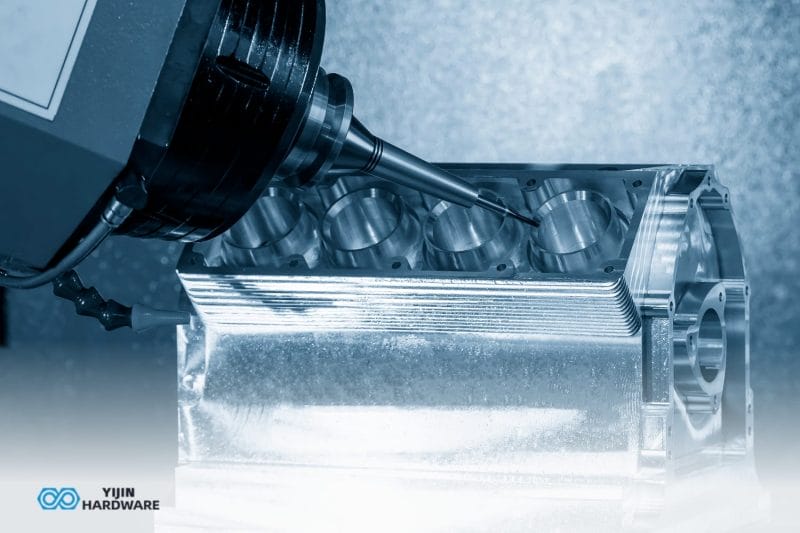
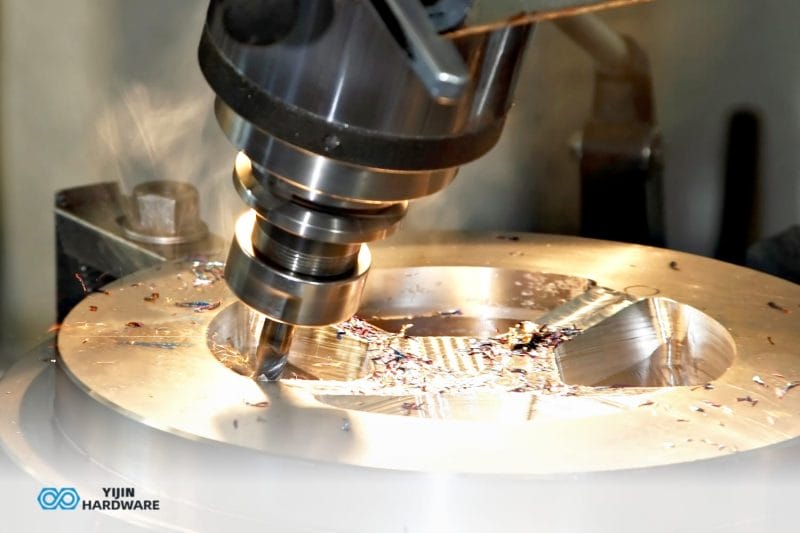
CNC milling removes material using rotating cutting tools that move along multiple axes, creating complex geometries by progressively removing material from HDPE stock. The primary challenge is effective chip evacuation, as HDPE produces long, stringy chips that can wrap around the tool and interfere with cutting efficiency.
At Yijin Solution, we specialize in CNC milling China, providing precise HDPE machining with effective chip removal and high-quality, intricate components.
Use 2-flute end mills instead of 4-flute tools designed for metals, run at 60-70% of maximum speeds for roughing operations, and implement climb milling (cutter rotating with the feed direction) for better surface finishes. For finishing passes, increase spindle speed while reducing depth of cut to 0.01-0.02 inches to achieve optimal surface quality.
| Tool Diameter | Spindle Speed (RPM) | Feed Rate (in/min) | Depth of Cut (in) |
|---|---|---|---|
| 1/8″ (3.175mm) | 14,000–18,000 | 40–70 | 0.03–0.06 |
| 1/4″ (6.35mm) | 12,000–16,000 | 60–100 | 0.06–0.10 |
| 3/8″ (9.525mm) | 10,000–14,000 | 70–120 | 0.08–0.12 |
| 1/2″ (12.7mm) | 8,000–12,000 | 80–150 | 0.10–0.15 |
CNC Turning of HDPE
CNC turning involves rotating the HDPE workpiece while a stationary cutting tool removes material to create cylindrical features. Sharp tooling with 10-15° relief angles and positive rake angles (5-15°) is essential to prevent material pushing or tearing during the operation. Optimal parameters include spindle speeds of 2,000-4,000 RPM (depending on diameter), feed rates of 0.1-0.5 mm/rev, and depth of cuts of 0.5-3mm for roughing and 0.2-0.5mm for finishing operations.
Rigid workholding is critical to prevent vibration that causes poor surface finish, while a point angle of 55-60° typically produces the best results for most turning operations.
CNC Routing of HDPE
CNC routing employs high-speed cutting tools specifically designed for processing sheet materials, allowing rapid production of components from HDPE sheet stock. This technique excels at processing 2D or 2.5D components with spindle speeds of 16,000-24,000 RPM, feed rates of 100-200 in/min for 1/4″ tools, and step-downs of 0.1-0.15″ per pass.
Vacuum tables provide optimal workholding for sheet materials, while tabs/bridges help prevent part movement during final cutting. Using compression or upcut spiral router bits with climb cutting produces better edge quality, though it requires more rigid machine setups to implement successfully.
CNC Drilling of HDPE
CNC drilling creates precisely controlled holes in HDPE using rotating drill bits at spindle speeds of 1,000-3,000 RPM and feed rates of 0.1-0.3 mm/rev. Standard twist drills tend to grab and pull into the material, so modified point angles (60-90°) significantly improve cutting efficiency and hole quality. For deeper holes (exceeding 3× diameter), peck drilling is recommended to prevent heat buildup and maintain consistent hole dimensions.
Through-holes should have backing material to prevent exit burrs, while proper drill bit selection and technique prevents common issues like hole deformation, oversizing, or material melting around the hole perimeter.
Yijin Solution excels in the field of machining plastics, and we provide high-quality CNC machined components. Contact us today for expert guidance. We are ready to help you ensure the best outcome for your project.
Machining High Density Polyethylene (HDPE) FAQs
What is the best tool to cut HDPE?
The best tool to cut HDPE plastic is a sharp, carbide-tipped cutter with high rigidity. Use a brand-new cutting tool to prevent melting and ensure smooth, precise cuts. To keep the feed rate consistent, avoid excessive heat buildup that can warp the material.
What is the best plastic for CNC machining?
Part of the polyethylene family, ultrahigh molecular weight polyethylene (UHMW-PE) offers excellent durability. However, the best plastic for CNC machining depends on application requirements like high tensile strength and chemical resistance. LDPE and low-density polyethylene are softer and less rigid, making them harder to machine precisely. 3D printing is an alternative for complex plastic designs, but CNC machining provides better accuracy.
What are the tolerances on HDPE CNC machining?
HDPE CNC machining tolerances depend on material flexibility and CAD design specifications. Unlike metals, PE has higher thermal expansion, which affects dimensional stability. Standard machining tolerances range from ±0.005 to ±0.015 inches, depending on part size. Proper fixturing and cooling techniques ensure high-precision results for HDPE components.
Back to Top: Machining High Density Polyethylene (HDPE) Guide






 English
  Spanish
  German
  French