Stainless Steel Sheet Metal Fabrication
Yijin Solution specializes in custom stainless steel sheet metal fabrication for medical, food processing, and aerospace applications, industries where material quality really matters. We work with Type 304, Type 316, Type 430, and specialty grades, using laser cutting, CNC press brake forming, TIG welding, and electropolishing to build complex components that meet your exact specs.
- ⬤Service
- ⬤Your Details
- ⬤Submit


What Makes Stainless Steel Sheet Metal Fabrication Different?
Stainless steel sheet metal fabrication transforms flat sheets containing ≥11% chromium into three-dimensional products through cutting, forming, welding, and finishing processes. The chromium forms a self-healing chromium oxide passive film, providing corrosion resistance in industrial environments. We fabricate austenitic grades like Type 304 and Type 316, ferritic grades including Type 430, and martensitic grades such as Type 410.
Type 304 exhibits 210 MPa yield strength when annealed and 1050 MPa when cold worked. Type 316 adds 2-3% molybdenum for chloride resistance. These materials maintain density between 7.5-8.0 g/cm³.
Material Grade Selection
| Grade Type | Key Grades | Properties | Applications |
|---|---|---|---|
| Austenitic | 304, 316, 310S | Non-magnetic, excellent formability | Medical devices, commercial kitchens |
| Ferritic | 430 | Magnetic, heat-resistant | Automotive, appliances |
| Martensitic | 410, 420 | High strength, magnetic | Cutting tools, fasteners |


What Sheet Metal Fabrication Services do We Provide?
Our metal fabrication services span from cutting through finishing operations. We handle sheets from 0.5 mm to 6 mm thickness with ±0.1 mm tolerance on critical dimensions.
Cutting Operations
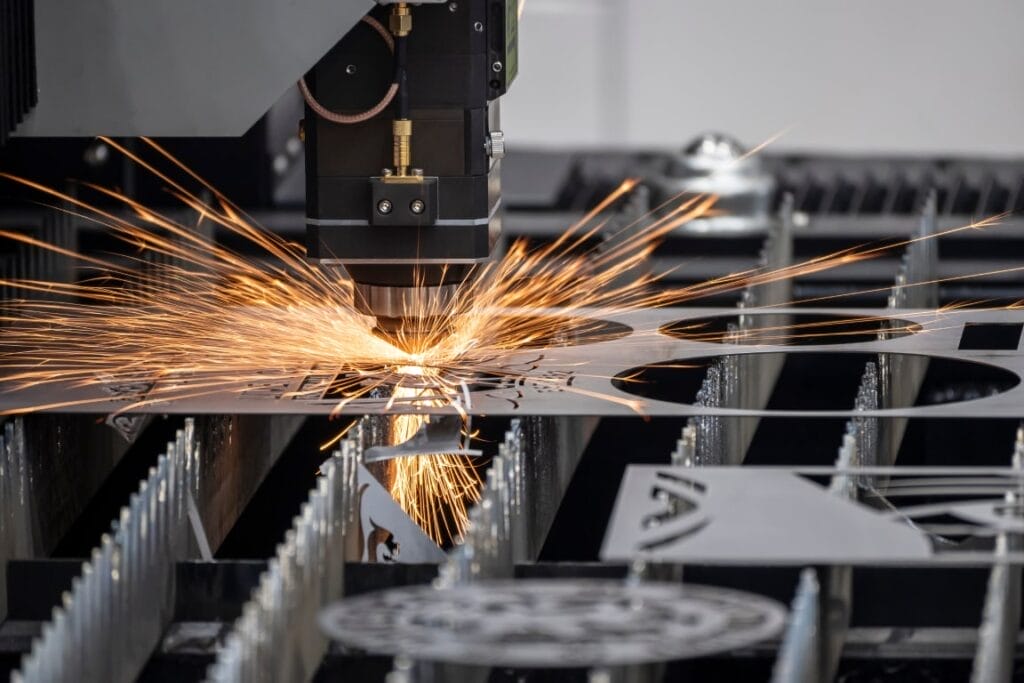
- Laser Cutting: Fiber laser systems cut complex profiles with ±0.1 mm accuracy up to 6 mm thickness
- Plasma Cutting: High-amperage plasma cuts material from 6 mm to 20 mm for steel plate fabrication
- Shearing: Guillotine shears make straight cuts using upper and lower blades
- Waterjet Cutting: High-pressure abrasive waterjet cuts without heat-affected zones
Forming and Bending
- Press Brake Bending: CNC press brakes form bends up to 3000 mm length with ±0.5° accuracy
- Roll Bending: Creates cylindrical and conical shapes for architectural applications
- Punching: CNC turret punch presses create holes at high production rates
- Deep Drawing: Progressive dies form complex shapes from flat blanks
Welding and Assembly
We apply TIG welding for thin material from 0.5 mm to 3 mm using tungsten electrodes with argon shielding. MIG welding handles sections from 3 mm to 12 mm for faster production. Both processes follow AWS D1.6 structural welding code requirements. Our workshop equipment includes fixtures for precise weld alignment and distortion control.
Surface Finishing Options
Surface finish options include:
- Electropolishing: Removes 5-25 μm surface layer for pharmaceutical equipment
- Mechanical Polishing: Creates mirror finishes with Ra 0.2-0.4 μm surface roughness
- Hairline Finishing: Produces directional grain patterns with 120-180 grit abrasives
- Powder Coating: Applies 50-100 μm protective coating in custom colors


How do We Achieve Precision in Complex Geometries?
We control accuracy through CNC-programmed machinery and springback compensation algorithms. Stainless steel exhibits 10-15% greater springback than carbon steel due to higher yield strength during forming operations.
Springback Compensation
Our press brake software calculates overbend angles based on material grade, thickness, and bend radius. Type 304 requires 2-4° additional angle for 90° final dimensions in 2 mm thickness. We measure first article parts and adjust parameters before production begins.
Weld Distortion Control
Fixture-based clamping maintains part alignment during multi-pass welding. Symmetric weld sequencing balances thermal stresses across assemblies. Skip welding alternates between locations to distribute heat input. We verify weld quality through dye penetrant testing and visual inspection per AWS standards.
Which Industries Benefit From Our Metal Fabrication?
Medical and Pharmaceutical
Medical device manufacturers specify Type 316L for surgical instrument trays, sterilization racks, and processing equipment. We electropolish surfaces to Ra 0.4 μm finish for sterilization requirements. Components meet biocompatibility standards for patient contact applications.
Food Processing and Commercial Kitchen
Restaurant and food processing facilities use Type 304 for conveyor systems, mixing tanks, and sanitary enclosures. The material resists organic acids and cleaning chemicals while maintaining hygiene through smooth finishes. We fabricate custom bench tops, handrail systems, and commercial kitchen equipment conforming to 3-A Sanitary Standards.
Aerospace and Automotive
Aerospace applications demand Type 321 for exhaust components operating at 815 °C. Automotive industry clients use Type 409 ferritic steel for catalytic converter housings requiring thermal cycling resistance.
Architectural and Construction
Type 316 panels provide exterior cladding in coastal environments where salt accelerates corrosion. We apply brushed finishes with 120-240 grit patterns or mirror polishing for decorative features. Our steel plate fabricator capability includes structural components following AISC 313–21 standards.


What Quality Standards and Certifications do We Maintain?
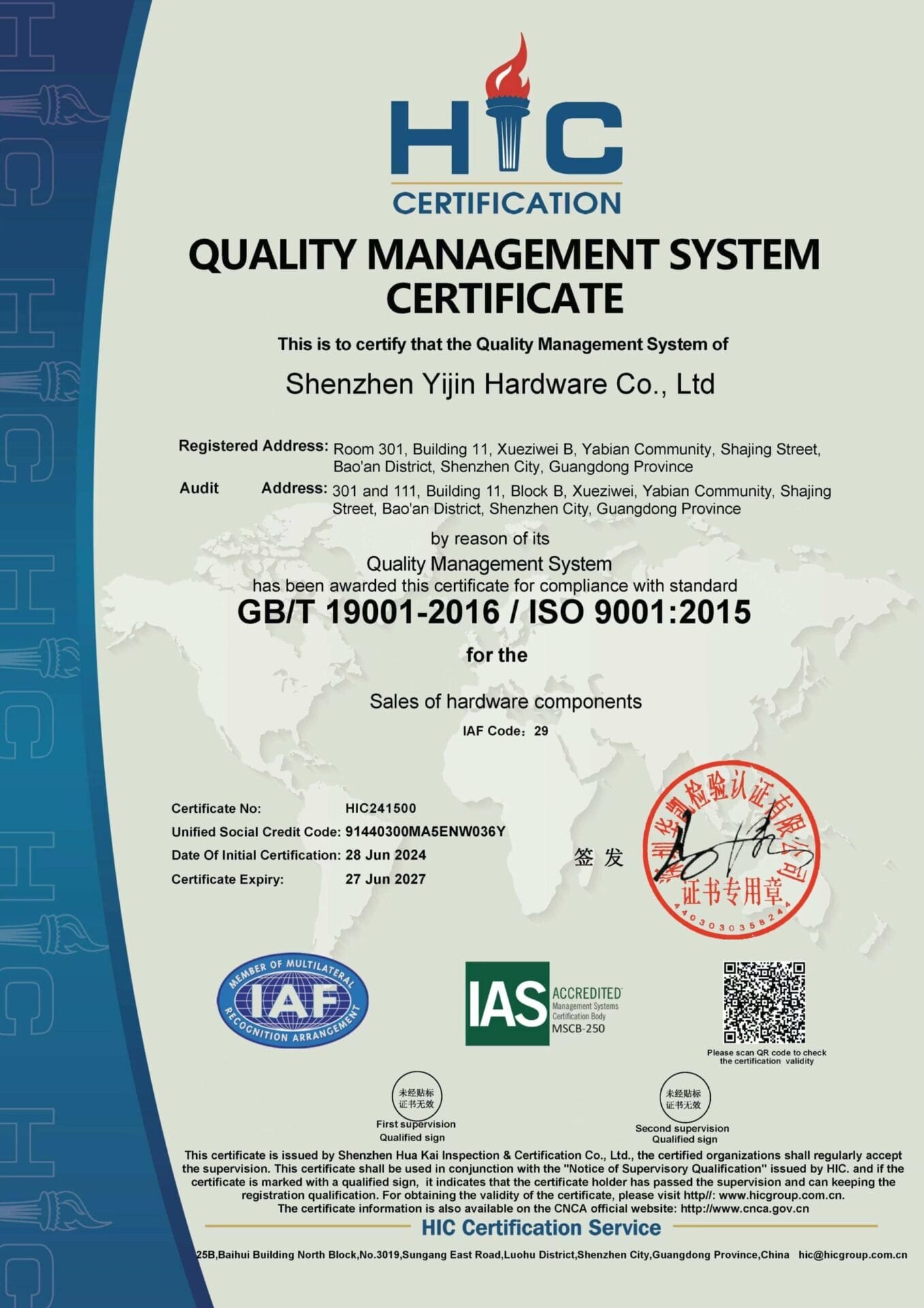
We operate under ISO 9001:2015 quality management with documented procedures for material traceability, process control, and inspection. Our AWS certified welders hold qualifications per AWS D1.6 for structural work.
Material Compliance
| Standard | Application | Verification |
|---|---|---|
| ASTM A480/A480M | Sheet specifications | Mill test reports |
| BS EN ISO 3506 | Fastener properties | Chemical analysis |
| ISO 15510 | Composition limits | Spectroscopy testing |
Material certificates verify chemical composition, mechanical properties, and heat treatment for every coil batch. We maintain full traceability from mill certification through final manufacturing with documented heat numbers.
Inspection Capabilities
Dimensional inspection uses calibrated micrometers measuring to ±0.01 mm, digital calipers to ±0.02 mm, and CMM equipment to ±0.005 mm. Surface finish verification employs profilometers measuring Ra values from 0.1 μm to 10 μm range. We conduct hydrostatic testing at 1.5× design pressure for pressure vessel components.
How does Design for Manufacturability Improve Your Parts?
Our custom fabrication process includes design review before prototype production. We optimize part geometry for efficient manufacturing and identify potential challenges early in your project.
Bending Design Guidelines
- Minimum bend radius: 2t for Type 304, 1.5t for annealed material (t = thickness)
- Bend relief cutouts: 0.5t to 1.0t depth at intersections
- Hole edge distance: Minimum 2t from bend lines and edges
- Inside corner radius: Full radius instead of sharp 90° angles
Hole and Cutout Standards
Standard hole diameters in 1 mm increments reduce tooling costs. Hole diameter should exceed 1.2× material thickness for punching. We maintain 2t minimum edge distance and 5 mm minimum web thickness between features for structural integrity.
Welding Joint Design
Fillet welds require minimum 3t size, while groove welds need 1.5t for complete penetration per AWS D1.6. V-groove welds use 60° included angle in material 6 mm and thicker with 1.5 mm root opening. Corner joints benefit from full-radius inside corners for improved weld access.


Why Choose Yijin Solution for Steel Fabrication Service?
Yijin Solution operates an ISO 9001 certified facility with integrated laser cutting, press brake forming, TIG welding, and electropolishing capabilities. Our engineering team brings extensive experience in metal plate fabrication across medical, aerospace, and commercial sectors. We work with stainless steel, aluminum, mild steel, and brass materials to manufacture products meeting precise specifications.
We deliver prototype quantities in 3-5 days and production volumes within 2-week lead times. Our quality system ensures accuracy through first article inspection, in-process verification, and final documentation. As your trusted supplier and stainless steel manufacturer, we provide comprehensive support, including material selection, tolerance optimization, and design consultation. Contact our team to discuss your metal work requirements and project details.
What Our Clients Say
Stainless Steel Sheet Metal Fabrication FAQs
Stainless steel requires specialized equipment due to high work hardening rates and greater springback than carbon steel. The material work hardens rapidly during cold forming, requiring 25-40% more force than equivalent carbon steel thickness. Proper tooling and cutting parameters successfully fabricate stainless steel when operators follow established procedures for each grade.
Type 304 provides easier welding with lower heat input and reduced hot cracking risk compared to Type 316. Type 316 contains 2-3% molybdenum that increases weld pool viscosity, requiring careful parameter control. Choose Type 304 for general fabrication and Type 316 when applications demand superior corrosion resistance in chloride environments.
The three primary techniques include cutting to separate material using laser or plasma, forming to bend material using press brakes, and joining to connect components through TIG or MIG welding. Cutting achieves ±0.1 mm accuracy, forming creates shapes with ±0.5° angle tolerance, and welding permanently attaches components per AWS structural codes.
CNC Resources

3D-Printed Snap-Fit Trim Housing Prototype: From CAD Review to Functional Assembly Validation
How a matched prototype set turned a visual concept into a practical basis for fit, feature, and production-readiness decisions. A

Low-Volume & Prototype CNC Machining in China
How prototype CNC machining prices behave from 1 to 500 units, what the move to production involves, and what a

CNC Milling | A Practical Guide to Parts, Tolerances, and Material Selection
Learn how CNC milling services handle part types, realistic tolerances, materials, 3-axis and 5-axis work, DFM, pricing, inspection, and sourcing
Start today. Get parts made fast.
Free Machined Parts Design to Your Projects with Fast Turnaround Times.
 English
  Spanish
  German
  French