


Soportes en un avión. Armarios en un rack de servidores. Bandejas de baterías en un vehículo eléctrico. Todas ellas empezaron siendo chapas planas. Todas ellas pasaron por una serie de operaciones para llegar de esa chapa plana a una pieza acabada y dimensionalmente precisa. Esa serie de operaciones es la fabricación de chapas metálicas.
Lo que importa desde el punto de vista del abastecimiento es la combinación. En corte el método formando secuencia, la técnica de unión, el acabado superficial: cada elección afecta al coste de la pieza, a la rapidez con que se envía y a su resistencia en servicio.
Esta guía explica qué procesos son adecuados para cada tipo de pieza, qué determina el coste por hora y cómo las decisiones tomadas en la fase CAD repercuten en todas las operaciones posteriores.
¿Qué es la fabricación de chapas metálicas?

Fabricación de chapas metálicas es el proceso de corte, conformado y unión de chapas metálicas planas para obtener piezas acabadas o ensamblajes. El material suele tener un grosor de 0,5 a 6 mm. Se diferencia del mecanizado CNC o la fundición en un aspecto fundamental: la chapa en bruto es su propia geometría de partida. No se retira material de un bloque ni se rellena un molde, sino que se da forma a lo que ya existe.
El resultado son componentes metálicos de dimensiones exactas con espesores de pared uniformes, acabados superficiales controlados y propiedades mecánicas repetibles. Esto se aprecia en carcasas, soportes, paneles, chasis, bastidores y conjuntos estructurales. El proceso abarca desde prototipos individuales hasta series de producción de cientos de miles, con operaciones que cambian a medida que aumenta el volumen.
¿En qué se diferencia la fabricación de chapas metálicas de otros procesos de fabricación?
Tres características diferencian la fabricación de chapa metálica del mecanizado, la fundición o la fabricación aditiva. Cada uno de ellos determina cómo especifica una pieza un comprador, cómo la cotiza un fabricante y dónde se esconden los costes.
- La geometría de la culata dirige la lógica del diseño: Una pieza de chapa metálica comienza como una pieza en bruto plana a la que se da forma. Esto significa que el diseñador tiene que pensar en términos de patrones planos, márgenes de curvatura y recuperación elástica desde la fase más temprana. Si una geometría no puede desplegarse limpiamente en una pieza en bruto plana sin solapar material, no puede fabricarse en una sola pieza. En el mecanizado, se resta de un bloque. En fundición, se rellena una cavidad. En chapa, la limitación es el desdoblamiento.
- El grosor es fijo, no variable: El grosor de la pared de una pieza de chapa metálica viene determinado por el calibre del material. No se puede adelgazar una sección y engrosar otra dentro de una misma pieza en bruto como se haría en un torno CNC. Si un diseño requiere un grosor de pared variable, se necesitan piezas en bruto separadas unidas entre sí o una operación de mecanizado secundaria. Esta limitación determina qué geometrías se pueden conseguir y en qué casos las operaciones adicionales merman el presupuesto.
- La precisión es una propiedad del sistema: La precisión dimensional de una pieza acabada de chapa metálica depende de la interacción de la precisión de corte, el estado de las herramientas, el comportamiento del material frente a la recuperación elástica, la estabilidad de la fijación, la secuencia de conformado y la medición durante el proceso. Ningún ajuste de la máquina por sí solo produce una tolerancia determinada. Lo hace toda la cadena de proceso. Dos fabricantes que coticen el mismo plano pueden ofrecer resultados notablemente diferentes, y la revisión DFM en la fase de diseño es más importante de lo que la mayoría de los equipos de compras esperan.
¿Cómo funciona la fabricación de chapas metálicas? Pasos fundamentales del proceso
Las operaciones específicas varían en función de la geometría y el volumen de las piezas, pero el flujo de trabajo principal es el mismo tanto si se trata de un taller de cinco personas como de una planta de producción de 100 personas. La tabla siguiente relaciona cada paso con la decisión que conlleva.
| Paso | Operación | Qué ocurre | Factor decisivo |
|---|---|---|---|
| 1 | Diseño y revisión DFM | El ingeniero revisa el modelo CAD para comprobar los radios de curvatura, el grosor de la pared, la colocación de los orificios y la idoneidad del material. | Tolerancias, compatibilidad de procesos |
| 2 | Selección de materiales | Chapa seleccionada por aleación, espesor y estado de la superficie: acabado de laminación, prepintado o galvanizado. | Solidez, resistencia a la corrosión, coste |
| 3 | Corte | Piezas en bruto planas cortadas de chapa mediante láser, chorro de agua, plasma o punzonadora. | Complejidad de la pieza, calidad del canto necesaria |
| 4 | Formación / Doblar | Piezas en bruto conformadas en formas tridimensionales mediante plegado, perfilado o estampado. | Ángulo de curvatura, radio, volumen del lote |
| 5 | Únase a | Componentes soldados, remachados, fijados o remachados en conjuntos. | Requisitos de carga, necesidad de desmontaje |
| 6 | Acabado de superficies | Piezas pintadas, con recubrimiento en polvo, anodizadas, chapadas o cepilladas. | Protección contra la corrosión, estética |
| 7 | Inspección | Verificación dimensional con respecto a los planos mediante MMC, VMS o calibración manual. | Clase de tolerancia, norma de calidad |
| 8 | Operaciones secundarias | Mecanizado CNC de características de tolerancia ajustada, inserción de herrajes, montaje. | Tolerancias de características críticas para la función |
El paso 1 merece especial atención. La revisión DFM es el punto en el que la mayor parte del coste de fabricación se controla o se crea. Selección del radio de curvatura, ubicación de los orificios en relación con las curvaturas, elección del calibre. Estas decisiones, que se toman antes de encargar el utillaje, tienen un mayor efecto en el coste final de la pieza que la mayoría de las variables del proceso posterior.
¿Cuáles son los principales procesos de fabricación de chapa metálica?

Las operaciones de chapa metálica se dividen en cuatro familias: corte, conformado, unión y acabado. Cada una tiene múltiples variantes de proceso. La elección correcta depende de la geometría de la pieza, el material, el volumen y los requisitos de tolerancia de la pieza acabada.
Operaciones de corte
El corte por láser ofrece la mejor calidad de bordes entre los métodos habituales de corte de chapa metálica. Maneja perfiles 2D complejos en aluminio, acero dulce y acero inoxidable con gran repetibilidad. Para espesores finos y medios, la mayoría de los fabricantes empiezan por el láser. Sin embargo, en volúmenes mayores o secciones muy gruesas, la ventaja del láser por pieza se reduce y los costes empiezan a favorecer otros métodos.
El corte por chorro de agua no introduce ninguna zona afectada por el calor. Esto lo convierte en el método preferido cuando el material es sensible al calor o está compuesto. Corta prácticamente cualquier material, incluidos aceros para herramientas endurecidos y cerámica, pero funciona más despacio que el láser y los costes de consumibles son más elevados.
El corte por plasma es más rápido y barato para el acero al carbono grueso, especialmente por encima de 6 mm. La contrapartida es la calidad de los bordes. Es inferior a la del láser, y el proceso no es adecuado para calibres finos o aplicaciones que requieran tolerancias muy estrictas en los bordes.
El punzonado y el troquelado son los productos de mayor volumen. El coste del utillaje se amortiza rápidamente a escala y los tiempos de ciclo por pieza son muy cortos. Para piezas en bruto sencillas en calibres estándar, el punzonado es difícilmente superable en coste una vez que se superan unos pocos miles de piezas.
Operaciones de conformado
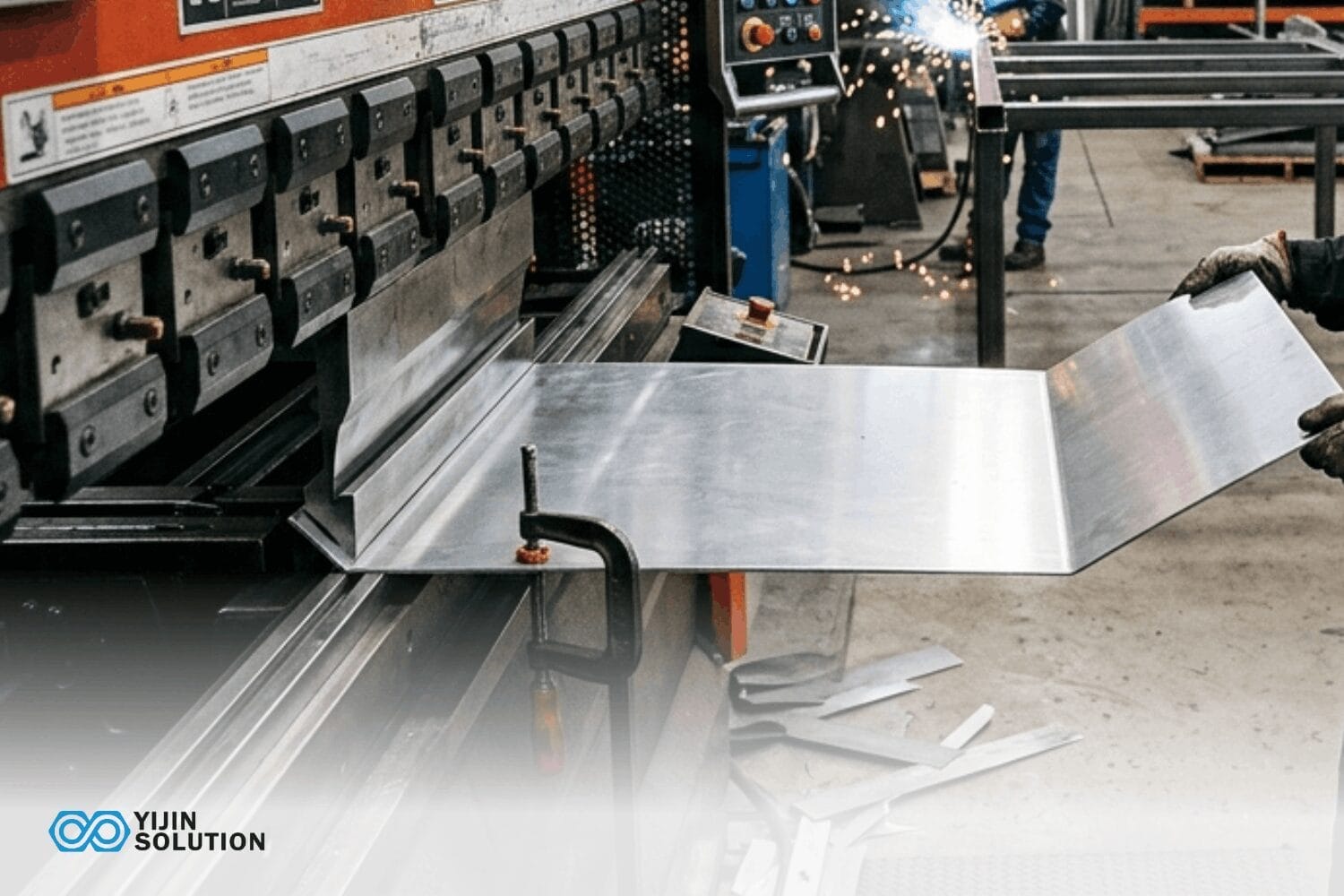
El plegado en prensa plegadora es el paso de conformado más común en chapa metálica. Consigue ángulos de curvatura con tolerancias estrechas en equipos CNC estándar, pero la precisión exacta depende del material, el grosor, el estado de la herramienta y el comportamiento del springback. El aluminio, por ejemplo, requiere un radio interior mayor que el acero dulce con el mismo grosor para evitar grietas. Estos detalles se confirman durante la revisión DFM, no se asumen a partir de una tabla genérica.
El perfilado produce curvas continuas para perfiles largos de sección transversal constante: canales, ángulos y secciones de sombrero. Es económico para grandes volúmenes, pero el coste de preparación de las herramientas es considerable, lo que lo hace poco práctico para tiradas cortas.
La estampación y la embutición profunda forman vasos, carcasas y envolventes en una sola carrera de prensa. El coste del utillaje es elevado. El coste por pieza a escala es muy bajo. Este es el proceso estándar para volúmenes superiores a 10.000 piezas, que abarcan paneles de carrocería de automóviles y carcasas de electrodomésticos.
Métodos de unión
La soldadura crea uniones permanentes de alta resistencia. MIG maneja con eficacia los ensamblajes de acero al carbono más gruesos. El TIG es adecuado para el acero inoxidable y el aluminio cuando el aspecto de la soldadura y el control de la penetración son importantes. La soldadura por puntos es la norma para grandes volúmenes de ensamblajes de chapas finas, especialmente en carrocerías de automóviles, donde la velocidad y la repetibilidad son los requisitos principales.
La fijación mecánica incluye remaches, tornillos, remaches y herrajes a presión, como los insertos PEM. Se aplica cuando es necesario desmontar o cuando la soldadura distorsionaría el material fino más allá de la tolerancia del plano.
La unión adhesiva aparece cada vez más en cajas de componentes electrónicos y carcasas de baterías de vehículos eléctricos, donde se necesita aislamiento térmico además de unión estructural. Distribuye la carga en un área mayor que la soldadura por puntos, pero añade tiempo de curado al ciclo de producción.
Acabado de superficies
El recubrimiento en polvo es el acabado por excelencia de las chapas metálicas. Duradero, rentable y disponible en una amplia gama de colores. El grosor típico del recubrimiento oscila entre 60 y 80 micrómetros.
El anodizado sólo se aplica al aluminio. Crea una capa de óxido que mejora la resistencia a la corrosión y acepta colorantes. El anodizado duro alcanza de 25 a 100 micrómetros y crea una superficie resistente al desgaste para aplicaciones funcionales.
La galvanoplastia con zinc, níquel o cromo añade protección contra la corrosión y dureza superficial. El zincado es estándar en los soportes y tornillería de acero dulce. El níquel y el cromo aparecen en superficies decorativas y de alto desgaste.
El cepillado y el granallado son acabados cosméticos. Mejoran el aspecto, pero no ofrecen una protección significativa contra la corrosión por sí solos. Acompáñelos de una capa transparente o un sellador para todo lo que esté expuesto a la intemperie.
La tabla siguiente relaciona los requisitos habituales de las piezas con el proceso de fabricación recomendado.
| Parte obligatoria | Proceso recomendado | Cuándo utilizar una alternativa |
|---|---|---|
| Perfil 2D complejo, volumen moderado | Corte por láser | Chorro de agua si el material es sensible al calor |
| Acero al carbono grueso, superior a 6 mm | Corte por plasma o chorro de agua | Láser para una tolerancia de bordes más ajustada |
| Caja o soporte doblado | Prensas plegadoras | Perfilado si sección transversal constante |
| Carcasa estampada de gran volumen | Estampación o embutición profunda | Prensas plegadoras de bajo volumen, menos de 500 piezas |
| Junta estructural permanente | Soldadura MIG o TIG | Fijación mecánica si es necesario desmontar |
| Acabado resistente a la corrosión, aluminio | Anodizado | Recubrimiento en polvo si se necesita variedad de color |
| Protección contra la corrosión, acero | Galvanoplastia de zinc o pintura en polvo | Galvanización en caliente para estructuras exteriores |
¿Qué materiales se utilizan en la fabricación de chapas metálicas?
La elección del material afecta a todas las decisiones posteriores: qué proceso de corte funciona, qué radios de curvatura se pueden conseguir, cómo se comporta la pieza ante la corrosión y cuánto acaba pesando. Cinco familias de materiales cubren la mayor parte del trabajo.
Calidades de acero dulce y al carbono como ASTM A1008 Las chapas laminadas en frío son los materiales de chapa más utilizados en todo el mundo. Es resistente, soldable y la opción más barata para aplicaciones estructurales. La contrapartida es la corrosión. El acero al carbono sin acabar necesita un revestimiento protector para todo lo que esté expuesto a la humedad, ya sea pintura en polvo, pintura o galvanizado.
El acero inoxidable de los grados 304 y 316L ofrece resistencia a la corrosión sin necesidad de acabado adicional. Es el material estándar para carcasas de equipos médicos, armarios de procesamiento de alimentos y equipos marinos. El inconveniente: el acero inoxidable se endurece durante el conformado. Es más difícil de doblar que el acero al carbono y requiere un utillaje y unos parámetros de plegado ajustados, lo que aparece como una partida en el presupuesto.
Aleaciones de aluminio, El aluminio, especialmente el 5052-H32 para piezas conformadas y el 6061-T6 para componentes estructurales, ofrece una excelente relación resistencia-peso y una resistencia natural a la corrosión. La materia prima cuesta de dos a tres veces más por kilogramo que el acero dulce, pero una pieza que se salta el acabado anticorrosión por ser de aluminio puede costar a veces menos en total. Los radios de curvatura tienen que ser más amplios que los del acero de grosor equivalente, normalmente de 1,5 a 2 veces el grosor de la chapa, o el material se agrieta.
Las aleaciones de cobre y latón como C110 y C260 se especifican para una alta conductividad eléctrica y térmica: barras colectoras, intercambiadores de calor, accesorios de fontanería. Se cortan bien con láser y son fáciles de conformar. El coste del material es mucho más elevado que el del acero o el aluminio, por lo que sólo se utilizan cuando la conductividad no deja otra alternativa.
Acero galvanizado conforme a ASTM A653 viene prerrevestido con una capa de zinc. Es la opción por defecto para conductos de calefacción, ventilación y aire acondicionado, paneles estructurales exteriores y equipos agrícolas. Una cosa que hay que tener en cuenta: la capa de zinc se quema en los puntos de soldadura. Cualquier ensamblaje unido requiere un tratamiento posterior a la soldadura, lo que añade un paso más al flujo de trabajo.
| Material | Grados comunes | Propiedades clave | Aplicaciones típicas | Notas sobre el proceso |
|---|---|---|---|---|
| Acero dulce / al carbono | ASTM A1008, A653 | Resistente, soldable, de bajo coste | Soportes estructurales, marcos, cerramientos | Propenso a la corrosión; requiere acabado |
| Acero inoxidable | 304, 316L | Resistente a la corrosión, limpiable | Equipamiento médico, alimentario y marino | Se endurece con el trabajo; más difícil de doblar |
| Aluminio | 5052-H32, 6061-T6 | Ligero, buena resistencia a la corrosión | Aeroespacial, electrónica, piezas de vehículos eléctricos | Mayor radio de curvatura que el acero |
| Cobre / Latón | C110, C260 | Alta conductividad, antimicrobiano | Electricidad, fontanería, intercambiadores de calor | Caro; el láser corta bien |
| Acero galvanizado | ASTM A653 G90 | Protección anticorrosión con revestimiento previo | HVAC, paneles estructurales exteriores | El revestimiento se quema en las soldaduras; planificar el tratamiento posterior a la soldadura. |
¿Cuánto cuesta la fabricación de chapas metálicas?
No hay una sola cifra que responda a esta pregunta, y cualquiera que le dé una está adivinando. El coste de la fabricación de chapa metálica es el producto de la interacción entre el material, el proceso, la geometría, el volumen y el acabado. Entender qué es lo que determina la cifra ayuda al comprador a diseñarla en lugar de sorprenderse en la fase de presupuesto.
El coste del material marca la pauta. El acero dulce es la chapa más barata que se puede comprar. El aluminio cuesta dos o tres veces más por kilogramo. Pero el precio de la materia prima es sólo el punto de partida. Una pieza de aluminio que no necesita ningún acabado anticorrosión puede costar a veces menos que una pieza de acero que necesita un baño de zinc y una capa cosmética de pintura en polvo. Lo que importa es el coste total de la pieza, no el coste del material por kilogramo.
Los ritmos del proceso de corte varían según el equipo y el material. El corte por láser suele ser de $75 a $150 por hora para la máquina, en función de la potencia y el tipo de material. El chorro de agua tiene un rendimiento de $100 a $200 por hora. Las trayectorias de corte complejas, el anidado estrecho y un mayor número de perforaciones añaden tiempo de máquina. Cada segundo extra en el láser es dinero.
La complejidad del conformado aumenta con cada pliegue. Cada pliegue adicional supone más tiempo de preparación y manipulación. Las piezas con más de cinco pliegues en varios planos requieren configuraciones por etapas y tiempos de ciclo prolongados. El coste de fabricación de metal por hora en las operaciones de plegado es comparable al del corte por láser, pero el rendimiento por pieza depende en gran medida de la geometría. No es lo mismo un simple soporte en L que una caja de seis curvas.
El volumen de los lotes es una de las palancas de costes más fuertes en el trabajo de la chapa. Los costes de preparación son fijos por trabajo: programación, configuración del utillaje, inspección de la primera pieza. Con 10 piezas, la configuración puede representar 60% del coste total. A partir de 1.000 piezas, ese mismo coste fijo se diluye y el precio por pieza disminuye drásticamente. El precio de fabricación de la chapa para una pieza determinada es muy diferente a partir de 50 unidades que a partir de 500 unidades.
El acabado superficial es la categoría de costes que más se subestima en la fase de oferta. El recubrimiento en polvo añade aproximadamente entre $5 y $25 por pieza, en función del tamaño y los requisitos de color. El anodizado cuesta entre $3 y $15 por pieza, según la clase y el tamaño de la pieza. Se trata de estimaciones orientativas, no de precios de oferta. Con frecuencia, el coste del acabado es la última partida que se tiene en cuenta durante la especificación y una de las primeras que hace que el presupuesto se salga de lo previsto.
Los requisitos de tolerancia más estrictos aumentan el tiempo de inspección, pueden requerir un mecanizado CNC secundario tras el conformado y conllevan un sobrecoste. El impacto exacto depende de las características que requieran tolerancias más estrictas, el material y la capacidad de proceso del fabricante. La forma más fiable de conocer el coste de una pieza concreta es enviar un archivo CAD para su revisión DFM.
Tolerancias de chapa metálica y diseño para la fabricación
Las tolerancias en la fabricación de chapa metálica no son un ajuste fijo de la máquina. Son el resultado de un sistema: variación de la recuperación elástica del material, desgaste de las herramientas, estabilidad de la fijación, efectos de la secuencia de plegado y medición durante el proceso. Dos piezas de dos fabricantes distintos, fabricadas con equipos similares, pueden tener una precisión dimensional muy distinta porque la cadena de proceso se ha gestionado de forma diferente.
Esta realidad es la razón por la que la revisión DFM importa más en chapa metálica de lo que la mayoría de los compradores esperan. Las directrices que figuran a continuación no son requisitos abstractos. Cada una de ellas está relacionada con un resultado concreto de coste o calidad.
- Radio de curvatura mínimo: Para acero dulce, un radio de 1x espesor de material es un punto de partida seguro. Para aleaciones de aluminio, prevea de 1,5 a 2 veces el grosor de la chapa. Un radio más estrecho de lo que permite el material provoca grietas y desechos. Confírmelo con el fabricante antes de cerrar el diseño, no después.
- Dimensionamiento y colocación de los orificios: Los orificios deben tener un diámetro de al menos 1 vez el grosor del material. Coloque un orificio a menos de 2 veces el grosor del material de una línea de doblado y se deformará durante el conformado. Desplazar un orificio 3 mm en un dibujo no cuesta nada. Desplazarlo una vez construido el utillaje cuesta un ciclo de revisión y una conversación que nadie quiere tener.
- Consistencia del grosor de la pared: Los cambios bruscos de espesor dentro de una misma pieza implican piezas en bruto separadas y una operación de unión, normalmente soldadura. Diseñe para un espesor uniforme por defecto. En el caso de piezas que realmente necesiten variaciones de grosor, planifique la unión en el diseño desde el principio.
- Radios de esquina: Los ángulos de desmoldeo no son necesarios en el conformado de chapa, a diferencia de los ángulos de inclinación. fundición a presión. Pero los radios de las esquinas deben ser lo suficientemente generosos para evitar concentraciones de tensiones. Los ángulos internos agudos concentran las tensiones y provocan grietas bajo cargas cíclicas.
- Tornillería: Los insertos PEM, las tuercas soldadas y las tuercas remachables deben especificarse en la fase de diseño. La inserción posterior de herrajes una vez conformada la pieza es costosa y puede comprometer la precisión dimensional en características que ya estaban dentro de la tolerancia.
La tolerancia estándar típica de la chapa metálica es de ±0,30 mm en las características generales, con una capacidad de precisión de ±0,10 mm en las superficies calificadas. Las tolerancias alcanzables dependen de la geometría de la pieza, el material, el calibre y la secuencia completa de fabricación. Cualquier cifra de tolerancia de la hoja de especificaciones de un proveedor refleja lo que ofrece el proceso en condiciones controladas, no una referencia industrial universal.
Más información: Tolerancia en la fabricación de chapas metálicas
¿Dónde se utiliza la fabricación de chapas metálicas?
La fabricación de chapas metálicas está presente en casi todos los sectores en los que se necesitan componentes metálicos de dimensiones exactas a gran escala. Lo que cambia de un sector a otro es qué propiedad es más importante: el peso, la resistencia a la corrosión, la conductividad o la capacidad de carga estructural.
- Automóvil: paneles de carrocería, marcos de puertas, soportes de bajos, carcasas de baterías de vehículos eléctricos, escudos térmicos. La chapa metálica de automoción se fabrica a gran escala y exige tolerancias repetibles en largas series de producción. Si la milésima pieza no coincide con la primera, la línea se detiene.
- Aeroespacial: cubiertas de bahías de aviónica, soportes estructurales, paneles de acceso, soportes de líneas hidráulicas. El peso y la precisión dimensional son igualmente críticos, y la trazabilidad de los materiales es obligatoria en cada pieza del conjunto.
- Equipos médicos: carcasas de instrumentos, armarios de equipos, paneles de quirófano. Estas piezas requieren acabados de acero inoxidable y compatibles con salas limpias, con documentación completa conforme a la norma ISO 13485.
- Electrónica: armarios rack para servidores, chasis de PCB, carcasas de blindaje EMI, normalmente de aluminio 5052 o acero galvanizado. Unas dimensiones internas uniformes y unos puntos de conexión a tierra fiables son los factores decisivos.
- Equipamiento industrial: guardamotores, bastidores de transportadores, carcasas de bombas, conductos de calefacción, ventilación y aire acondicionado. Aplicaciones de gran volumen y bajo coste en las que predominan el acero al carbono y el acero galvanizado.
- Productos de consumo: paneles de electrodomésticos, herrajes de muebles, revestimientos arquitectónicos. La calidad del acabado superficial es más importante aquí que en el trabajo industrial, y el proceso de fabricación debe ofrecer una consistencia cosmética en volumen.
Traslade su programa de chapa metálica a una única fuente
Los programas de chapa metálica pierden dinero en las diferencias entre proveedores. Cortar en un taller, doblar en otro, soldar en un tercero... cada traspaso es otro apilamiento de tolerancias, otro plazo de entrega que se introduce en el programa y otro proveedor al que perseguir cuando una pieza sale mal. En el momento en que el montaje falla en el cliente, ningún proveedor es responsable del problema.
Yijin Solution ofrece servicios de fabricación de chapa metálica desde una única planta de Shenzhen, que abarca el corte por láser, el plegado en plegadora, la soldadura y el acabado bajo un mismo techo. El mismo equipo de ingeniería que realiza el presupuesto de la pieza también revisa la eficiencia del anidado, la secuencia de plegado y el acceso a la soldadura antes de comprometer el material, y el mismo sistema de calidad, certificado por IATF 16949, ISO 13485 y AS9100D, rige cada paso desde la bobina bruta hasta la caja embalada.
Envíe sus archivos CAD para obtener una revisión DFM gratuita y un presupuesto en 24 horas.
Preguntas frecuentes sobre ¿Qué es la fabricación de chapa metálica?
¿Cuándo no es la fabricación de chapa el proceso adecuado?
La chapa metálica no encaja bien cuando la pieza requiere un grosor de pared variable, cavidades internas complejas o rebajes que no pueden formarse a partir de una pieza en bruto plana. Si el diseño no puede desplegarse en un patrón plano sin superposición de material, no puede fabricarse como una sola pieza de chapa metálica.
¿Cuál es la diferencia entre la fabricación de chapas metálicas y la estampación de metales?
La fabricación de chapas metálicas utiliza equipos de uso general (cortadoras láser, prensas plegadoras, estaciones de soldadura) para producir piezas en volúmenes bajos o medios con una inversión mínima en herramientas. El estampado utiliza troqueles personalizados para formar piezas en una sola pasada de prensa a muy alta velocidad, pero el troquel en sí cuesta entre miles y decenas de miles de dólares.
¿Cómo puedo reducir los costes de fabricación de chapa metálica sin comprometer la calidad?
Las decisiones de mayor impacto se toman en la fase CAD. Utilice espesores de chapa estándar en lugar de espesores no estándar. Reduzca al mínimo el número de pliegues, ya que cada pliegue añade tiempo de preparación y manipulación. Mantenga las distancias entre taladros y dobleces por encima de 2 veces el grosor del material para evitar distorsiones que provoquen rechazos.
¿Se pueden fabricar piezas de chapa de varios materiales en un mismo conjunto?
Sí, pero cada interfaz de material introduce una consideración de diseño. Si se unen metales distintos (por ejemplo, aluminio con acero inoxidable), existe el riesgo de corrosión galvánica en el punto de contacto si el conjunto está expuesto a la humedad. Esto se evita aislando la junta con una arandela de barrera, un sellante o un elemento de fijación no conductor.
¿Qué información debo incluir al solicitar un presupuesto de fabricación de chapa metálica?
Como mínimo: un archivo CAD 3D (preferiblemente STEP o IGES), un plano 2D acotado con anotaciones GD&T en las características críticas, la especificación del material y el acabado, la cantidad necesaria y la fecha de entrega prevista. Si la pieza se acopla con otros componentes, incluya el contexto de montaje o los planos de la pieza acoplada.
Volver arriba: ¿Qué es la fabricación de chapa metálica? Procesos, materiales, costes y aplicaciones






 English
  Spanish
  German
  French