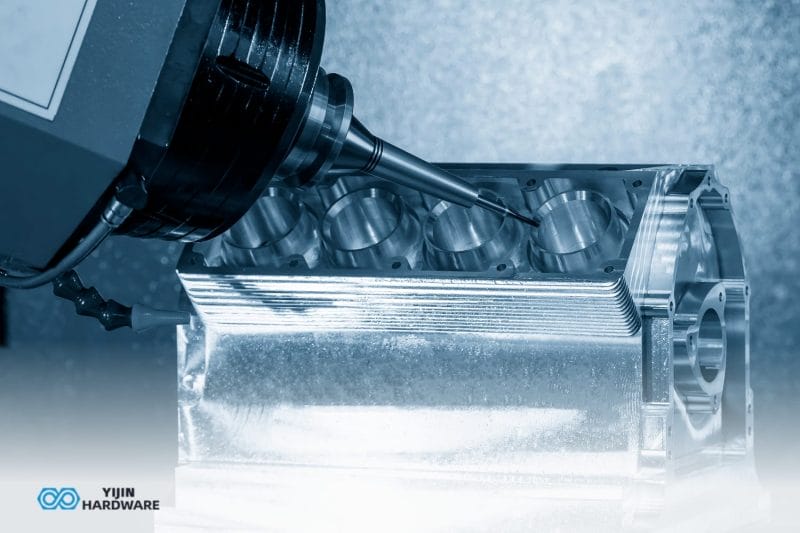
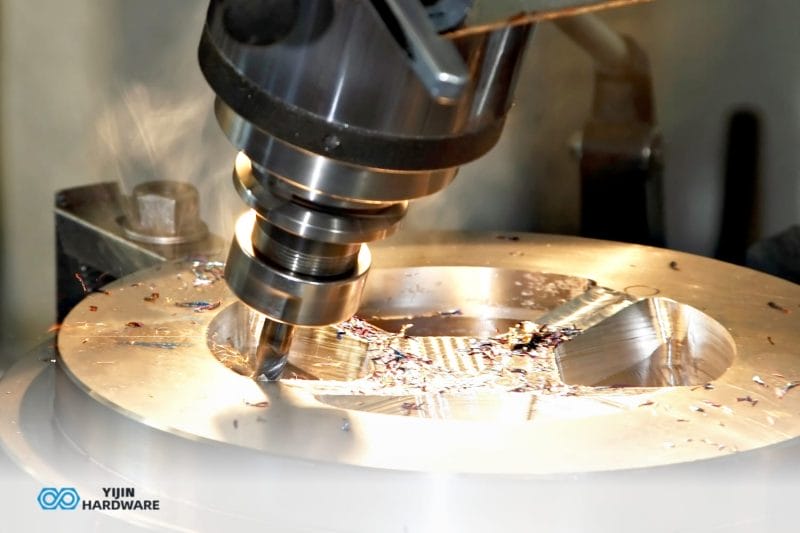

Brackets on an aircraft. Enclosures in a server rack. Battery trays in an EV. All of them started as flat sheet metal. All of them went through a series of operations to get from that flat stock to a finished, dimensionally accurate part. That series of operations is sheet metal fabrication.
What matters from a sourcing perspective is the combination. The cutting method, the forming sequence, the joining technique, the surface finish: each choice affects what the part costs, how quickly it ships, and whether it holds up in service.
This guide covers which processes fit which part types, what drives cost per hour, and how decisions made at the CAD stage ripple through every downstream operation.
Qu'est-ce que la fabrication de tôles ?
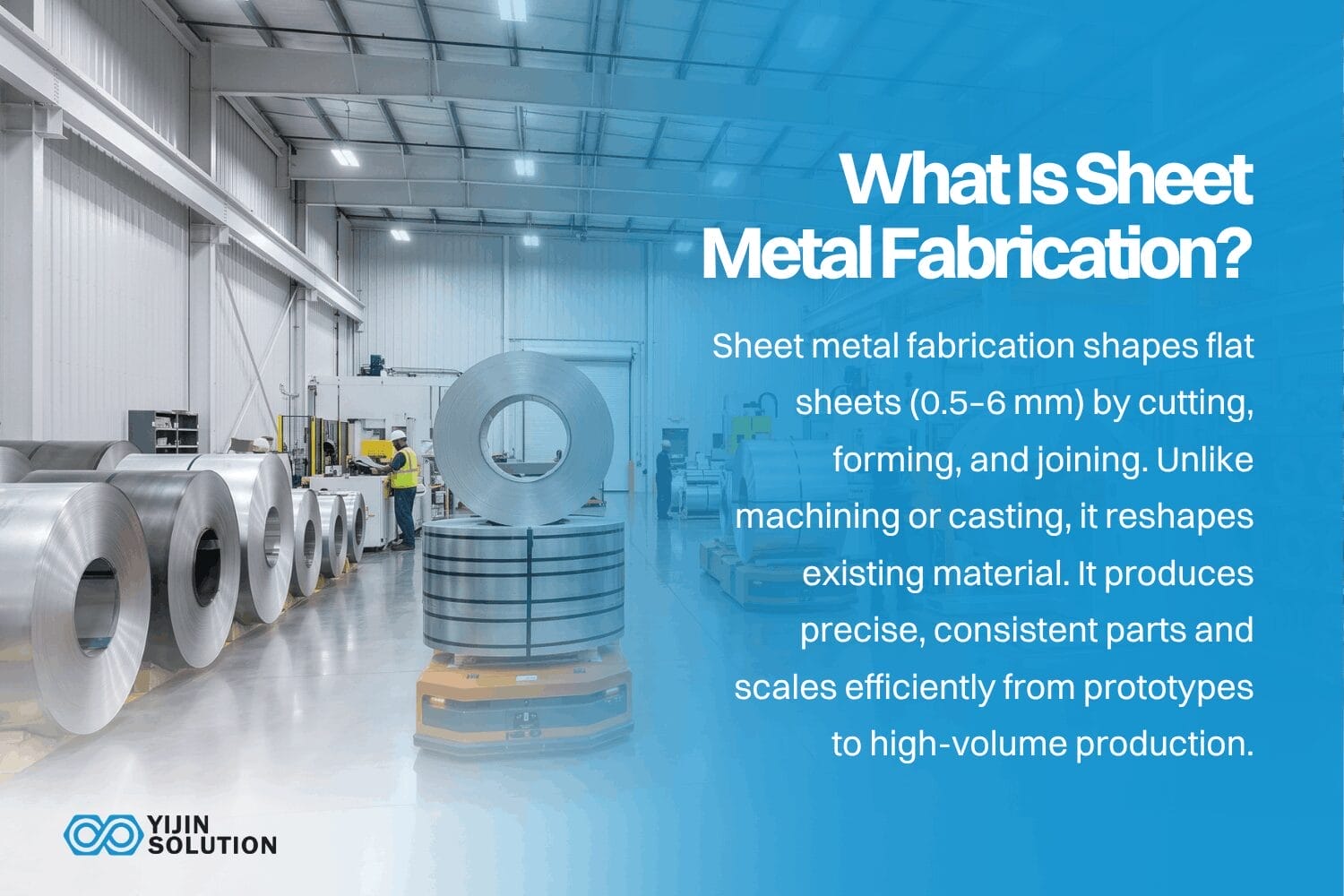
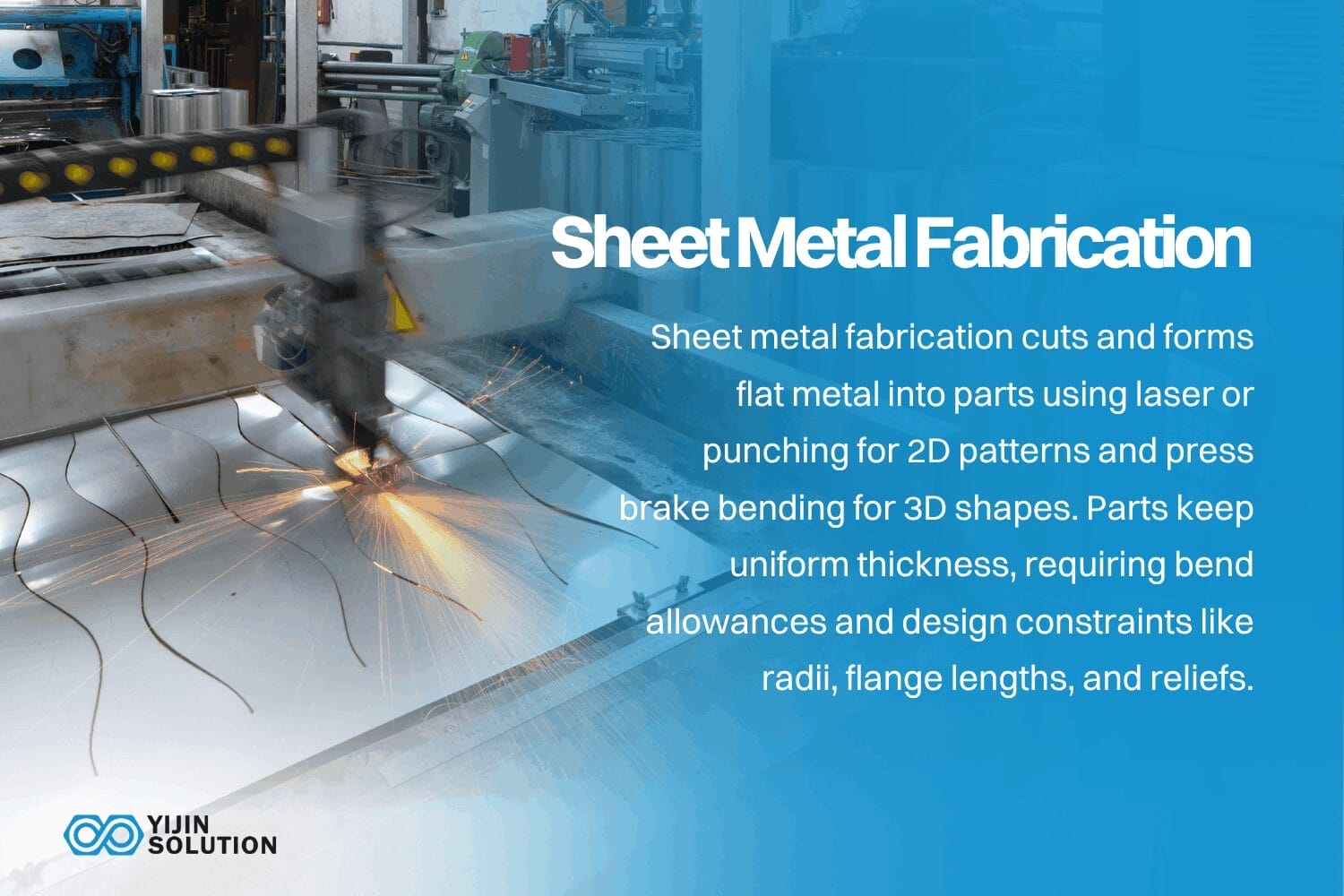
Fabrication de tôles is the process of cutting, forming, and joining flat metal sheets into finished parts or assemblies. The material is typically 0.5 to 6 mm thick. It is different from CNC machining or casting in a fundamental way: the raw sheet is its own starting geometry. You’re not removing material from a block or filling a mold; you’re shaping what’s already there.
The output is dimensionally accurate metal components with consistent wall thickness, controlled surface finish, and repeatable mechanical properties. This is seen in enclosures, brackets, panels, chassis, frames, and structural assemblies. The process scales from single prototypes to production runs in the hundreds of thousands, with operations shifting as volume increases.
What Makes Sheet Metal Fabrication Different from Other Manufacturing Processes?
Three characteristics separate sheet metal fabrication from machining, casting, or additive manufacturing. Each one shapes how a buyer specifies a part, how a fabricator quotes it, and where cost hides.
- Stock geometry drives design logic: A sheet metal part begins as a flat blank and is formed into shape. That means the designer has to think in terms of flat patterns, bend allowances, and springback from the earliest stage. If a geometry can’t unfold cleanly into a flat blank without overlapping material, it can’t be fabricated in a single piece. In machining, you subtract from a block. For casting, you fill a cavity. In sheet metal, the constraint is the unfolding.
- Thickness is fixed, not variable: The wall thickness of a sheet metal part is set by the stock gauge. You can’t thin one section and thicken another within a single blank the way you would on a CNC lathe. If a design calls for varying wall thickness, it needs separate blanks joined together or a secondary machining operation. This constraint determines what geometries are achievable and where additional operations eat into the budget.
- Precision is a system property: The dimensional accuracy of a finished sheet metal part depends on the interaction of cutting accuracy, tooling condition, material springback behavior, fixturing stability, forming sequence, and in-process measurement. No single machine setting produces a given tolerance. The full process chain does. Two fabricators quoting the same drawing can deliver noticeably different results, and DFM review at the design stage matters more than most procurement teams expect.
How does Sheet Metal Fabrication Work? Core Process Steps
Specific operations vary by part geometry and volume, but the core workflow is consistent whether you’re in a five-person job shop or a 100-person production facility. The table below maps each step to the decision it carries.
| Étape | Fonctionnement | What Happens | Key Decision Factor |
|---|---|---|---|
| 1 | Design & DFM Review | Engineer reviews CAD model for bend radii, wall thickness, hole placement, and material suitability. | Tolerances, process compatibility |
| 2 | Sélection des matériaux | Sheet stock selected by alloy, thickness, and surface condition: mill finish, pre-painted, or galvanized. | Strength, corrosion resistance, cost |
| 3 | Découpage | Flat blanks cut from sheet using laser, waterjet, plasma, or punch press. | Part complexity, edge quality needed |
| 4 | Forming / Pliage | Blanks formed into 3D shapes using press brakes, roll forming, or stamping. | Bend angle, radius, batch volume |
| 5 | Adhésion | Components welded, riveted, fastened, or clinched into assemblies. | Load requirements, disassembly need |
| 6 | Finition de surface | Parts painted, powder coated, anodized, plated, or brushed. | Corrosion protection, aesthetics |
| 7 | L'inspection | Dimensional verification against drawing callouts using CMM, VMS, or manual gauging. | Tolerance class, quality standard |
| 8 | Secondary Operations | CNC machining of tight-tolerance features, hardware insertion, assembly. | Critical-to-function feature tolerances |
Step 1 deserves extra attention. DFM review is the point at which most fabrication cost is either controlled or created. Bend radius selection, hole placement relative to bends, gauge choice. These decisions, made before any tooling is ordered, have a larger effect on final part cost than most downstream process variables.
What are the Main Sheet Metal Fabrication Processes?
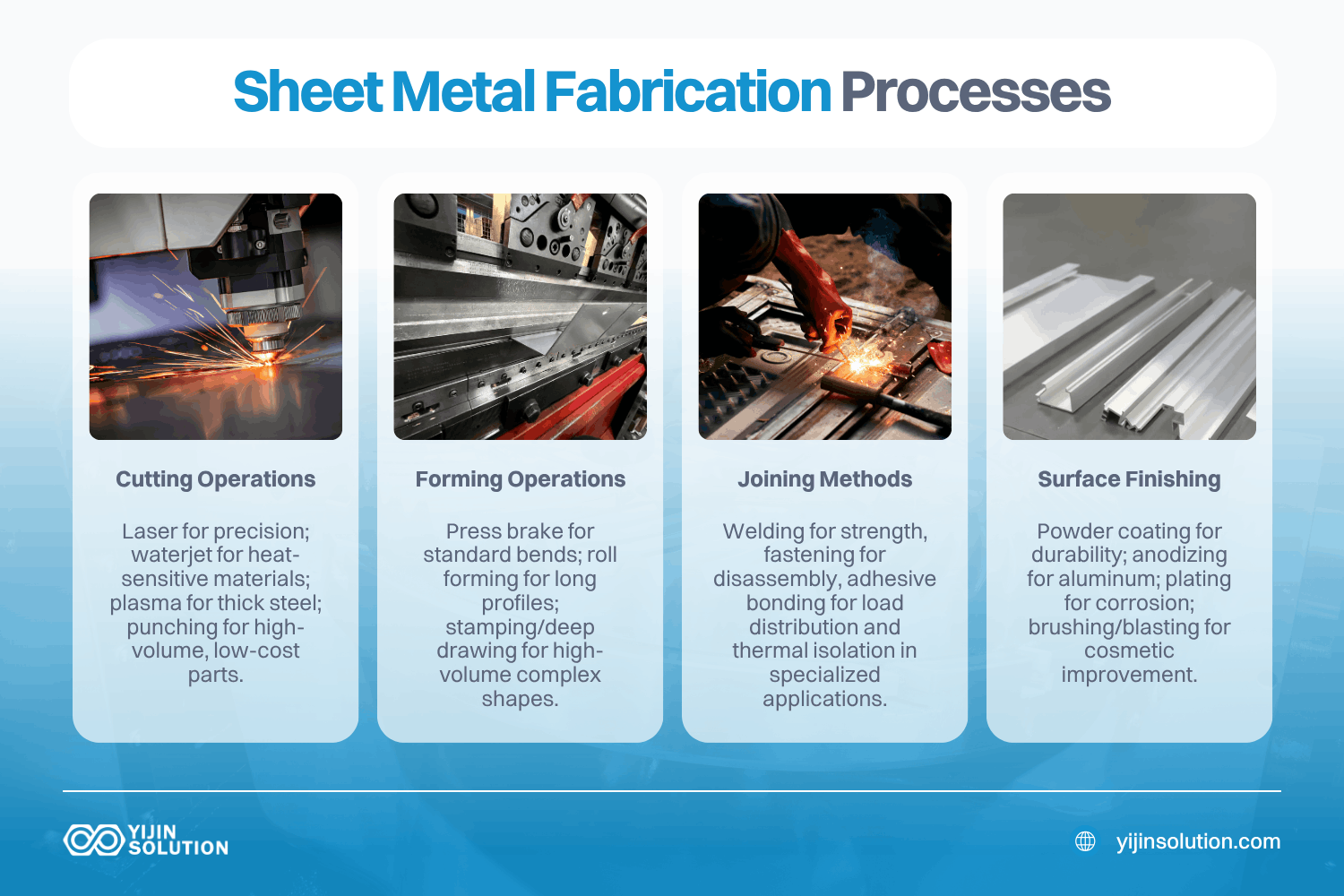
Sheet metal operations fall into four families: cutting, forming, joining, and finishing. Each has multiple process variants. The right choice depends on part geometry, material, volume, and the tolerance requirements of the finished part.
Cutting operations
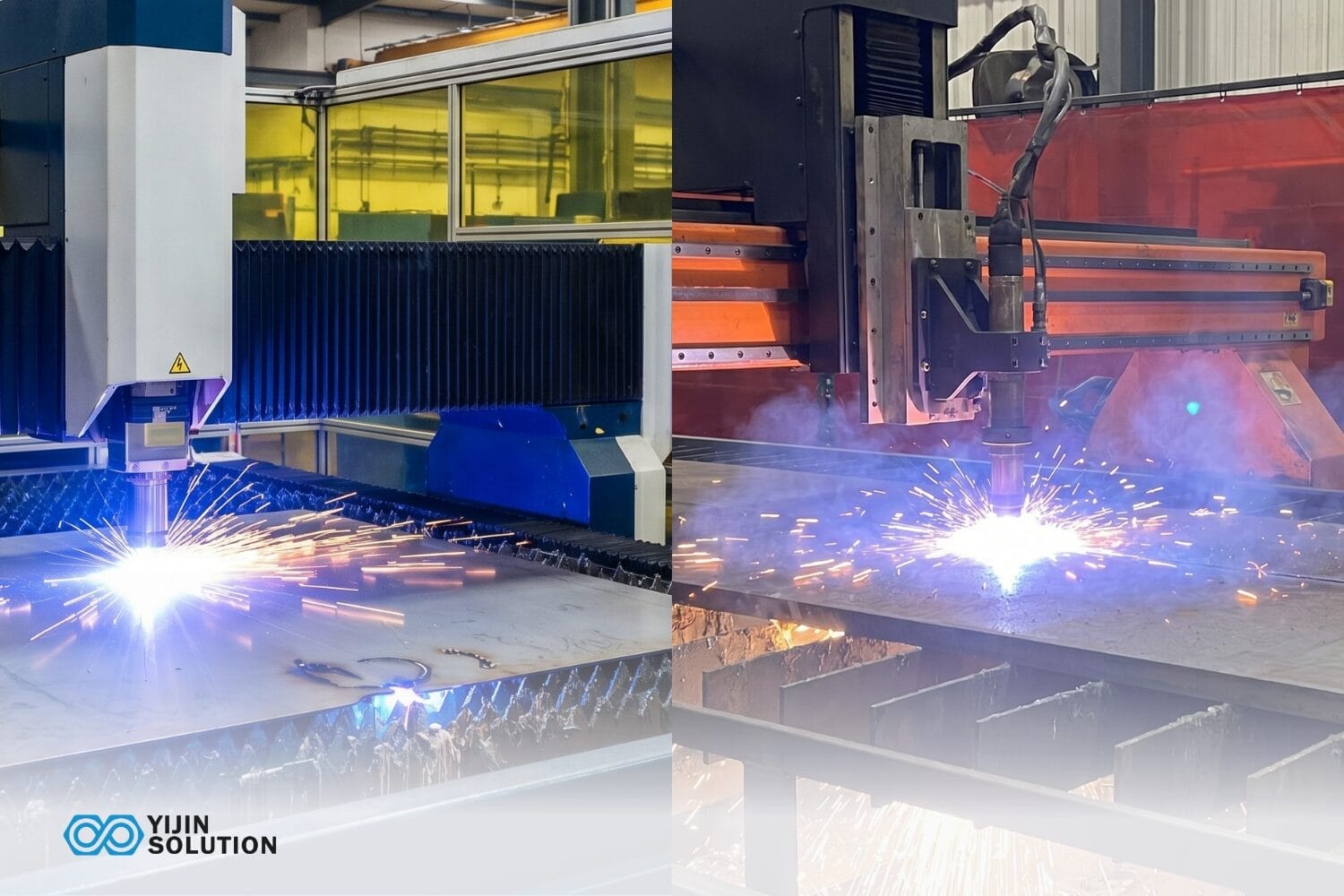
Laser cutting delivers the best edge quality among common sheet metal cutting methods. It handles complex 2D profiles in aluminum, mild steel, and stainless steel with high repeatability. For thin to medium gauges, laser is where most fabricators start. At higher volumes or very thick sections, though, laser’s per-part advantage narrows, and the economics start favoring other methods.
Waterjet cutting introduces no heat-affected zone. That makes it the method to reach for when the material is heat-sensitive or composite. It cuts virtually anything, including hardened tool steels and ceramics, but it runs slower than laser and the consumable costs are higher.
Plasma cutting is faster and cheaper for thick carbon steel, especially above 6 mm. The trade-off is edge quality. It’s lower than laser, and the process isn’t suited for thin gauges or applications where tight edge tolerances are on the drawing.
Punching and blanking are the volume play. Tooling cost amortizes quickly at scale, and cycle times per part are very short. For simple blanks in standard gauges, punching is hard to beat on cost once you’re above a few thousand pieces.
Forming operations
Press brake bending is the most common forming step in sheet metal. It achieves bend angles within close tolerances on standard CNC equipment, but the exact accuracy depends on material, thickness, tooling condition, and springback behavior. Aluminum, for instance, requires a larger inner radius than mild steel at the same thickness to avoid cracking. These specifics are confirmed during DFM review, not assumed from a generic table.
Roll forming produces continuous bends for long, constant cross-section profiles: channels, angles, and hat sections. It’s economical at high volumes, but the tooling setup cost is significant, which makes it impractical for short runs.
Stamping and deep drawing form cups, shells, and enclosures in a single press stroke. Tooling cost is high. Per-part cost at scale is very low. This is the standard process for volumes above 10,000 parts, covering automotive body panels and appliance housings.
Joining methods
Welding creates permanent, high-strength joints. MIG handles thicker carbon steel assemblies efficiently. TIG suits stainless steel and aluminum when welding appearance and penetration control matter. Spot welding is the standard for high-volume thin sheet assemblies, particularly in automotive body panel work, for which speed and repeatability are the primary requirements.
Mechanical fastening covers rivets, screws, clinching, and press-fit hardware like PEM inserts. It applies when disassembly is required, or when welding would distort thin material beyond the drawing tolerance.
Adhesive bonding shows up more and more in electronics enclosures and EV battery housings, where thermal isolation is needed alongside structural bonding. It distributes load across a larger area than spot welds but adds cure time to the production cycle.
Finition de surface
Powder coating is the workhorse finish for sheet metal. Durable, cost-effective, available in a wide color range. Typical coating thickness runs 60 to 80 micrometers.
Anodizing applies only to aluminum. It builds an oxide layer that improves corrosion resistance and accepts dye for color. Hard anodizing reaches 25 to 100 micrometers and creates a wear-resistant surface for functional applications.
Electroplating with zinc, nickel, or chrome adds corrosion protection and surface hardness. Zinc plating is standard on mild steel brackets and fastener hardware. Nickel and chrome show up on decorative and high-wear surfaces.
Brushing and bead blasting are cosmetic finishes. They improve appearance but don’t offer significant corrosion protection on their own. Pair them with a clear coat or sealant for anything exposed to the elements.
The table below maps common part requirements to a recommended fabrication process.
| Part Requirement | Recommended Process | When to Use an Alternative |
|---|---|---|
| Complex 2D profile, moderate volume | Découpe au laser | Waterjet if heat-sensitive material |
| Thick carbon steel, above 6 mm | Plasma or waterjet cutting | Laser for tighter edge tolerance |
| Bent enclosure or bracket | Press brake bending | Roll forming if constant cross-section |
| High-volume stamped shell | Stamping or deep drawing | Press brake for low volume, under 500 pcs |
| Permanent structural joint | MIG or TIG welding | Mechanical fastening if disassembly needed |
| Corrosion-resistant finish, aluminum | Anodisation | Powder coat if color variety needed |
| Corrosion protection, steel | Zinc electroplating or powder coat | Hot-dip galvanizing for outdoor structural |
Which Materials are Used in Sheet Metal Fabrication?
Material choice affects every downstream decision: which cutting process works, what bend radii are achievable, how the part handles corrosion, and what it ends up weighing. Five material families cover the vast majority of the work.
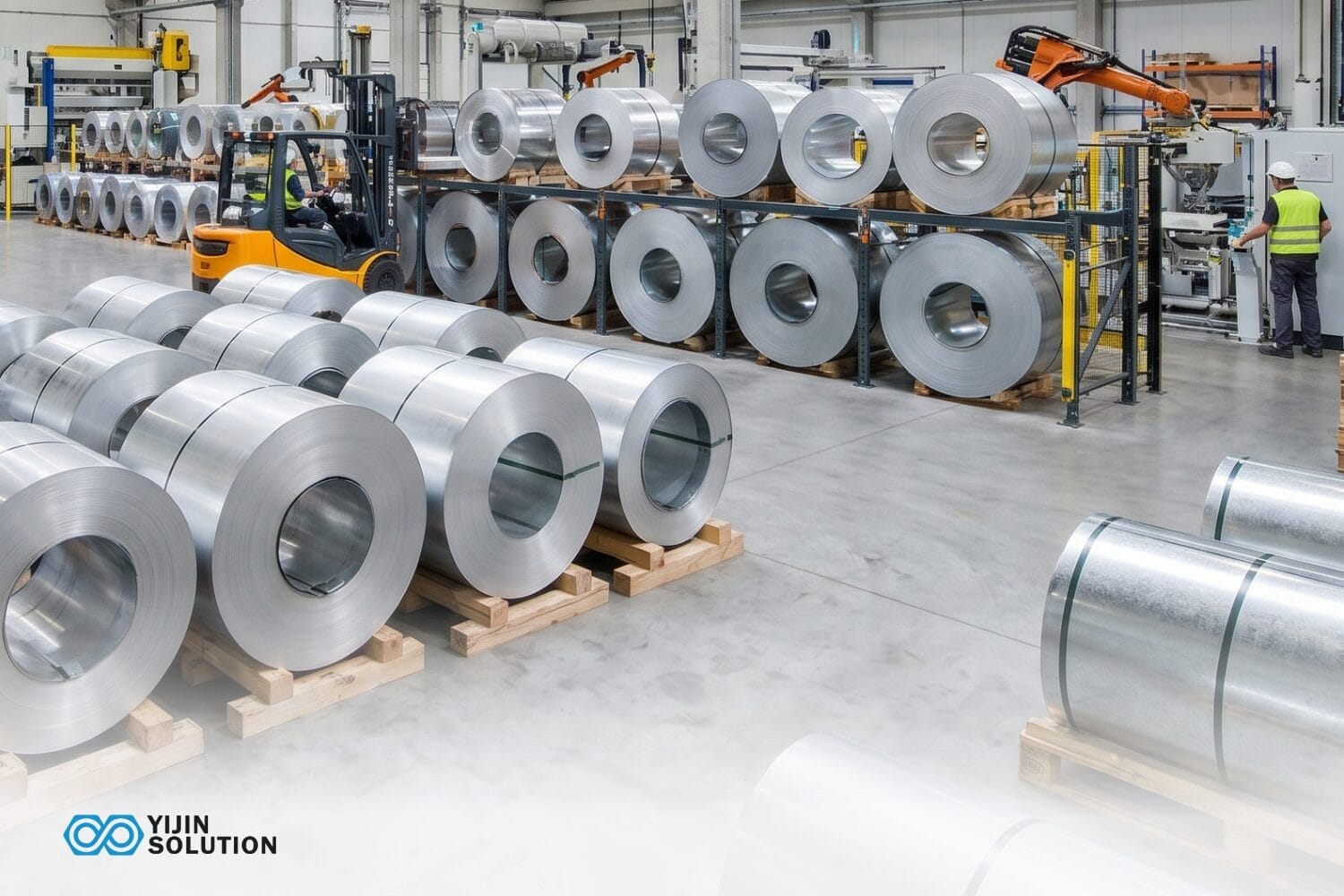
Mild and carbon steel grades like ASTM A1008 cold-rolled sheet are the most widely used sheet metal materials globally. It is strong, weldable, and the cheapest option for structural applications. The trade-off is corrosion. Unfinished carbon steel needs a protective coating for anything exposed to moisture, whether that’s powder coat, paint, or zinc plating.
Stainless steel in grades 304 and 316L gives you corrosion resistance without additional finishing. It’s standard for medical equipment housings, food-processing enclosures, and marine hardware. The catch: stainless work-hardens during forming. It’s harder to bend than carbon steel and needs adjusted tooling and press brake parameters, which shows up as a line item on the quote.
Aluminum alloys, particularly 5052-H32 for formed parts and 6061-T6 for structural components, offer an excellent strength-to-weight ratio and natural corrosion resistance. The raw material costs two to three times more per kilogram than mild steel, but a part that skips the corrosion finish because it’s aluminum can sometimes cost less in total. Bend radii need to be wider than steel at equivalent thickness, typically 1.5 to 2 times the sheet thickness, or the material cracks.
Copper and brass alloys like C110 and C260 are specified for high electrical and thermal conductivity: busbars, heat exchangers, plumbing fittings. They laser-cut well and are easy to form. Material cost is significantly higher than steel or aluminum, so you’ll only see them where the conductivity requirement leaves no alternative.
Galvanized steel conforming to ASTM A653 comes pre-coated with a zinc layer. It’s the default for HVAC ductwork, outdoor structural panels, and agricultural equipment. One thing to watch: the zinc coating burns at weld points. Post-weld treatment is required for any joined assembly, and that adds a step to the workflow.
| Matériau | Notes communes | Propriétés principales | Applications typiques | Process Notes |
|---|---|---|---|---|
| Mild / Carbon Steel | ASTM A1008, A653 | Strong, weldable, low cost | Structural brackets, frames, enclosures | Prone to corrosion; requires finish |
| Acier inoxydable | 304, 316L | Corrosion resistant, cleanable | Medical, food, marine equipment | Work-hardens; harder to bend |
| Aluminium | 5052-H32, 6061-T6 | Lightweight, good corrosion resistance | Aerospace, electronics, EV parts | Larger bend radius vs steel |
| Copper / Brass | C110, C260 | High conductivity, antimicrobial | Electrical, plumbing, heat exchangers | Expensive; laser cuts well |
| Acier galvanisé | ASTM A653 G90 | Pre-coated corrosion protection | HVAC, outdoor structural panels | Coating burns at welds; plan post-weld treatment |
What does Sheet Metal Fabrication Cost?
No single number answers this question, and anyone who gives you one is guessing. Sheet metal fabrication cost is the product of material, process, geometry, volume, and finish, all interacting. Understanding what drives the number helps a buyer design for it instead of getting surprised at the quoting stage.
Material cost sets the floor. Mild steel is the cheapest sheet metal you can buy. Aluminum runs two to three times more per kilogram. But raw material price is only the starting line. A part that needs no corrosion finish in aluminum can sometimes cost less in total than a steel part that requires zinc plating and a cosmetic powder coat. Total part cost is what matters, not material cost per kilogram.
Cutting process rates vary by equipment and material. Laser cutting typically runs $75 to $150 per hour for the machine, depending on power and material type. Waterjet runs $100 to $200 per hour. Complex cut paths, tight nesting, and higher pierce counts add machine time. Every extra second on the laser is money.
Forming complexity adds up with each bend. Every additional bend means additional setup and handling time. Parts with more than five bends in multiple planes need staged setups and extended cycle times. The metal fabrication cost per hour for press brake operations is comparable to laser cutting, but throughput per part depends heavily on geometry. A simple L-bracket and a six-bend enclosure are not the same job.
Batch volume is one of the strongest cost levers in sheet metal work. Setup costs are fixed per job: programming, tooling configuration, first-article inspection. At 10 parts, setup may represent 60% of total cost. At 1,000 parts, that same fixed cost is spread thin and per-part price drops sharply. The sheet metal fabrication price for any given part looks meaningfully different at 50 units versus 500.
Surface finish is the cost category most often underestimated at the quoting stage. Powder coating adds roughly $5 to $25 per part depending on size and color requirements. Anodizing runs $3 to $15 per part depending on class and part size. These are directional estimates, not quoted prices. Finish cost is frequently the last line item considered during specification and one of the first to push a quote beyond the expected range.
Tighter tolerance requirements increase inspection time, may require secondary CNC machining after forming, and carry a cost premium. The exact impact depends on which features need tight tolerances, the material, and the fabricator’s process capability. The most reliable way to understand cost for a specific part is to submit a CAD file for DFM review.
Sheet Metal Tolerances and Design for Manufacturability
Tolerances in sheet metal fabrication are not a fixed machine setting. They’re the outcome of a system: material springback variation, tooling wear, fixturing stability, bend sequence effects, and in-process measurement. Two parts from two different fabricators, run on similar equipment, can come out with measurably different dimensional accuracy because the process chain was managed differently.
That reality is why DFM review matters more in sheet metal than most buyers expect. The guidelines below aren’t abstract requirements. Each one connects to a specific cost or quality outcome.
- Minimum bend radius: for mild steel, a radius of 1x material thickness is a safe starting point. For aluminum alloys, plan for 1.5 to 2x the sheet thickness. Going tighter than the material allows causes cracking and scrap. Confirm this with your fabricator before design lock, not after.
- Hole sizing and placement: holes should be at least 1x material thickness in diameter. Place a hole closer than 2x material thickness to a bend line and it will distort during forming. Moving a hole 3 mm on a drawing costs nothing. Moving it after tooling is built costs a revision cycle and a conversation nobody wants to have.
- Wall thickness consistency: abrupt thickness changes within a single part mean separate blanks and a joining operation, usually welding. Design for uniform gauge by default. For parts that genuinely need varying thickness, plan the joint into the design from the start.
- Corner radii: draft angles aren’t required in sheet metal forming, unlike moulage sous pression. But corner radii must be generous enough to avoid stress concentrations. Sharp internal corners concentrate stress and lead to cracking under cyclic load.
- Fastener hardware: PEM inserts, weld nuts, and clinch nuts should be specified at the design stage. Retrofitting hardware insertion after a part is formed is expensive and can compromise dimensional accuracy on features that were already within tolerance.
Typical standard sheet metal tolerance is ±0.30 mm on general features, with precision capability to ±0.10 mm on qualifying surfaces. Achievable tolerances depend on part geometry, material, gauge, and the full fabrication sequence. Any tolerance figure from a supplier’s spec sheet reflects what the process delivers under controlled conditions, not a universal industry benchmark.
Plus d'informations : Sheet Metal Fabrication Tolerance
Where is Sheet Metal Fabrication Used?
Sheet metal fabrication shows up in almost every industry where dimensionally accurate metal components are needed at scale. What changes between sectors is which property matters most: weight, corrosion resistance, conductivity, or structural load capacity.
- Automobile : body panels, door frames, underbody brackets, EV battery enclosures, heat shields. Automotive sheet metal runs at high volume and demands repeatable tolerances across long production runs. If the thousandth part doesn’t match the first, the line stops.
- Aérospatiale : avionics bay covers, structural brackets, access panels, hydraulic line brackets. Weight and dimensional accuracy are equally critical, and material traceability is mandatory on every part in the assembly.
- Medical equipment: instrument housings, equipment enclosures, operating theater panels. These parts require stainless steel and clean-room compatible finishes, with full documentation per ISO 13485.
- Électronique : server rack enclosures, PCB chassis, EMI shielding housings, typically in aluminum 5052 or galvanized steel. Consistent internal dimensions and reliable grounding points are what make or break the assembly.
- Industrial equipment: motor guards, conveyor frames, pump housings, HVAC ducts. High-volume, cost-driven applications where carbon steel and galvanized steel dominate.
- Consumer products: appliance panels, furniture hardware, architectural cladding. Surface finish quality matters more here than in industrial work, and the fabrication process must deliver cosmetic consistency at volume.
Move Your Sheet Metal Program to a Single Source
Sheet metal programs lose money in the gaps between vendors. Cutting at one shop, bending at another, welding at a third – every handoff is another tolerance stack-up, another lead time inserted into the schedule, and another supplier to chase when a part comes back wrong. By the time the assembly fails fit-up at the customer, no single vendor owns the problem.
Yijin Solution provides services de fabrication de tôles from a single Shenzhen facility, covering laser cutting, press brake bending, welding, and finishing under one roof. The same engineering team that quotes the part also reviews it for nesting efficiency, bend sequence, and weld access before any material is committed – and the same quality system, certified to IATF 16949, ISO 13485, and AS9100D, governs every step from raw coil to packed crate.
Send your CAD files for a free DFM review and quote within 24 hours.
FAQs on What is Sheet Metal Fabrication?
When is sheet metal fabrication not the right process?
Sheet metal is a poor fit when the part requires variable wall thickness, complex internal cavities, or undercuts that cannot be formed from a flat blank. If the design cannot unfold into a flat pattern without overlapping material, it cannot be fabricated as a single sheet metal piece.
What is the difference between sheet metal fabrication and metal stamping?
Sheet metal fabrication uses general-purpose equipment (laser cutters, press brakes, welding stations) to produce parts in low to mid volumes with minimal tooling investment. Stamping uses custom dies to form parts in a single press stroke at very high speed, but the die itself costs thousands to tens of thousands of dollars.
How do I reduce sheet metal fabrication cost without compromising quality?
The highest-impact decisions happen at the CAD stage. Use standard sheet gauges rather than non-standard thicknesses. Minimize the number of bends, since each bend adds setup and handling time. Keep hole-to-bend distances above 2x material thickness to avoid distortion that causes rejects.
Can sheet metal parts be made from multiple materials in one assembly?
Yes, but each material interface introduces a design consideration. Joining dissimilar metals (for example, aluminum to stainless steel) risks galvanic corrosion at the contact point if the assembly is exposed to moisture. Isolating the joint with a barrier washer, sealant, or non-conductive fastener prevents this.
What information should I include when requesting a sheet metal fabrication quote?
At minimum: a 3D CAD file (STEP or IGES preferred), a dimensioned 2D drawing with GD&T callouts on critical features, the material and finish specification, the quantity required, and the target delivery date. If the part mates with other components, include the assembly context or mating part drawings.
Retour en haut de la page : What Is Sheet Metal Fabrication? Processes, Materials, Costs & Applications