


Material choice shapes more than the price of a sheet metal part. It determines how the part behaves in its environment — how well it resists corrosion, how cleanly it forms and welds, what surface finish is achievable, and whether it holds up over time in its actual application. Mild steel, stainless steel, aluminum, copper, and brass are all standard fabrication materials. However, each one carries a different set of mechanical properties, process constraints, and cost implications.
Most material decisions happen early — during design review, at the quoting stage, or when a drawing is being finalized. At that point, the choice often comes down to what is familiar or what has been used before, rather than what the application actually requires. That gap between assumption and requirement is where material mismatches tend to originate.
A material list on its own only goes so far. What matters is understanding where each option makes sense, where it doesn’t, and how the tradeoffs play out across corrosion resistance, formability, weldability, and cost. This guide covers the eight most common sheet metal materials used in industrial fabrication and gives you a structured way to compare them for your specific application.
What is Sheet Metal?
Sheet metal is flat-rolled metal stock formed into parts through cutting, bending, stamping, and welding. Its defining characteristics are a high surface area relative to thickness, consistent material properties across the sheet, and compatibility with high-speed forming processes that would be impractical with solid stock.
Those properties make sheet metal the practical choice for a wide range of industrial applications. Enclosures, structural panels, brackets, chassis, ductwork, and housing components are all typically sheet metal parts. You’ll find it wherever a thin-walled, formed structure is needed at repeatable quality and manageable cost.
The specific alloy and grade used determines how the material behaves across the full fabrication sequence: how it cuts, how it forms, how it welds, what surface finish it accepts, and how it performs in its end-use environment. That makes material selection the first and most consequential decision in any sheet metal fabrication program.
Common Types of Sheet Metal Materials

The materials below cover most industrial sheet metal fabrication needs. Each option has different trade-offs in cost, strength, corrosion resistance, formability, and weldability.
- Stahl
- Rostfreier Stahl
- Aluminium
- Kupfer
- Messing
1. Steel
Baustahl
Mild steel is the default starting point for most general sheet metal parts. It’s affordable, easy to form, easy to weld, and available in virtually every fabrication market. For brackets, enclosures, frames, and structural panels, this is where the material conversation usually begins.
The two grades you’ll see most often are cold-rolled steel (ASTM A1008) and hot-rolled steel (ASTM A1011). Cold-rolled steel is the better choice when surface finish and dimensional consistency matter. It’s the standard substrate for painted and powder-coated parts. Hot-rolled steel suits more structural applications where appearance is secondary.
Cost is one of the main reasons mild steel dominates general fabrication. It’s the lowest-cost structural metal on this list, and with a tensile strength of 400–550 MPa and a yield strength around 250 MPa, it covers the mechanical requirements of most standard industrial parts.
The one area where mild steel falls short is corrosion resistance. It doesn’t hold up in wet, outdoor, or chemically exposed environments without a protective finish. If the application involves moisture, humidity, or salt exposure, galvanized steel or stainless steel is the more appropriate starting point.
Verzinkter Stahl
Galvanized steel is the natural next step when mild steel gives you the right strength and cost profile, but bare steel doesn’t offer enough corrosion protection. The hot-dip zinc coating protects the base metal sacrificially — it corrodes first, keeping the steel underneath intact even where the surface is scratched or cut.
That’s what positions galvanized steel between mild steel and stainless in most material hierarchies. It carries a modest cost premium over bare steel — well below stainless — and suits outdoor enclosures, HVAC components, construction hardware, and automotive panels where moderate corrosion resistance is the requirement.
In fabrication, it cuts and forms much like standard mild steel. Welding is where the process changes: the zinc coating burns off at weld temperatures and produces hazardous fumes, so ventilation and weld zone preparation are non-negotiable. If the part involves significant welding, flag this early in the quoting process.
For moderate corrosion environments, galvanized steel is the more economical choice over stainless steel. For salt spray, marine exposure, or chloride-rich conditions, it’s not sufficient — stainless steel 316 or aluminum 5052 is the correct specification.
2. Rostfreier Stahl
Rostfreier Stahl 304
304 stainless steel is the next step when mild steel does not give enough corrosion resistance and galvanized steel no longer gives the finish or durability the part calls for. It gives you a strong mix of corrosion resistance, appearance, strength, and fabrication performance. That is why it shows up so often in food equipment, medical housings, kitchen hardware, and industrial enclosures.
Compared with mild steel, 304 costs more, but in many indoor or moderately demanding environments, it removes the need for an extra protective coating. Compared with galvanized steel, it usually gives you a cleaner bare-metal finish and better long-term corrosion resistance.
It also works well in fabrication. 304 welds cleanly with standard TIG and MIG processes, and it forms well in many applications. The main thing to watch is springback. It tends to spring back more than mild steel, so bend radii and forming details need a closer look during design.
Chloride exposure is the part to check carefully. It is easy to hear “stainless” and assume it can handle any corrosive environment, but 304 can still pit in coastal, marine, or chloride-rich conditions. If the part will see salt spray, seawater, or aggressive chemicals, 316 is usually the better material to consider before you lock in the spec.
Rostfreier Stahl 316
316 stainless steel is the specification when 304’s corrosion resistance isn’t sufficient for the service environment. The difference comes down to molybdenum: the 2–3% addition to 316’s base composition significantly improves resistance to chloride-induced pitting and crevice corrosion, which is the failure mode 304 is vulnerable to in aggressive environments. That’s what makes 316 the standard grade for marine hardware, offshore equipment, chemical processing vessels, and medical implant housings.
From a fabrication standpoint, 316 and 304 behave nearly identically. Both form and weld using the same processes, and mechanical properties are comparable: tensile strength 515–690 MPa, yield strength 205–310 MPa. The decision between them is driven by service environment and cost, not manufacturability.
316 typically runs 25–35% more expensive than 304 at the material level. In a dry indoor environment, that premium adds no engineering value. Where chloride exposure — salt spray, seawater, or aggressive process chemicals — is a real service condition, 316 is the correct specification.
3. Aluminum
Aluminium 5052
Aluminum 5052 is the most common aluminum sheet grade for fabricated parts, and the reason comes down to its combination of formability, corrosion resistance, and low weight. Where a part needs to be shaped, formed, and exposed to the elements without adding unnecessary mass, 5052 is where the aluminum discussion usually starts.
The comparison with 6061 is the decision most engineers face. 5052 forms more easily — it handles tighter bend radii and deeper draws that would crack harder aluminum grades. That makes it the right fit for enclosures, chassis, fuel tanks, marine components, and aerospace panels where forming complexity is part of the design requirement. The tradeoff is machinability: 5052 doesn’t machine as cleanly as 6061, and drill breakout is more aggressive. For parts that combine forming and secondary CNC operations, that distinction matters.
In H32 temper, tensile strength runs 228 MPa and yield strength 193 MPa — sufficient for a wide range of structural fabricated parts, though not the strongest aluminum option on the list. It welds cleanly with MIG or TIG using ER5356 filler wire.
If the part requires complex forming and corrosion resistance is a service condition, 5052 is the correct grade. If strength and machinability take priority over formability, 6061 is the better starting point.
Aluminium 6061
Aluminum 6061 is the structural grade of the aluminum sheet options. In T6 temper, tensile strength reaches 310 MPa and yield strength 276 MPa — significantly stronger than 5052 and sufficient for load-bearing brackets, frames, and structural panels. It also machines cleanly with an excellent surface finish, making it the preferred grade for hybrid parts that combine sheet metal forming with CNC-machined features.
The forming constraint is real and needs to be accounted for at the design stage. 6061-T6 work-hardens rapidly and will crack at tight bend radii. The minimum bend radius is typically 1×T in T4 temper, rising to 3×T in T6. If the design includes complex bends, deep draws, or tight radii, 5052 is the correct material. If strength and machinability are the priority, 6061 is the right call. Still, forming limitations need to be resolved before the design is locked.
6061 also anodizes well and is the preferred grade where hard anodizing is part of the surface specification.
4. Copper
Copper solves a different problem from steel, stainless, or aluminum. Its primary value is conductivity — electrical and thermal — and that’s what drives almost every copper sheet metal specification. Where a part needs to carry current, manage heat transfer, or provide reliable shielding, copper is the material the application points to.
Typical applications include busbars, grounding straps, RF shielding panels, transformer components, and heat exchanger parts. Copper offers the highest electrical conductivity of any common sheet metal material, along with a thermal conductivity of 385 W/m·K. It forms well and supports soldering and the joining methods standard in electrical fabrication. Tensile strength runs 220–380 MPa depending on temper.
Outside of electrical and thermal applications, copper is hard to justify. It’s significantly more expensive than mild steel and denser than steel or aluminum, which makes it the wrong choice for anything structural or cost-sensitive where conductivity isn’t the requirement.
Oxidation is worth planning for early. Copper develops a brown-green patina over time, which is acceptable for most grounding and shielding applications but problematic where contact conductivity needs to be maintained. For those parts, specify tinned or silver-plated copper sheet from the outset.
5. Brass
Brass sits closer to copper than to steel in application logic, but it offers a different balance of properties. It doesn’t match copper’s conductivity, but it machines and forms more easily, and it gives visible parts a more refined appearance. That combination positions brass as the material of choice for terminals, connectors, nameplates, decorative hardware, and architectural trim — parts where machinability, moderate corrosion resistance, and aesthetics all factor into the specification.
Tensile strength ranges from 300 to 580 MPa depending on composition and temper, which covers the mechanical requirements of most connector and hardware applications with no need for additional coatings.
Cost is the main constraint. Brass runs four to six times the material cost of mild steel, which makes it the wrong choice for structural or general fabrication work. It belongs in the specification when the design genuinely requires its combination of appearance, machinability, and corrosion resistance — not as a default or a precaution.
For parts where strength is the only requirement, mild steel or aluminum is the correct choice. Where function and appearance both drive the specification, brass is the material that delivers both.
Sheet Metal Material Properties: Comparison Table
The table below covers all eight materials across the properties that drive fabrication decisions.
| Material | Tensile Str. | Dichte | Corrosion Res. | Verformbarkeit | Schweißeignung | Fab. Tolerance* | Am besten für |
|---|---|---|---|---|---|---|---|
| Baustahl | 400–550 MPa | 7.85 g/cm³ | Low — needs coating | Ausgezeichnet | Ausgezeichnet | ±0.10–±0.30 mm | Painted brackets, frames, enclosures |
| Verzinkter Stahl | 330–500 MPa | 7.85 g/cm³ | Moderate — zinc coat | Gut | Good † | ±0.10–±0.30 mm | Outdoor panels, HVAC, construction |
| Rostfreier Stahl 304 | 515–620 MPa | 7.93 g/cm³ | Gut | Gut | Gut | ±0.10–±0.30 mm | Food, medical, and indoor enclosures |
| Rostfreier Stahl 316 | 515–690 MPa | 7.98 g/cm³ | Excellent — chloride-resistant | Gut | Gut | ±0.10–±0.30 mm | Marine, offshore, chemical processing |
| Aluminium 5052 | 228 MPa | 2.68 g/cm³ | Gut | Ausgezeichnet | Good — MIG/TIG | ±0.10–±0.30 mm | Marine enclosures, aerospace panels, fuel tanks |
| Aluminium 6061 | 310 MPa | 2,70 g/cm³ | Gut | Mäßig | Mäßig | ±0.10–±0.30 mm | Structural brackets, machined/formed parts |
| Kupfer | 220–380 MPa | 8,96 g/cm³ | Moderate — patinas | Ausgezeichnet | Good — solder/TIG | ±0.10–±0.30 mm | Busbars, RF shielding, heat exchangers |
| Messing | 300–580 MPa | 8.50 g/cm³ | Gut | Gut | Mäßig | ±0.10–±0.30 mm | Terminals, connectors, decorative trim |
* Fabrication tolerances are Yijin Solution’s verified sheet metal capabilities: precision ±0.10 mm, standard ±0.30 mm. For tight-tolerance features, secondary CNC machining after forming achieves ±0.01 mm precision.
† Galvanized steel welding requires ventilation and weld zone preparation to manage zinc fume emissions.
If the table narrows your choice to two materials, the decision framework below gives you the six questions that resolve it.
Tell us your target material, thickness, and production volume — our engineers will confirm fabrication feasibility and achievable tolerances. Request a free DFM review.
Sheet Metal Thickness and Gauge Reference

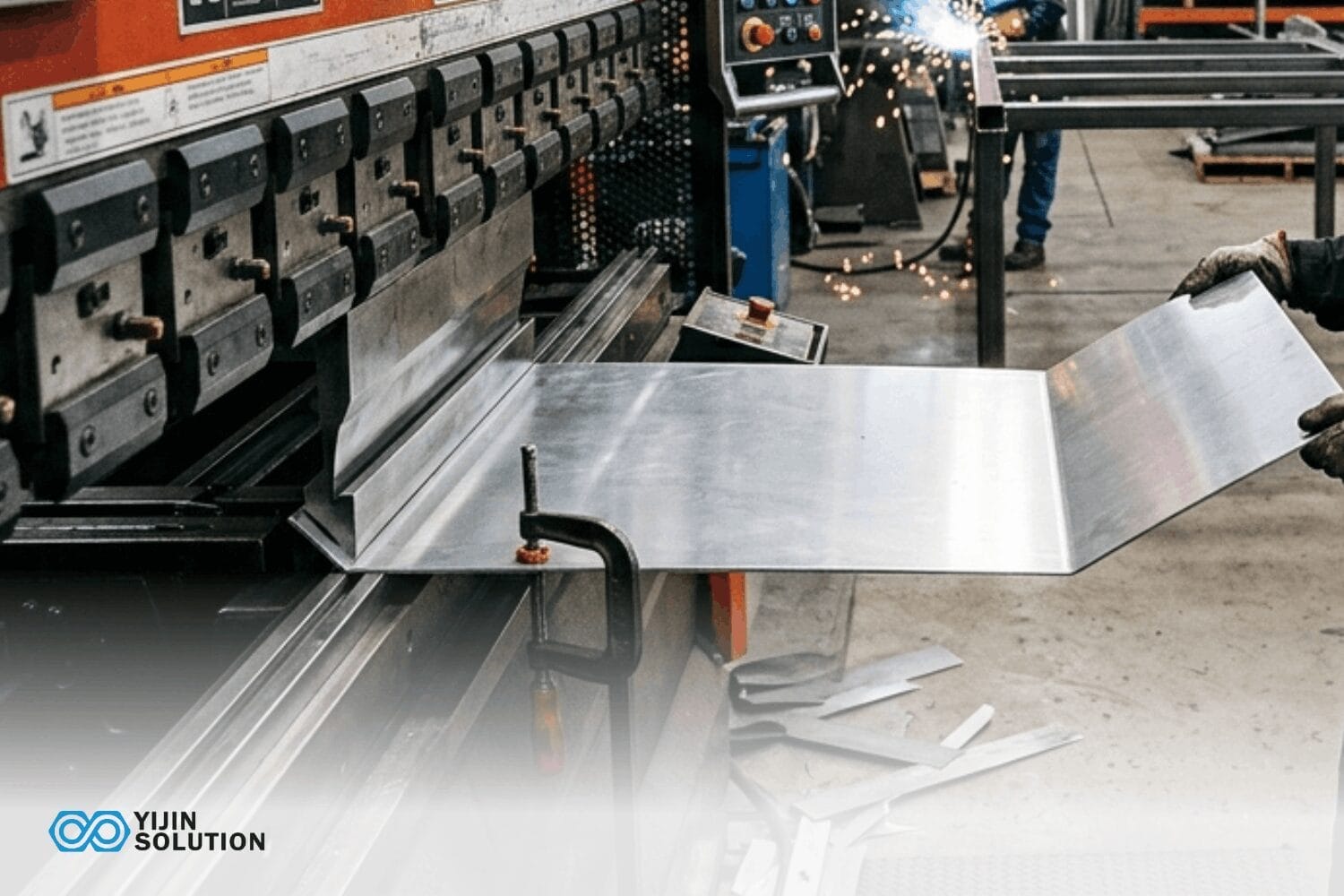
The US gauge system is a legacy thickness standard, but the conversion differs by material. 16-gauge steel is 1.59 mm; 16-gauge aluminum is 1.29 mm. Using the wrong conversion introduces dimensional error before fabrication starts. Always specify thickness in millimeters on engineering drawings.
The table below covers the most common fabrication gauges for steel, stainless steel, and aluminum, with typical application context for each range.
| Gauge (US) | Steel (mm) | Stainless (mm) | Aluminum (mm) | Gemeinsame Bewerbung |
|---|---|---|---|---|
| 28 | 0.38 | 0.38 | 0.33 | Light enclosures, liners |
| 24 | 0.64 | 0.64 | 0.51 | HVAC ductwork, thin panels |
| 22 | 0.84 | 0.84 | 0.71 | Electronic enclosures |
| 20 | 1.02 | 0.91 | 0.81 | General fabrication |
| 18 | 1.27 | 1.14 | 1.02 | Structural panels, brackets |
| 16 | 1.59 | 1.52 | 1.29 | Heavy-duty brackets, frames |
| 14 | 1.90 | 1.90 | 1.63 | Structural supports |
| 12 | 2.66 | 2.67 | 2.05 | Load-bearing components |
| 11 | 3.05 | 3.05 | 2.34 | Heavy structural panels |
For parts near the upper size limit, confirm panel dimensions and bending sequence with your fabricator before finalizing the design. Large panels are sensitive to bend sequence, and incorrect ordering makes subsequent bends geometrically impossible on standard press brake tooling.
How to Choose the Right Sheet Metal Material
The right sheet metal material depends on the application, fabrication method, and performance requirements. Instead of starting with price alone, it helps to assess the main decision factors step by step. The six steps below will help you narrow down the right option for your part.
1. What is the corrosion environment?
This is the first question because it eliminates the most options. A dry indoor part with a painted finish can be mild steel. An outdoor or humid environment without a coating specification points toward galvanized steel or 304 stainless as a minimum. Coastal or chloride-rich conditions narrow the field further, as 316 stainless or aluminum 5052 are the materials that hold up in those conditions. Getting this wrong early is difficult to fix later.
2. What are the mechanical load requirements?
Once the corrosion environment is defined, check whether the part carries structural loads. Mild steel and stainless steel 304 both offer significantly higher strength than aluminum 5052. If weight reduction is a priority, aluminum’s density advantage over steel is substantial and often justifies the cost difference. Still, confirm the load case before making that trade-off.
3. How complex is the forming geometry?
Parts with tight bend radii, deep draws, or compound curves favor aluminum 5052 and cold-rolled mild steel. Aluminum 6061-T6 and work-hardened stainless grades are more prone to cracking at aggressive radii. If the design includes bends tighter than 2×T or deep-drawn features, the material needs to be chosen with formability in mind before the geometry is finalized.
4. Does the part require welding?
Mild steel and stainless 304/316 weld cleanly with standard MIG and TIG processes. Galvanized steel welds, but zinc fume management adds process steps and cost. Aluminum needs the correct filler alloy — ER5356 for 5052, ER4043 for 6061 — and heat input needs to be controlled carefully. Copper and brass require specialized parameters and take longer. If the part involves non-ferrous welds, flag this at the quoting stage.
5. What are the surface finish requirements?
For painted or powder-coated parts, mild steel is the most cost-effective substrate. For bare metal finishes, stainless steel and anodized aluminum give the cleanest results. Copper and brass have natural appeal, but both oxidize in service. If appearance needs to be maintained over time, clear lacquer or electroplating should be part of the specification from the start, not added later.
6. Does the cost hold up against the performance requirements?
Cost is the last question, not the first. At prototype volumes, the differences are manageable, but at production scale, the gap between mild steel and 316 stainless steel or copper becomes significant. Before upgrading material, confirm that the performance requirement is genuine. Specifying 316 stainless steel for a dry indoor enclosure adds roughly 35% to material cost with no engineering benefit. The cost check is there to validate the decision, not to drive it.
Sheet Metal vs. CNC Machining: When Does Material Choice Change?
Sheet metal fabrication and CNC machining share many of the same materials, but the process constraints are different. Sheet metal forming adds formability requirements that machining doesn’t face. CNC machining delivers tighter tolerances that sheet metal fabrication can’t match as-built. Most industrial assemblies use both processes on different features of the same part.
The table below compares Yijin Solution’s verified capabilities across both processes.
| Faktor | Herstellung von Blechen | CNC-Bearbeitung |
|---|---|---|
| Material Forms | Sheet, coil, plate stock | Bar, billet, plate, tube |
| Typische Materialien | Mild steel, SS 304/316, Al 5052/6061, copper, brass | Al 6061, Al 7075, SS 303/304/316, titanium, engineering plastics |
| Präzisionstoleranz | ±0,10 mm | ±0,01 mm |
| Standard-Toleranz | ±0,30 mm | ±0,05 mm |
| Maximale Teilegröße | 2440 × 1220 mm | Milling: 3000 mm long; Turning: ø400 mm |
| Lead Time — Prototype | 3-7 Tage | 7 days minimum |
| Lead Time — Production | 7-15 Tage | 10–15 days standard |
| Geometry Strengths | Large panels, enclosures, complex bends | Complex 3D geometry, tight-tolerance bores and threads |
| Materialabfälle | Low — nesting efficiency | High — chips from billets |
| Am besten für | Thin-walled structures, high-surface-area parts | High-tolerance components, solid structural parts |
Sheet metal wins on lead time, material efficiency, and part size. CNC machining wins on tolerance and geometric complexity. For parts where formed panels need tight-tolerance bored features, the correct approach is sheet metal fabrication followed by CNC finishing. Both are available under one roof at Yijin-Lösung, with no part transfer between suppliers.
Source Your Metal Parts with Yijin Solution
Material selection doesn’t end when the grade is chosen – it carries through every stage of fabrication, from bend feasibility and weld access to finishing and tolerance stack-up. Getting that continuity right separates a part that works on paper from one that performs in production.
We are a direct-factory sheet metal fabrication service operating out of a 25,000+ m² facility in Shenzhen. We produce parts in-house across mild steel, stainless steel, aluminum, copper, and brass, with full-process capability covering laser cutting, bending, stamping, welding, and secondary finishing — no brokers, no outsourced steps.
Before any file goes into production, our engineering team runs a material-specific DFM review covering bend radius feasibility, weld joint accessibility, coating allowances, and tolerance stack-up on formed assemblies. Precision fabrication holds ±0.10 mm; where tighter tolerances are required, CNC secondary operations are performed in-house.
Prototype lead times run 3–7 days; production runs complete in 7–15 days. Our quality systems are certified to AS9100D, IATF 16949, and ISO 13485, covering safety-critical applications across the industries we serve.
Upload your CAD file to receive a free DFM review.
FAQs on How to Choose the Right Sheet Metal Material
What material is sheet metal made from?
A range of metals and alloys are used to produce sheet metal. Mild steel, stainless steel, aluminum, copper, brass, galvanized steel, and titanium are among the most common. For industrial fabrication, mild steel, stainless steel 304, aluminum 5052, and aluminum 6061 account for most parts. The correct material depends on the corrosion environment, mechanical load case, forming requirements, and cost target of the specific application.
What is the best material for sheet metal fabrication?
There’s no single best sheet metal material. Mild steel is the lowest-cost option for coated indoor structural parts. Stainless Steel 304 suits food, medical, and hygiene applications. Aluminum 5052 is the right choice where weight and corrosion resistance both matter. Stainless Steel 316 is specified for marine or chloride-rich service. The six-step framework in this article gives you the correct sequence for resolving that decision.
What thickness does sheet metal come in?
Sheet metal is available from approximately 0.38 mm to 6 mm and above, depending on the material. For most enclosures and structural parts, the practical fabrication range is 0.8–3.0 mm. Always specify thickness in millimeters on engineering drawings, as gauge numbers differ by material, and using the wrong conversion introduces dimensional error before a sheet is cut.
How do I choose between mild steel and stainless steel for sheet metal parts?
Choose mild steel when you will paint or powder coat the part, when it operates in a dry indoor environment, and when cost is a constraint. Choose stainless steel when the part requires bare metal corrosion resistance or when appearance specifications exclude coated surfaces. Stainless steel typically costs three to four times more than mild steel at the material level, but that premium is justified when corrosion resistance is a real service requirement, not just a precaution.
Can aluminum sheet metal be welded?
Yes, aluminum sheet metal welds using MIG or TIG processes with the correct filler alloy. Aluminum 5052 uses ER5356 filler;aluminum 6061 uses ER4043 filler. Welders must remove the oxide layer immediately before welding, and they must control heat input carefully to prevent distortion in thin sections. Flag aluminum weld joints to your fabricator in the quoting stage.
What tolerances are achievable in sheet metal fabrication?
Achievable tolerance depends on the operation. Our precision sheet metal fabrication holds ±0.10 mm; standard fabrication holds ±0.30 mm. Cutting operations hold tighter than bending; formed dimensions accumulate more variation than laser-cut edges. For features that require tolerances tighter than ±0.10 mm, CNC machining after forming is standard practice.
Zurück zum Anfang: How to Choose the Right Sheet Metal Material






 English
  Spanish
  German
  French