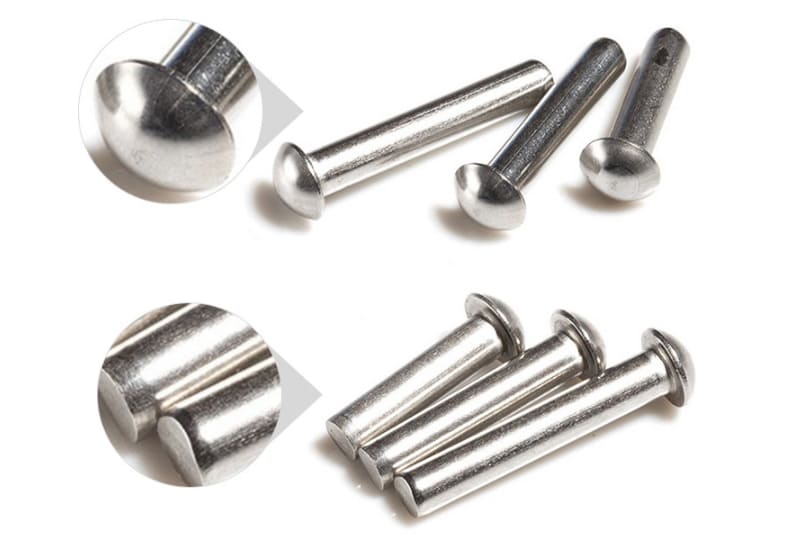

High-strength fasteners span a wide spectrum from SAE Grade 8 hex bolts and metric Class 10.9 socket heads to fully custom alloy bolts. Tensile strength across that range runs from 830 MPa at the lower end of the structural range all the way past 1,200 MPa. Grade selection, combined with material choice, heat treatment, and thread form, sets the actual load a fastener can carry in service.
This guide covers how grade systems work, which materials apply to which environments, what types of high-strength fasteners exist, and the practical design decisions that determine whether a well-specified fastener will actually perform efficiently in service.
What are High Strength Fasteners?
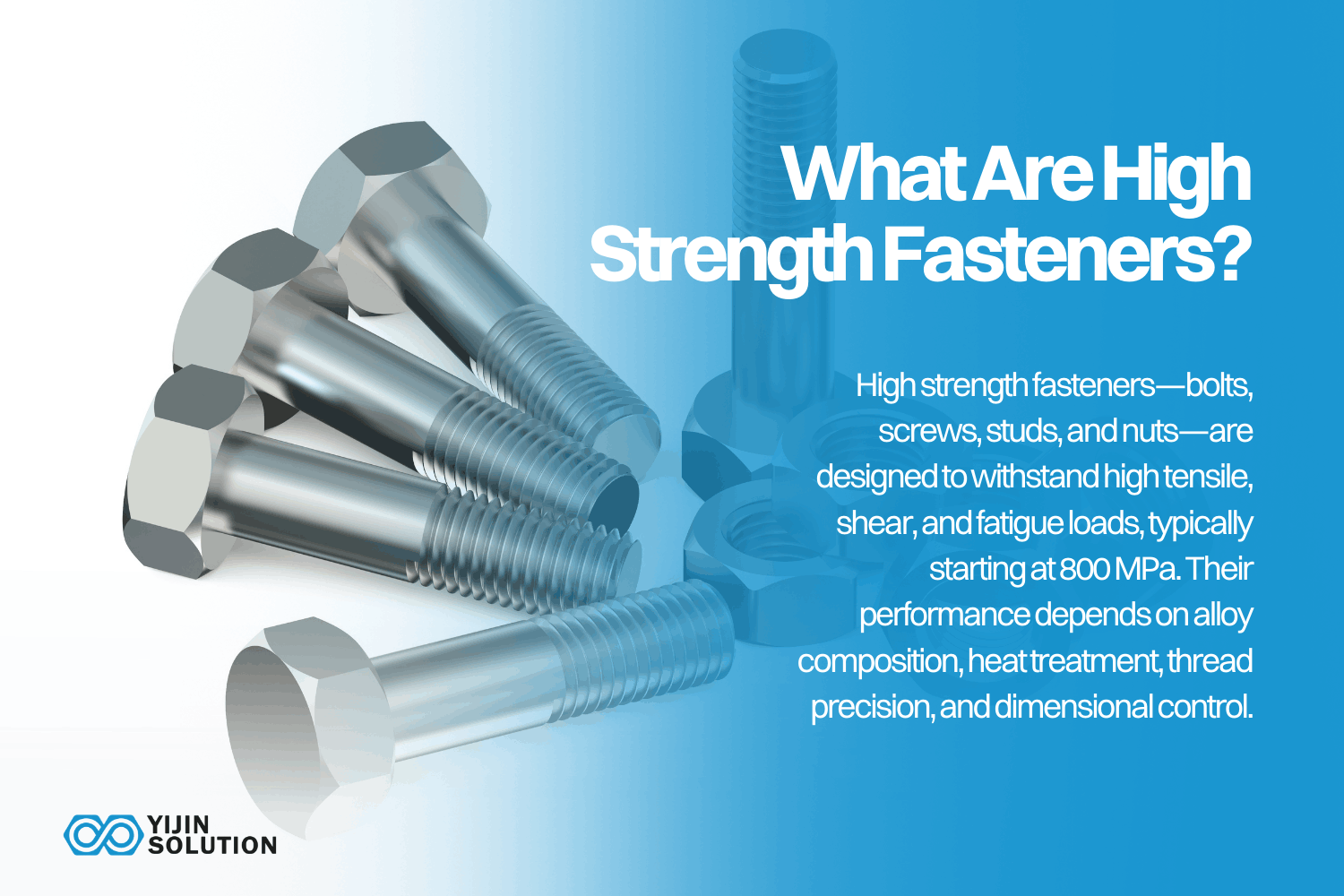
High-strength fasteners are bolts, screws, studs, and nuts engineered to resist elevated tensile loads, shear forces, and fatigue stress. They start at a minimum tensile strength of 800 MPa or higher. The distinction from standard fasteners isn’t just the material grade; it’s the combination of alloy composition, heat treatment process, thread form, precision, and dimensional control. These variables determine how a fastener behaves under sustained load.
A Class 12.9 bolt and a Class 4.8 bolt may look identical on a shelf, but under load, they behave like different components. Specifying ‘high strength’ without defining which standard, which grade, and which application your project needs will most likely create the ambiguity that causes joint failures.
How are High Strength Fasteners Graded?
Three grading systems cover the vast majority of high-strength bolts and screws used in engineering today: SAE J429 for inch-series fasteners, ISO 898-1 for metric property classes, and ASTM F3125 for structural steel construction bolts. Each system uses different marking conventions and tensile requirements. The table below maps them side by side.
| Grading System | Klasse | Min. Tensile Strength | Typische Anwendung | Anmerkungen |
|---|---|---|---|---|
| SAE J429 | Grade 8 | 150,000 psi / 1,034 MPa | Automotive, heavy machinery | Six radial dashes on the bolt head |
| ISO 898-1 | Class 10.9 | 1,040 MPa | Industrial equipment, automotive | 10.9 stamped on the head |
| ISO 898-1 | Class 12.9 | 1,220 MPa | High-load precision assemblies | 12.9 stamped on the head |
| ASTM F3125 | A325 | 827 MPa / 120 ksi | Structural steel construction | Replaces legacy A325 standard |
| ASTM F3125 | A490 | 1,034 MPa / 150 ksi | Heavy structural connections | Do not hot-dip galvanise – embrittlement risk |
What does ‘Class 12.9’ actually mean?
The ISO two-number system encodes both strength and ductility in the designation.
The first number multiplied by 100 gives the nominal tensile strength in MPa. The second number represents the yield-to-tensile ratio as a percentage, multiplied by ten. Class 12.9 means 1,200 MPa nominal tensile strength and a 90% yield ratio.
This tells us that the bolt begins to deform permanently at around 1,080 MPa. The high yield ratio makes Class 12.9 bolts effective in precision assemblies where a very specific preload must be maintained without significant plastic elongation.
What Materials are Used in High Strength Fasteners?
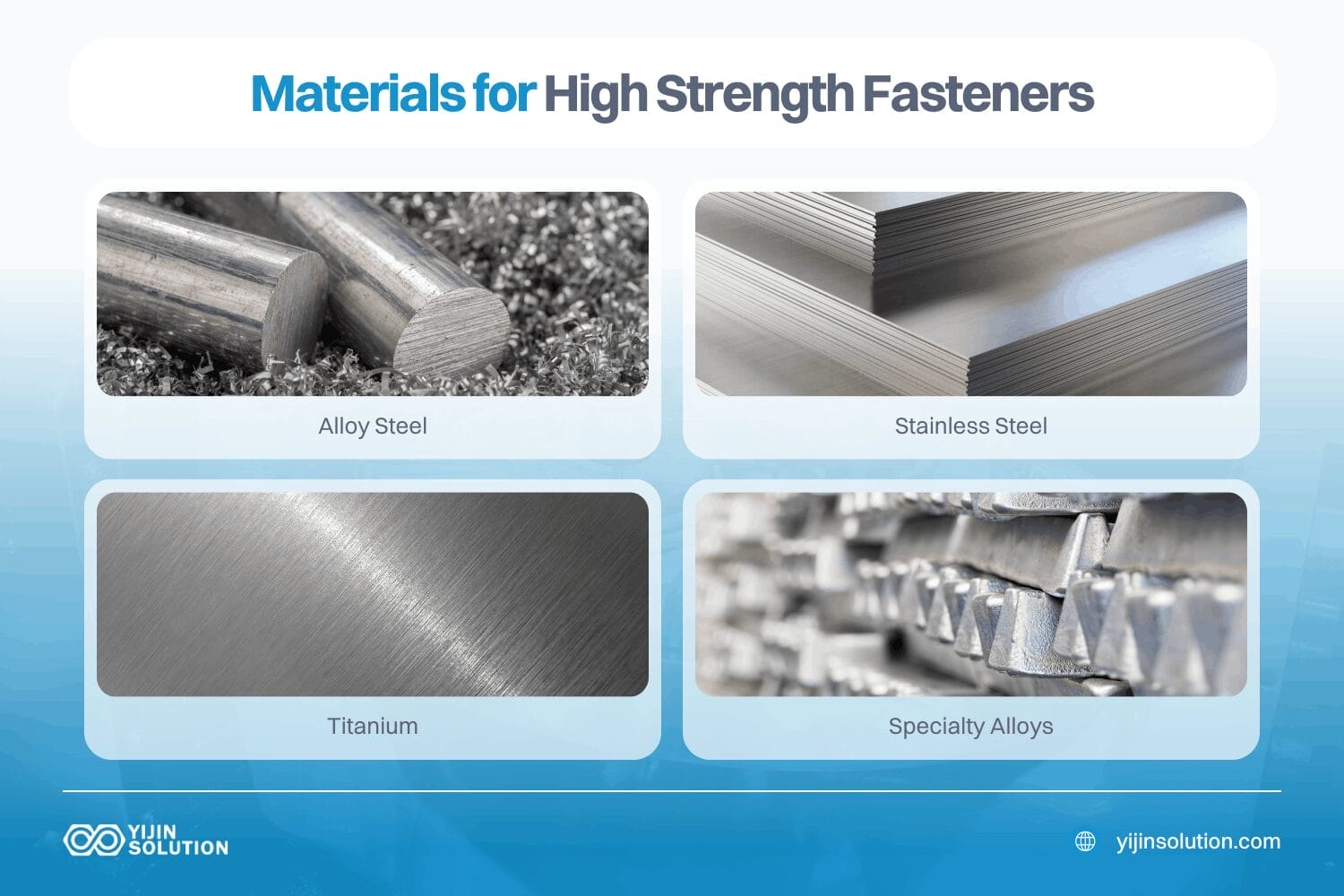
Material choice determines more than raw strength. It sets the corrosion resistance, weight penalty, machinability, and the compatible surface coating. Choosing a high-strength grade that can’t survive your operating environment forces a costly redesign after tooling.
Legierter Stahl
Alloy steel is the standard base material for high-strength bolts and screws. Quenching and tempering alloy steel grades containing chromium, manganese, and molybdenum produces Class 10.9 and 12.9 property classes reliably and at competitive cost.
The trade-off comes in electroplating: zinc-plated Class 12.9 bolts carry a hydrogen embrittlement risk if the post-plating bake-out process isn’t controlled correctly. A bolt that passes dimensional inspection can still fail in service if the baking time or temperature was insufficient. Mechanical zinc or Geomet coatings eliminate that risk entirely.
Rostfreier Stahl
A2-70 and A4-80 are the standard stainless steel grades for most corrosion-resistant fastener applications. A2-70 uses 304 stainless steel and is suitable for general indoor and mildly corrosive environments. A4-80 adds molybdenum, which substantially improves chloride resistance . It is the right choice for marine hardware, chemical processing equipment, and medical devices.
The practical limit is tensile strength: A4-80 tops out around 800 MPa. When an application demands both high corrosion resistance and tensile strength above that threshold, cold-worked A4-100 or precipitation-hardened grades such as 17-4 PH are the options to specify.
Titan
Grade 5 titanium delivers tensile strength of around 950 MPa at roughly 60% the weight of steel. That strength-to-weight ratio makes it the preferred material for aerospace structural joints, medical implant fasteners, and motorsport components where every gram is budgeted.
It does come with a machining cost: fine-pitch threads in titanium require specialised tooling, controlled cutting speeds, and flood coolant to prevent work hardening. Lead times for prototype quantities run longer than standard alloy steel, and per-part cost reflects the material and process premium.
Specialty alloys
Inconel 718 bolts retain adequate strength above 1200°F, making them the go-to choice for turbine casings, exhaust manifolds, and any bolted joint that sees prolonged high-temperature exposure.
MP35N is a cobalt-nickel-chromium-molybdenum alloy that reaches tensile strengths above 2,000 MPa while resisting hydrogen sulphide and chloride stress corrosion cracking. This is the combination required for deep-sea oil field service, where standard grades fail rapidly.
Neither alloy is available in standard stock for non-standard geometries. Both require custom manufacturing to drawing, and both require a manufacturer with the equipment and process knowledge to machine them reliably.
Types of High Strength Fasteners and Their Applications
The term ‘high-strength fasteners’ covers several distinct product forms. Each is suited to a different joint geometry, assembly method, and load direction. Specifying the right type is as important as specifying the right grade.
High-strength bolts
Hex cap bolts in SAE Grade 8 and ASTM F3125 grades A325 and A490 dominate structural steel construction and heavy machinery applications. These are used where the bolt and nut together provide clamping force across a flange or joint face, rather than the bolt threading into a tapped hole.
ASTM F3125 consolidated six older structural bolt standards into a single specification. Grade A490 carries a minimum tensile strength of 150 ksi. Hot-dip galvanising is prohibited on A490 bolts due to the risk of hydrogen embrittlement; this is specified directly in the RCSC Specification for Structural Joints Using High-Strength Bolts.
High-strength screws
Socket head cap screws in Class 12.9 are the standard fasteners for precision machinery. The compact cylindrical head fits into counterbores, which keeps the fastener head below the mating surface. This is essential in close-clearance assemblies where a hex head would foul adjacent components.
Button head and flat head variants trade some of the axial load capacity for an even lower profile. High-performance screws in titanium or Inconel are almost always custom-manufactured to drawing. Standard stock in these materials is limited to common sizes and length ranges.
Studs and threaded rods
Studs are used where both ends of the fastener need to be threaded. This is typical in engine cylinder heads, pressure vessel flanges, and piping connections.
ASTM A193 Grade B7 chromium-molybdenum alloy steel studs, rated to 125 ksi minimum tensile strength, are the industry standard for petrochemical piping and high-temperature pressure vessel service. They’re paired with ASTM A194 Grade 2H heavy hex nuts.
When specifying studs to a manufacturer, the key inputs are thread form and pitch on both ends, engagement length, double-end versus full-thread configuration, and the required material certification.
Structural bolting assemblies
A structural bolting assembly consists of a bolt, a heavy hex nut, and a hardened washer, supplied and installed together. The RCSC Specification governs how these assemblies are designed, installed, and inspected in structural steel connections. Tension-control bolt assemblies simplify field installation and remove reliance on torque wrenches for pretension verification.
Always match nut and washer grade to the bolt grade. Mixing grades causes unpredictable clamping behaviour and can undermine the joint’s designed slip resistance.
Standard vs. Custom High-Strength Fasteners — When to Choose Each
Standard off-the-shelf fasteners cover most industrial applications. When they don’t, custom manufacturing is the path. The table below maps the decision across six practical factors.
| Faktor | Standard Off-the-Shelf | Custom-Manufactured | Am besten für |
|---|---|---|---|
| Grade availability | SAE Grade 8, Class 10.9/12.9, ASTM A325/A490 | Any grade, alloy, and geometry to a drawing | Known load conditions with standard geometry |
| Toleranzen | Commercial standard — ±0.10–±0.20 mm typical | Down to ±0.02 mm on thread and shank features | Tight-fitting precision assemblies |
| Material flexibility | Limited to stocked alloys | Titanium, Inconel, duplex stainless steel, MP35N | Specialty temperature or corrosion environments |
| Lead time | Immediate from distributor stock | 7–15 days for samples; 10–20 days for mass production | Schedule-driven projects |
| MOQ | Single piece | Flexible — viable from prototype quantities | Prototyping through mass production |
| Cost model | Lower per-unit at commodity grades | Competitive at volume; higher upfront for tooling | Budget vs. performance trade-off |
In aerospace, medical, and sub-sea applications, the combination of strength, corrosion resistance, non-standard geometry, and traceability requirements routinely rules out standard stock. Custom manufacturing in those cases isn’t a cost premium — it’s risk mitigation. A failed fastener in a flight-critical joint or a pressure vessel costs orders of magnitude more than the difference between a commodity bolt and a custom-built one.
Key Design Considerations for High-Strength Bolting
Selecting the right grade is one decision. Key design decisions come next. Thread form, engagement length, preload, and coating compatibility all influence fastener performance in the field. These are the design variables that matter most.
Thread form and engagement length
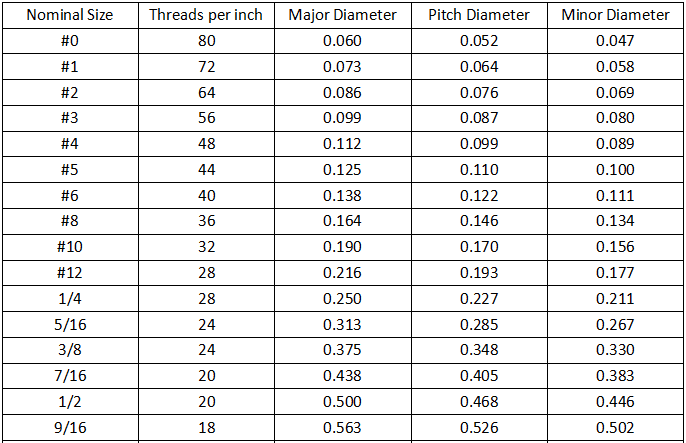
Coarse threads resist cross-threading during assembly and are faster to run down. Fine threads offer higher tensile load capacity per unit of thread engagement and better vibration resistance due to a lower helix angle. For steel fasteners threading into steel tapped holes, an engagement length of 1–1.5 times the nominal bolt diameter suffices to develop the full bolt tensile load before thread stripping.
In aluminum or softer host materials, increase engagement to at least 2 times the diameter or install a threaded insert. Engagement shorter than the guidelines moves the failure mode from bolt fracture to thread stripping.
Preload and torque
Approximately 45% of applied installation torque overcomes thread friction, and roughly 40% overcomes the friction at the nut bearing face. Only 10–15% of the total torque actually stretches the bolt and generates the clamping preload that the joint depends on. This means that surface coating and lubrication must be defined at the design stage, not left to the assembly team.
Specifying a dry, uncoated bolt when the design assumes a lubricated condition can cut preload in half at the same applied torque. For safety-critical joints, torque-angle methods or direct tension indication washers provide more reliable preload verification than torque wrench readings alone.
Coating and hydrogen embrittlement risk
Electroplated zinc on alloy steel fasteners with tensile strengths above 1,000 MPa carries a hydrogen embrittlement risk. The steel absorbs atomic hydrogen during the acid pickling step before plating. If post-plating bake-out isn’t executed correctly, the hydrogen remains trapped and can cause delayed brittle fracture under load.
The RCSC specification prohibits hot-dip galvanizing on A490 bolts for the same reason. For high-strength alloy steel applications requiring a zinc-based protective coating, mechanical zinc deposition or Geomet coatings avoid the pickling step entirely and carry no embrittlement risk.
Stainless steel fasteners are inherently passive in most environments, but A2-grade stainless can suffer crevice corrosion in chloride-rich conditions. Specify A4-80 or A4-100 where saltwater, bleach, or chloride process streams are present.
Why Partner with Yijin Solution for Custom High-Strength Fasteners?
Selecting the right fastener grade and material is only part of the engineering work in the global industrial fasteners’ market of today. Translating that specification into a reliable, production-ready part requires a manufacturer with the right process knowledge.
Every custom fastener project at Yijin Solution starts with a Design for Manufacturability review. Before any production decision is made, our engineers check thread form compatibility, material grade selection, coating and heat treatment sequence, and tolerance requirements against the application data you provide.
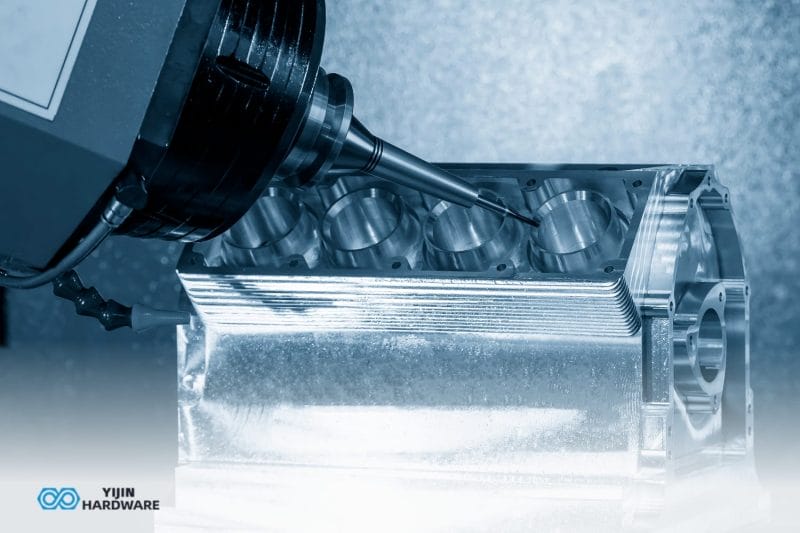
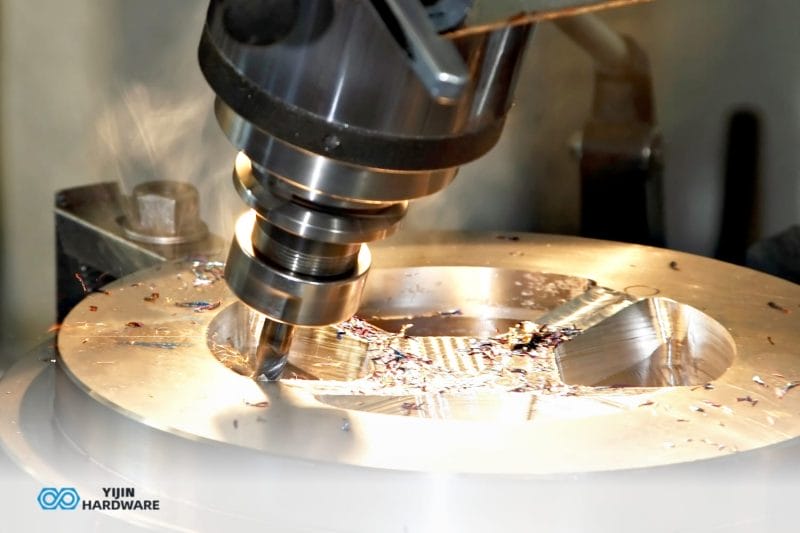
Unser custom fastener manufacturing capability covers tolerances down to ±0.02 mm on thread and shank features. Maximum specifications run to M24 diameter or 1,000 mm length, produced across our CNC lathe and Swiss-type turning centers. Upload your drawing or send your specifications today. Our engineers will review it and respond within 24 hours. Get a free DFM review and quote.
High Strength Fasteners FAQs
What is the strongest standard bolt grade available?
Class 12.9 under ISO 898-1 and SAE Grade 8 are the highest grades available in standard commercial stock. Class 12.9 carries a nominal tensile strength of 1,220 MPa. Above that threshold, specialty alloys such as MP35N exceed 2,000 MPa. However, they are not available as standard catalog items. Parts in these materials require custom manufacturing to a specific drawing and geometry.
What’s the difference between high-strength bolts and high-strength screws?
The distinction is in the joint method, not the strength level. A bolt is used with a nut to clamp two or more parts together; a screw threads directly into a tapped hole in one of the mating parts.
Both can be manufactured to the same strength grade as Class 12.9 applies equally to hex cap bolts and to socket head cap screws. Head geometry and joint configuration drive the choice. Socket head cap screws in Class 12.9 are the standard format for precision machinery where head clearance is restricted.
Are stainless steel bolts considered high-strength?
Standard A2-70 and A4-80 grades do not qualify as high-strength by structural engineering standards. A4-80 has a minimum tensile strength of 800 MPa, which is below the Class 10.9 threshold of 1,040 MPa. Cold-worked A4-100 approaches 1,000 MPa and is viable for moderate to high-strength stainless applications.
For applications requiring both high tensile strength and corrosion resistance, precipitation-hardened 17-4 PH stainless steel or duplex stainless grades deliver the combination. These are typically custom-manufactured parts, not off-the-shelf stock.
What tolerances can I expect on custom high-strength fasteners?
Our precision tolerances on custom fasteners run to ±0.02–±0.05 mm on thread and shank features, with standard tolerance at ±0.05–±0.10 mm. The achievable tolerance depends on thread form, nominal diameter, material, and feature geometry. Our maximum specification covers fasteners up to M24 in diameter or 1,000 mm in length.
How do I specify a custom high-strength fastener to a manufacturer?
A complete specification covers six inputs: thread form and pitch, nominal diameter and length, material grade and heat treatment condition, dimensional tolerances on critical features, required surface coating or finish, and certification requirements.
Certification requirements typically involve AS9100D traceability, First Article Inspection documentation, and material composition analysis. Finalizing a DFM review before locking the drawing catches thread engagement mismatches, coating conflicts, and tolerance stack-up issues before they reach the production floor.
Zurück zum Anfang: What are High Strength Fasteners? Types, Grades & How to Select the Right One