

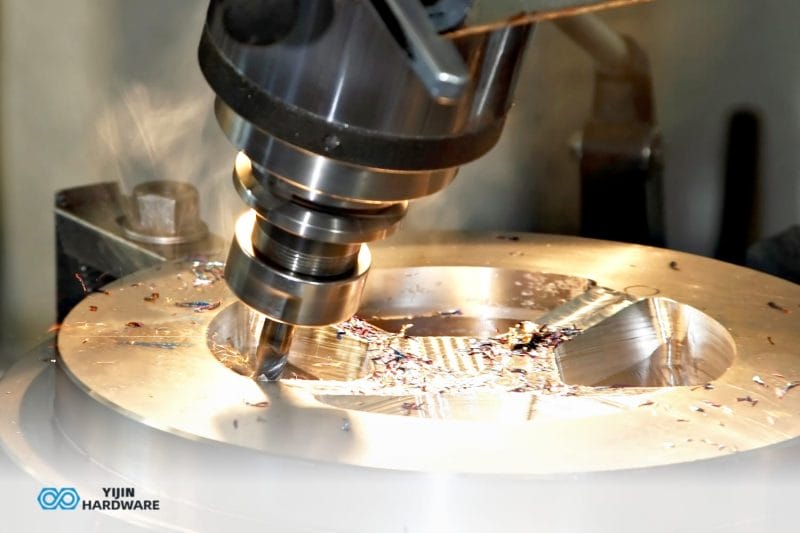


CNC routers and CNC mills both use computer-controlled cutting tools to machine parts with precision, but they are optimized for fundamentally different applications. CNC mills are made with heavy, rigid frames to handle high cutting forces in tough materials, such as steel and titanium. CNC routers, on the other hand, sacrifice some of that structural rigidity in favor of larger work envelopes, faster traverse speeds, and lower equipment costs. That makes them the best option for machining wood, plastics, composites, foam, and soft metals, like aluminum.
A CNC router is a multi-axis automated cutting machine that removes material according to programmed toolpaths. The machine essentially moves a rotating cutting tool across a workpiece at high speeds, carving complicated 2D and 3D geometries with incredible accuracy. This process is super helpful for applications that need large part dimensions, high material removal rates in softer substrates, or fast iteration during prototyping.
In this guide, our team at Yijin Solution discusses the mechanical principles of CNC routing. We explore the core components that drive performance, and establish technical boundaries that determine when routing is the right process choice. For engineers and designers choosing manufacturing methods for plastic enclosures, wooden fixtures, composite panels, or soft metal components, understanding these capabilities is cardinal to making the right process decision.
Key Takeaways
- CNC routers is a type of computer-controlled cutting machine that is commonly used to remove materials from a variety of wood composites, engineered plastics, composites, metals, foams, and softer materials.
- CNC routers are made up of a gantry and linear motion system, spindle, motors, drive system, controllers, and bed system.
- CNC routers are the optimal choice if you produce signage, cabinetry, or flat-pack furniture. Any manufacturing project that requires nesting is ideal for a CNC router.
So What Is a CNC Router?
A CNC router is a computer-controlled cutting machine that removes material from wood, plastics, composites, foam, and softer metals through high-speed rotary cutting. “CNC” stands for Computer Numerical Control—basically meaning the machine follows digital instructions (defined in G-code or other CAM-generated programs), eliminating operator variability and ensuring dimensional consistency across production runs.
High Speed, Low-Torque Architecture
The main difference between CNC routers and CNC mills lies in their spindle characteristics. CNC routers operate at high rotational speeds, which are usually 18,000 to 24,000 RPM or higher, with relatively low torque output. This makes them best for shearing through softer materials quickly and cleanly. CNC mills run at lower speeds, often 3,000 to 8,000 RPM, but deliver much higher torque. This means they are able to handle the cutting forces required for harder metals, like steel or tool steel. This speed-versus-torque trade-off directly influences material compatibility. Routers work well with materials that need fast material removal rather than heavy chip loads.
While CNC routers are optimized for non-metallic substrates, appropriately specified machines with rigid construction and enough spindle power can properly machine aluminum brass, aluminum, and other soft metals. This is mainly for applications where production colume justifies tooling investment.
Nesting & Material Efficiency
One of the biggest advantages of CNC Routing in production environments is the ability to nest multiple parts on standard sheet stock. CAM lets engineers arrange components on a 4’x8’ sheet (or other standard dimensions) to maximize material yield, minimize waste, and reduce per-part material costs. This is helpful when fabricating plastic enclosures, wooden panels, or foam inserts where material costs represent a huge portion of total part cost.
Application Range
CNC routers handle both high-volume repetitive cutting and complex, intricate geometries with equal efficiency. Some common applications include architectural millwork, plastic and composite fabrication, prototyping for product development, tooling and fixture construction, and precision components for assembly operations. Once a toolpath is programmed and validated, the router executes it with consistent accuracy across hundreds or even thousands of cycles. This gets rid of the dimensional drift that happens in manual processes.
How does a CNC Router Work?
A CNC router operates by executing G-code instructions—a standardized programming language that defines toolpaths, feed rates, spindle speeds, and tool changes. The machine’s controller interprets these commands and coordinates motion across multiple axes while managing spindle operation and auxiliary functions.
Motion System & Axis Configuration
Most CNC routers use a standard three-axis system. The X-axis handles side-to-side movement. The Y-axis controls front-to-back travel. The Z-axis manages the vertical cutting depth.
A high-speed spindle holds the cutting tool. This tool is usually a rotating end mill or a router bit. It moves along these three axes to cut away material at specific points.
Some setups are more advanced. A 4-axis system adds rotation around the X-axis. A 5-axis system adds two more rotational axes at the same time. These extra axes allow you to cut complex 3D shapes and undercuts. You can finish the entire job without manually repositioning the part.
Chip Load & Thermal Management
Chip load is the exact amount of material removed by each cutting edge during one full spin. You must optimize this amount for every single type of material. Wrong feed rates will quickly cause heat damage. Moving too slowly through plastics like acrylic creates heavy friction. This excess heat melts the plastic and ruins the cut edges. Wood requires equal care because poor chip removal leaves dark char marks on your workpiece. You need to carefully balance your feed rate, spindle speed, and cutting depth. A proper balance maintains the perfect chip load and stops the tool from just rubbing against the material.
Workholding: Vacuum Table Systems
Unlike CNC mills that use mechanical vises, CNC routers use vacuum tables as the main workholding method. A vacuum pump creates negative pressure through a porous spoilboard, securing thin sheet materials without clamps. This allows for full-sheet nesting for maximum material efficiency. It also stops toolpath interference from fixtures and allows for rapid part loading. Vacuum force scales with surface area, making is best for sheet goods, but unsuitable for small parts.
Gantry Rigidity & Surface Finish
CNC routers use a moving gantry design where the spindle traverses the machine length. Insufficient gantry rigidity causes tool deflection under cutting forces, producing chatter marks; repetitive surface waves perpendicular to the cutting direction. For applications that need tolerances of ±0.005” or mirror finishes, gantry stiffness (determined by rail diameter, linear guide quality, and frame construction) becomes an extremely important specification.
What Materials Can Be Cut On a CNC Router?
CNC routers are versatile machines used across multiple industries. They are optimized for materials that allow high-speed cutting without excessive tool wear or requiring heavy cutting forces. Material selection depends on spindle power, tooling, and thermal management capabilities.
Engineered Plastics
- Acrylic (PMMA): Requires sharp tools and optimized feed rates to prevent edge melting and crazing
- Polycarbonate (PC): Tougher than acrylic but prone to chip buildup; benefits from climb milling strategies
- Acetal (POM/Delrin): Low-friction material with excellent dimensional stability; machines cleanly with minimal burring
- PEEK: High-performance thermoplastic requiring rigid setups and carbide tooling due to its toughness
- Wood: Widely used in the woodworking industry for cabinetry, furniture, and intricate designs.
- Plastic: CNC routers can cut and shape plastics like acrylic, PVC, and polyethylene, making them ideal for signage and display products.
Wood/Wood Composites
- Hardwoods (maple, oak, walnut), softwoods (pine, cedar), MDF, plywood, and particleboard
- Engineered wood products, like Baltic birch and phenolic-backed plywood for tooling uses
Soft Metals
- Aluminum 6061-T6: Most common CNC router aluminum alloy; good machinability and weldability
- Aluminum 7075: Higher strength but more challenging to machine; requires flood coolant or mist systems
- Brass: Free-machining alloys (C360) cut cleanly; requires lower spindle speeds than aluminum
- Copper: Soft and gummy; prone to built-up edge on cutting tools
Composite Materials
- Carbon fiber sheet: Requires diamond-coated or carbide tooling; generates abrasive dust requiring proper extraction.
- Fiberglass (G19/FR4): Common for electrical insulation components; highly abrasive to cutting tools
CNC routers handle these materials efficiently when machining parameters are matched to substrate properties. Metals typically require flood coolant, mist lubrication, or compressed air for chip evacuation and thermal control.
What are the Key Components of a CNC Router?

CNC routers consist of several core components, each playing a role in the machine’s precision and functionality.
Gantry and Linear Motion System
The gantry holds the spindle assembly and moves across the X and Y axes. The stiffness of this gantry directly controls your overall cut quality. A weak frame will bend under heavy cutting pressure. This unwanted movement creates vibrations and ruins the surface finish of your parts. Industrial machines solve this problem by using reinforced steel or thick aluminum frames. These strong frames glide smoothly on precise linear guide rails.
Spindle: Air-Cooled vs. Water-Cooled
The spindle is the motorized cutting head that rotates the tool at high speeds (typically 18,000–24,000 RPM). Two cooling configurations are standard:
- Air-Cooled Spindles: Use integral fans to dissipate heat. Suitable for intermittent duty cycles and lighter production. Lower cost but noisier and less effective for sustained high-load operation.
- Water-Cooled Spindles: Circulate coolant through internal passages for superior thermal management. Required for continuous production runs, aluminum machining, and applications demanding consistent dimensional accuracy. Quieter operation but requires chiller/pump systems.
Controller
The controller processes G-code and coordinates movement of the router’s axes, spindle speed, and auxiliary functions (coolant, vacuum table, tool changes). It ensures the cutting tool follows the programmed toolpath with precise timing. Industrial controllers support look-ahead processing to maintain smooth motion through complex geometries.
Motors: Servo vs. Stepper
Motors control movement along the X, Y, and Z axes, enabling the router to execute complex designs with precision.
- Servo Motors: Standard on industrial machines, providing closed-loop position feedback and the ability to recover from missed steps under heavy cutting loads.
- Stepper Motors: Found on entry-level machines; lack position feedback and can lose steps when cutting forces exceed motor torque capacity.
Drive System: Rack and Pinion
Large routers use helical rack and pinion systems to drive motion on the X and Y axes. These angled gears provide a smooth and continuous connection. This precise design greatly reduces loose movement or backlash. It allows the machine to travel very fast across long distances. Traverse speeds can easily exceed 2000 inches per minute. Fast travel is absolutely essential for overall shop productivity. It helps operators process full standard material sheets much faster.
Table/Bed
The bed supports the workpiece and is typically integrated with the vacuum plenum for workholding. Some machines feature a moving table design, while others use a stationary table with a moving gantry. T-slot tables allow mechanical clamping when vacuum holding is unsuitable for small parts or irregular shapes.
What are the Advantages of CNC Routers?
There are several benefits to using a CNC router over traditional, manual methods:
- Cost Efficiency: For large surface area parts, CNC routers offer a much lower cost per part than CNC mills due to larger work envelopes and faster remocal rates in soft materials
- Repeatability: CNC routers bring consistent repeatability in batch production, often keeping tolerances of ±0/1mm (±0/004”)
- Automation: Once programmed, a CNC router can operate without human intervention, reducing labor costs and allowing for longer production runs.
- Flexibility: CNC routers can work with a wide range of materials, and their tools can be swapped out to accommodate different tasks.
These benefits make CNC routers an excellent choice for both hobbyists and industrial manufacturers looking to improve productivity and reduce costs.
CNC Router vs. CNC Mill: What’s the Difference?
Both CNC routers and CNC mills are used to cut materials, but there are some key differences between the two:
| Feature | CNC Router | CNC Mill |
|---|---|---|
| Work Envelope | Large (often 4’x8′ or larger). Designed for sheet goods. | Compact. Designed for thick, heavy blocks of material. |
| Spindle Speed | High (10k – 24k RPM). High speed is needed for clean cuts in wood/plastic. | Low to Mid (up to 12k RPM). High torque is needed to “plow” through steel. |
| Material Specialty | Wood, Acrylic, Foam, Soft Aluminum. | Steel, Titanium, Inconel, Hard Alloys. |
| Axis Rigidity | Lighter gantry for fast movement across large areas. | Heavy, cast-iron construction to withstand massive cutting forces. |
| Accuracy | Generally ±0.05mm to ±0.1mm. | Ultra-precise, often reaching ±0.005mm. |
How to Choose Between a CNC Router and CNC Mill?
- Choose a CNC Router if: You are producing signage, cabinetry, or flat-pack furniture. It’s great at nesting. Nesting cuts many shapes from one large sheet. This smart layout leaves very little scrap. You waste less material. You save more money on raw boards.
- Choose a CNC Mill if: You are manufacturing engine components, molds, or medical implants that require extreme precision and the ability to cut through hardened metals 24/7.
CNC Router Applications Across Industries

CNC routers are used in a variety of industries, providing valuable solutions for a wide range of applications.
Electronics Manufacturing
- Plastic enclosures for instrumentation and control panels
- PCB drilling and routing for prototype circuit boards
- G10/FR4 fiberglass insulation boards for electrical components
Aerospace
- Trimming aluminum honeycomb panels for aircraft interior structures
- Machining lightweight aluminum components (6061/7075) for non-structural applications
- Composite layup tooling and forming molds from MDF or foam
Automotive
- Interior automotive component prototypes (dashboard panels, trim pieces, console assemblies)
- Foam and composite tooling for low-volume production
- Acrylic and polycarbonate light covers and lens prototypes
Industrial Fabrication
- Custom fixtures and jigs from phenolic plywood or aluminum plate
- Large-format plastic components for machinery guards and covers
- Signage and wayfinding systems for commercial facilities
Prototyping & Product Development
CNC routers enable rapid iteration during design validation, allowing engineers to test fit, form, and function before committing to injection molding or metal stamping tooling.
For large surface area parts such as sheet panels or enclosures, CNC routers offer significantly lower cost per part than CNC mills due to larger work envelopes and faster material removal rates in soft materials. CNC routers deliver consistent repeatability in batch production and prototyping, typically maintaining tolerances of ±0.1mm (±0.004″) across hundreds of identical parts once toolpaths are validated.
Start Your CNC Routing Project with Yijin Solution
At Yijin Solution, we use industrial-grade CNC routers for projects that require speed and efficiency. We handle the programming, tooling, and quality control to deliver parts that match your specifications.
Don’t guess which process you need. Upload your CAD files (.STEP, .DXF), and our engineers will review the geometry. We will confirm if CNC routing is the most economical method or if your part requires the heavy-duty precision of a CNC mill.
FAQs on What is a CNC Router?
How accurate is a CNC router compared to other CNC machines?
CNC routers typically achieve tolerances between ±0.05 mm and ±0.1 mm. This is suitable for woodworking, plastics, and large-format parts. CNC mills offer higher precision for tight-tolerance metal components.
What software is used to operate a CNC router?
Popular software includes Fusion 360, VCarve, and Mastercam for CNC router operations. CNC routers use CAD software for design and CAM software to generate toolpaths, and these toolpaths are converted into G-code instructions for the machine.
What industries benefit most from CNC routers?
Industries like woodworking, signage, furniture, and plastics manufacturing benefit significantly. CNC routers are ideal for large panels, custom designs, and rapid prototyping. They are also widely used in education and small-scale production environments.
Back to Top: What Is a CNC Router? Definition and How It Works






 English
  Spanish
  German
  French