

Careers in CNC machining offer stable, well-paying opportunities across multiple industries for technically-minded individuals. Computer numerical control (CNC) technology uses computerized systems to precisely cut and shape materials, creating essential components for everything from medical devices to aerospace technology. This guide explores the pathways and employment opportunities in this growing field.
Key Takeaways
- CNC machining careers span from entry-level operators to advanced CNC programmers, with median salaries starting around $48,550
- Entry requires technical training through specialized programs (typically 36 weeks) or apprenticeships
- Essential skills include CAD/CAM software knowledge, blueprint reading, and precise measurement techniques
- Career growth paths lead to programming, engineering, and management positions
- High demand for talented CNC machinists exists across aerospace, automotive, medical, and defense industries
What is CNC Machining?
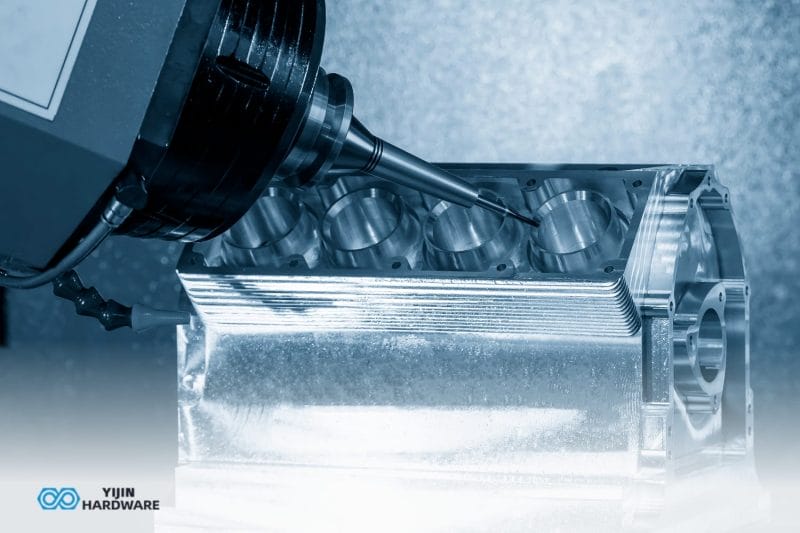
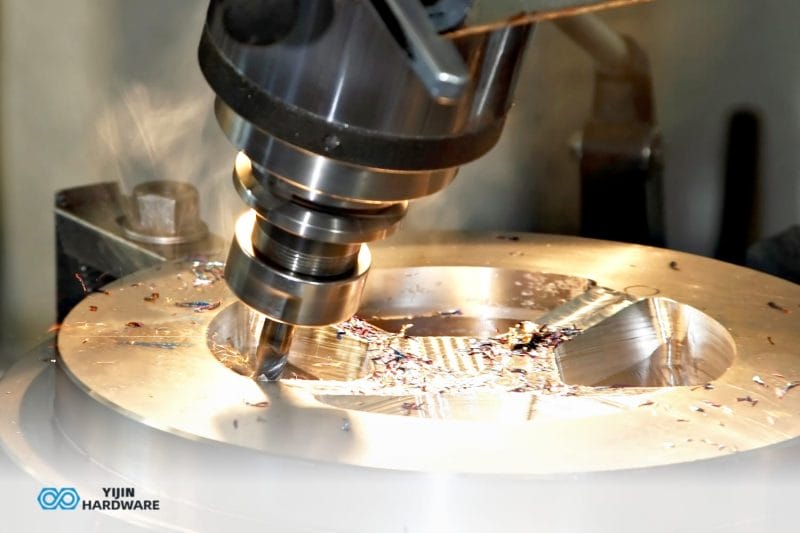
CNC machining is a manufacturing process that uses computer-controlled machines to precisely cut and shape materials. Computer numerical control technology translates design files into specific instructions (G-code and M-code) that guide automated tools to cut materials with tolerances as tight as ±0.0001 inches. This advanced manufacturing method enables complex, repeatable operations impossible with manual machine operation techniques.
| Machine Type | Primary Function | Common Applications |
|---|---|---|
| CNC Mills | Cut materials using rotating tools | Complex parts, prototype creation |
| CNC Lathes | Shape materials while they rotate | Cylindrical components, precision parts |
| Plasma Cutters | Cut using a plasma torch | Metal sheet cutting, industrial fabrication |
| EDM Machines | Remove material using electrical discharges | Complex geometries, hardened materials |
Why Choose a CNC Machining Career?
Careers in CNC machining offer exceptional stability and growth potential. The manufacturing industry continues to experience high demand for skilled CNC professionals, with the global CNC machine market valued at $56 billion in 2021. According to Career Explorer, there are around 327,000 machinists in the U.S.
- Technological engagement: Work with multi-axis machines and CAD/CAM systems
- Career stability: Essential manufacturing role with consistent demand
- Impact on safety: Components you machine may directly contribute to submarine sonar systems or medical device reliability
Unlike many technical careers, CNC machining provides opportunities without requiring a four-year degree, offering a reliable 9-to-5 job with attractive permanent job prospects.
CNC Machining Career Types & Salary Guide
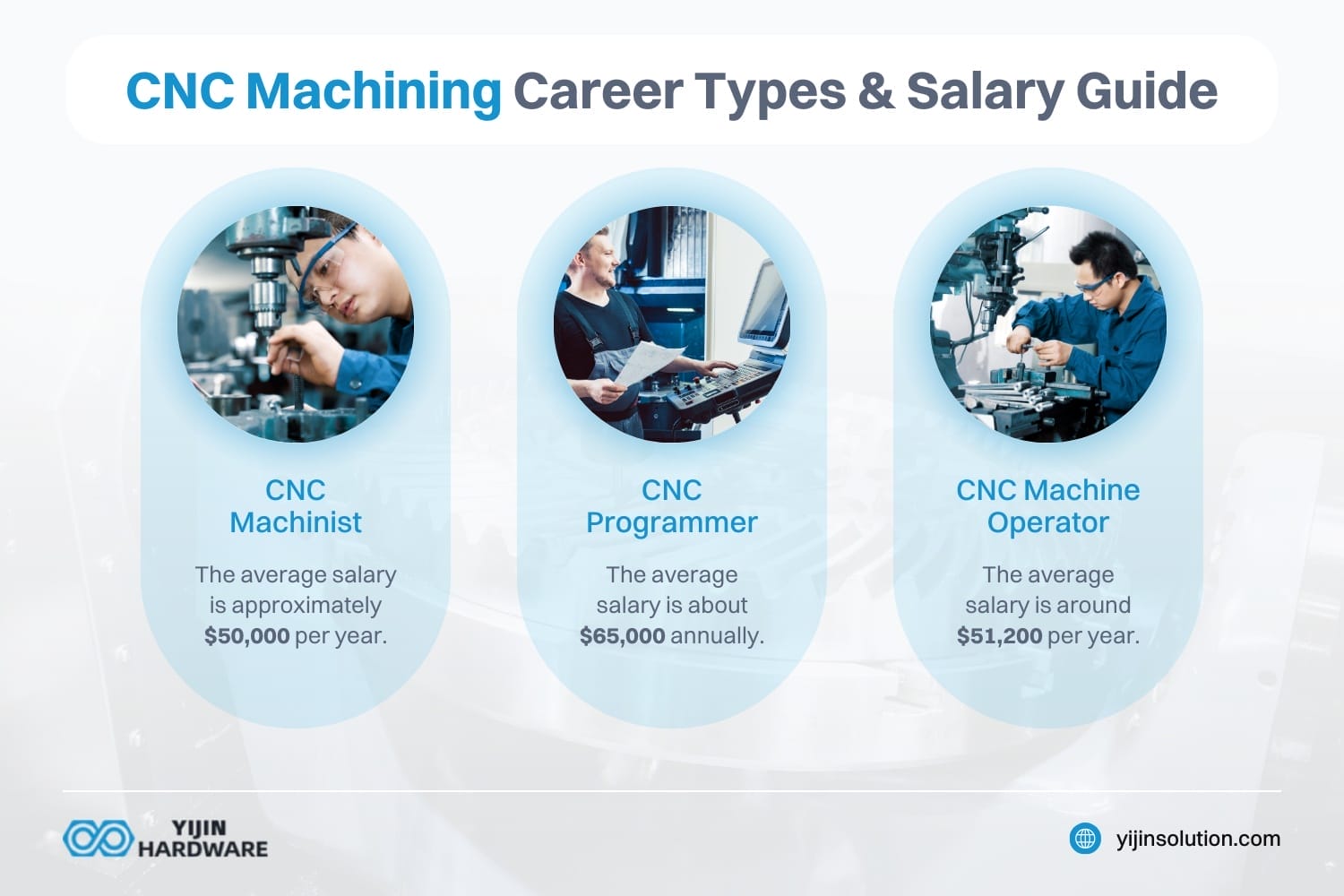
CNC machining career types range from entry-level operator positions to advanced programming and engineering roles, with varying salary ranges. The career path typically begins with machine operation, where technicians run CNC equipment and monitor production.
Career Progression Pathway
| Career Level | Typical Roles | Required Skills | Average Salary |
|---|---|---|---|
| Entry-Level | CNC Operator, Inspector, Apprentice | Basic operation, measurement, and safety | $35,000-$45,000 |
| Mid-Level | Setup Technician, CNC Setup Operator, Quality Control | G-code, CAM software, GD&T | $45,000-$60,000 |
| Advanced | Design Engineer, Field Tech, Applications Specialist | Advanced programming, troubleshooting | $65,000-$80,000 |
| Leadership | Shop Manager, Production Manager, Owner | Technical expertise plus business/management skills | $80,000-$100,000+ |
Specialized Career Paths
- Defense & Submarine Manufacturing: Create components with extreme precision for underwater vessels
- Aerospace CNC Specialist: Machine components from exotic alloys for aircraft and spacecraft
- Medical Device Machinist: Produce implantable devices and surgical instruments
What Skills do you Need for a CNC Machining Career?
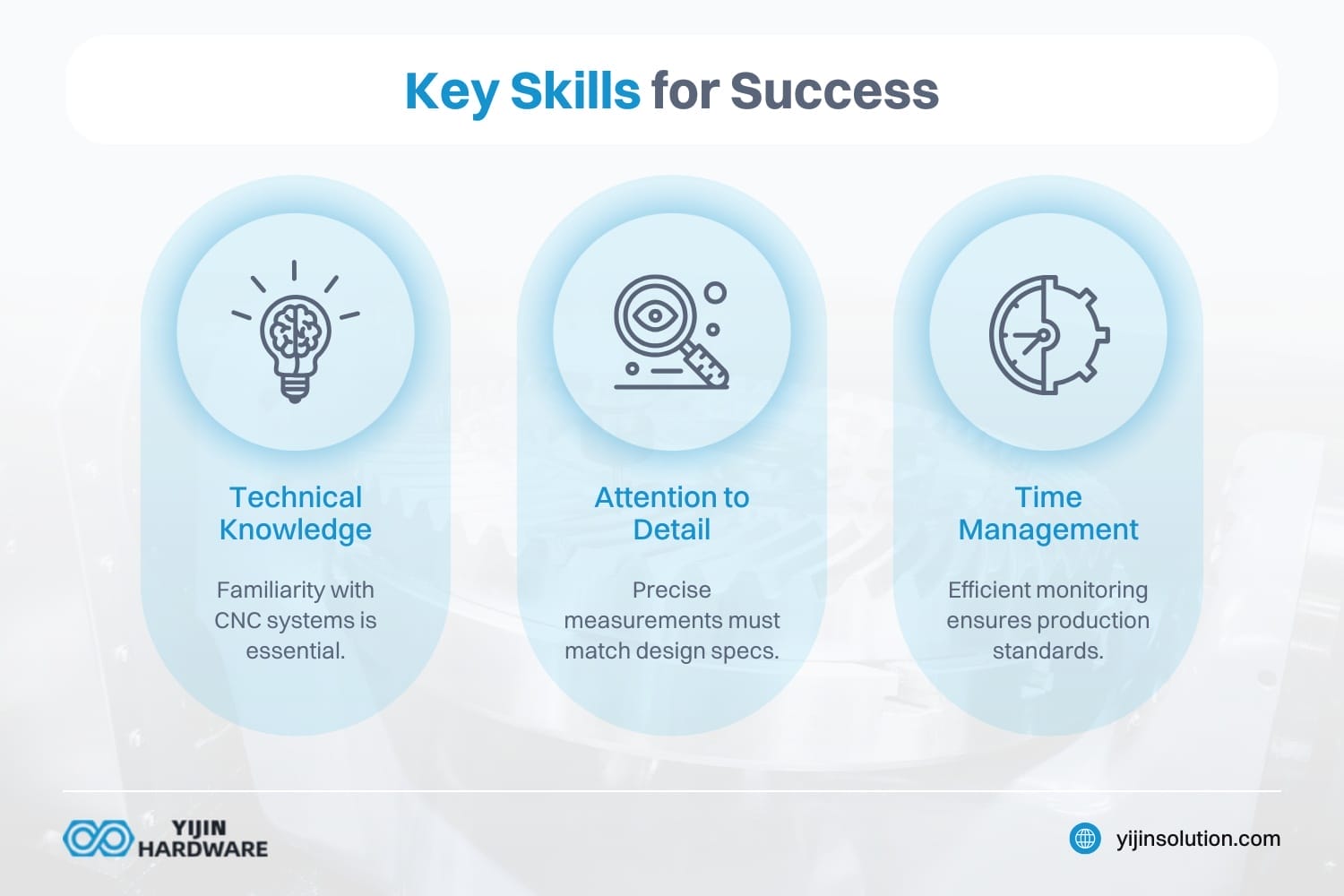
CNC machining careers require a blend of technical knowledge, mathematical precision, and practical abilities. Mathematical skills form the foundation of CNC work, particularly trigonometry for calculating tool paths and dimensional relationships. A CNC machinist must develop proficiency with CAD/CAM software that enables professionals to convert 3D models into optimized G-code instructions that control machine operations with micron-level precision.
Technical Skill Requirements
- Mathematics: Trigonometry, coordinate geometry, and dimensional calculations
- Software Proficiency: CAD programs (SolidWorks, AutoCAD) and CAM software (Mastercam, Fusion 360)
- G-Code Knowledge: Understanding programming commands (G01 for linear movement, G02/G03 for circular)
- Metrology Skills: Using CMMs, micrometers, and other precision measurement instruments
- Material Science: Understanding the machinability of various metals, plastics, and composite materials
Essential Technical Competencies
| Skill Area | Basic Level | Advanced Level |
|---|---|---|
| Programming | Basic G-code editing | Custom macro programming, CAM optimization |
| Measurement | Micrometer/caliper use | CMM programming, GD&T interpretation |
| Tooling | Standard tool selection | Custom tool design, tool path optimization |
| Problem-Solving | Basic troubleshooting | Complex issue diagnosis, preventive solutions |
| Machine Knowledge | Single-machine operation | Multi-axis setup, advanced parameter control |
The physical aspects include standing for long periods, occasional lifting of materials, and maintaining focus in manufacturing environments with multiple sensory inputs. Operating CNC machines requires an eye for detail and the ability to make necessary adjustments when performing routine maintenance. Modern CNC professionals also need adaptability to keep pace with rapid technological changes in the field.
What is the Average Salary for a CNC Machinist?
The average salary of a CNC machinist varies based on experience, specialization, and location. According to the Bureau of Labor Statistics, the median annual salary for CNC operators in the United States was $48,550 as of May 2023.
| Position | Experience Level | Typical Salary Range |
|---|---|---|
| CNC Operator | Entry (0-2 years) | $35,000-$45,000 |
| Setup Technician | Mid (2-5 years) | $45,000-$60,000 |
| CNC Programmer | Advanced (5+ years) | $65,000-$80,000 |
Using a Randstad salary checker can provide location-specific information. Several factors affect salary, including the highest paying cities for CNC machinists and additional responsibilities.
How do you Become a CNC Machinist?
CNC machinists enter the field through specialized technical training programs, apprenticeships, or structured on-the-job training. Dedicated CNC machinist training programs typically range from 36 weeks to 2 years, covering blueprint reading, geometric dimensioning, and hands-on machine operation.
Most successful professionals begin with a high school diploma before specializing in CNC technology through a training program. New skills in CNC equipment programming can lead to a higher starting salary.
What does a Day in the Life of a CNC Machinist Look Like?
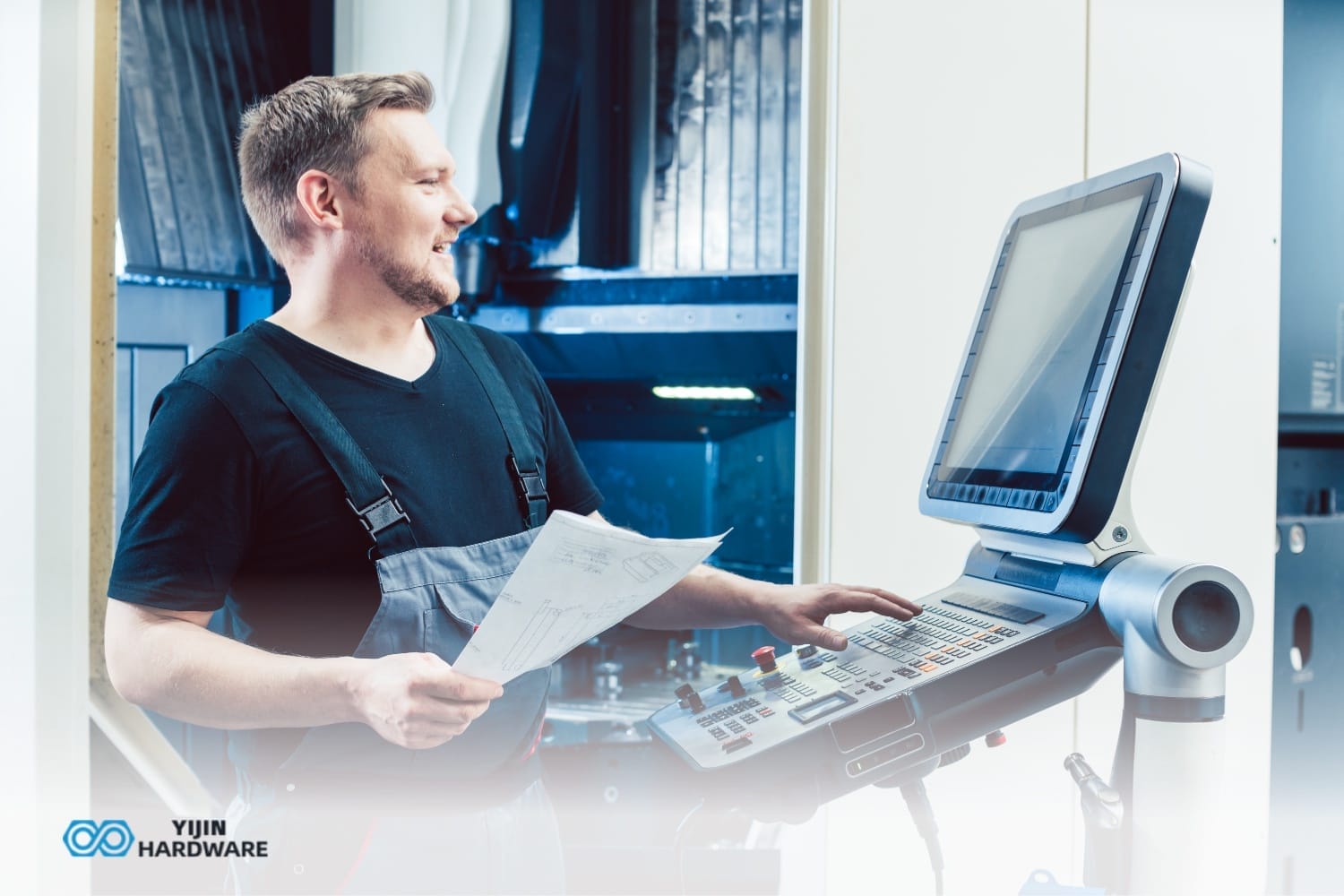
CNC machinists spend their workdays operating CNC machines to transform raw materials into precision components. A typical shift begins with reviewing technical drawings and production schedules. Machinists must then prepare machines by loading materials, mounting tools, setting work coordinates, and initializing control programs. Working as a CNC machinist involves:
Morning Setup
- Review engineering drawings and production schedules
- Perform machine warmup and reference positioning
- Mount tooling with appropriate holders and offsets
- Set up tools and secure raw materials
Production Operations
- Monitor the CNC machine’s operation and tool performance
- Perform first article inspection with precision instruments
- Make necessary adjustments to maintain dimensional specifications
- Troubleshoot programming or tooling issues
The work environment combines the precision of a technical lab with the productivity focus of manufacturing. Spending your shift maintaining machine functionality and ensuring precise measurements directly contributes to success in this role.
Which Industries Hire CNC Machinists?
CNC machinist jobs are available across numerous industries requiring precision-manufactured components. Employment opportunities exist in:
| Industry | Critical Components | Material Challenges |
|---|---|---|
| Defense/Naval | Submarine sonar systems, hull components | Corrosion-resistant alloys |
| Aerospace | Turbine blades, structural components | Titanium alloys, Inconel |
| Medical | Implantable devices, surgical instruments | Biocompatible titanium |
| Automotive | Precision engine components | Hardened steels, aluminum alloys |
How is the CNC Machining Field Evolving?
CNC technology is evolving rapidly through the integration of advanced technologies and smart manufacturing principles. The industry is transitioning to hybrid manufacturing systems that combine traditional subtractive machining with additive capabilities (3D printing) within a single machine setup. This evolution enables components with internal features and complex geometries previously impossible to manufacture, dramatically expanding design possibilities and requiring machinists to stay updated with new skills.
Cutting-Edge Technological Developments
- Hybrid Manufacturing: Machines that both add and remove material in a single setup
- Extreme Multi-Axis Capabilities: 7+ axis machines creating complex components in one operation
- Lights-Out Manufacturing: Fully automated systems that run unattended for extended periods
- AI-Powered Adaptive Control: Systems that adjust cutting parameters in real-time based on material conditions
- Digital Twin Integration: Virtual testing of machining operations before physical production
Impact on CNC Career Skills
| Technology Trend | Required Skill Development | Career Opportunity |
|---|---|---|
| Automation/Robotics | Robot programming, automation sequencing | CNC Automation Specialist |
| AI/Machine Learning | Data interpretation, parameter optimization | Process Optimization Engineer |
| Digital Manufacturing | CAD/CAM/CAE software proficiency | Digital Manufacturing Technician |
| Multi-Axis Machining | Complex toolpath programming, 3D modeling | Multi-Axis Programming Specialist |
| Metrology Integration | Advanced measurement, in-process verification | Quality Integration Technician |
The evolution toward “smart machining” connects CNC equipment with broader factory systems through IoT protocols that enable real-time monitoring and predictive maintenance. Machinists must develop their career skills through continuous learning. CNC machining could be the ideal career path for technically-minded individuals who enjoy combining programming with hands-on work.
What are the Advantages and Challenges of CNC Machining Careers?
CNC machining careers provide exceptional technical engagement and stability while presenting specific challenges that require adaptation. The primary advantage is outstanding job security, with the global CNC market projected to reach 2.8 million machine units by 2030. This field offers advancement based on skill level rather than academic credentials, creating opportunities for technically-minded individuals to progress rapidly through open positions and develop related jobs.
Career Advantages
Career advantages for CNC machinists, besides the large demand for CNC machinists, include clear advancement, hands-on work, problem-solving opportunities, and more.
Technical Advantages
- Hands-on work with cutting-edge manufacturing technology
- Visible results as designs transform into precision components
- Continuous learning as technology and techniques evolve
- Direct impact on critical products that affect people’s lives
- Problem-solving opportunities that engage technical creativity
Practical Advantages
- Stable employment resistant to economic fluctuations
- Clear advancement pathways based on demonstrated skills
- Transferable expertise applicable across manufacturing sectors
- Competitive compensation without extensive student debt
- Opportunity to work on projects with national significance (defense, medical)
Career Considerations
Career considerations to keep in mind include both the physical aspects and the professional requirements
Physical Aspects
- Standing for long periods in manufacturing environments
- Precise hand coordination for setup and measurement tasks
- Eye strain from detailed inspection and monitoring activities
- Hearing protection requirements in production environments
- Potential exposure to cutting fluids and materials
Professional Requirements
- Continuous skill updates to match evolving technology
- Precision focus and attention to microscopic details
- Potential shift work in facilities operating 24/7
- Adaptation to changing manufacturing methods
- Responsibility for expensive materials and equipment
The ideal candidate enjoys technical problem-solving and takes pride in creating precision components that enable advanced technology to function.
Yijin Solution: Leading CNC Machinists
CNC machining careers offer exceptional opportunities for technically-minded individuals seeking stable, rewarding work with clear advancement potential. The manufacturing process combines cutting-edge technology with tangible results, creating components essential for industries ranging from defense and aerospace to medical and automotive manufacturing. With appropriate training and skill development, CNC professionals can advance from entry-level positions to specialized roles.
The continued evolution of CNC technology through automation, multi-axis capabilities, and smart manufacturing principles ensures this career path will remain relevant and in demand. Contact Yijin Solution to learn more about our CNC machining services.
CNC Machining Careers FAQs
Is CNC machining a good career for someone without a college degree?
CNC machining is an excellent career path for those without four-year degrees. Technical training programs provide the necessary skills without requiring extensive academic credentials. Understanding machine tools and operating CNC machines can be learned through formal education or structured apprenticeships.
How long does it take to become a CNC programmer?
Becoming a CNC programmer typically takes 2 to 5 years, combining initial technical training with hands-on experience. Most programmers begin as machine operators, gaining practical experience with G-code and machine behavior before transitioning to programming roles. To prepare the program effectively, you’ll need to test the program and make necessary adjustments.
What’s the difference between a CNC operator and a CNC programmer?
CNC operators run pre-programmed machines, monitor production, and make minor offset adjustments to maintain part quality. CNC programmers create the G-code that controls machine movements, develop complex toolpaths, and optimize cutting strategies based on material properties and part geometry. The CNC machinist role often falls between these positions, with responsibilities for both operation and programming tasks.
Can CNC machining skills transfer to submarine and defense manufacturing?
CNC machining skills transfer directly to submarine and defense manufacturing, where precision components are critical for national security. The specialized skills in exotic material machining and ultra-precise tolerances are highly valued in naval defense manufacturing. The manufacturing industry particularly values machinists with experience in military specifications.
Is working from home possible in CNC machining careers?
Working from home is generally not possible for CNC machine operators, who must spend long periods physically operating equipment. However, some related jobs within the field offer remote possibilities, particularly for CNC programmers who develop toolpaths. The manufacturing process requires physical presence for machine monitoring.
Back to Top: CNC Machining Careers






 English
  Spanish
  German
  French