






Aerospace machining creates precision components for aircraft, spacecraft, and flight vehicles that meet the industry’s rigorous demands. This specialized field combines advanced CNC techniques with strict quality standards to produce parts that perform flawlessly under extreme conditions.
At Yijin Solution, we offer 15 years of aerospace machining expertise, delivering components that major aerospace companies like Boeing and Honeywell Aerospace rely on for their manufacturing processes.
Key Takeaways
- Aerospace machining achieves tolerances within 0.0001 inches (2.54 micrometers), far exceeding standard precision machining requirements.
- AS9100 certification is mandatory for aerospace manufacturers, with 105 requirements beyond ISO 9001:2015 quality standards.
- 5-axis CNC machining creates complex aerospace geometries with 40% fewer setups than conventional 3-axis processes.
- Specialized materials like titanium alloys and superalloys require specific machining techniques for aerospace applications.
- Complete traceability and documentation are essential for all aerospace components and aircraft parts.
What is Aerospace Machining?
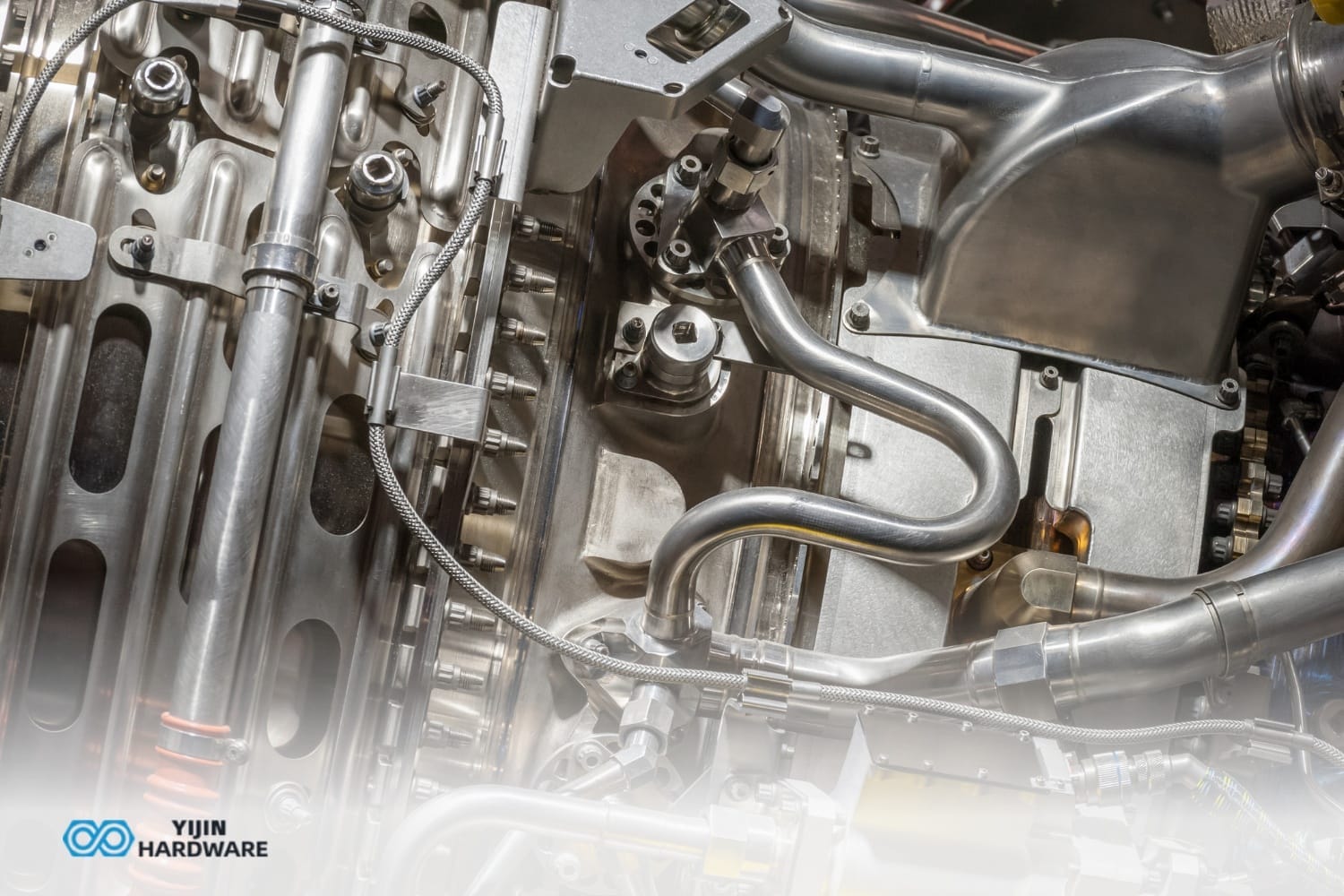
Aerospace machining creates vital components for commercial and military aircraft using advanced precision techniques that ensure reliability and safety. Aircraft parts must maintain structural integrity under extreme conditions while minimizing weight to improve fuel efficiency. The aerospace industry requires this specialized approach because precision directly impacts flight safety, operational performance, and the aircraft’s overall lifespan. According to Boeing’s engineering standards, aerospace components typically operate under temperature variations of -65°F to +350°F (-54 °C to +177 °C).
Aerospace machining represents a critical manufacturing process in aviation safety. Modern aircraft contain between 2 and 3 million precision-machined parts, each requiring rigorous quality control. The global aerospace industry, valued at over $838 billion in 2023 according to Teal Group, depends on these specialized manufacturing techniques to maintain its exceptional safety record of just 0.2 fatal accidents per million flights.
How Does Aerospace Machining Differ From Standard Machining?
Aviation CNC machining demands significantly tighter tolerances than standard industrial machining processes. While standard machine shops typically work with tolerances of ±0.005 inches, aerospace precision machining consistently achieves tolerances of ±0.0001 inches or better through specialized CNC machining techniques.
Components manufactured for the aerospace industry must perform perfectly in extreme environments not encountered elsewhere, including high temperatures reaching 2000°F (1093°C) and pressure variations from 0.2 atm to 1.2 atm during flight. At Yijin Solution, our CNC machining China operations specialize in meeting these demanding aerospace standards. Several key factors separate aerospace CNC machining from conventional manufacturing methods:
| Factor | Standard Machining | Aerospace Machining |
|---|---|---|
| Tolerances | ±0.005 inches | ±0.0001 inches |
| Quality Systems | ISO 9001 | AS9100/ISO 9001 |
| Material Traceability | Limited batch tracking | Complete documentation from raw material to finished part |
| Inspection Requirements | 10-15% sampling | 100% inspection for critical parts with documented results |
| Material Types | Commercial-grade alloys | Specialized aerospace-grade alloys with certification |
| Design Complexity | Moderate (3-axis typical) | Extremely complex geometries requiring 5-axis capability |
| Surface Finish | 125-250 μin Ra typical | 16-32 μin Ra or better required for aerodynamic surfaces |
The machining process for aerospace parts also optimizes material usage to reduce weight without compromising strength. This critical balance significantly improves fuel efficiency and aircraft performance, particularly in commercial and military aircraft where every gram matters. Research by Airbus Engineering shows that a 100-pound weight reduction in a commercial airliner saves approximately 14,000 gallons of fuel annually.
What Types of Machining Processes Are Used in Aerospace Manufacturing?

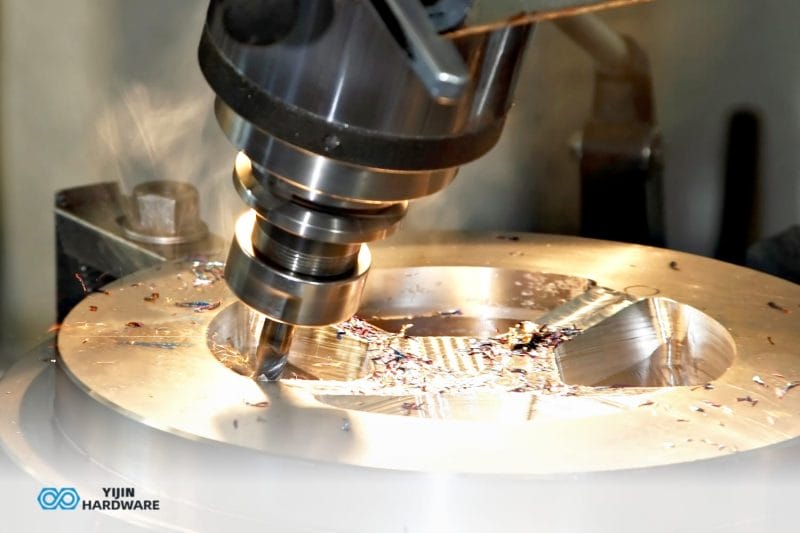
Aerospace manufacturing utilizes 5-axis CNC machining, precision CNC turning, and EDM machining to create high-precision components with tight tolerances. Horizontal machining centers add to this mix. They clear chips efficiently on deep pockets and large structural parts. CNC machining forms the foundation of modern aerospace production, with different CNC processes serving various needs within the global aerospace industry.
5-Axis CNC Machining
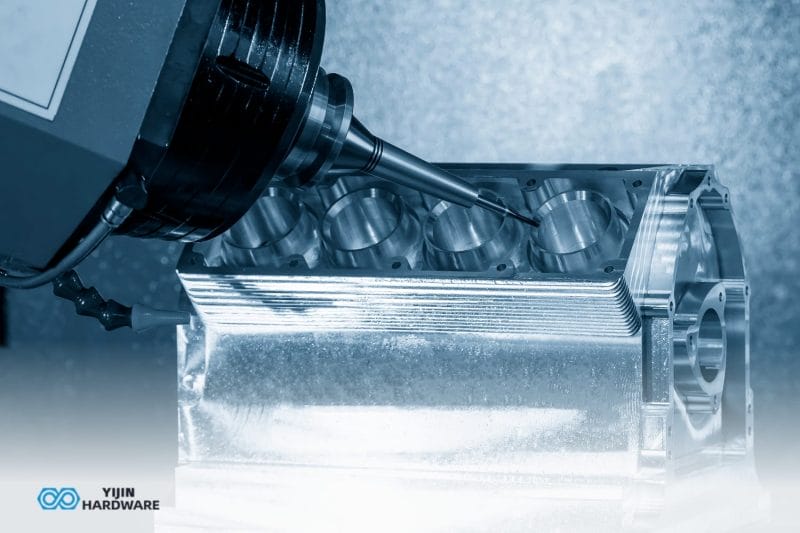
5-axis CNC machining represents the gold standard for aerospace component manufacturing and plays a crucial role in producing parts for companies like Boeing and Airbus. Unlike standard 3-axis CNC machines, 5-axis CNC machines add two rotational axes that allow complete access to the workpiece from virtually any angle during cutting operations. This enhanced capability makes it possible to create complex geometries like turbine blades with 92% less setup time compared to traditional methods.
The advantages of 5-axis machining for aerospace applications include:
- Creating complex geometries is impossible with conventional machining methods (reduces part count by up to 30%).
- Reducing setup time by completing parts in one operation instead of multiple setups (40–60% time savings).
- Improving surface finish through optimal tool positioning throughout the machining process (achieving 16 μin Ra).
- Enabling the creation of internal features and undercuts in aerospace components with wall thickness as little as 0.020 inches.
Precision CNC Turning
CNC turning processes are critical for manufacturing cylindrical aerospace components with exceptional precision and consistency. The machinist uses computer-controlled lathes to create precision parts like pins, shafts, fasteners, and cylindrical housings that must meet exact specifications. Modern CNC turning centers achieve roundness within 0.0001 inches and concentricity within 0.0002 inches — qualities that matter critically for rotating components in aircraft engines and control systems.
EDM Machining
Electrical Discharge Machining (EDM) plays a specialized role in aerospace manufacturing, particularly for complex aerospace components that can’t be created with traditional cutting tools. This advanced machining process creates extremely small features in hardened materials with remarkable efficiency. EDM uses controlled electrical discharges to erode material rather than cutting it mechanically, making it ideal for producing aerospace engineering components with intricate internal geometries and dimensional tolerances of ±0.0001 inches (2.54 micrometers).
What Materials Are Used in Aerospace Machining?
The materials used in aerospace CNC machining include aluminum alloys, titanium alloys, and superalloys. They must provide optimal performance under extreme conditions while maintaining minimal weight for fuel efficiency. Aluminum alloys dominate aerospace applications, comprising approximately 50% of aircraft structural components due to their excellent strength-to-weight ratio and superior corrosion resistance.
Titanium and its alloys follow in importance, offering exceptional heat resistance for critical engine components, while specialized superalloys handle the most extreme temperature environments in modern aircraft systems.
Aluminum Alloys
Aluminum remains the most widely used material in aircraft manufacturing, with various aluminum alloys serving different aerospace and defense applications. Their exceptional strength-to-weight ratio makes these materials ideal for both commercial and military aircraft components. The aerospace industry relies on several common aerospace-grade aluminum alloys:
- 7075-T6: Used for structural components requiring high strength in critical applications
- 2024-T3: Popular for fuselage structures and wing components that experience variable stresses
- 6061-T6: Utilized for general-purpose structural elements throughout the aircraft
Titanium Alloys
Titanium has become increasingly important in modern aerospace engineering due to its remarkable performance characteristics. This versatile metal weighs 40% less than steel while offering comparable strength, making it ideal for aerospace applications where weight reduction is crucial. Titanium exhibits excellent corrosion resistance even in aggressive environments, and its heat resistance far exceeds aluminum’s capabilities.
This is particularly important for parts near aircraft engines that experience high temperatures during operation.
Superalloys
High-performance superalloys handle extreme heat in mission-critical aerospace applications where other materials would fail. Materials like Inconel, Hastelloy, and Waspaloy withstand temperatures exceeding 2000°F without losing their mechanical properties, making them essential for the production of aerospace parts in jet engines and exhaust systems. CNC machining of these specialized materials requires expertise, as they present significant challenges during the manufacturing process compared to more conventional metals.
How Do Quality Standards Impact Aerospace Machining?
Quality standards, such as AS9100 certifications, fundamentally shape the entire aerospace machining process from material selection through final inspection. The aerospace industry requires AS9100 certification as the mandatory quality management system for all manufacturers in the supply chain. This comprehensive standard adds 105 specific requirements beyond the basic ISO 9001:2015 framework, ensuring that every machined part meets the exacting specifications necessary for flight safety. These systems also align with FAA airworthiness standards, so each part carries the documentation regulators expect for certified aircraft.
Quality-related issues in aerospace components represent a significant cost to the industry, emphasizing why aerospace and defense contractors insist on stringent standards.
AS9100 Certification
The AS9100 quality management system represents the global standard specifically developed for aerospace manufacturing. This certification impacts every aspect of how aerospace machining companies operate:
- Enforces strict documentation and traceability requirements for all materials and processes (requiring 100% documentation retention for a minimum of 10 years)
- Mandates comprehensive risk management protocols for critical aerospace components (risk priority numbers must be calculated for all potential failure modes)
- Requires detailed process control measures throughout the manufacturing method (statistical process control with Cpk values ≥ 1.33 for critical characteristics)
- Establishes thorough supplier management protocols to ensure quality at every level (supplier performance must be measured and maintained above 95%)
Aerospace precision machining facilities must pass rigorous third-party audits to obtain and maintain AS9100 certification, with recertification required every three years.
Inspection and Verification
Quality control in aerospace requires advanced inspection techniques far beyond those used in standard manufacturing environments:
- Coordinate Measuring Machines verify dimensions to micrometers on complex aerospace parts (with measurement uncertainties of ±0.0001 inches or less)
- Non-destructive testing finds internal defects without damaging the machined components (detecting flaws as small as 0.005 inches in critical areas)
- Material testing confirms mechanical properties meet specifications under various conditions (including elevated temperature testing up to 1800°F)
- Critical flight-safety components undergo 100% inspection rather than statistical sampling (no sampling plans permitted for primary structural or flight control components)
These inspection processes ensure that every component leaving an aerospace machining facility meets the exact specifications required for safe operation in demanding flight conditions.
Surface finish is particularly critical, as microscopic imperfections can become stress concentration points during flight. Modern aerospace requirements typically specify surface roughness values between 16-32 μin Ra for aerodynamic surfaces and 4-8 μin Ra for bearing surfaces, measured using calibrated profilometers with NIST-traceable standards.
What Are the Key Applications of Aerospace Machining?
CNC machining for aerospace applications spans the entire aircraft manufacturing ecosystem, including engine components and structural components, that must perform flawlessly under extreme conditions. Engine components present the most demanding challenges due to their exposure to high temperatures and mechanical stresses during operation. Structural components must balance maximum strength with minimum weight to improve fuel efficiency and aircraft performance.
Aircraft Engine Components
Aircraft engine components require the highest level of precision in aerospace CNC machining, with tolerances measured in micrometers:
- Turbine blades: Complex airfoil shapes requiring sophisticated 5-axis CNC machines for production (operating in temperatures up to 2000°F while rotating at 20,000+ RPM)
- Compressor discs: High-precision components with tight tolerance features that rotate at extreme speeds (experiencing centrifugal forces exceeding 15,000 G)
- Combustion chambers: Thin-walled structures with complex geometries that withstand high temperatures (temperature gradients of 1000°F across 0.25 inches of material)
- Fuel nozzles: Precision components with microscopic flow features that control combustion efficiency (flow accuracy within ±1.5% at pressures up to 1000 psi)
These components endure temperatures exceeding 2000°F (1093°C) while rotating at incredible speeds during flight. The machining process for these parts requires exceptional expertise in both material handling and tool selection. Aviation CNC machining companies must meet the demanding specifications set by major manufacturers like Boeing and Airbus, as well as companies within the aerospace and defense sectors.
At Yijin Solution, we specialize in manufacturing turbine components with integrated cooling channels that improve efficiency by 12% while extending service life by up to 40%.
Structural Components
Structural aerospace components deliver strength while minimizing aircraft weight through precision machining:
- Wing ribs and spars: Internal structures providing wing strength during various flight conditions (supporting loads up to 3.75 times the aircraft’s weight during extreme maneuvers)
- Bulkheads: Major structural elements separating aircraft compartments and distributing loads (thickness variations controlled within ±0.003 inches across 60+ inch components)
- Landing gear components: High-stress parts that absorb landing forces and must never fail in service (designed to absorb impact forces of 6–12 feet per second vertical descent rate)
- Fuselage frames: Structural elements forming the aircraft body and maintaining its aerodynamic shape (position tolerance of ±0.005 inches across assembled structures)
These components often feature complex pocket designs created through CNC milling operations. Material remains only where needed for structural support, while precise machining removes excess weight through controlled material removal. This approach significantly impacts the aircraft’s overall performance and operating costs throughout its service life. Advanced structural designs using CNC machining techniques can reduce component weight by 25-40% compared to traditional manufacturing methods, while maintaining or improving structural integrity.
How is Technology Advancing Aerospace Machining?
Technology rapidly transforms aerospace machining through innovative digital systems and automation that enhance precision and efficiency. Computer-Aided Design and Manufacturing software enables the creation of increasingly complex aerospace components that were impossible to produce just a decade ago. Advanced CAM software has substantially reduced programming time for aerospace components in recent years, improving overall manufacturing efficiency.
Digital systems optimize toolpaths for maximum precision while minimizing production time in the aerospace manufacturing process. According to Deloitte, 81% of aerospace companies are already using or planning to use AI and machine learning for quality control. The role of CNC machining in aerospace continues to expand as new technologies make it possible to achieve ever-tighter tolerances and more complex geometries for both commercial and military aircraft applications.
Digital Manufacturing Integration
Modern aerospace machining now incorporates advanced digital manufacturing principles that revolutionize how parts are produced:
- Model-Based Definition (MBD) replaces traditional drawings with comprehensive 3D models that include all manufacturing data (reducing documentation errors by 73% according to Boeing implementation studies)
- Digital twins simulate entire manufacturing processes before cutting metal, eliminating costly errors and optimizing production (reducing setup time by 48-62%)
- AI-enhanced toolpaths optimize material removal strategies automatically for improved efficiency and surface finish (increasing material removal rates by 35% while maintaining tolerance requirements)
- Real-time monitoring identifies process variations immediately, ensuring consistent quality throughout production runs (detecting tool wear 0.003 inches before dimensional variations occur)
These technologies improve both quality and production efficiency in aerospace CNC machining. The global aerospace industry increasingly adopts these digital approaches to meet growing demands for more sophisticated aircraft components. A recent Deloitte aerospace manufacturing analysis shows that companies implementing digital manufacturing technologies reduce production costs by an average of 18% while improving quality metrics by 32%.
At Yijin Solution, our implementation of digital manufacturing technologies has enabled us to reduce first-article inspection times by 64% while improving first-pass yield rates to 97.3% for complex aerospace parts. Our proprietary digital thread approach ensures complete traceability from design through manufacture, enabling rapid troubleshooting and continuous process improvement.
Hybrid Manufacturing
New hybrid manufacturing approaches combine additive and subtractive processes to create parts that would be impossible through either method alone:
- 3D printing creates near-net shapes that are subsequently refined through precision CNC machining (reducing raw material usage by 40-70%)
- Directed energy deposition adds features to machined components, allowing for design flexibility (enabling internal cooling channels that improve component lifespan by 30-45%)
- These approaches significantly reduce material waste in the production of aerospace parts (typical buy-to-fly ratios improved from 15:1 to 3:1)
- Complex aerospace components become possible at lower costs through these combined technologies (reducing production costs by 25-40% for specific component types)
Yijin Solution | The Future of Aerospace Machining
At Yijin Solution, we remain at the forefront of CNC machining for aerospace, continuously upgrading our capabilities to support the industry’s most demanding applications.
Our specialized experience with difficult-to-machine materials like Inconel 718, titanium Ti-6Al-4V, and maraging steels ensures we can meet even the most challenging requirements. Precision and reliability form the foundation of our manufacturing philosophy for every component we produce for the aerospace sector.
Our project work meets the same demands. We engineered high-precision forming solutions for Thales Alenia Space, holding ±0.003 mm tolerance while lifting production efficiency by 35%. On a coaxial dual-rotor UAV motor mount, our CNC machining raised first-pass yield from 80% to 99.8% at ±0.005 mm.
Contact Yijin Solution today to discuss your aerospace component needs. Our precision CNC machining capabilities support even the most demanding applications in aviation, aerospace, and defense industries.
FAQs on What is Aerospace Machining?
What are the career prospects and opportunities for aerospace machinists in the current market?
Career prospects for aerospace machinists are promising due to increasing demand within the aerospace industry. CNC aerospace machining is vital for producing high-precision aerospace machined parts, which creates job opportunities. The applications of aerospace CNC machining continue to expand, offering machinists chances to work with advanced technologies and cutting-edge materials.
Are there any special surface finish requirements for CNC Machining aerospace components?
Yes, specific finishes are required for aerospace parts to enhance durability and reduce friction. Machining in the aerospace industry demands smooth surfaces to prevent stress concentrations and fatigue. Various coatings and polishing methods are used in the aerospace industry to meet strict standards. The aerospace industry requires rigorous inspection to ensure compliance with safety regulations.
How does aerospace CNC machining differ from other types of machining?
CNC machining aerospace parts involves tighter tolerances and exotic materials used in aerospace CNC applications. Unlike general machining, precision CNC machining is crucial for parts for the aerospace industry to ensure reliability. Companies like Boeing rely on CNC machining in the aerospace sector to produce parts with extreme accuracy. The production of aerospace parts must meet stringent regulations for the aerospace and defense industries.
Back to Top: What is Aerospace Machining?