




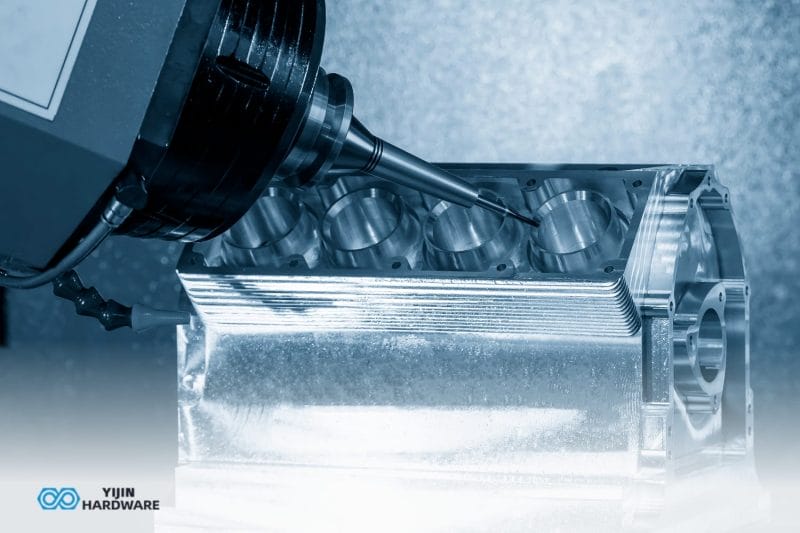
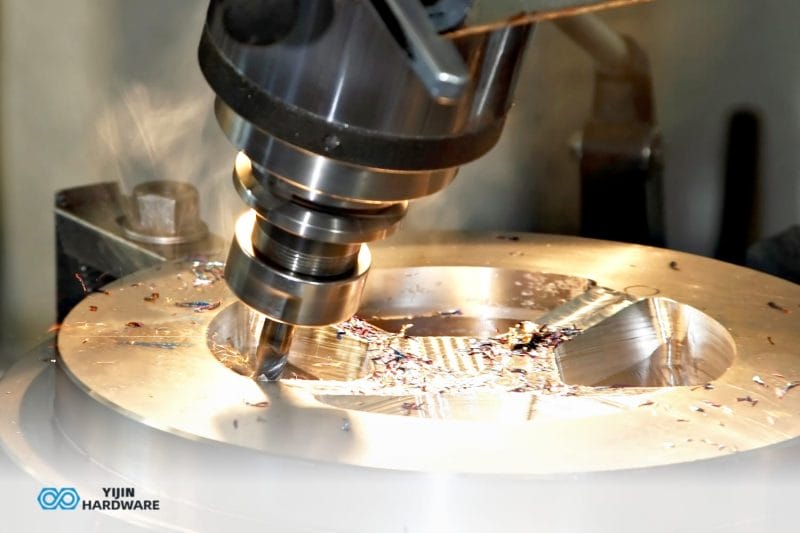

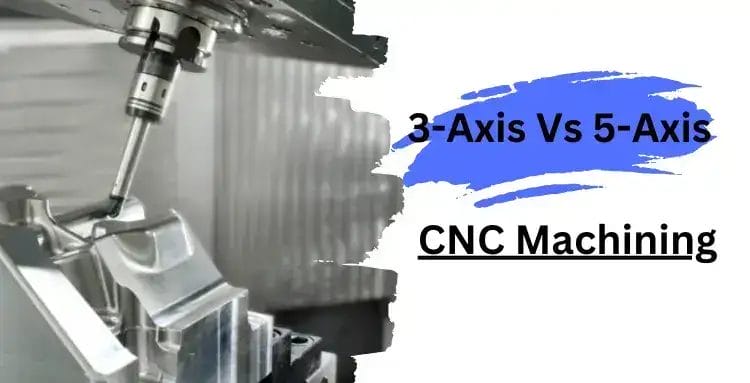
3-axis CNC machining moves the cutting tool along X, Y, and Z. 5-axis CNC machining adds two rotational axes so the tool or workpiece can approach the part from more angles. The practical difference is setup control: 3-axis machining is efficient for simpler geometry, while 5-axis machining can reduce setups and improve access on complex custom parts.
For buyers, the right choice is not “more axes is always better.” The right choice is the process that produces the required geometry, tolerance, surface finish, lead time, and cost for your specific part.
| Machining approach | Best for | Cost pattern | Buyer note |
|---|---|---|---|
| 3-axis CNC | Flat faces, simple pockets, holes, slots, basic prismatic parts | Lower programming and machine cost | Efficient when the part can be machined from one or a few simple setups. |
| 3+2 axis CNC | Angled features, multi-face access, indexed positioning | Middle range | The part is tilted into position, then machined with fixed-axis cutting. |
| Continuous 5-axis CNC | Impellers, turbine parts, medical components, complex contours, undercut access | Higher programming and machine cost, fewer setups for complex geometry | Best when simultaneous tool movement improves geometry, finish, or setup accuracy. |

Pros and Cons of 3-Axis vs 5-Axis CNC
| Option | Advantages | Tradeoffs |
|---|---|---|
| 3-axis CNC | Lower cost, simpler programming, fast setup for straightforward parts | More setups for multi-face geometry, limited access to angled features |
| 5-axis CNC | Fewer setups, better tool access, improved accuracy across complex faces | Higher programming demand, higher machine cost, not needed for simple parts |
Preserved Technical Body From the Live Page
The sections below preserve the deeper technical material from the audited live page, while the new top section adds the audit-requested visual explanation and quick-reference decision support.
How do 3-Axis CNC Machines Work?
3-axis CNC machines operate by moving the cutting tool along three perpendicular axes. The X-axis controls left-to-right movement, the Y-axis controls front-to-back movement, and the Z axes controls up-and-down movement. These 3-axis machine types maintain a fixed orientation between the tool and workpiece throughout the cutting process.
During operation, the workpiece remains stationary in the computer numerical control system while the tool moves along these three axes to remove material according to programmed instructions. For complex parts requiring machining from multiple sides, operators must manually reposition and re-secure the workpiece between operations, which increases production time and can introduce alignment errors.
3-Axis Technical Specifications
| Parameter | Typical Specification |
|---|---|
| Positioning Accuracy | ±0.0002″ (0.005 mm) |
| Repeatability | ±0.0001″ (0.0025 mm) |
| Rapid Traverse | 1,500 IPM (38 m/min) |
| Maximum Spindle Speed | 12,000-15,000 RPM |
Despite these limitations, 3-axis milling machines excel at producing parts with flat surfaces, simple contours, and features accessible from the top and sides of the workpiece. They’re ideal for 2.5D machining, where features maintain a constant Z-height across any given XY plane.
How do 5-Axis CNC Machines Work?
5-axis CNC machines move the cutting tool or workpiece along three linear axes (X, Y, Z) plus two rotational axes (A, B). The A-axis rotates around the X-axis, while the B-axis rotates around the Y-axis, allowing the tool to approach the workpiece from virtually any angle during CNC milling operations.
These 5-axis machine types operate in two primary modes: 3+2 positioning (indexed machining) and continuous 5-axis. In 3+2 positioning, the machine locks the rotational axes at specific angles and then performs 3-axis machining at those positions. With continuous 5-axis machining, all five axes move simultaneously during cutting operations, enabling the creation of complex contoured surfaces.
5-Axis Machine Kinematics
The rotational axes in multi-axis machining can be configured in various ways:
Rotary Table/Tilting Table (Table-Table): Both rotational axes move the workpieceSwivel Head/Tilting Head (Head-Head): Both rotational axes move the cutting toolTable-Head Combination: One rotational axis moves the workpiece, one moves the tool
At Yijin Solution, our 5-axis machines feature advanced encoders that provide positional feedback with resolution as fine as 0.0001 degrees, ensuring precise control during complex contouring operations. This technology excels at producing parts with compound angles, undercuts, and contoured surfaces found in industries like aerospace, medical, and automotive.
How much do 3-Axis and 5-Axis CNC Machines Cost?
3-axis CNC milling machines typically cost between $25,000 and $50,000, making them accessible for small to medium-sized businesses and startups. These types of CNC machines represent a lower initial investment with more straightforward maintenance requirements and operational costs, making them cost-effective for simpler part production.
The 5-axis machine cost is substantially more, ranging from $80,000 to over $500,000 depending on size, capabilities, and precision. This higher price reflects their mechanical complexity, sophisticated control systems, and advanced capabilities. Beyond the machine itself, additional costs include more expensive CAD/CAM software, specialized tooling, and advanced operator training.
Total Cost Comparison
| Factor | 3-Axis CNC | 5-Axis CNC |
|---|---|---|
| Machine Cost | $25,000-$50,000 | $80,000-$500,000+ |
| CAM Software | $5,000-$15,000 | $15,000-$40,000 |
| Operator Training | $2,000-$5,000 | $8,000-$15,000 |
| Annual Maintenance | $2,000-$5,000 | $8,000-$20,000 |
While 5-axis machines require a larger initial investment, they can provide long-term cost advantages for complex parts by reducing setup time, minimizing handling, and enabling the production of parts that would be impossible or prohibitively expensive on a 3-axis mill. For example, our aerospace clients report a 30-40% reduction in overall production costs for complex components despite the higher hourly machine rate.
When Should You Choose 3-Axis CNC Machining?
You should choose 3-axis CNC when your parts have primarily flat surfaces and simple geometries. The 3-axis machine is ideal for projects with straightforward designs that don’t require complex angled cuts or undercuts, such as electronic housings, simple brackets, flat panels, and basic mechanical components.
Budget considerations often favor 3-axis CNC milling when comparing 3 axis mill vs. 5 axis for simpler projects, due to the lower initial investment, simpler operation, and reduced maintenance costs. If you’re producing high volumes of simple parts where setup time isn’t a significant factor in per-part cost, 3-axis machining offers excellent value and efficiency.
When Should You Choose 5-Axis CNC Machining?
You should choose a 5-axis CNC when your parts have complex geometries, compound angles, or undercuts that would require multiple setups on a 3-axis machine. The capabilities of 5-axis CNC machines are essential for parts with contoured surfaces, deep cavities with angled walls, or features that must be machined from multiple angles with high precision.
Industries requiring high-precision complex components like aerospace, medical, automotive, and mold making benefit most from 5-axis CNC milling capabilities. For example, turbine blades, medical implants, and complex automotive components typically require 5-axis machining to achieve the necessary geometry and surface finish using t-slot cutters and dovetail milling cutters at optimal angles.
Case Study: Aerospace Component
A leading aerospace company approached Yijin Solution to manufacture titanium structural components for a new aircraft design. The challenge included:
- Complex contoured surfaces
- Multiple compound-angle features
- Internal channels requiring angled tool access
- Critical weight-to-strength requirements
- Precision tolerances (±0.0005″)
Our 5-axis solution delivered:
- 40% reduction in overall production time
- Single-setup manufacturing with zero alignment errors
- 35% improvement in surface finish quality
- 25% reduction in material waste
- 100% first-article inspection pass rate
At Yijin Solution, we recommend 5-axis CNC machining when setup reduction would significantly impact production costs, especially for medium to low-volume production of complex parts. The ability to machine a part completely in one setup not only saves time but also improves accuracy by eliminating alignment errors from multiple setups.
What Industries Benefit Most from Each Technology?
The automotive industry benefits from both technologies, with 3-axis machines producing simple brackets, housings, and flat components, while 5-axis machines create complex engine components, turbine parts, and custom fixtures. Automotive manufacturers often maintain both capabilities to balance cost and complexity requirements in their manufacturing process.
The aerospace industry heavily relies on 5-axis machining to produce complex components like turbine blades, structural parts with compound angles, and lightweight components with intricate features. The ability to machine difficult materials like titanium and high-temperature alloys from multiple angles is crucial for aerospace applications requiring the ability to machine complex shapes.
Medical device manufacturing utilizes 5 axis CNC machining for creating orthopedic implants, custom prosthetics, and surgical instruments with complex geometries. Meanwhile, general machining for consumer products, electronics, and industrial equipment often employs 3-axis machines for the cost-effective production of simpler components. Quality is especially important for medical devices; the National Tooling & Machining Association provides industry standards for different machining techniques.
Industry-Specific Applications
| Industry | 3-Axis Applications | 5-Axis Applications |
|---|---|---|
| Automotive | Brackets, housings, flat components | Engine parts, complex fixtures |
| Aerospace | Simple brackets, plates | Turbine blades, structural components |
| Medical | Basic instruments, fixtures | Implants, prosthetics, complex devices |
| Energy | Mounting plates, simple housings | Turbine blades, impellers, pump components |
Historical Development Connection
The origins of CNC technology trace back to the aerospace industry needs in the 1940s and 1950s. John Parsons and Frank L. Stulen at Parsons Corporation created the first experimental CNC milling machine specifically for producing helicopter blades with high precision. The technology has since evolved dramatically, with modern 5-axis machines representing the culmination of decades of advancement in motion control, software capabilities, and mechanical precision.
What are the Programming Requirements for each Technology?
3-axis CNC programming requires basic knowledge of G-code, M-code, and standard CAD/CAM software. Operators need understanding of toolpaths, cutting parameters, and fixturing, but the programming is relatively straightforward with fewer variables to manage compared to 5-axis programming for basic machining tasks.
5-axis CNC programming demands advanced CAD/CAM skills and specialized software that can handle multi-axis toolpaths and collision detection. Programmers must understand tool orientation, machine kinematics, and complex toolpath strategies while considering potential collisions between the tool, workpiece, and machine components during machining operations.
Programming Complexity Comparison
| Parameter | 3-Axis | 5-Axis |
|---|---|---|
| Code Generation | Simple linear and circular interpolation | Complex spline interpolation with tool orientation |
| Collision Detection | Basic tool and fixture checking | Advanced simulation with full machine kinematics |
| Post-Processing | Standard post-processors | Machine-specific posts with rotary transformations |
| Toolpath Strategies | 2.5D and simple 3D strategies | Multi-axis simultaneous strategies |
At Yijin Solution, we use advanced CAM systems with machine-specific post-processors that simulate the exact kinematics of our CNC machines. This ensures optimal toolpaths and eliminates potential collisions before any actual machining begins. While 5-axis programming requires approximately twice the preparation time of similar 3-axis parts, this additional complexity is offset by the reduced setup time and the ability to complete complex parts in a single operation.
How do Maintenance Requirements Compare?
3-axis CNC machines have lower maintenance requirements due to their simpler mechanical design with fewer moving parts. Regular maintenance typically involves lubrication, belt checks, and occasional alignment verification, resulting in less downtime and lower ongoing maintenance costs for these machining options.
Unlike 3-axis, 5-axis CNC machines require more frequent and complex maintenance due to additional rotational components and more sophisticated control systems. The rotary axes need regular calibration to maintain accuracy, and the more complex mechanics demand closer monitoring and more specialized maintenance skills in the machining process.
How does Part Accuracy Compare Between Technologies?
3-axis CNC milling machines can achieve excellent accuracy for simpler parts, typically maintaining tolerances of ±0.001″ (0.025 mm) for standard operations. Their accuracy is most consistent when machining flat surfaces and features that can be accessed directly from above or from the sides at 90-degree angles in the machining process.
Compared to 3-axis, 5-axis CNC machines maintain comparable or better accuracy even when creating complex geometries, with typical tolerances of ±0.0005″ (0.0127 mm) or better for precision applications. More importantly, they maintain this accuracy across complex contoured surfaces and angled features that would require multiple setups on 3-axis machines in the manufacturing process.
What Recent Technological Advances are Changing CNC Machining?
Industry 4.0 integration is transforming both 3-axis vs. 5-axis CNC with enhanced connectivity, real-time monitoring, and data-driven optimization. These advancements allow manufacturers to track machine performance, predict maintenance needs, and optimize production schedules for maximum efficiency in the manufacturing process.
Automated tool path optimization algorithms are increasingly sophisticated, particularly for 5-axis CNC machining, where they can dynamically adjust cutting strategies based on material conditions and tool wear. These systems reduce programming time while improving surface finish and extending tool life for machining parts with complex geometries.
How Yijin Helps Choose the Right Process
Yijin Solution manufactures custom CNC parts using the machining approach that fits the drawing, tolerance, material, surface finish, and production quantity. Our engineering team can review whether 3-axis, 3+2, or 5-axis machining is the most efficient route before production begins.
Upload your CAD files and drawings for a free DFM review and quote.
FAQs
Is 5-axis CNC always more accurate than 3-axis CNC?
No. 5-axis CNC can improve accuracy on complex multi-face parts by reducing setups, but a simple part can be highly accurate on 3-axis equipment.
What is 3+2 axis machining?
3+2 axis machining indexes the part or tool into an angled position and then machines with fixed-axis cutting. It is not the same as continuous simultaneous 5-axis motion.
Can a 5-axis CNC machine perform all the operations of a 3-axis machine?
Yes. A 5-axis CNC machine can perform standard 3-axis operations, but that does not mean every part should be routed to 5-axis machining. Simple prismatic parts are often more economical on 3-axis equipment.
How much more expensive is 5-axis machining compared to 3-axis for the same part?
For simple parts, 5-axis machining can cost more because programming and machine time are higher. For complex multi-face parts, 5-axis machining can reduce total cost by lowering setup count, fixture work, and alignment risk.
What types of materials can be machined on 5-axis versus 3-axis machines?
Both 3-axis and 5-axis CNC machining can process aluminum, stainless steel, titanium, brass, copper, and engineering plastics. The axis choice is driven more by geometry, access, and tolerance than by material alone.
Does Yijin sell 5-axis CNC machines?
No. Yijin Solution provides custom part manufacturing services. We use CNC equipment to manufacture customer parts; we do not sell CNC machines.
How do I know which process my part needs?
Send the drawing, CAD file, material, tolerance, surface finish, and quantity. Yijin can review the geometry and recommend the most efficient machining route.