


Aluminum 7075 is a high-strength, heat-treatable aluminum alloy with zinc as the primary alloying element (5.1-6.1%), offering exceptional mechanical properties with tensile strength up to 83 ksi (572 MPa) in the T6 temper. Developed in 1936 by Japanese company Sumitomo Metal, this premium aluminum alloy combines outstanding strength-to-weight ratio with good fatigue resistance, making it ideal for high-stress applications in aerospace, military, and sporting equipment.
Though more expensive than common aluminum alloys and challenging to weld, 7075 remains the material of choice when maximum strength and performance are required. Yijin Hardware specializes in the precision machining of 7075 aluminum components.
Key Takeaways
- Aluminum 7075 is a high-strength, heat-treatable alloy with zinc as its primary alloying element, offering an exceptional strength-to-weight ratio that makes it ideal for high-stress applications in aerospace, military, and sporting equipment.
- Its unique composition and various temper conditions, especially the T6 temper, provide outstanding mechanical properties that are optimized through precision machining techniques.
- Despite being more expensive and challenging to weld, Aluminum 7075 is widely utilized for critical structural parts, with machining best practices addressing challenges such as chatter, tool wear, and heat buildup.
What is Aluminum 7075?
Aluminum 7075 is a high-strength alloy with zinc as the primary alloying element. It belongs to the 7000 series of aluminum alloys. This material offers an excellent strength-to-weight ratio. 7075 aluminum finds use in highly stressed structural parts. Its properties make it ideal for aerospace and automotive applications. According to MATEC Web of Conferences, its compression strength is 629.5-787.52 MPa.
What is the Chemical Composition of Aluminum 7075?
The composition of Aluminum 7075 consists of aluminum as the base metal (87.1-91.4%) with several key alloying elements that provide its distinctive properties. Zinc serves as the primary alloying element at 5.1-6.1%, followed by magnesium at 2.1-2.9% and copper at 1.2-2.0%. These three elements work synergistically to create the alloy’s exceptional strength through precipitation hardening mechanisms.
Here’s the composition table for aluminum 7075:
| Element | Percentage Range | Role in Alloy |
|---|---|---|
| Aluminum | 87.1-91.4% | Base metal providing lightweight properties |
| Zinc | 5.1-6.1% | Primary alloying element enhancing strength |
| Magnesium | 2.1-2.9% | Enables precipitation hardening |
| Copper | 1.2-2.0% | Increases tensile strength and hardness |
| Chromium | 0.18-0.28% | Controls grain structure and prevents stress corrosion |
| Iron | 0-0.5% | Impurity element (kept to minimum) |
| Silicon | 0-0.4% | Impurity element (kept to minimum) |
| Manganese | 0-0.3% | Improves grain structure |
| Titanium | 0-0.2% | Grain refiner |
| Others | 0.05-0.15% | Trace elements |
What are the Different Tempers of Aluminum 7075?
The different tempers of Aluminum 7075 refer to specific heat treatment conditions that dramatically alter the alloy’s mechanical properties. Each temper designation indicates a particular processing history that modifies the microstructure to achieve specific performance characteristics.
Here’s the table comparing the different tempers of Aluminum 7075:
| Temper | Description | Tensile Strength | Yield Strength | Elongation | Applications |
|---|---|---|---|---|---|
| 7075-O | Annealed condition | 33 ksi (228 MPa) | 15 ksi (103 MPa) | 16% | Forming operations requiring maximum ductility |
| 7075-T6 | Solution heat-treated and artificially aged | 83 ksi (572 MPa) | 73 ksi (503 MPa) | 11% | High-strength applications, aircraft structures |
| 7075-T651 | T6 with stress relief by stretching | 83 ksi (572 MPa) | 73 ksi (503 MPa) | 11% | Improved dimensional stability for precision parts |
| 7075-T73 | Overaged for improved stress corrosion resistance | 73 ksi (505 MPa) | 63 ksi (435 MPa) | 5% | Applications requiring better corrosion resistance |
| 7075-T7351 | T73 with stress relief by stretching | 73 ksi (505 MPa) | 63 ksi (435 MPa) | 5% | Critical aerospace components with corrosion exposure |
How do the Mechanical Properties of 7075 Aluminum Compare?
The mechanical properties of 7075 aluminum compare favorably against most other aluminum alloys, particularly in terms of strength characteristics. These properties vary significantly depending on the temper condition, with the T6 temper offering the highest strength values.
| Property | 7075-T6 | 6061-T6 | 2024-T3 | 5052-H32 | 3003-H14 |
|---|---|---|---|---|---|
| Primary Alloying Element | Zinc | Magnesium & Silicon | Copper | Magnesium | Manganese |
| Tensile Strength | 83 ksi (572 MPa) | 45 ksi (310 MPa) | 65 ksi (448 MPa) | 33 ksi (228 MPa) | 22 ksi (152 MPa) |
| Yield Strength | 73 ksi (503 MPa) | 40 ksi (276 MPa) | 47 ksi (324 MPa) | 28 ksi (193 MPa) | 17 ksi (117 MPa) |
| Elongation | 11% | 12% | 18% | 12% | 14% |
| Weldability | Poor | Excellent | Fair | Excellent | Excellent |
| Corrosion Resistance | Fair | Good | Fair | Excellent | Excellent |
| Machinability | Good | Excellent | Good | Good | Fair |
| Formability | Fair | Good | Fair | Excellent | Excellent |
| Relative Cost | High | Moderate | High | Moderate | Low |
Which Aluminum Alloy Should You Choose?
When choosing between 7075 and other aluminum alloys, consider these key decision factors:
- Choose 7075 when: Maximum strength is required, weight reduction is critical, and cost is not the primary concern. Ideal for aerospace components, high-stress structural parts, and military applications.
- Choose 6061 when: A good balance of properties is needed with better weldability, corrosion resistance, and lower cost. Suitable for general structural applications, marine hardware, and automotive components.
- Choose 2024 when: Good strength and excellent fatigue resistance are needed. Common in aircraft structures and other high-stress applications where fatigue is a concern.
- Choose 5052 or 3003 when: Formability and corrosion resistance are more important than strength. Better for sheet metal work, food processing equipment, and chemical handling applications.
What are Some Common Challenges for Aluminum 7075?
Some common challenges for aluminum 7075 are chatter, tool wear, and heat buildup. Let’s dive into what exactly these issues are and how to solve them!
Chatter
- Issue: Vibration in thin-walled parts
- Solution: Use optimized cutting paths and adjust feed rates
Tool Wear
- Issue: Faster wear than with softer alloys
- Solution: Use sharp carbide tools with wear-resistant coatings
Heat Buildup
- Issue: Can cause dimensional inaccuracies
- Solution: Apply proper cooling and optimize cutting parameters
Overcoming Challenges
To successfully machine 7075 aluminum, it’s important to use effective strategies. This includes using proper fixturing methods to secure the workpiece and implementing adaptive machining techniques that adjust to the material’s properties. Additionally, optimizing tool paths helps maintain consistent cutting conditions. This ensures high-quality results and minimizes the impact of chatter, tool wear, and heat buildup.
Are there any Design Considerations for Aluminum 7075?
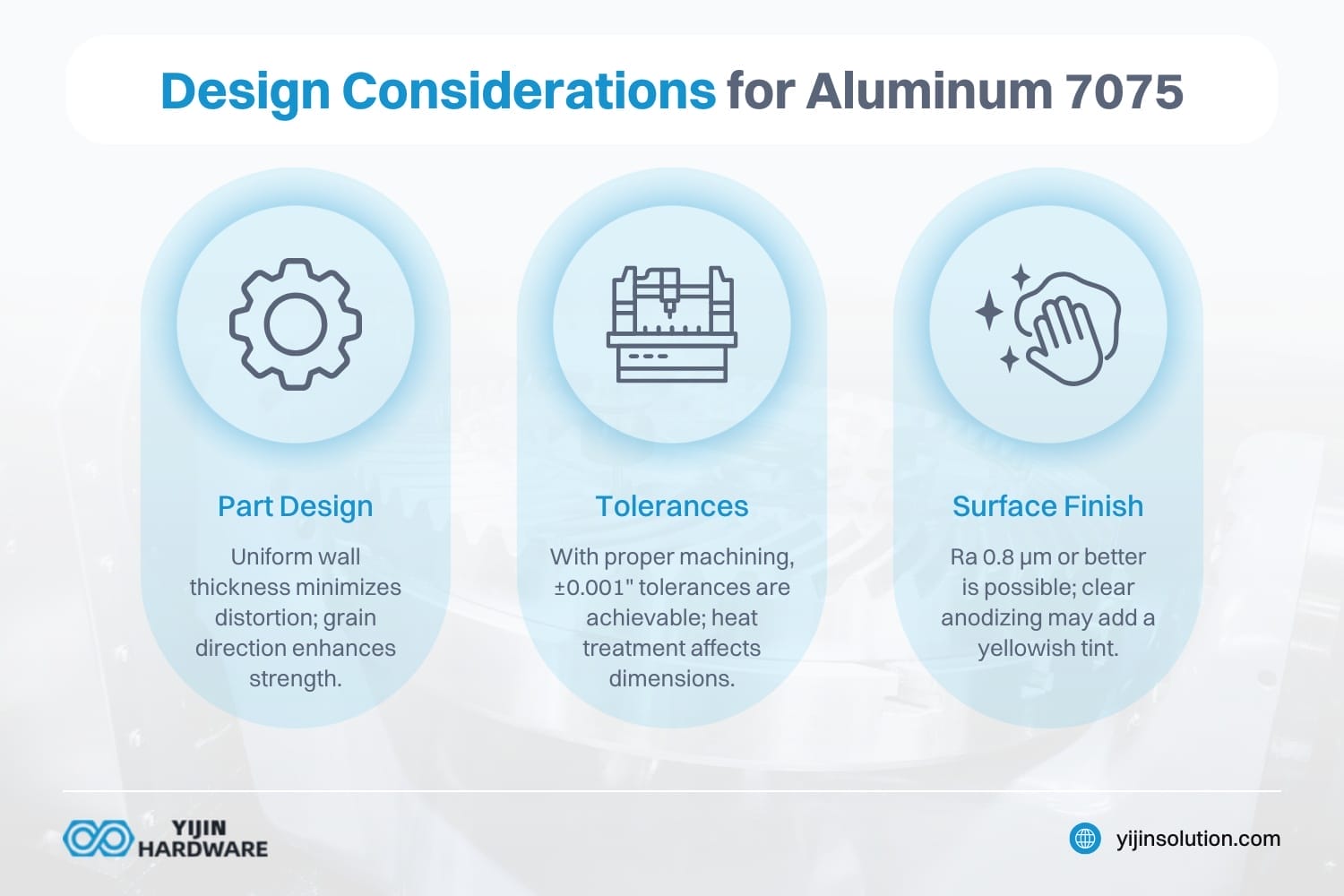
Designing with 7075 aluminum requires attention to tolerances, wall thickness, and grain direction. These factors ensure optimal strength, dimensional stability, and machinability.
Part Design
Design parts with uniform wall thickness when possible. This practice helps minimize distortion during machining. Consider the grain direction when designing for maximum strength.
Tolerances
7075 aluminum can achieve tight tolerances. Tolerances of ±0.001” are achievable with proper machining practices. Consider the effects of heat treatment on final dimensions.
Surface Finish
7075 can achieve excellent surface finishes. Ra values of 0.8 μm or better are possible. Anodizing may produce a yellowish tint when clear anodized.
What are the Industry Applications of Aluminum 7075?

7075 aluminum is widely used in aerospace, automotive, and military industries. Its high strength and lightweight properties make it suitable for structural parts under heavy stress.
Aerospace
7075 aluminum is widely used in aircraft structures. Common aerospace applications include:
- Wing spars and stringers
- Fuselage frames and bulkheads
- Landing gear components
- Seat tracks and structural fittings
- Aircraft fittings and gussets
The Boeing 747 and 777 utilize significant amounts of 7075 aluminum in their wing structures and other high-stress components. NASA has also employed 7075 in various spacecraft structures where weight reduction and reliability are paramount.
Military and Defense Applications
The defense industry relies on 7075 aluminum for:
- M16 rifle receivers and components
- Military aircraft structures
- Tactical equipment frames
- Armor plate backing
- Missile components
The U.S. military’s adoption of 7075 aluminum for the M16 rifle in the 1960s represents one of the most widely recognized applications, demonstrating the alloy’s durability in demanding combat conditions.
Other Applications
7075 aluminum finds use in:
- Mold tooling
- Sports equipment
- Military hardware
Its versatility makes it suitable for various high-stress applications.
What are Important Aluminum 7075 Machining Best Practices?
Proper machining practices are essential for achieving precision with 7075 aluminum, such as using the right tools, cutting fluids, and fixturing. This minimizes tool wear and ensures quality.
Cutting Fluid
Use water-soluble cutting fluids when machining 7075 aluminum. These fluids help manage heat and improve chip evacuation. Proper coolant management extends tool life.
Tool Paths
Optimize tool paths to maintain consistent chip loads. This practice helps reduce tool wear and improve surface finish. Consider using high-speed machining techniques for complex parts.
Fixturing
Use rigid fixturing to minimize vibration during machining. This approach helps prevent chatter and improves part quality. Consider using vacuum fixtures for thin parts.
How is Aluminum 7075 Processed and Manufactured?
Aluminum 7075 is processed and manufactured through specialized techniques that accommodate its metallurgical characteristics while maximizing its exceptional mechanical properties. The processing pathway typically follows these steps:
- Casting: The alloy is first cast into billets or ingots from molten aluminum mixed with precisely controlled amounts of zinc, magnesium, copper, and other alloying elements.
- Hot Working: The cast material undergoes hot working (typically 350-450 °C) through processes like:
- Extrusion – For creating profiles and bars
- Forging – For complex, high-strength components
- Rolling – For producing plates and sheets
- Cold Working: Further shaping may include cold working techniques, such as:
- Cold rolling – For tighter dimensional control
- Drawing – For producing wire and small-diameter rod
- Forming – For creating specific shapes from sheet material
- Heat Treatment: The critical step that develops the alloy’s strength through:
- Solution heat treatment at approximately 480 °C (900 °F)
- Rapid quenching in water
- Artificial aging at 120-150 °C (250-300 °F) for 24 hours (for T6 temper)
Machining Considerations
Machining 7075 aluminum requires specific approaches:
- Sharp, properly designed cutting tools are essential
- Higher cutting speeds than steel but lower than other aluminum alloys
- Moderate feed rates to prevent work hardening
- Proper cooling to prevent heat buildup
- Rigid setups to minimize vibration and chatter
The alloy’s high strength can lead to higher cutting forces and tool wear compared to other aluminum alloys, but its machinability is generally rated as good (70-80% of the machinability of 2011-T3 aluminum, which is considered 100% machinable).
Forming Limitations
7075 has limited formability, particularly in the high-strength tempers:
- Minimum bend radius for T6 sheet is typically 6–10 times the material thickness
- Complex forming should be performed in the O (annealed) condition
- Parts formed in O condition can be subsequently heat treated to higher strength tempers
- Spring back is significant and must be accounted for in tooling design
Surface Treatments
Common surface treatments for 7075 aluminum include:
- Anodizing (Type II or Type III/hard anodizing)
- Chemical conversion coating
- Painting with appropriate primers
- Alodine (chromate conversion) treatment for corrosion protection
The anodizing process creates a protective oxide layer that improves corrosion resistance and provides a surface suitable for paint adhesion or decorative finishes.
Yijin Hardware: Affordable 7075 Aluminum Machining
Yijin Hardware is one of the top 7075 CNC aluminum machining factories, offering expert CNC machining services for 7075 aluminum. We deliver high-quality parts at competitive prices. Our team understands the unique challenges of working with this alloy. Contact us for your 7075 aluminum machining needs. We’re ready to bring your designs to life.
7075 CNC Aluminum Machining Factory FAQs
Is 7075 harder to machine than 6061?
7075 aluminum is harder to machine than 6061, requiring more advanced CNC milling techniques. The difference between 6061 and 7075 arises from 7075-T6 aluminum’s higher strength and toughness. A practical machinist might struggle with 7075 due to its toughness, requiring specialized cutters and end mills. While 6061 and 7075 are both machinable, 7075 is one of the harder alloys to machine effectively.
What grade of aluminum is best for machining?
6061 aluminum is one of the most commonly used grades for CNC turning and milling due to its versatility. It offers excellent machinability, making it the go-to choice for many CNC machinists. For high-strength applications, 7075 aluminum CNC machinable parts can be considered, though it is harder to machine. The choice between 6061 and 7075 depends on the specific requirements, such as strength or machinability.
Why can’t you weld 7075 aluminum?
Welding 7075 aluminum can lead to weak, brittle joints due to its high zinc content and strength. The alloy’s properties change significantly when exposed to heat, particularly in the heat-affected zone. 7075-T6 aluminum requires precise heat control and post-weld treatment to maintain strength. Many suppliers prefer using 7075 in CNC-machined parts rather than welded parts to preserve material integrity.
Back to Top: Aluminum 7075 Machining | Properties & Applications






 EN
EN  ES
ES  RU
RU  DE
DE  FR
FR