


A sheet metal quote reflects decisions made weeks or months before the purchase order lands. Material cost, machine time, finishing, inspection, batch size: each line item ties back to a design choice, a specification call, or a sourcing decision earlier in the process. The total cost of sheet metal fabrication is rarely a surprise to buyers who understand how those decisions compound.
This guide breaks down what drives fabrication pricing and how each variable interacts with the others. Whether the goal is comparing quotes for a first prototype or renegotiating pricing on a production run, the underlying principle is the same: spend less per part without giving up the things that matter.
Why Sheet Metal Fabrication Cost is a System Output
Fabricación de chapas metálicas is the process of transforming flat metal stock into finished parts through a series of operations, including corte, formando, joining, finishing, and inspection.
Industries from automotive and aerospace to HVAC and consumer electronics rely on fabricated sheet metal for enclosures and structural components. Each sector has its own cost dynamics, but the underlying mechanics of how pricing accumulates across operations are consistent.
The reason cost behaves the way it does in sheet metal fabrication is that none of these stages operate in isolation. A change in material grade affects cutting speed and tool wear. A tighter bend radius changes the number of press brake setups. A acabado superficial requirement adds a downstream operation that didn’t exist in the original estimate. Each decision ripples forward into the next.
Buyers who understand this interaction make better sourcing decisions. They know which cost levers to pull during design review and which ones to leave alone. They also recognize when two superficially similar parts carry very different prices for reasons that trace back to specification choices rather than fabrication capability.
What Determines the Cost of Sheet Metal Fabrication?
Some of the interrelated variables around sheet metal fabrication costs are within the buyer’s direct control, like material selection and part geometry. Others, like regional labor rates and raw material market pricing, are not.
The table below maps the primary cost drivers, their relative impact, and the degree of buyer influence over each one.
| Cost Driver | Impact Level | Buyer Control? | Notas |
|---|---|---|---|
| Material type and grade | Alta | Sí | Stainless steel costs 2 to 3x more than mild steel. Aluminum sits between the two for most structural applications. |
| Material thickness | Alta | Sí | Thicker stock increases cutting time, tool wear, and forming force. |
| Part complexity and geometry | Alta | Partially | Each bend, hole, and cutout adds an operation. Compound angles and tight radii add more. |
| Fabrication process | Alta | Sí | Corte por láser, punching, flexión, welding: each carries a different cost structure. |
| Tolerances required | Medium, High | Sí | Tighter tolerances require additional inspection, slower machine settings, and sometimes secondary machining. |
| Order volume and quantity | Alta | Sí | Setup costs are fixed per run. Higher volumes lower the per-part share. |
| Surface finish and treatments | Medio | Sí | Powder coating, anodizing, and plating each add cost. Raw finish with deburring is the cheapest option. |
| Lead time required | Medio | Sí | Rush orders carry a 15 to 30% premium depending on capacity and complexity. |
| Location of manufacturer | Medio | Sí | China-based suppliers typically offer 30 to 50% lower unit cost for equivalent quality and certification level. |
The highest-impact levers for most buyers are material choice, order volume, and process selection. The sections below break each driver down.
Material type and grade
Material choice determines both how a part performs and what it costs to produce. Mild steel, specifically ASTM A36, is the most affordable structural option and covers a wide range of enclosure, bracket, and frame applications.
Stainless Steel 304 and 316 cost significantly more but deliver corrosion resistance that mild steel does not offer. Aluminum 5052 and 6061 fall between the two on price and offer a better strength-to-weight ratio for applications where mass matters.
Material typically accounts for 40 to 60% of total part cost depending on process and volume. Choosing stainless steel when mild steel meets the performance requirement is one of the most common sources of avoidable cost in sheet metal projects.
Part complexity and geometry
Complexity means operations, and operations mean time. Each additional bend requires a separate press brake setup and each cutout adds laser time. Tight corner radii or compound angles increase the risk of scrap, which drives cost further.
Cost typically grows disproportionately with complexity. A bracket with two bends and four holes is straightforward. A chassis with twelve bends, three welded tabs, and a set of tapped holes is a different job entirely. Reviewing geometry for simplification during DFM review, before the design is locked, directly reduces per-part cost without changing part function.
Fabrication process selection
The process a fabricator uses affects both unit cost and lead time. The table below maps the most common sheet metal processes to their volume sweet spots.
| Proceso | Lo mejor para | Volume Sweet Spot |
|---|---|---|
| Corte por láser | Complex 2D profiles, prototypes, mixed batches | 1 to 10,000+ |
| Turret punching | High-volume flat parts with standard hole patterns | 500 to 50,000+ |
| Prensas plegadoras | Any part requiring formed features | All volumes |
| Welding and assembly | Multi-component assemblies | Low, medium |
| Stamping and deep drawing | High-volume symmetrical forms | 10,000+ |
Process choice and volume are linked. Laser cutting dominates at low volumes because it requires no dedicated tooling. Turret punching becomes competitive above roughly 500 parts for designs with repetitive hole patterns, because the per-hit cost drops below laser time for standard features.
Order volume and setup costs
Setup costs in sheet metal fabrication are fixed per order: Programación CNC, fixture preparation, first-article inspection. Whether the run produces 10 parts or 1,000 parts, that setup cost stays the same. The per-part share shrinks as volume grows.
A laser cutting program takes the same time to write for 10 parts as for 1,000. At 10 parts, that programming cost might add $15 per part. At 1,000, it adds $0.15. Most cost-per-part curves flatten significantly above 100 to 500 units. If the design is final and demand is predictable, ordering a larger batch upfront delivers better return than multiple small runs with repeated setup charges.
Surface finish and secondary operations
Every finish adds a process step. Raw deburring is the cheapest option. Powder coating, common for structural and enclosure parts, adds corrosion resistance but also adds cost per square foot of surface area. Anodizing applies mainly to aluminum parts and improves both appearance and protection. Plating with zinc, nickel, or chrome carries additional expense and is typically spec-driven rather than aesthetic.
When the as-formed tolerance range is insufficient for a given feature’s functional requirements, secondary CNC machining may be needed. This adds a separate operation, separate fixturing, and a separate inspection step. Each of these contributes to the final part price.
How These Factors Interact: Why Sheet Metal Cost is Always Contextual
The cost drivers listed above do not operate independently. They compound and interact in ways that make flat-rate pricing tables misleading for anything beyond the simplest parts.
Consider a stainless steel enclosure with several tight-radius bends and a precision surface finish requirement. The material is more expensive to cut than mild steel. It forms less predictably, increasing press brake cycle time. And the finish specification adds an inspection step to verify dimensional accuracy after forming. Three cost drivers, each moderate on its own, compound into a part that costs substantially more than a mild steel equivalent with standard bends and raw finish.
Now consider a second scenario: a geometrically complex bracket ordered in a batch of 20 with a two-week delivery requirement. Low volume means setup costs dominate the per-part calculation. Complex geometry means extended machine time. And the compressed timeline may trigger rush pricing on top of everything else. This is the highest-cost combination in sheet metal fabrication, and it is a common configuration for new-product prototype orders.
Buyers who understand how these variables interact can sequence their decisions more effectively. Locking down volume and simplifying geometry before selecting material, for instance, gives the fabricator room to optimize. Doing it in the reverse order limits everyone’s options.
How much does Sheet Metal Fabrication Cost? Typical Price Ranges
Pricing varies by part complexity, material, volume, and geography. No two quotes are identical. But useful reference ranges exist for buyers who need a starting point before requesting formal quotes.
For prototype and single parts, expect $50 to $500+ per piece depending on size, material, and the number of operations involved. Setup costs are fully absorbed by a single part at this volume, which is why single-part pricing feels high relative to production runs.
At low-volume production of 10 to 100 parts, per-part cost typically falls to $20 to $150 for moderately complex designs. Setup cost still dominates the per-part equation at this range.
For mid-to-high volume runs above 500 parts, simple bracket-type parts in mild steel can reach $5 to $30 per unit. Stainless steel and aluminum parts with finishing requirements will sit higher.
Disclaimer: These ranges are illustrative reference points. Actual pricing for any given part depends on the full combination of variables covered in the sections above. The only reliable way to know what your specific part will cost is to get a quote based on your actual design.
Metal fabrication cost per hour
Hourly machine rates are how fabricators calculate their internal costs, but they can mislead buyers who use them to compare quotes without context. A fiber laser running at $150 to $200 per hour cuts faster than a waterjet at $75 to $120 per hour. The laser’s higher rate often produces a lower per-part cost because the cycle time is shorter.
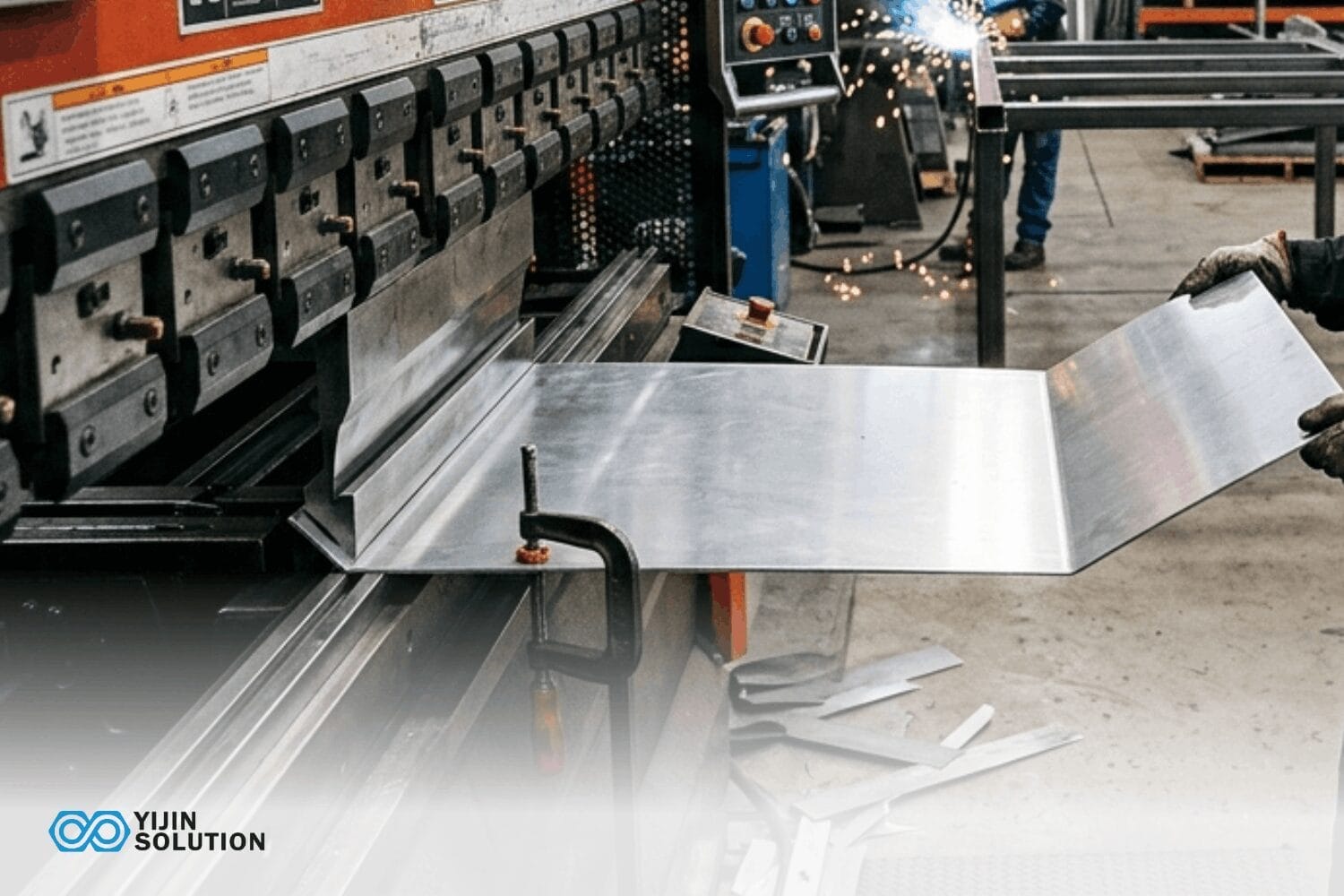
Press brake rates typically run $50 to $150 per hour. Manual welding falls in the $40 to $120 per hour range, while robotic welding costs more per hour but less per weld on repetitive joints. When comparing quotes, ask for per-part cost at your target volume. Hourly rate without cycle time context is not a useful comparison metric.
How to Reduce Sheet Metal Fabrication Costs Without Compromising Quality

Cost reduction in sheet metal fabrication happens mostly at the design stage. By the time a part reaches the shop floor, most of the cost is already locked in. The levers below are listed in approximate order of impact.
Simplify geometry early
Each additional bend, hole, or cutout adds a machine operation. Combining features into a single setup reduces laser time. Standard bend radii of 1x material thickness are faster and cheaper to produce than tight or non-standard radii that require custom tooling.
Reviewing geometry for simplification during DFM review, ideally with the fabricator, is where the most per-part cost comes out of a design. It’s also the least disruptive change a buyer can make, because it happens before anything is committed to metal.
Choose the right material for the application
Over-specifying material grade is one of the easiest cost levers to address. Mild steel costs significantly less than Stainless Steel 304. If the application doesn’t require corrosion resistance, the upgrade adds cost without adding function.
For aluminum sheet metal applications, Aluminum 5052 forms and welds well and is often more cost-effective than 6061. Whichever you’re picking, the right material is the one that meets the performance requirement at the lowest total cost. Discussing material options with your fabricator before locking the design frequently uncovers savings that would be invisible from the design side alone.
Consolidate orders to amortize setup costs
Running a larger batch in a single order reduces the per-part share of programming, fixturing, and setup time. If future demand is predictable, blanket order can reduce per-part cost by 15 to 25% compared to multiple small runs.
For example: if setup costs $300 and the order is for 50 parts, that’s $6 per part in setup alone. Order 500 and it drops to $0.60. The part itself hasn’t changed; only the allocation of fixed cost has.
Loosen tolerances where the application allows
Sheet metal tolerances adequate for most structural and enclosure applications do not require the tightest specification across every feature. Tighter tolerances mean additional inspection steps and may require secondary CNC machining on specific surfaces.
Identifying Critical-to-Function surfaces during design review and holding tight tolerances only where the design truly demands it is one of the most effective cost reduction strategies. Good DFM review processes flag over-specified tolerances before production begins, preserving quality where it matters and reducing cost where it doesn’t.
Work with a full-service manufacturer
Sourcing cutting, bending, welding, and finishing from multiple vendors introduces coordination cost, shipping cost, and quality risk at each handoff. A single-source fabricator that handles the full process, including secondary operations and inspection, reduces total landed cost and shortens delivery.
The savings from single-sourcing come from eliminating inter-vendor logistics, reducing first-article inspection duplication, and removing the communication overhead of managing multiple suppliers against a single delivery schedule.
Get Your Sheet Metal Costs Under Control Before Tooling Starts
Cost-optimized sheet metal parts start at the DFM stage, before a single tool path is written. Material substitutions, tolerance reviews, and geometry simplifications decided here cut cost on every part that follows.
As part of our custom sheet metal services, Yijin Solution treats DFM as a costing exercise, not a checkbox. Every drawing that comes in for a quote is reviewed against bend feasibility, nesting efficiency, secondary operation count, and tolerance-to-function fit before pricing is returned.
Upload your design for a free DFM review and quote within 24 hours.
Cost of Sheet Metal Fabrication FAQs
How is sheet metal fabrication priced?
Sheet metal fabrication is priced based on material cost, machine time, number of operations, order volume, and any secondary finishing. Fabricators typically calculate a base material cost plus a per-operation rate for cutting, bending, welding, and finishing. Volume discounts apply once setup costs are spread across a larger batch.
What is the minimum order quantity for sheet metal fabrication?
Most sheet metal fabricators accept orders from a single prototype through to mass production volumes. There is no fixed minimum order quantity, though per-part cost is highest at very low volumes due to setup cost allocation. Discussing your projected annual volume upfront helps the fabricator optimize pricing from the first order.
Is laser cutting or punching cheaper for sheet metal parts?
Laser cutting is generally more cost-effective for prototype and low-volume runs because it requires no dedicated tooling. Turret punching becomes more competitive at higher volumes, typically above 500 parts, for designs with standard hole patterns. The per-hit cost of punching is lower than laser time for repetitive features. The right answer depends on part geometry and batch size.
How do lead times affect sheet metal fabrication cost?
Standard production lead times are priced into the standard rate. Rush or expedited orders typically carry a 15 to 30% premium depending on capacity and part complexity. Standard sheet metal production lead times generally run 7 to 15 working days, with expedited options available at a premium. Building realistic lead time into the project schedule is often the most straightforward way to avoid premium pricing.
What is the difference between precision and standard tolerance in sheet metal fabrication?
Standard sheet metal tolerance is adequate for most structural and enclosure applications. Precision tolerance is used for critical-fit features and requires additional inspection steps. Typical standard sheet metal tolerance is ±0.30 mm on general features, with precision capability to ±0.10 mm on qualifying surfaces. Specifying precision tolerances across the whole part when only a few features require it adds unnecessary cost. Identify Critical-to-Function surfaces and specify tighter tolerances selectively.
Volver arriba: Cost of Sheet Metal Fabrication: What Drives Pricing and How to Reduce It






 English
  Spanish
  German
  French