




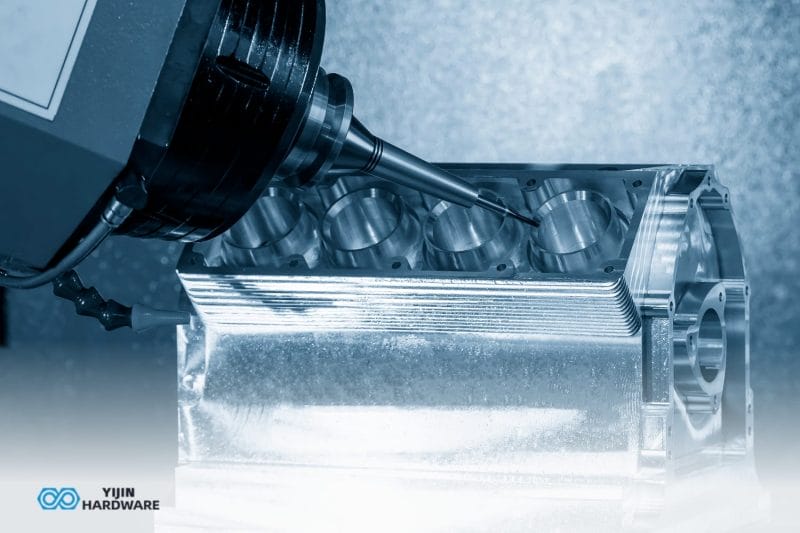
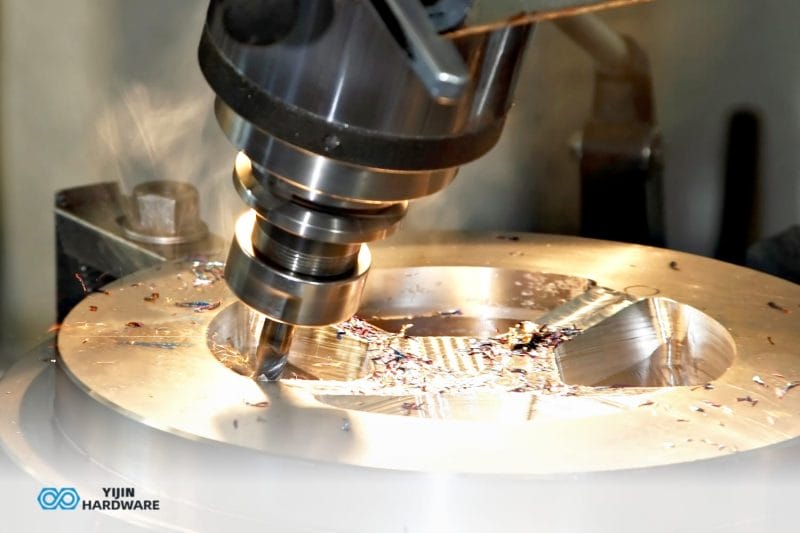


2.5-axis CNC machining is a cutting process that moves both in two axes (X and Y) while the Z-axis moves in discrete steps between cuts. Unlike full 3-axis machining, 2.5-axis cannot move in all three dimensions at once, making it ideal for creating prismatic parts (components with flat surfaces at different heights) and machining sheet materials.
2.5-axis CNC machining is cost-effective for specific applications, making it a valuable tool in the manufacturing industry. At Yijin Solution, we are highly skilled in providing high-quality 2.5-axis CNC machining services, leveraging advanced technology to meet precise manufacturing needs.
Key Takeaways
- 2.5-axis CNC machining moves in two axes (X and Y) while also moving in the Z-axis to a limited extent, ideal for creating prismatic parts and sheet components.
- Common applications include electronics enclosures, automotive brackets, medical device housings, aerospace tooling, and rapid prototyping due to its simplicity, cost-effectiveness, and quick turnaround.
- Compared to full 3-axis machining, 2.5-axis machining offers simpler programming, lower cost, and faster operation for suitable geometries but cannot produce complex, smooth contoured surfaces.
What is 2.5 Axis CNC Machining?
2.5-axis CNC machining refers to a machining process where the cutting tool moves in two axes (typically X and Y) while the third axis (Z) moves separately in a limited fashion. This contrasts with true 3-axis machining, where the tool can move in all three axes simultaneously.
In 2.5-axis machining, the tool completes operations at one Z-height before moving to another height. This stepped approach creates a “2.5D” effect—more than flat 2D machining but less capable than full 3D machining that can create smooth contoured surfaces.
The name “2.5-axis” reflects this positioning between 2-axis and 3-axis capabilities. This machining method is widely used in manufacturing due to its simplicity and cost-effectiveness for appropriate part geometries.
What are the Applications of 2.5 Axis CNC Machining?

The applications of 2.5-axis CNC machining include sheet materials, prismatic parts, and design flexibility. 2.5-axis machining is also applicable to several cutting edge industries that CNC machining regularly caters to, including electronics, automotive, and aerospace.
| Industry | Common Applications | Key Features |
|---|---|---|
| Electronics | Electronic enclosures, Instrument panels, Heat sinks, PCB fixtures | Internal pockets, Mounting holes, Ventilation slots, Cable routing cutouts |
| Automotive | Mounting brackets, Gauge panels, Prototype parts, Fixture components | Mounting holes, Alignment features, Weight reduction pockets, Assembly interfaces |
| Medical | Equipment mounts, Device housings, Laboratory fixtures, Surgical guides | Precision holes, Fluid channels, Instrument mounts, Sterilizable surfaces |
| Aerospace | Simple brackets, Panel components, Tooling fixtures, Non-structural parts | Lightweighting features, High-precision holes, Material certification compliance |
| Prototyping | Concept models, Test fixtures, Design validation parts, Low-volume production | Fast turnaround, Design iterations, Functional testing features |
| Sheet Material Processing | Custom panels, Flat components, Cover plates, Structural elements | Multiple pocket depths, Through-cuts, Edge profiles, Pattern replication |
| Prismatic Parts | Blocks with various features, Multi-level components, Stepped parts | Flat surfaces at different heights, Perpendicular walls, Various pocket depths |
| Design Flexibility | Rapid prototypes, Design iterations, Custom components | Quick turnaround, Cost-effective modifications, Feature variations |
What Software and Tools are used for 2.5 Axis CNC Machining?
2.5-axis CNC machining relies on specialized CAM (Computer-Aided Manufacturing) software that generates toolpaths and converts designs into G-code machine instructions. These programs offer varying features specifically optimized for 2.5-axis operations and are widely used by companies offering CNC milling China services.
Siemens NX
Enterprise-level solution with advanced feature recognition that reduces programming time by up to 90% through automated toolpath generation.
SolidWorks CAM
Integrated CAD/CAM solution offering seamless design-to-manufacturing workflow with built-in Knowledge Base for operation standardization.
CAMWorks
Features Automatic Feature Recognition (AFR) that identifies over 20 machining features, including irregular pockets, dramatically reducing programming time.
Fusion 360
Cloud-based platform with extensive toolpath strategies and simulation capabilities at a lower price point, ideal for small-to-medium operations
Additionally, according to AutoDesk, Fusion 360 offers integrated CAD/CAM that allows users to set up jobs and perform effective 2.5 and 3-axis milling operations. This highlights the software’s capability to streamline milling processes.
What are the Operations in 2.5 Axis CNC Machining?
2.5-axis CNC machining performs several fundamental operations that create features at varying depths with limited Z-axis movements. Each operation uses specific cutting tools and strategies to remove material and create precise features.
- Facing – Uses face mills to create flat, level surfaces by removing material to a uniform depth. Facing operations typically use larger diameter milling tools (2–6 inches) for material removal and surface finish quality.
- Profiling – Employs end mills to cut along the outside or inside edge of a part’s profile at various depths. Profiling creates the basic shape of components using tools typically ranging from 1/8″ to 1″ diameter.
- Pocketing – Creates recessed areas within a workpiece using end mills to remove material to specific depths. Pocketing operations require consideration of corner radii (determined by tool diameter) and often use trochoidal toolpaths for material removal.
- Drilling – Uses twist drills to create precise holes at specified locations and depths. Drilling operations often require proper speeds and feeds based on material and hole diameter.
- Tapping – Creates internal threads in pre-drilled holes using taps. Tapping operations must be carefully synchronized with spindle rotation to prevent thread damage.
These operations can be combined in a single setup, allowing complex prismatic parts to be machined efficiently with minimal tool changes and fixture adjustments.
How does 2.5-Axis Machining Compare to 3-axis Machining?
The primary difference between 2.5-axis and 3-axis machining is how the cutting tool moves. This fundamental difference affects capability, complexity, speed, and cost.
| Feature | 2.5-Axis Machining | 3-Axis Machining |
|---|---|---|
| Axis Movement | X and Y simultaneous, Z to a lesser extent | All X, Y, and Z are simultaneous |
| Part Complexity | Limited to prismatic parts (flat surfaces, pockets, profiles) | Can create complex contoured surfaces and organic shapes |
| Programming Complexity | Simpler programming, faster setup time | More complex programming requiring advanced CAM skills |
| Machine Cost | Lower equipment investment | Higher equipment cost due to complex control systems |
| Operation Speed | Often faster for suitable geometries | May require slower feed rates for complex surfaces |
| Surface Finish | Less refined on sloped surfaces (stepped appearance) | Better surface finish possible on contoured surfaces |
| Applications | Electronic enclosures, brackets, flat panels | Mold cavities, sculptured surfaces, complex parts |
Advantages and Limitations

2.5-axis CNC machining offers several advantages, including cost-effectiveness for producing parts with flat surfaces and reduced programming time. However, it is limited in handling complex 3D geometries compared to 3-axis machining.
| Advantages of 2.5-Axis Machining | Limitations of 2.5-Axis Machining |
|---|---|
| Cost-efficiency – Lower equipment investment due to simpler control systems and mechanics | Geometric constraints – Cannot machine undercuts, draft angles, or true 3D contoured surfaces that require XYZ movement |
| Programming speed – Reduced programming time | Stepped appearance – Creates visible “stair-stepping” on sloped surfaces due to its Z-axis movements |
| Processing efficiency – Often faster machining cycles for suitable geometries due to optimized toolpaths with less acceleration/deceleration | Tool accessibility issues – Cannot approach workpieces at angles other than perpendicular to the work surface |
| Lower training requirements – Easier for operators to learn | Surface finish limitations – Less capable of achieving fine surface finishes on sloped surfaces |
| Simplified fixturing – Workholding solutions are typically less complex and expensive | Feature limitations – Cannot produce spiral grooves or variable-depth slots |
Yijin Solution | Premium 2.5 Axis CNC Machining Services
At Yijin Solution, we specialize in providing premium 2.5-axis CNC machining services. Our advanced machines and software ensure high-quality products with precise manufacturing needs. Contact us today to explore how our services can meet your manufacturing requirements. With our expertise, you can achieve accurate production of parts with flat surfaces.
What is 2.5 Axis CNC Machining FAQs
What is 2.5D in CNC?
2.5D in CNC refers to machining operations where depth is controlled but not continuously adjusted. This approach is commonly used for drill holes, pockets, and engraving tasks. Volume-based milling techniques improve efficiency by optimizing material removal strategies. Software like NX for manufacturing helps automate 2.5D toolpath programming for streamlined production.
What are the differences between 3D printing and CNC milling?
3D printing is an additive process that builds parts layer by layer—ideal for complex internal geometries and low-volume prototypes using plastics, resins, or select metals, but generally slower and with coarser surface finishes. CNC milling is subtractive, carving parts from solid blocks of metal, wood, or composites, offering higher precision, smoother surfaces, and faster throughput for larger runs at the expense of higher setup and material costs.
Which materials work best with 2.5-axis machining?
2.5-axis milling excels when working with prismatic or sheet-based stock, producing flat surfaces, pockets, slots and drilled features in a single setup. Typical materials include sheet metals—such as aluminum, mild steel and stainless steel—and non-ferrous alloys like brass and copper, prized for their combination of lightweight strength and corrosion resistance.
Back to Top: What is 2.5 Axis CNC Machining?