
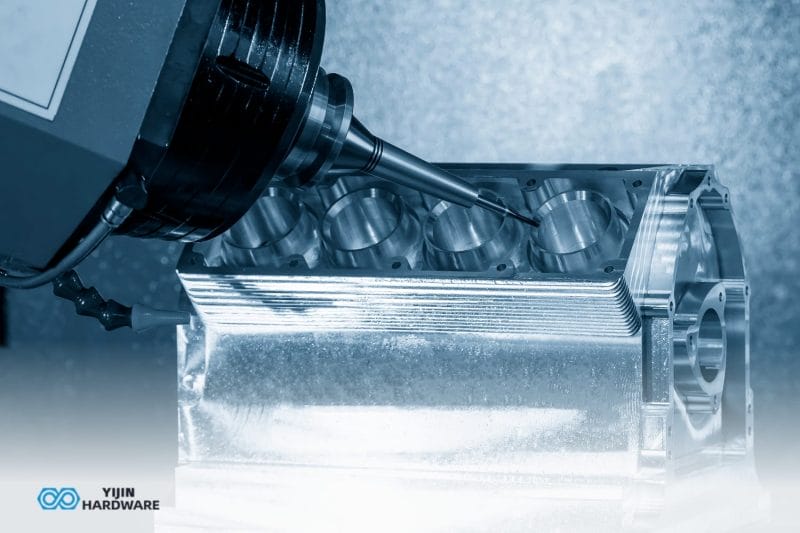
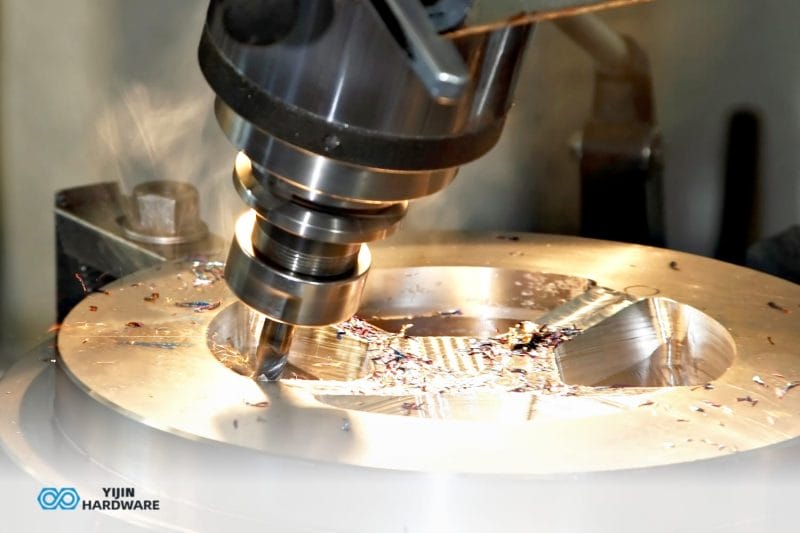

Swiss type CNC machining feeds bar stock through a guide bushing beside a sliding headstock. This support keeps long, slender workpieces from deflecting during the cut. The process holds tolerances a standard lathe cannot match on small parts. Swiss type CNC machining entered watchmaking in the late 1970s, according to Avanti Engineering. That history is where the process gets its name.
Yijin Solution runs Swiss type CNC machining for medical, aerospace, electronics, and watchmaking clients. Explore our Swiss machining service for full capabilities. This guide covers the machine’s key components, how it works, and its limits. Read on to see where Swiss type CNC machining fits your project.
Principales conclusiones
- Swiss type CNC machining employs a sliding headstock and guide bushing to support small, complex parts, ensuring exceptional precision and surface finish.
- Its guide bushing, sliding headstock, rotating spindle, and collet work together for efficient, multi-axis operations.
- This process is widely used across industries like medical, aerospace, and watchmaking due to its ability to reduce cycle times and maintain tight tolerances.
- Swiss machining suits small-diameter parts and high-volume runs best. Large parts and one-off prototypes are usually a poor fit.
What are the Key Components of Swiss Type CNC Machines?
The key components of Swiss type CNC machines are its guide bushing, sliding headstock, rotating spindle, and collet. These unique features set them apart from conventional lathes, such as guide bushing and sliding headstocks. We’ve outlined how these components work together to achieve high precision and efficiency.
Guide Bushing
The guide bushing is a critical element in Swiss type CNC machining. It supports the workpiece close to the cutting tool. This support reduces deflection and vibration during machining. The guide bushing allows for machining of long, slender parts with high precision.
Sliding Headstock
A sliding headstock is the defining feature of Swiss type CNC machines. It moves along the Z-axis, feeding the bar stock through the guide bushing. This design allows for precise control of the workpiece position. The sliding headstock enables continuous machining of long parts.
Rotating Spindle
The rotating spindle holds and spins the cutting tool at high speeds. Swiss type CNC machines often have multiple spindles. This feature allows for simultaneous machining operations. Multiple spindles increase efficiency and reduce cycle time.
Collet
The collet grips and secures the bar stock in the machine. It ensures the workpiece remains fixed during machining. Collets come in various sizes to accommodate different bar stock diameters. The right collet size directly affects how tight a tolerance the setup can hold.

What are the Working Principles of Swiss Type CNC Machining?
The working principle behind Swiss Type CNC machining is the sliding headstock design that feeds material through a guide bushing, allowing cutting tools to work close to this support point to minimize deflection and vibration in small-diameter workpieces. Understanding these principles is key to grasping their advantages over conventional methods.
Operational Principles
Swiss type CNC machines use round bar stock fed through a guide bushing. Only a small portion of the workpiece is exposed to the tooling area. The bar stock moves along the Z-axis while cutting tools remain stationary. This approach provides superior support and precision for machining.
Primary Machining Functions
Swiss type CNC machines perform various machining operations, including turning and milling:
- Girar: Removes material using a stationary cutting tool
- Fresado: Uses rotary cutters to create complex features
- Drilling: Creates precise holes in the workpiece
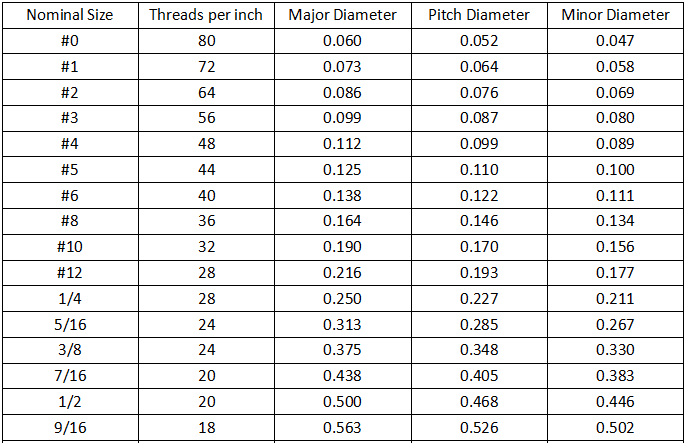
- Threading: Produces internal and external threads with high accuracy
What Part Sizes Can Swiss Type CNC Machining Produce?
Swiss type CNC machining runs on bar-fed stock. Part size follows directly from the machine’s bar capacity. Knowing these limits helps you check part fit before requesting a quote.
| Especificación | Alcance típico |
|---|---|
| Bar stock diameter | Up to roughly 1.5 in, about 38 mm |
| Common finished part diameter | Well under 1 in for most production parts |
| Length-to-diameter ratio | 3:1–10:1 or higher |
| Simultaneous machine axes | 7–13 on modern equipment |
These ranges vary by machine model and shop. Confirm them against your part’s exact geometry before ordering. Industry groups such as the Precision Machined Products Association track Swiss-type turning closely. It’s a core process for parts in this size class.
What are the Advantages of Swiss Type CNC Machining?

The advantages of Swiss type CNC machining include superior precision, exceptional surface finishes, reduced cycle times through simultaneous operations, and the ability to produce complete complex components in a single setup. These advantages have boosted the Swiss type CNC automatic lathe market, which was valued at about $1.547 billion in 2025 according to Data Insight Market.
Let’s dissect the advantages of Swiss type CNC machining further:
Alta precisión
Swiss type CNC machines achieve tight tolerances through guide bushing support. The bushing holds the workpiece right at the cutting zone. This system holds tolerances as tight as ±0,0002 pulgadas, about 0.005 mm. That precision applies to both diameters and lengths, exceeding what conventional turning delivers on slender components.
Superior Surface Finishes
The minimal workpiece deflection and vibration result in surface finishes regularly achieving 16 Ra or better without secondary operations. This makes Swiss machining ideal for parts requiring precision within extremely tight tolerances.
Complex Part Production
Swiss type CNC machines excel at manufacturing intricate and delicate parts. They have B-axis milling capabilities and can produce highly complex geometries complete in one setup, eliminating the tolerance stacking errors introduced by multiple operations on different machines.
Eficacia
Swiss type CNC machines produce parts faster than traditional CNC lathes. They can manufacture up to 30 parts per hour for some components. The process reduces the need for secondary operations. This efficiency leads to shorter lead times and lower production costs.
What Are the Limitations of Swiss Type CNC Machining?
Swiss type CNC machining is not the right process for every part. Weigh these trade-offs against your project’s volume, size, and budget. That comparison shows whether Swiss machining is the correct specification.
High Equipment Investment
A single Swiss-type CNC machine costs from the mid five figures to six figures. That’s before tooling and workholding. The investment pays off once the machine runs enough parts, since volume spreads the cost across many units.
A Practical Part-Size Ceiling
Swiss type CNC machines handle small-diameter, bar-fed parts, not large components. A part needing a bigger diameter exceeds what the bar stock and guide bushing support. That part fits a standard CNC lathe or machining center better.
Most Economical at Volume
Setup and tooling costs amortize over a production run, not a single part. A one-off prototype often costs less on a standard lathe. Swiss machining earns its keep once volume climbs into higher production runs.
What Materials can be Processed on Swiss Type Machines?
Swiss Type CNC machines can effectively process virtually any machinable material, though they particularly excel with materials that form small, controllable chips and maintain consistent dimensional stability during cutting operations. Materials commonly machined on Swiss equipment include:
| Categoría de material | Specific Grades/Types | Aplicaciones | Consideraciones especiales |
|---|---|---|---|
| Aceros inoxidables | 303, 304, 316L, 17-4 PH | Medical components, aerospace parts, food processing equipment | Excellent corrosion resistance and mechanical properties |
| Aleaciones de titanio | Ti-6Al-4V, commercially pure titanium | Medical implants, aerospace components, high-performance applications | Critical for applications requiring weight reduction |
| Brass & Bronze | Various copper alloys | Electrical components, connectors, decorative parts | Machines exceptionally well with excellent surface finishes |
| Aleaciones de aluminio | 6061, 7075, other aluminum grades | Various precision components | Machines rapidly; requires special attention to chip evacuation due to long, stringy chips |
| Medical-Grade Plastics | PEEK, Delrin (POM), PTFE | Medical device applications | Selected for biocompatibility requirements |
| Aleaciones exóticas | Inconel, Hastelloy, high-temperature superalloys | High-performance applications | Requires reduced cutting parameters and enhanced tool wear monitoring |
What are the Applications of Swiss Type CNC Machining?
Swiss type CNC machining serves industries that need small, precise, repeatable parts. Its tolerances and surface finishes fit sectors from aerospace to watchmaking equally well.
Industries Using Swiss Type CNC Machining
Swiss type CNC machining is common in several high-tech industries, including medical devices and information technology:
| Industria | Common Products |
|---|---|
| Aeroespacial | Miniature aerospace components |
| Automoción | Automotive sensors and connectors |
| Productos sanitarios | Spinal and dental implants, Medical instruments |
| Electrónica | High-tech electronic parts |
| Defensa y Militar | Componentes de precisión |
| Information Technology | Various precision parts |
| Optics | Componentes ópticos |
| Watchmaking | Watch components |
| Fabricación general | Precision screws and fasteners |
Swiss Type CNC Machines vs. Traditional CNC Machines: How do they differ?
Swiss type CNC machines differ from traditional CNC lathes in several ways, such as the workpiece support and ideal part size. Understanding these differences helps in choosing the right machine for specific applications.
| Característica | Swiss Type CNC | Traditional CNC |
|---|---|---|
| Material Feed Mechanism | Swiss machines advance the material through a guide bushing, with the Z-axis motion occurring primarily in the material feed rather than tool movement | Conventional turning centers hold the workpiece in a chuck or collet while tools traverse along the Z-axis |
| Cutting Zone Dynamic | Cutting operations occur within 1-3 mm of the guide bushing support point | Tools often engage material several inches from the nearest support point |
| Tool Approach | Swiss Type machines typically position cutting tools perpendicular to the material axis (radial approach) | Conventional turning machines position cutting tools parallel to the material axis |
| Multi-Operation Capability | Modern Swiss machines routinely incorporate 5, 7, or even 13 axes of simultaneous motion | Conventional turning machines are generally limited to more constrained axis |
What are the Advanced Features in Modern Swiss Type CNC Machines?

Modern Swiss type CNC machines incorporate advanced features, including multi-axis capabilities and programmable lasers. These innovations expand their capabilities and improve efficiency.
Multi-Axis Capabilities
Some Swiss type CNC machines feature B-axis milling spindles. This addition essentially turns them into five-axis turn-mills. Multi-axis capabilities allow for complex machining in a single setup. This feature reduces the need for multiple machines or setups.
Programmable Lasers
Recent Swiss type CNC machines may include programmable lasers. These lasers can perform cutting, welding, and engraving operations. Laser integration expands the machine’s versatility. It allows for additional processes without removing the part.
Advanced Control Systems
Modern Swiss type CNC machines use sophisticated control systems. These systems allow precise control over cutting forces and tool movements. Advanced controls improve part quality and reduce cycle times. They also enable easier programming and operation.
Yijin Solution: Efficient Swiss Type CNC Machining
Yijin Solution machines Swiss type CNC parts across 80-plus Swiss-type lathes in our Shenzhen facility. We produce precision parts for medical, aerospace, electronics, and watchmaking clients. AS9100D and IATF 16949 certification back our work for safety-critical industries.
Every job gets a free DFM review before it enters production. Tolerance risks and material choices get flagged before cutting starts. Explore our CNC Swiss screw machining services for tolerance ranges and materials. We’ll confirm lead times for your exact part.
Ready to quote a Swiss-machined part? Póngase en contacto con nosotros for your Swiss type CNC machining needs.
FAQs on What is Swiss Type CNC Machining?
How Do I Choose the Right Swiss Machining Partner?
A Swiss machining partner’s fit depends on matching equipment to your part. Check diameter, tolerance, and volume needs first. Confirm their axis count, guide bushing capability, and in-house material stock before you request a quote.
A free DFM review catches tolerance risks and material issues before production. Changes are still inexpensive to make at that stage.
Is Swiss Machining Suitable for High-Volume Production?
Swiss machining is well suited to high-volume production. Setup and tooling costs spread across every part in the run. Multiple spindles and continuous bar feed let one machine run unattended through extended cycles. That keeps per-part cost low at volume.
What is a Swiss Automatic Lathe?
A Swiss automatic lathe is another name for a Swiss type CNC machine. It’s the same sliding-headstock, bar-fed equipment described throughout this guide. The global market for this equipment reached about 1.547 billion dollars in 2025. Source: Mercado de la información. That reflects how widely manufacturers rely on it for small precision parts.
Is Swiss CNC Machining Cost-Effective?
Swiss CNC machining is cost-effective once volume is high enough. Higher volume spreads setup and tooling costs across more parts. Below that threshold, a standard CNC lathe or milling center often costs less. The break-even point depends on part complexity, material, and tolerance. Request quotes at your target volume to compare directly.
What is the Minimum Order Quantity for Swiss Type CNC Machining?
Yijin Solution accepts Swiss type CNC machining orders from single prototypes through full production runs. Our direct factory model scales without switching vendors. There’s no fixed minimum order quantity. Per-part cost simply favors higher volumes, where setup and tooling amortize across more units.
How Long Does Swiss Type CNC Machining Take?
Swiss type CNC machining prototypes typically ship in 3–7 days at Yijin Solution. Full production runs usually take 2–4 weeks, depending on part complexity and volume. Confirm exact timing when you request a quote. Machine availability and material lead time affect scheduling.
Volver arriba: What is Swiss Type CNC Machining?




 English
  Spanish
  German
  French