- Precision Parts Manufacturer
- Services
- 3d Printing
- Large Format
Large Format 3D Printing
When Your Parts Won't Fit in a Standard Printer
Need to print something bigger than a meter in any direction? That’s where large format 3D printing comes in. We’re talking architectural pieces, aerospace components, automotive parts, and industrial equipment—the kind of stuff that’s either impossible or ridiculously expensive to make through traditional manufacturing. At Yijin Hardware, we run industrial-grade systems that can handle these oversized builds across different materials, delivering the quality you need at a scale that actually makes sense for your project.
- ⬤Service
- ⬤Your Details
- ⬤Submit


What is Large Format 3D Printing and How does it Work?
Large-scale 3D printing is an additive manufacturing technology that builds oversized three-dimensional objects by depositing materials layer-by-layer according to digital 3D design files. The advancement has evolved from desktop 3D printers to industrial 3D printing systems that offer print volume up to 30 times larger than conventional printers.
Large-format 3D printing technologies include:
- Fused Deposition Modeling (FDM): Most common for large parts using thermoplastics
- Stereolithography (SLA): Uses photopolymers for smooth surface finish
- Wire Arc Additive Manufacturing (WAAM): For metal parts with welding technology
- Directed Energy Deposition (DED): Uses focused energy to melt materials
- Delta-Style Large Format Printers: Known for high speed and large build areas
These systems enable the fabrication of complex parts that would require long lead times or be prohibitively expensive with traditional manufacturing methods.


Our Large Format 3D Print Services
Yijin Hardware provides comprehensive large 3D printing service with build volumes up to 3’×2’×3′ for plastic parts and specialized capabilities for metal fabrication. Our equipment delivers exceptional print quality across three primary service categories:
Cost Reduction & Part Consolidation
We help reduce manufacturing costs by consolidating multiple components into single parts, minimizing material waste, and eliminating expensive tooling requirements.
Rapid Prototyping & Development
Our large-scale production services enable functional prototypes without size limitations of standard printers, accelerating product development and iteration cycles.
Custom Manufacturing Solutions
We specialize in producing end-use parts with complex geometry, reducing lead times and production costs compared to injection molding for low-volume manufacturing needs.
| Service Type | Key Benefits | Typical Applications | Lead Time |
|---|---|---|---|
| Cost Reduction | 40-60% tooling savings, simplified assembly | Aerospace, automotive industries | 3-10 days |
| Functional Prototyping | Full-scale testing, rapid iteration | Product development, validation | 2-7 days |
| Custom Manufacturing | Complex geometries, low-volume production runs | Medical, specialized equipment | 4-14 days |


What Materials Can Be Used in Large Format 3D Printing?
Large format 3D printing works with diverse 3D printing materials tailored to specific application requirements. Our material portfolio includes:
Thermoplastics
Photopolymers
- Standard Resins: General purpose, clear
- Functional Resins: Tough, flexible, heat-resistant
- Specialty Resins: Ceramic-filled, biocompatible
Metal Alloys
- Aluminum Alloys: 6061, 7075
- Stainless Steels: 316L, 17-4 PH
- Specialty Metals: Inconel, Titanium, Tool Steel
Sustainable Options
- Recycled Filaments: Post-consumer plastics
- Bio-based Materials: Plant-derived polymers
- Composite Materials: Fiber-reinforced for enhanced properties
Each material undergoes rigorous testing to ensure reliability and optimize performance under intended use conditions.
Which Industries Benefit Most from Large Format 3D Printing?
Aerospace, automotive, construction, and entertainment industries gain significant advantages from our large format 3D printing technologies. These capabilities enable:
Aerospace Applications
- Lightweight structural components
- Complex ducting systems
- Tooling for aircraft manufacturing
Automotive Solutions
- Full-scale design prototypes
- Custom production tools
- Specialty end-use parts
Construction Innovation
- Architectural elements and façade components
- Complex structural forms
- Custom fixtures and fittings
Entertainment Production
- Oversized props and set pieces
- Costume elements
- Themed environment components
The defense sector also uses large-format 3D printing for vehicle parts and infrastructure, while manufacturing industries implement it for production tooling and specialized equipment.


What Technical Specifications Should You Know About Large Format 3D Printing?
Technical specifications for large format 3D printing include key parameters that determine part quality and production capabilities:
Build Volume & Dimensions
Our systems achieve build volumes up to 3’×2’×3′ for polymer printing and up to 9″ dimensions for metal components through DMLS technology. For larger projects, we employ specialized fabrication services.
Resolution & Precision
- Layer Heights: 0.025 mm to 0.8 mm depending on material and technology
- Dimensional Accuracy: ±0.1% (minimum ±0.2 mm)
- Feature Resolution: Down to 0.1 mm for detailed parts
Performance Parameters
- Print Speeds: 20-150 mm/s based on material and precision requirements
- Temperature Capabilities: Build chamber temperatures up to 200 °C
- Material-Specific Parameters: Customized for optimal part performance
| Technology | Max Build Volume | Layer Height | Dimensional Accuracy | Surface Finish (Ra) |
|---|---|---|---|---|
| FDM/FFF | 3’×2’×3′ | 0.1-0.8 mm | ±0.1% (min ±0.2 mm) | 150-600 |
| SL | 1.5’×1’×1.5′ | 0.025-0.1 mm | ±0.1% (min ±0.1 mm) | 100-250 |
| MJF | 11″×15″×15″ | 0.08 mm | ±0.2% (min ±0.2 mm) | 180-350 |
How does the Large Format 3D Printing Process Work?
The large format 3D printing process follows a systematic workflow to ensure quality design results:
Design Preparation
- CAD file optimization for printability
- Orientation and support structure planning
- Simulation analysis to identify potential issues
Printing Setup
- Material parameter configuration
- Temperature profile establishment
- Environmental condition control
Production Execution
- Layer-by-layer material deposition
- Real-time monitoring
- Process parameter adjustment as needed
Post-processing
- Support removal
- Surface treatment and finishing
- Heat treatment (for applicable materials)
- Dimensional verification and quality control
Our process incorporates AI-assisted monitoring for optimized production control, ensuring consistent results across prototyping and production.


Why Choose Yijin Hardware for Large Format 3D Printing?
Yijin Hardware delivers superior large-scale 3D printing through our advanced capabilities and commitment to quality. We offer a wide range of materials and finishes that differentiate us through:
Technical Excellence
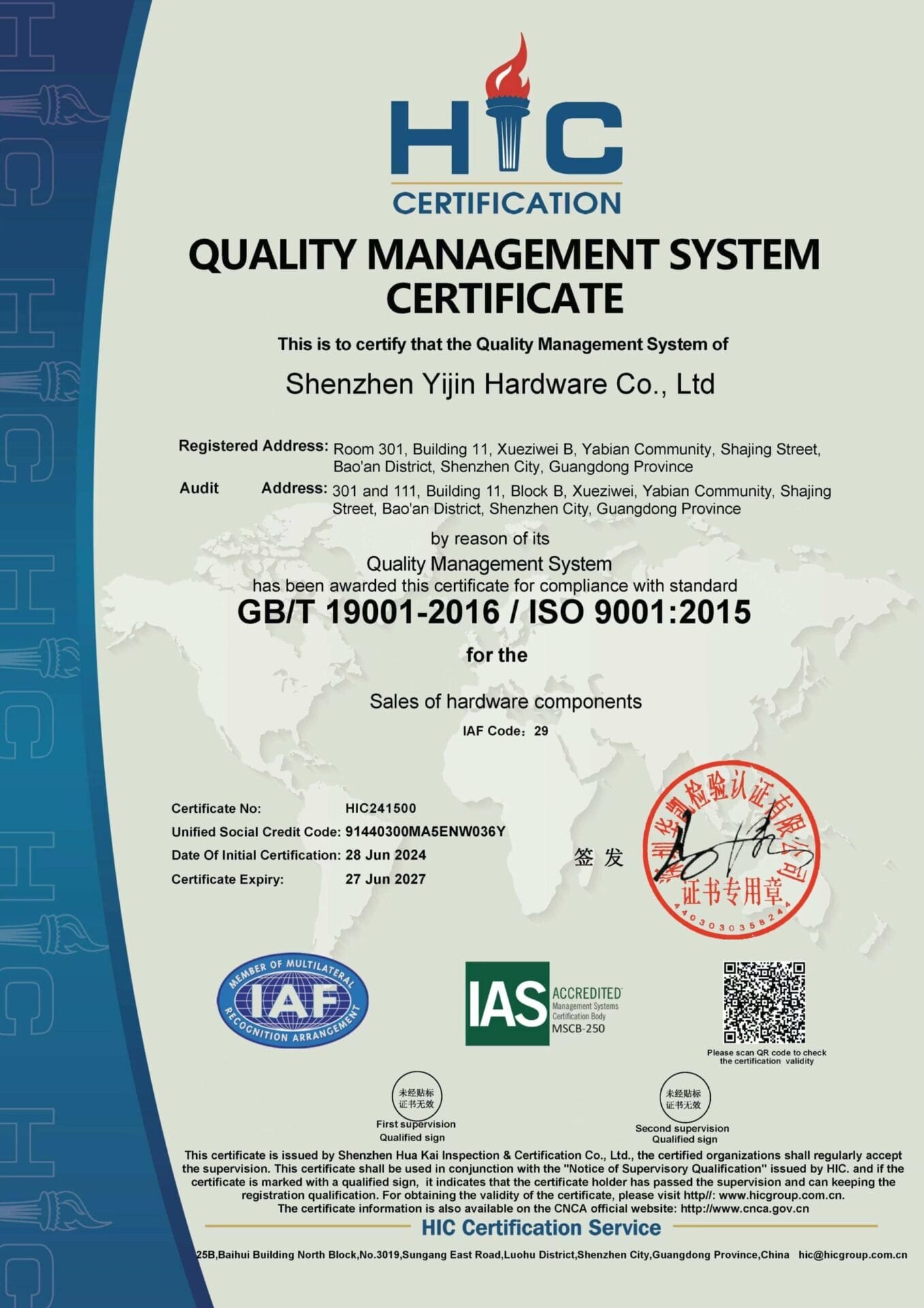
- ISO 9001:2015 certified quality management system
- Advanced large format 3D printing without the high costs
- Comprehensive material testing and validation
Complete Solution Approach
- End-to-end service from 3D design services through finishing
- Multi-technology capabilities including selective laser sintering
- Integrated CNC machining for hybrid manufacturing services
Manufacturing Alternatives
- Complementary capabilities in thermoforming and traditional fabrication
- Cost-effective options for various production needs
- Flexible approaches based on project requirements
Our 3D printing experts bring decades of experience in additive manufacturing to every 3D printing job, providing valuable insights that deliver quality parts fast while minimizing costs.

What Our Clients Say
Large Format 3D Printing FAQs
Lead time for injection moulded parts varies based on tooling requirements and production volume. For prototype parts using rapid aluminum tooling, we typically deliver first articles within 15-20 days from design approval. Production tooling takes 25-45 days depending on complexity. Once tooling is complete, we produce high quality parts in 1-15 days based on quantity and secondary operations. For 3D printed injection mold prototypes, turnaround can be even faster.
For an accurate injection molding quote, we need your 3D CAD files (STEP, STP, SLDPRT preferred), desired material specifications, required surface finish, anticipated production volume, and project timeline. Additionally, information about complex design features, tolerances, and any secondary operations helps us provide comprehensive pricing tailored to your injection molding needs.
We maintain consistent quality across large production runs through scientific molding practices and comprehensive process monitoring. Our manufacturing method begins with establishing optimal parameters during initial setup, which are then precisely maintained through computerized controls. We implement Statistical Process Control (SPC) to monitor variables and detect trends before they affect quality. For plastic products requiring the highest quality standards, we offer additional inspection services.
CNC Resources

Cast Aluminum | Everything You Need to Know About Alloys, Casting, and Machining
Pick the wrong aluminum alloy or casting method, and you’re looking at thousands wasted on tooling and months of production

How Many Jobs are Available in Metal Fabrication Right Now?
Metal fabrication currently employs 57,810 structural metal fabricators and fitters across the United States, according to May 2023 data from

Top 10 Sheet Metal Fabrication Companies Leading the Industry in 2025
Sheet metal fabrication takes flat metal sheets and turns them into functional parts through cutting, bending, and assembly—using advanced CNC
Start today. Get parts made fast.
Free Machined Parts Design to Your Projects with Fast Turnaround Times.