

Choosing between CNC machining vs. injection molding services depends primarily on your production volume, material requirements, and design complexity. CNC machining is a subtractive process that excels for low-to-medium volume production (under 500 units) with its precision of ±0.001″, while plastic injection molding dominates high-volume manufacturing with exceptional cost efficiency.
As a leading provider of precision CNC machining services, Yijin Solution offers expertise in both manufacturing methods to help you make the optimal choice for your specific project needs.
Key Takeaways
- CNC machining is ideal for low volumes (under 500 units) with excellent precision (±0.001″), while injection molding excels in high-volume production.
- Material options differ significantly—CNC machining allows work with a broader range of materials, including metals and hard plastics, while injection molding primarily works with thermoplastics.
- Initial tooling costs for injection molding range from $1,500–$100,000+, making it cost-prohibitive for small production runs.
- CNC machining offers greater flexibility for changes in design and faster turnaround for prototypes, making it more flexible for product development.
- The production volume threshold where injection molding becomes more cost-effective typically falls between 500–1,000 units.
What is CNC Machining and How does it Work?

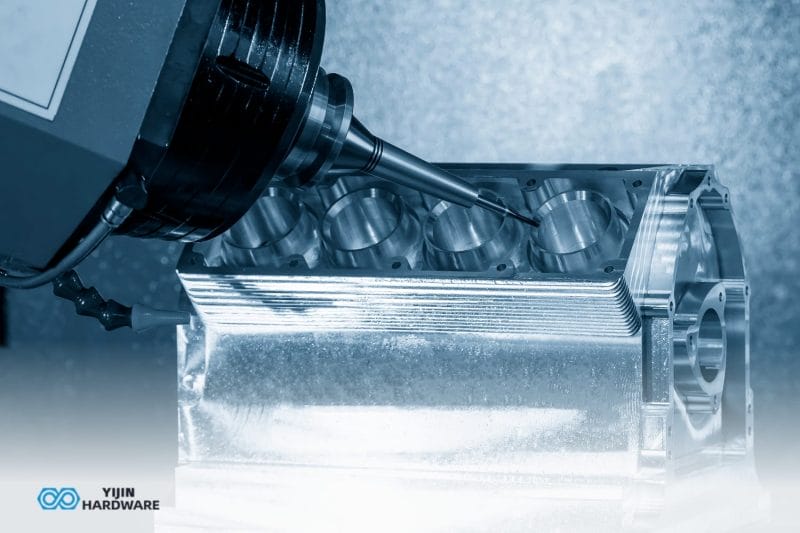
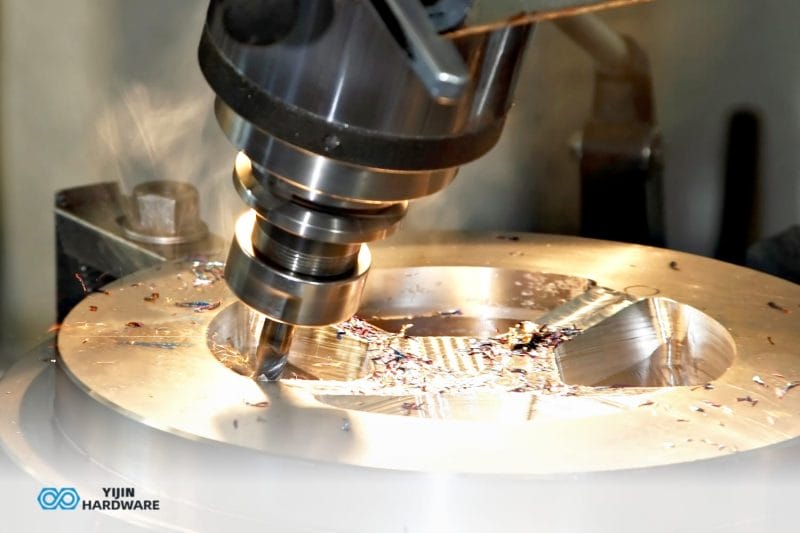
CNC machining is a subtractive manufacturing process that removes material from a solid block of material to create the final part shape. CNC machining involves using computer-controlled cutting tools to precisely cut, drill, and shape materials according to programmed instructions. CNC machining allows working with a wide range of materials, including metals (aluminum, steel, titanium) and plastics (ABS, POM, PEEK).
How the CNC Process Works
- Design Phase: Creation of 3D model using CAD software
- CAM Programming: Conversion of 3D model to toolpaths and G-code
- Machine Setup: Material fixturing and tool selection
- Machining Operation: Computer-controlled material removal
- Quality Inspection: Verification of dimensions and tolerances
The CNC process begins with a CAD (Computer-Aided Design) model that is translated into machine instructions through CAM (Computer-Aided Manufacturing) software. These instructions, known as G-code, direct the CNC machine’s movements with exceptional precision. Common machines include 3-axis CNC mills for simple parts, 5-axis CNC mills for complex geometries, CNC lathes for cylindrical components, and routers for larger flat sheet materials.
Types of CNC Machines and Their Applications
- 3-axis CNC mills: Standard machines for basic parts with features accessible from top and sides
- 5-axis CNC mills: Advanced machines capable of complex geometries and undercuts
- CNC lathes: Specialized for cylindrical parts with rotational features
- CNC routers: Large-format machines for wood, composites, and sheet materials
What is Plastic Injection Molding and How does it Work?

Plastic injection molding is a manufacturing method that creates parts by injecting molten material into a custom-designed injection mold cavity. Once injected, the material cools and solidifies into the shape of the mold cavity, creating the final part. This process is primarily used for thermoplastics like ABS, polypropylene, polycarbonate, and polyethylene.
The Injection Molding Cycle Explained
- Clamping: The two halves of the mold are secured together under pressure
- Injection: Plastic pellets are melted and injected into the mold cavity
- Dwelling: Pressure is maintained as material cools to prevent backflow
- Cooling: The molten plastic solidifies taking the shape of the mold
- Ejection: The mold opens and ejector pins remove the finished part
- Reset: The cycle restarts for the next part
The injection molding process involves several key components: an injection unit that melts and delivers the plastic, a custom mold that shapes the part, and a clamping system that holds the mold closed during injection. Modern injection molding machines are categorized by their clamping force (typically 30-4,000 tons) and shot capacity, which determine the maximum part size and material volume they can process.
Types of Injection Molds
- Single-cavity molds: Create one part per cycle, lower cost option for lower volumes
- Multi-cavity molds: Create multiple identical parts per cycle, more efficient for higher volumes
- Family molds: Create different related parts in a single cycle
- Hot runner molds: Advanced systems that minimize material waste and cycle time
How do CNC Machining and Injection Molding Compare on Key Factors?
CNC machining vs.injection molding differ fundamentally across multiple factors, including cost structure, production speed, and material compatibility. Understanding these differences is essential for making cost-effective manufacturing decisions.
| Factor | CNC Machining | Plastic Injection Molding |
|---|---|---|
| Initial Investment | Low to moderate | High (expensive mold fabrication) |
| Per-Unit Cost | Higher (remains relatively constant) | Lower (decreases with volume) |
| Production Volume | Ideal for low to medium (1-500 units) | Optimal for high volume (500+ units) |
| Typical Tolerances | ±0.001″ (0.025 mm) | ±0.005″ (0.127 mm) |
CNC machining offers greater flexibility and precision with lower initial investment, while injection molding offers unmatched efficiency and economy for large production runs once the mold is created. The fundamental difference in approach—removing material versus forming it—impacts everything from cost structure to design capabilities.
Which Manufacturing Process Offers Better Precision and Tolerances?
CNC machining provides significantly tighter tolerance than injection molding, typically achieving ±0.001″ (0.025 mm) precision compared to injection molding’s ±0.005″ (0.127 mm). This superior precision makes CNC machining the preferred choice for parts requiring exact dimensions and fine details. The direct control over cutting tools allows for more precise feature creation than is possible with the flow dynamics of molten plastic.
Injection molding’s tolerances are affected by material shrinkage during cooling, mold wear over time, and process variables like temperature and pressure. The physics of how molten plastic flows and cools creates inherent limitations in achievable precision. While adequate for many applications, parts requiring the highest precision typically need machining.
When Precision Matters Most
- Aerospace components: Critical flight systems often require CNC machining’s superior tolerances
- Medical devices: Surgical instruments and implantable devices benefit from CNC precision
- Optical components: Lens housings and precision mounts demand tight tolerances
Parts with critical dimensions often utilize a hybrid approach—producing the basic shape through injection molding, then finishing precise features with secondary CNC machining operations. When it comes to injection molding, compared to CNC machining, CNC machining wins in precision and tolerances.
What Materials Can Each Process Use?
CNC machining works with a significantly broader range of materials than injection molding, including metals, plastics, wood, and composites. Common CNC-machinable materials include aluminum, steel, titanium, brass, copper, plastics (ABS, POM, PEEK, PC), wood, and various composites.
| Material Category | CNC Machining | Injection Molding |
|---|---|---|
| Metals | Aluminum, Steel, Titanium, Brass, Copper | Limited to Metal Injection Molding (MIM) |
| Thermoplastics | ABS, PEEK, POM (Delrin), PC, HDPE | ABS, PP, PE, PC, PA (Nylon), POM, PS |
| Thermosets | Phenolics, Epoxy | Limited applications |
| Other | Wood, Composites, Ceramics | Elastomers, TPE, TPU |
Injection molding primarily works with thermoplastics that can be melted and reformed repeatedly. Materials like polycarbonate (PC), High-density polyethylene (HDPE), and ABS are widely used due to their excellent flow properties. Engineering-grade plastics like PEEK often require CNC machining due to their high processing temperatures and costs.
What are the Cost Considerations CNC Machining and Plastic Injection Molding?
When outsourcing to a service provider like Yijin Solution, CNC machining typically has lower initial costs but higher per-part costs compared to injection molding. For CNC machining services, you’ll primarily pay for programming time, machining time, material costs, and finishing operations, with typical part costs ranging from $25 to $200+, depending on complexity and material.
Injection molding services require substantial upfront investment for mold creation—typically $1,500 to $5,000 for simple molds and up to $100,000+ for complex molds. However, once the mold is created, per-part service costs drop dramatically—often to just $1-$5 per part.
Total Project Cost Analysis
- Short run (1 to 100 parts): CNC machining almost always more economical
- Medium run (100 to 500 parts): Requires detailed analysis of specifics
- Large run (500+ parts): Injection molding typically more economical
- Long-term production: Consider mold maintenance and replacement costs
For short runs or one-time orders, CNC machining services generally provide better value. For ongoing production needs exceeding several hundred units, the higher initial investment in injection molding tooling typically pays for itself through substantially lower per-part costs.
How do Design Complexity and Flexibility Compare?
CNC machining is highly precise at creating complex external geometries and precision features, but faces limitations with internal features for part design due to tool accessibility constraints. The cutting tool must be able to physically reach every surface that needs machining.
| Design Feature | CNC Machining | Injection Molding |
|---|---|---|
| Internal Geometries | Limited by tool access | Excellent capability |
| Undercuts | Difficult, may require multiple setups | Possible with side actions |
| Wall Thickness | Flexible, no minimum | Requires uniformity (0.5-3 mm typical) |
| Sharp Corners | Excellent capability | Limited by material flow |
| Textured Surfaces | Limited, requires special tools | Excellent, can be built into a mold |
What are the Finish and Appearance Capabilities of Each Method?
CNC machining produces an excellent surface finish through controlled cutting parameters and various post-processing options. Machined parts can achieve surface roughness as low as 0.8μm Ra (micrometers roughness average), creating smooth, precise surfaces.
Different tool types and machining strategies can create various textures and surface patterns, while secondary operations like polishing, anodizing, powder coating, and bead blasting can enhance appearance and performance characteristics.
The fundamental differences in how each of the two processes creates surfaces directly impact their aesthetic qualities. CNC machining creates surfaces through direct tool contact, allowing for precise control but potentially leaving tool marks. In contrast, injection molding replicates the mold surface exactly, which can produce exceptionally smooth or deliberately textured finishes but requires the mold itself to have the desired finish quality.
Common Surface Treatments and Finishes
CNC Machining Surface Treatments:
- Mechanical polishing (achieves mirror finishes)
- Bead/sand blasting (creates matte textures)
- Anodizing (for aluminum, adds color and corrosion resistance)
- Powder coating (adds durable colored finish)
- Chemical treatments (passivation, blackening)
Injection Molding Surface Treatments:
- Mold texturing (creates consistent patterns)
- In-mold decoration (adds graphics during molding)
- Painting and coating (secondary operations)
- Pad printing (adds text or graphics post-molding)
- Heat treatments (improve surface properties)
Surface Finish Application Examples
- Consumer electronics: Injection molded housings with custom textures for grip and aesthetics
- Medical instruments: CNC machined stainless steel with electropolished finish for sterilization
- Automotive components: Combination of molded parts with selective machined surfaces for critical interfaces
What are the Lead Time and Production Speed Differences?
CNC machining offers shorter lead time but slower per-part production compared to injection molding. A CNC-machined part can often be produced within 5-15 business days from design approval. This makes CNC machining ideal for prototype and urgent production needs.
Injection molding has longer initial lead times due to mold fabrication, which typically takes 4 to 8 weeks. However, once the mold is ready, production speed is unmatched—cycle times range from seconds to minutes per part, and multiple-cavity molds can produce large numbers of parts simultaneously.
Typical Timeline Comparison
| Production Stage | CNC Machining | Injection Molding |
|---|---|---|
| Initial Setup/Tooling | 1 to 5 days | 4 to 8 weeks |
| First Parts Production | 5 to 15 days | 4 to 10 weeks |
| Additional 100 Units | 1 to 2 weeks | 1 to 2 days |
| Additional 1,000 Units | 4 to 8 weeks | 1 to 2 weeks |
For time-sensitive projects requiring immediate parts, CNC machining is fast at delivering first articles, while injection molding delivers superior long-term production efficiency.
What Industries and Applications Favor Each Manufacturing Method?
CNC machining is preferred in aerospace, medical, automotive, and other industries requiring precision parts in moderate volumes. CNC milling is particularly valuable for parts that must be made from specific high-performance materials or that require tight tolerances.
Real-World Application Examples
CNC Machining Applications:
- Aerospace structural components and brackets
- Medical device prototypes and surgical instruments
- Custom automotive performance parts
- Low-volume production of specialized industrial equipment
- Precision jigs and fixtures for manufacturing
Injection Molding Applications:
- Consumer electronic housings and components
- Automotive interior and under-hood plastic components
- Medical device housings and disposable components
- Packaging components produced in millions of units
- Toys, household items, and consumer products
Many products leverage both technologies at different stages—using CNC machining for prototyping and initial market testing, then transitioning to injection molding once designs are finalized and volume justifies the tooling investment.
What Environmental and Sustainability Factors Should Be Considered?
CNC machining creates more material waste than injection molding due to its subtractive nature. According to Science Direct, CNC machining can definitely be more sustainable if the machining parameters are optimized to lessen material waste.
Material utilization rates typically range from 30-70% depending on part geometry. In contrast, injection molding’s material efficiency can reach 85-95% since almost all material enters the final part.
| Sustainability Factor | CNC Machining | Injection Molding |
|---|---|---|
| Material Efficiency | Lower (30-70% material utilization) | Higher (85-95% material utilization) |
| Energy Per Part | Higher | Lower for high volumes |
| Recyclability | Material-dependent | Most thermoplastics recyclable |
| Chemical Usage | Cutting fluids and coolants | Release agents and colorants |
| Waste Stream | Solid waste (chips) | Primarily sprue and runner waste |
Yijin’s Sustainable Manufacturing Approaches
At Yijin Solution, we implement comprehensive sustainability practices for both manufacturing methods:
- Material recovery systems that reclaim and recycle CNC machining chips
- Closed-loop cooling and lubrication systems that minimize water consumption
- Energy-efficient equipment with advanced power management
- Optimized nesting and cutting strategies to maximize material utilization
- Water-based coolants that reduce environmental impact
How to Make the Final Decision Between CNC Machining and Injection Molding?
The optimal manufacturing service choice depends on analyzing four key factors: production volume, material requirements, design complexity, and timeline. Production volume is typically the most decisive factor—choose CNC machining services for quantities under 500 units and injection molding services for quantities over 1,000 units.
Decision Flowchart for Service Selection
- Evaluate Production Volume
- Under 500 units → Likely CNC machining service
- Over 1,000 units → Likely injection molding service
- 500-1,000 units → Requires further analysis
- Consider Material Requirements
- Metal parts required → CNC machining service
- Specialized engineering plastics → Check compatibility with both services
- Standard thermoplastics → Either service depending on other factors
- Analyze Design Complexity
- Complex internal features → Favors injection molding service
- Precision external features → Favors CNC machining service
- Design might change → Favors CNC machining service
- Assess Timeline and Budget
- Need parts quickly → CNC machining service (shorter lead time)
- Long-term production → Injection molding service (better economy)
- Limited upfront budget → CNC machining service (lower initial investment)
Yijin Solution offers a specialized consultation service to determine whether a hybrid approach might be optimal for your specific application. Our engineering team can analyze your design for “split manufacturing” potential and develop phased manufacturing plans.
Case Study: Hybrid Manufacturing Approach
A medical device manufacturer came to Yijin Solution with a product requiring both high precision and eventual high volume. We implemented a phased approach:
- Initial prototypes: Full CNC machining for rapid iteration and testing
- Market validation: Small batch (200 units) CNC machined for market testing
- Production scaling: Main housing injection molded with critical interfaces CNC machined
- Full production: Multiple cavity mold with optimized design for 10,000+ units annually
This approach balanced time-to-market, investment timing, and long-term cost optimization.
Yijin Solution | Affordable CNC Machining and Injection Molding
The choice between CNC machining and plastic injection molding services represents a critical manufacturing decision. For businesses needing custom parts, CNC machining services offer unmatched flexibility, precision, and material versatility for low to medium production volumes. In contrast, injection molding services deliver unbeatable efficiency and economy for high-volume production for plastic parts once the initial mold investment is made.
To summarize the key decision factors:
- Choose CNC machining for lower volumes, precision requirements, material flexibility, and when designs might change
- Choose injection molding for higher volumes, complex internal features, and long-term production efficiency
- Consider volume thresholds, material compatibility, and design requirements when making your decision
Yijin Solution provides both manufacturing services, offering comprehensive analysis to determine the optimal process for your specific project requirements. For consultation on your next manufacturing project or to request a service quote, contact Yijin Solution today.
CNC Machining vs. Plastic Injection Molding FAQs
Can injection molded parts be as strong as CNC machined parts?
Injection molded parts can be structurally robust, but typically aren’t as strong as CNC machined parts made from solid material. The injection molding process may introduce weld lines where material flows meet. However, proper material selection and design optimization can create injection molded parts with excellent strength-to-weight ratios suitable for most applications.
Is it possible to combine both manufacturing methods for a single product?
Yes, hybrid approaches that leverage injection molding and CNC machining are increasingly common. Many products use injection molding for the main body, while using CNC machining for precision features. For example, a medical device might use injection-molded housings with CNC-machined precision components for optimal cost-performance balance.
What are the most common defects in injection molding and how can they be prevented?
Common injection molding defects include sink marks (depressions near thick sections), flow lines (visible patterns from material flow), warping (part distortion during cooling), and flash (excess material at parting lines). These defects can be prevented through proper mold design with uniform wall thickness, optimized gate placement, appropriate processing parameters (temperature, pressure, cooling time), and material selection with suitable flow characteristics.
How do the types of CNC machines affect part capabilities and costs?
Different CNC machines have significant impacts on capabilities and costs. 3-axis mills handle basic geometries cost-effectively but require multiple setups for complex features. 5-axis mills can create complex geometries in a single setup, reducing labor costs and improving accuracy but at higher machine rates. CNC lathes are optimal for cylindrical parts with rotational features. Machine selection affects not only technical capabilities but also pricing, with more advanced machines commanding premium rates but potentially reducing overall costs through efficiency.
Back to Top: CNC Machining vs. Plastic Injection Molding






 English
  Spanish
  German
  French