


At some point in a fabrication project, the question comes up: should this part be sheet metal or plate metal? It may come up during design, when a drawing is reviewed, or when a quote comes back higher than expected.
At first glance, the two seem similar. Both are flat metal stock, and both are available in steel, aluminum, and stainless steel. But they are processed differently, and that difference affects cost, lead time, tolerances, and part performance.
A common dividing line is 6 mm. In ASTM standards and day-to-day fabrication practice, that thickness often marks the shift from sheet to plate, along with a change in the equipment, methods, and applications involved.
This article explains the difference between sheet metal and plate metal, when each one is used, and what that choice means in production.
Quick Comparison Table of Sheet Metal vs. Plate Metal
The table below gives a clear side-by-side overview of the main differences in thickness, processing methods, common applications, cost considerations, and more. It’s a helpful starting point if you want to compare the two options quickly.
| Attribute | Sheet Metal | Plate Metal |
|---|---|---|
| Thickness range | Under 6 mm and up to ~4.5 mm in standard gauges | 6 mm and above |
| Typical measurement | Gauge number | mm or inches |
| Weight per unit area | Lighter | Significantly heavier |
| Formability | High — readily bent, stamped, drawn | Low — forming requires heavy pressure or heat |
| Fabrication processes | Laser cutting, punching, bending, stamping, roll forming | Plasma/waterjet/flame cutting, heavy welding, machining |
| Structural strength | Moderate — suited to enclosures, panels, brackets | High — suited to load-bearing, impact-resistant, structural roles |
| Surface finish options | Wide — cold-rolled, hot-rolled, galvanized, coated | More limited — hot-rolled most common; cold-rolled for tighter tolerance |
| Relative material cost | Lower per unit weight | Higher per unit weight |
| Common materials | Mild steel, stainless steel, aluminum, copper, brass | Structural steel, stainless steel, aluminum alloy plate, AR/wear plate |
| Typical tolerances | ±0.10 mm precision / ±0.30 mm standard | ±0.25–0.50 mm typical for cut edges |
| Lead time for Yijin Solution fabrication | Prototyping: 3–7 days / Production: 7–15 days | Varies by secondary operations |
What is the Difference Between Sheet Metal and Plate Metal
Thickness Range & Typical Measurement
Sheet metal is flat metal stock under 6 mm thick. Plate metal is flat metal stock at 6 mm or greater. The thickness determines the classification, the fabrication approach, and the structural role the material can fill.
Sheet thickness is expressed in gauge, which is a unit-less number. A higher gauge means a thinner sheet. Plate thickness is specified directly in millimeters or inches. This matters because the gauge-to-mm conversion is not universal: a 10-gauge steel sheet measures 3.43 mm, while a 10-gauge aluminum sheet measures 3.57 mm. The same gauge number produces different thicknesses depending on the metal.
A gauge chart translates these numbers into actual dimensions that you can specify on drawings.
| Gauge | Steel Sheet (mm) | Steel Sheet (in) | Aluminum Sheet (mm) | Aluminum Sheet (in) | Stainless Steel (mm) |
|---|---|---|---|---|---|
| 30 | 0.30 | 0.012 | 0.30 | 0.012 | 0.30 |
| 22 | 0.76 | 0.030 | 0.81 | 0.032 | 0.76 |
| 18 | 1.27 | 0.050 | 1.27 | 0.050 | 1.27 |
| 16 | 1.52 | 0.060 | 1.62 | 0.064 | 1.52 |
| 14 | 1.90 | 0.075 | 2.03 | 0.080 | 1.90 |
| 12 | 2.66 | 0.105 | 2.95 | 0.116 | 2.66 |
| 10 | 3.43 | 0.135 | 3.57 | 0.141 | 3.43 |
| 8 | 4.18 | 0.165 | 4.11 | 0.162 | 4.18 |
| 7 | 4.55 | 0.179 | 4.55 | 0.179 | 4.55 |
Sheet metal gauge chart
It’s important to note that parts specified at exactly 6 mm may fall into either category depending on your fabricator’s classification. Confirm this before finalizing drawings, particularly if the part sits at the boundary between formed sheet geometry and machined plate construction.
Common Applications

Sheet Metal
Sheet metal’s combination of formability, low weight, and fast fabrication cycle makes it suitable for high-volume, precision-sensitive, and weight-constrained industries. These are the common applications of sheet metal:
- Automotive & Transportation: Body panels, doors, bonnets, underbody shields, HVAC ducting, and structural brackets. Formability, consistent surface finish, and gauge-controlled weight are the key drivers.
- Aerospace & Defense: Fairings, access panels, interior lining components, brackets, and antenna housings. Aluminum and stainless steel sheets specified for strength-to-weight ratio in gauges 14–22.
- Electronics & Enclosures: Server chassis, control panels, junction boxes, and custom electronic enclosures. Stainless steel and mild steel sheets in 1–3 mm gauges, laser-cut and press-brake formed.
- Architecture & Construction: Roofing panels, cladding, flashings, and HVAC ductwork. Galvanized and aluminum sheet chosen for corrosion resistance and roll-form compatibility.
- Industrial Equipment: Guards, covers, frames, brackets, and mounting plates. Sheet’s fast laser-cut-and-bend cycle makes it cost-effective for short-to-medium runs without tooling investment.
- Medical Devices: Instrument enclosures, trays, and housings. Stainless Steel 304 and 316L sheets specified for cleanability, biocompatibility, and compliance with ISO 13485 requirements.
Plate Metal
You should specify plate metal when load-bearing capacity, impact resistance, or pressure containment exceeds what formed sheet geometry can achieve. These are the applications in which plate thickness is non-negotiable:
- Structural Construction: Steel columns, gusset plates, base plates, and connection details. Structural steel plate in 10–50 mm thickness, typically specified to ASTM A36 or equivalent structural grade.
- Shipbuilding & Marine: Hull plating, decks, and bulkheads. Corrosion resistance and weld integrity under sustained load are the primary specs; plate grade and coating system are selected together.
- Heavy Machinery & Mining: Wear plates, chassis frames, bucket liners, and support structures. Often specified in AR400 or AR450 abrasion-resistant plates for extended service life in high-abrasion environments.
- Pressure Vessels & Tanks: Boiler shells, chemical storage tanks, and pressure vessel walls. Material specifications follow ASME Boiler and Pressure Vessel Code or PED requirements, with mandatory material traceability throughout.
- Tooling & Mold Bases: Mold plates, die sets, and bolster plates for injection molding and stamping tooling. Plate stock provides the material removal allowance that machined tooling requires.
- Defense & Ballistic Protection: Vehicle armor and blast shields. High-hardness steel plate selected by ballistic performance standards. Thickness and Brinell hardness values are both specified on the drawing.
Fabrication Processes

Material form selection changes the equipment, the weld procedures, the post-processing steps, and the cost structure of your part. This is the detail you may miss when specifying at the boundary between sheet and plate.
Sheet Metal Fabrication Processes
- Laser cutting: The primary process for sheet metal up to approximately 20 mm. It is fast, dimensionally accurate, and capable of complex 2D profiles without tooling. At Yijin Solution, our laser cutting handles sheets up to 2440 × 1220 mm with cut-edge tolerances of ±0.10 mm.
- Punching & stamping: High-speed production of repeated hole patterns and formed features. Once the tooling is amortized, this process offers cost-effectiveness for medium-to-high volumes.
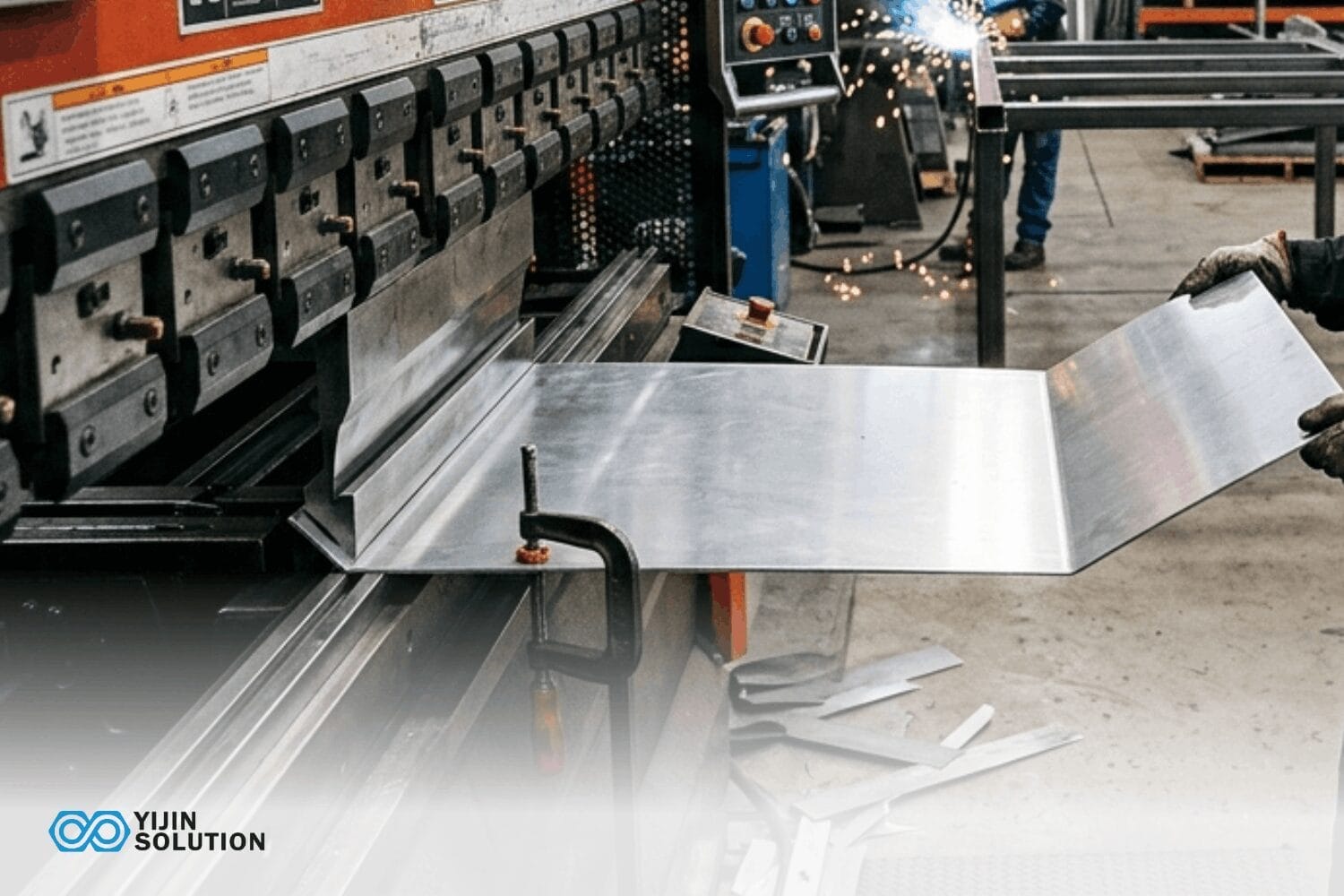
- Bending & press brake forming: Sheet is bent to a specified angle on a press brake. Most sheet metals bend cleanly without cracking at gauges under 3 mm. Thicker gauges require larger press tonnage and wider minimum bend radii. Both processes should be confirmed with the fabricator before drawing release.
- Roll forming: Sheet is progressively formed through a series of rollers to produce continuous profiles like channels, angles, and corrugated panels. Economical at high volumes for consistent cross-section parts.
- Welding: MIG, TIG, and spot welding are all standard for sheet metal assemblies. Thin gauge under 1.5 mm requires TIG or spot welding, as MIG at full heat causes burn-through on light gauge material.
Plate Metal Fabrication Processes
- Plasma & flame cutting: Standard for plates above 6 mm and faster than laser at its thickness. However, edge quality is rougher and a heat-affected zone is produced. Waterjet is preferred where tight tolerances or HAZ sensitivity apply.
- Waterjet cutting: Cold-cuts plate without producing a heat-affected zone. It is used for high-alloy steels, hardened plates, or any application where thermal distortion at the cut edge affects downstream machining tolerances.
- Sawing: Bandsaw or circular saw for straight cuts on structural plate and bar stock. Low setup cost, slow cycle time making it suitable for low quality requirements.
- Heavy welding: Plate joints require multi-pass weld procedures, pre-heat for sections above 20 mm, and post-weld stress relief heat treatment for structural or pressure-rated assemblies. Welding consumable selection and procedure qualification add lead time that sheet metal welding does not.
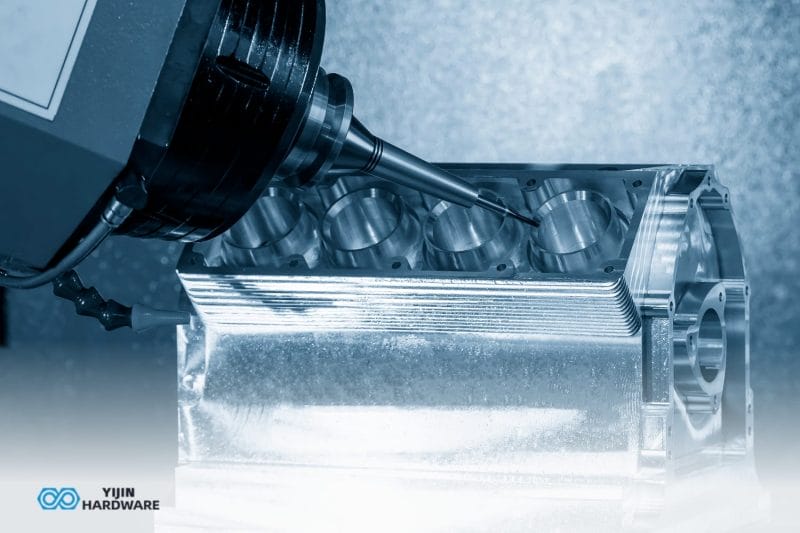
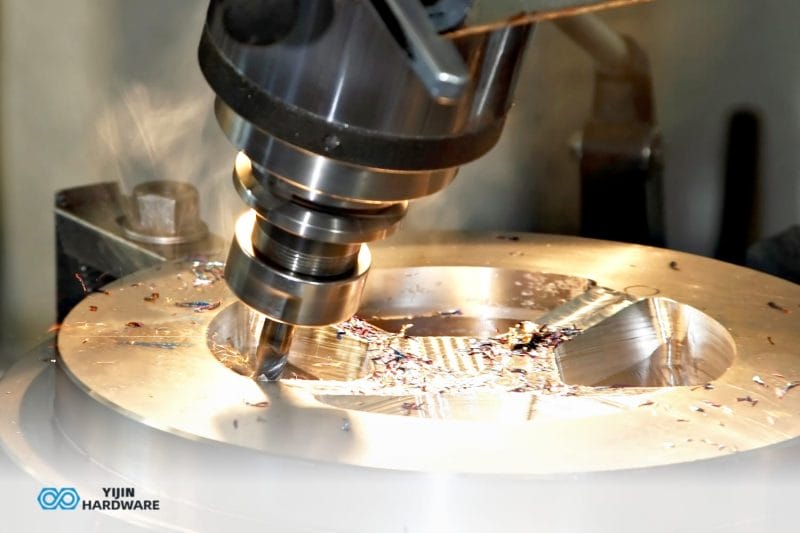
- CNC machining: The plate is machined after cutting to achieve tight-tolerance features. Yijin’s CNC machining service holds ±0.01 mm precision on plate-sourced components, with secondary operations carried out under the same order as fabrication.
Material Options by Form
Most metals are available in both sheet and plate form, but the specific grades, surface conditions, and stock sizes differ by form factor. Here’s how the most common materials break down:
- Mild / Carbon Steel: Available in cold-rolled, hot-rolled, and galvanized sheet and plate. Cold-rolled sheet delivers a cleaner as-supplied surface for painted or coated applications. The A36 plate is the standard structural starting point for machined frames and welded structures.
- Stainless Steel: Sheet grades 304 and 316L are standard for medical, food processing, and architectural applications requiring corrosion resistance and cleanable surfaces. Stainless steel plates are used for pressure vessels, chemical tanks, and heavy marine applications where weld-through thickness and chemical exposure combine.
- Aluminum: Sheet grades 6061-T6 and 5052-H32 are seen in aerospace panels, automotive components, and enclosures. Both offer excellent formability and strength-to-weight ratios. Plate grade 6061-T651 is the standard starting material for machined structural components, tooling fixtures, and mold bases.
- Copper & Brass: Primarily available in sheet form. Copper sheet is used for electrical busbars and heat exchangers; brass sheet is used for decorative architectural elements and precision-formed components. Plate grades are less common and typically sourced to order for specific conductivity or load-bearing applications.
Tell us your material, thickness, and application, and we’ll confirm the right form factor and fabrication method for you. We’ll also give you a free DFM review within 24 hours.
How to Choose Between Sheet Metal and Plate Metal
A useful way to think about the choice is to start with the part’s structural role. If the design gains strength mainly from bends and formed geometry, a thinner format is often enough. If it relies more on section thickness and material mass for strength, a thicker form is usually more suitable. Once that distinction is clear, the differences in fabrication method, cost, and typical application become much easier to understand.
Choose Sheet Metal When:
- Wall thickness under 6 mm is sufficient, and part geometry rather than material mass carries the structural load.
- The part requires bending, stamping, or roll forming. Sheet’s ductility is the property that makes these processes viable without cracking or springback failures.
- Weight is a design constraint. Sheet’s lower mass per unit area is an advantage in aerospace, automotive, and portable equipment where every gram has a cost.
- Prototype lead time matters. Sheet metal’s laser-cut-and-bend cycle produces first articles in days, with no tooling required. Punching and stamping tooling adds cost only when volume justifies it.
- Surface finish is a specification requirement. Cold-rolled sheet delivers a cleaner as-supplied surface than hot-rolled plate. This is an important detail for painted, anodized, or coated final finishes.
Choose Plate Metal When:
- Wall thickness of 6 mm or above is required to carry structural load, resist impact, or contain pressure. Geometry alone can’t substitute for a material selection at these load levels.
- The application involves welded structures, large frames, or heavy-duty machinery bases. Plate stiffness and weld joint thickness are structural requirements, not design preferences.
- The part will be CNC machined after cutting. Plate stock provides the material removal allowance needed to achieve tight tolerances on bores, mating faces, and threaded features.
- Abrasion resistance, wear resistance, or ballistic protection is a specification. These properties only exist in plate grades and have no sheet metal equivalent.
- The part is a mold base, tooling plate, or fixture. Plate stock is the standard starting form for all tooling applications, as sheet gauge doesn’t provide the section depth that machined tooling requires.
Conclusion
Getting the material specification right sets the project up for success. Turning that specification into a finished part that matches your drawing is where the right fabrication partner makes the difference.
At Yijin Solution, every project begins with a Design for Manufacturability review before any material is cut. Our engineering team works through your drawing with the fabrication process in mind — confirming that the design is set up to produce consistent, accurate parts from the first article through to volume production. It is a collaborative step that saves time and keeps the project moving.
From prototyping to production, everything runs through the same Shenzhen facility. Sheet metal fabrication, CNC machining for tighter features, and secondary operations are all handled under a single order, with no handoffs between suppliers and no variation between your approved samples and your production parts. We support parts up to 2440 × 1220 mm and tolerances up to ±0.10 mm. Prototype lead times run 3–7 days; production runs 7–15 days.
Backed by AS9100D, IATF 16949, and ISO 13485 certifications, we help you move forward with greater confidence in quality, consistency, and manufacturability. Have a drawing ready? Request a free DFM review and sheet metal quote to confirm your material, thickness, and fabrication route before you release the part.
Sheet Metal vs. Plate Metal FAQs
What is the thickness cutoff between sheet metal and plate metal?
The industry-standard cutoff is 6 mm, or 0.25 inches. Metal under 6 mm is classified as sheet; metal at 6 mm or above is classified as plate. Some suppliers draw the line slightly differently, so confirm the classification with your fabricator when specifying parts near the boundary.
What does sheet metal gauge mean, and how do I convert it to millimeters?
Gauge is a unit-less legacy measurement for sheet metal thickness. A higher gauge number means a thinner sheet. The conversion to millimeters varies by metal type: 16-gauge mild steel is 1.52 mm, while 16-gauge aluminum is 1.62 mm. Always specify thickness in millimeters or decimal inches on engineering drawings to prevent supplier misinterpretation and ensure dimensional consistency across materials. Take a look at our sheet metal gauge conversion table above for reference.
Is plate metal stronger than sheet metal?
Plate metal carries a higher structural load per section than sheet metal of the same alloy, because greater thickness provides more material cross-section to resist bending, shear, and impact forces. A well-designed sheet metal part using ribs, flanges, and formed geometry achieves high stiffness with far less material weight. Therefore, sheet metal dominates in aerospace and automotive body structures where weight is a primary design constraint.
Can sheet metal be welded the same way as plate metal?
Sheet metal under 3 mm requires TIG or spot welding because MIG at standard parameters causes burn-through on thin gauge. Plates above 6 mm are welded with multi-pass MIG or flux-core processes, with preheat required for sections above 20 mm to prevent hydrogen cracking and achieve full joint penetration. Weld procedure and filler selection must match both the base metal and the section thickness. Note that they’re not interchangeable between sheet and plate applications.
What tolerances can I expect from sheet metal fabrication?
Laser cutting of sheet metal achieves ±0.10 mm precision on cut edges under our standard process, with ±0.30 mm as the standard fabrication tolerance. Bending tolerance is typically ±0.5° on angle, which translates to ±0.2–0.5 mm positional variation depending on flange length. For tighter features, CNC machining after fabrication is standard practice and achieves ±0.01 mm.
What is the lead time for sheet metal fabrication parts?
Our sheet metal prototyping runs 3–7 days; production orders run 7–15 days, depending on complexity, secondary operations, and volume. Unlike injection-molded or die-cast parts, sheet metal fabrication requires no tooling lead time. Laser programs load directly from your CAD file. One-off and short-run parts go from drawing to first article faster than any other metal fabrication process.
Back to Top: Sheet Metal vs. Plate Metal: What’s the Difference






 English
  Spanish
  German
  French