
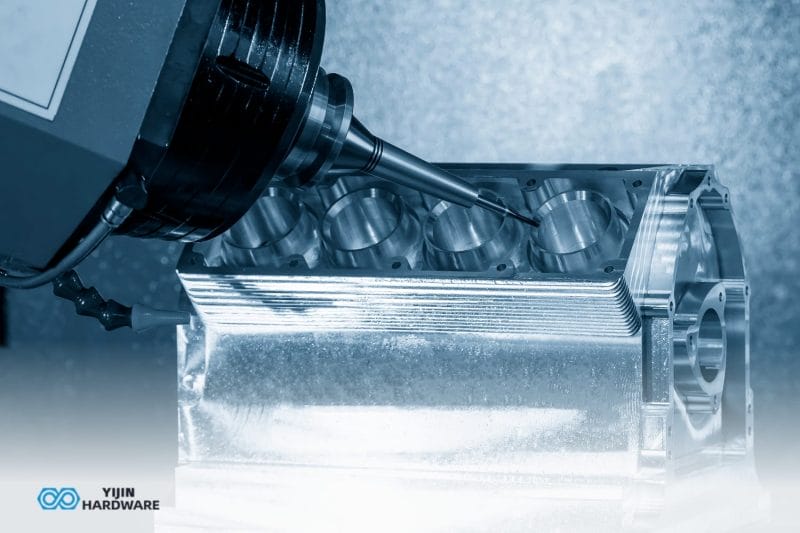
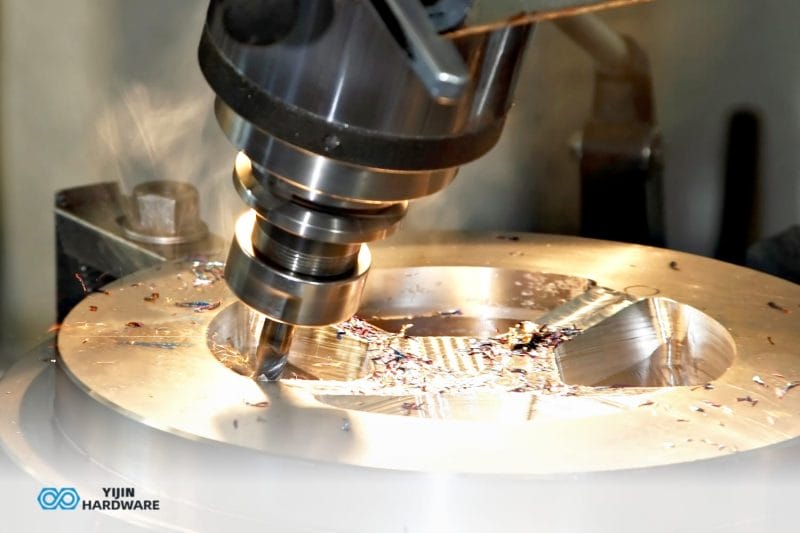

CNC machining removes material from solid blocks to create industrial components, while sheet metal fabrication shapes flat metal sheets into useful items. You’ll often choose CNC for complex 3D parts requiring tight tolerances, and sheet metal fabrication for items needing bends, folds, or large flat surfaces.
According to Markets and Markets, the global CNC machine market was valued at approximately $67.5 billion in 2023. This market is expected to grow to $80.4 billion by 2028. At Yijin Solution, you can order your CNC machining services online without hassle. We’ve also created this guide to help you understand the differences between CNC machining and sheet metal fabrication.
Key Takeaways
- There are process and material differences between CNC machining and sheet metal fabrication.
- CNC machining is best for custom parts with complex geometries.
- Both fabrication and machining can be used for prototyping.
- CNC machining is more costly, but gets you a higher precision in regard to shapes and detail.
What is the Main Difference Between CNC Machining and Sheet Metal Fabrication?

The main differences between CNC machining and sheet metal fabrication are the type of process and the forms of the materials used. CNC machining excels at creating complex 3D shapes with high precision from solid materials. Sheet metal fabrication focuses on transforming flat metal sheets into functional parts through operations like cutting, punching, bending, and welding.
Here’s a quick guide on the main differences between how CNC sheet metal machines manufacture sheet metal, and how CNC machining works:
| Feature | CNC Machining | Sheet Metal Fabrication |
|---|---|---|
| Process Type | Subtractive manufacturing | Forming and assembling metal sheets |
| Material Form | Solid blocks or billets | Flat metal sheets |
| Ideal Applications | Precision parts with complex geometries | Enclosures brackets panels and chassis |
| Common Materials | Aluminum steel plastics and composites | Steel aluminum copper and brass |
| Tolerance and Precision | Very high precision and tight tolerances | Moderate precision, suitable for larger parts |
| Typical Volume | Low to medium volume production | Medium to high volume production |
| Setup and Cost | Higher setup time and cost per part | Lower setup cost and efficient scaling |
Fabrication vs. Machining | Can Both Processes Be Used for Prototyping?
Yes, both fabrication and machining can be used for prototyping. You’ll find fabrication better for structural components and housings, while machining works best for precision parts. Your choice depends on your prototype’s requirements, complexity, and budget. Many successful prototypes use both processes.
Fabrication for Prototyping
- Larger components like frames and enclosures.
- Cost-effective solutions for simple shapes.
- Quick turnaround times for basic structures.
- Flexibility for design modifications.
Machining for Prototyping
- Tight tolerances for mechanical components.
- Complex geometries and internal features.
- Compatibility with various materials.
- High-quality surface finishes.
What are the Main Cost Differences Between CNC Machining and Sheet Metal Fabrication?
Sheet metal fabrication costs less for simple, large parts with minimal waste. Different types of CNC machining costs more due to material waste and programming time. But CNC machining also delivers higher precision. Your production volume, design complexity, and material choice determine which offers better value for your project.
These are the situations when sheet metal fabrication is more cost-effective:
| Situation | Description |
|---|---|
| Part Size | Large simple parts |
| Design Complexity | Parts with bends and basic cutouts |
| Production Volume | Medium to large production runs |
| Material Specification | Parts made from standard sheet thicknesses |
And these are when CNC machining is more cost-effective:
| Situation | Description |
|---|---|
| Design Complexity | Complex geometries |
| Precision Requirements | Extremely tight tolerances |
| Feature Requirements | Parts with internal features |
| Production Volume | Low-volume high-precision components |
How does the Precision of CNC Machining Compare to that of Sheet Metal Fabrication?
CNC machining achieves higher precision than sheet metal fabrication, with tolerances as tight as ±0.0005 inches compared to sheet metal’s typical ±0.005 inches. Your parts requiring extreme accuracy or complex geometries will benefit from CNC, while sheet metal works for less demanding applications.
| Precision Factor | CNC Machining | Sheet Metal Fabrication |
|---|---|---|
| Tolerances | As tight as ±0.0005 inches | Typically, ±0.005 to ±0.030 inches |
| Complex Geometries | Maintains consistent accuracy | Less precise |
| Internal Features | Creates precise cavities | Limited precision |
| Dimensional Stability | Holds tighter stability | Variable (affected by bending) |
| Surface Finish | Superior | Standard |
Which Industries Benefit Most from CNC Machining?

Aerospace, medical device, automotive, and defense industries benefit most from CNC machining due to their need for high-precision parts with complex geometries. Your parts requiring tight tolerances and consistent quality will see the greatest advantage from CNC’s accuracy and repeatability.
Aerospace
The aerospace industry pushes the boundaries of what’s possible in precision manufacturing. When jet engines roar to life at 30,000 feet, their components must perform flawlessly despite extreme thermal stresses and relentless vibration. Behind every successful flight lies an intricate dance of lightweight yet incredibly strong structural elements—where a single gram of unnecessary weight can translate to thousands in additional fuel costs over an aircraft’s lifetime.
Critical flight systems demand meticulous attention at every production stage, with multi-layered quality inspections that would seem excessive in any other industry. The stakes couldn’t be higher: components that fail at cruising altitude don’t just cause inconvenience—they risk catastrophe.
Medical Device Manufacturing
The human body is remarkably unforgiving to foreign materials, which is why implantable devices require not just dimensional perfection, but also immaculate surface finishes that won’t trigger rejection or inflammation. Behind the scenes of modern healthcare marvels are diagnostic machines whose reliability we take for granted.
The difference between detecting a tumor at stage one versus stage four often comes down to the precision of components that translate infinitesimal signals into life-saving early diagnoses.
Automotive
Today’s vehicles are rolling laboratories of engineering innovation, with prototype components passing through countless iterations before you ever see them on the showroom floor. Under the hood, high-performance engines push metallurgical limits—where microscopically precise fuel delivery systems and perfectly balanced rotating assemblies extract maximum energy from every drop of fuel.
The competitive world of motorsport takes these demands to extremes. When victory margins are measured in thousandths of a second, custom racing components deliver those crucial advantages—whether it’s a precisely engineered suspension component that maintains ideal tire contact through a corner, or a lightweight drivetrain part that reduces rotational mass for explosive acceleration.
Defense and Military
When soldiers depend on their equipment in combat situations, “good enough” isn’t in the vocabulary. Weapon systems combine hundreds of precision components that must function flawlessly in environments ranging from arctic ice to desert sandstorms. Communication systems—the lifeline of modern military operations—require housings that can shield sensitive electronics while being tossed in transport vehicles or exposed to enemy jamming attempts.
Military vehicles operate in conditions commercial equivalents would never survive. From amphibious assaults to mountain patrols, their specialized components contend with corrosive salt water one day and freezing temperatures the next—all while possibly facing hostile fire. The unsung heroes of combat effectiveness are often the custom-designed tactical tools that give personnel the specific capabilities their missions demand, from specialized breaching equipment to modular field repair systems.
When Should You Use CNC Machining Services for Custom Parts?
Use CNC machining services like Yijin Solution when you need custom parts with complex geometries, tight tolerances (±0.0005 inches), or special materials. Your projects requiring precision components for aerospace, medical, or automotive applications benefit most from CNC’s accuracy and consistent quality.
CNC vs. Sheet Metal Fabrication FAQs
What materials are compatible with CNC machining?
CNC machining works with almost any solid material including metals, plastics, wood, composites, and foams. Your project’s specific requirements will determine which material offers the best combination of machinability, cost, and performance properties. The versatility of CNC machining with different materials makes it suitable for everything from aerospace components to medical devices to consumer products.
Can sheet metal fabrication be used for decorative items?
Yes, sheet metal fabrication is excellent for creating decorative items like wall art, sculptures, furniture, and architectural elements. Your design ideas can be transformed into unique metal pieces through cutting, bending, and finishing techniques that highlight the material’s beauty. Modern fabrication technologies allow for incredible detail and precision, making sheet metal a versatile process for functional and decorative applications.
Which process is more environmentally friendly?
Sheet metal fabrication is generally more environmentally friendly than CNC machining because it produces less waste material. Your scraps from sheet metal can be easily recycled, while CNC machining can waste up to 90% of the original material block through cutting.
Back to Top: CNC vs. Sheet Metal Fabrication






 English
  Spanish
  German
  French