

La fabricación ajustada (lean manufacturing) es una forma estructurada de identificar y eliminar el desperdicio de la producción, paso a paso. El marco surgió de la Sistema de producción Toyota en las décadas posteriores a la Segunda Guerra Mundial y hoy es la disciplina operativa más adoptada en la fabricación.
Una investigación del Lean Enterprise Research Center de la Cardiff Business School estima que aproximadamente el 60% de la actividad en una operación de fabricación típica no aporta valor al cliente, que es la brecha que las herramientas lean están diseñadas para cerrar. Para los compradores que evalúan a un socio de fabricación, lean es señal de disciplina operativa. Un proveedor lean trabaja según el takt time, mantiene colas más cortas entre operaciones y entrega de forma más predecible que uno que trabaja con producción por lotes y colas.
Esta guía explica qué es realmente la fabricación lean en la práctica: los cinco principios básicos, los ocho desperdicios que combate, las herramientas que impulsan las operaciones diarias y las señales que indican a un comprador si un proveedor es realmente lean o solo lo dice.
¿Qué es la fabricación lean?
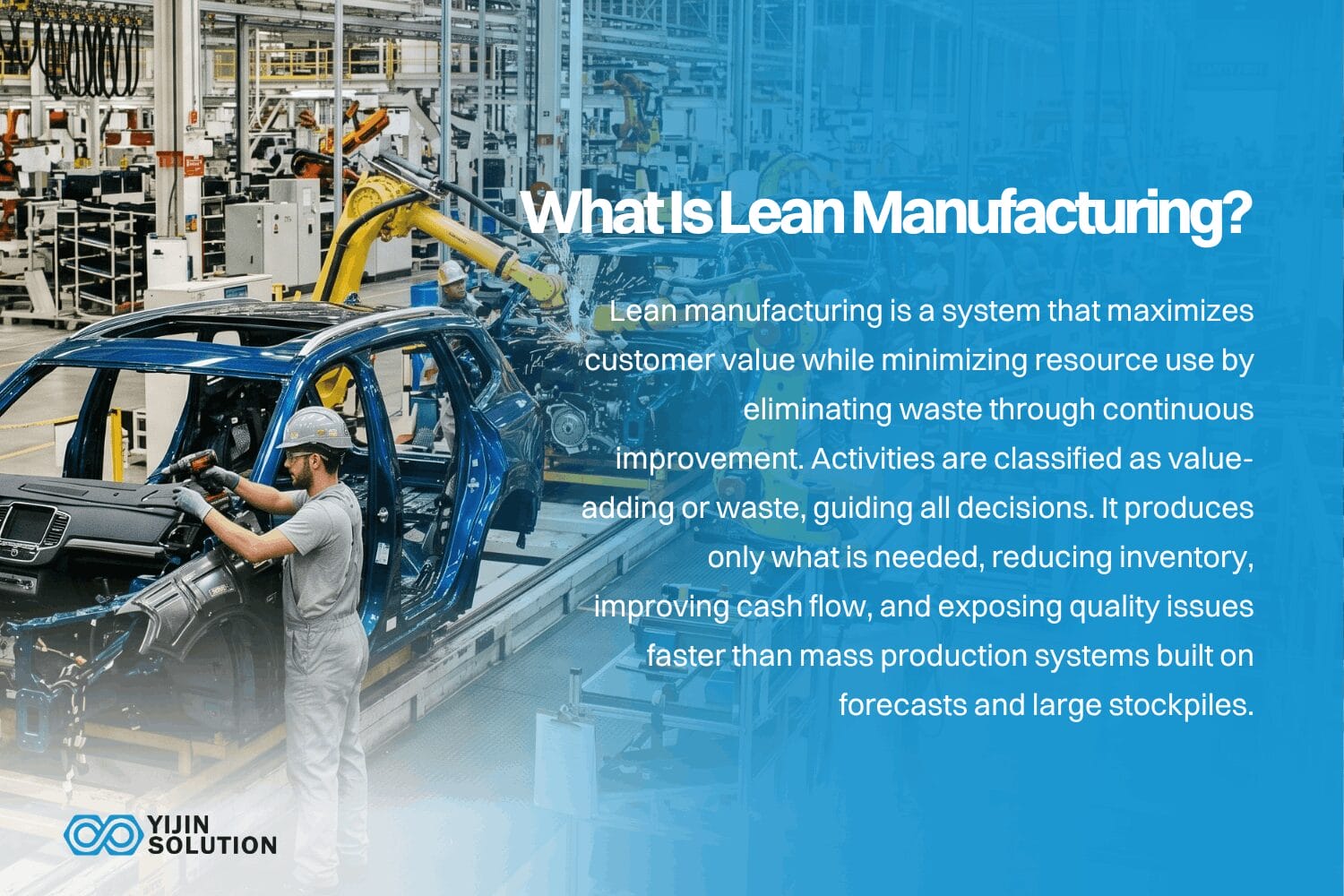
El lean manufacturing es una metodología de producción que maximiza el valor entregado al cliente y minimiza los recursos consumidos para crear ese valor. La Lean Enterprise Institute y la American Society for Quality (ASQ) lo describen como un enfoque sistemático para identificar y eliminar el desperdicio mediante la mejora continua.
Toda actividad de un proceso de fabricación pertenece a una de dos categorías: o aporta un valor por el que el cliente está dispuesto a pagar, o genera desperdicio. Este es el marco de decisión sobre el que se construye el pensamiento lean. Clasificar, mecanizar, montar e inspeccionar según especificación aportan valor. Esperar, transportar, retrabajar y sobreproducir no lo hacen.
Lean se diferencia de la producción en serie tradicional de forma fundamental. La producción en serie fabrica según previsión, mantiene grandes inventarios y absorbe el desperdicio en los gastos generales. Lean produce lo que se necesita, cuando se necesita y en la cantidad necesaria. El resultado es menos inventario, un flujo de caja más saludable y una detección más rápida de los problemas de calidad, porque las piezas defectuosas no quedan enterradas en las existencias.
El enfoque se originó en Toyota a finales de la década de 1940. Los ingenieros Taiichi Ohno y Eiji Toyoda crearon un sistema en torno a dos ideas. Jidoka significa detener la línea en el momento en que se produce un defecto. Just-in-time significa producir solo lo necesario, cuando se necesita. Toyota lo llamó Toyota Production System (TPS).
Los fabricantes occidentales adoptaron este enfoque en las décadas de 1980 y 1990 bajo el nombre de producción ajustada. El libro de 1990 La máquina que cambió el mundo popularizó el término al documentar cómo los métodos de Toyota superaban a la producción en serie tradicional en calidad, coste y velocidad de entrega. El término “lean” fue acuñado originalmente por John Krafcik en 1988 y posteriormente formalizado por James Womack y Daniel Jones.
Los cinco principios del Lean Manufacturing
La fabricación lean se basa en cinco principios fundamentales, formalizados por James Womack y Daniel Jones en su libro de 1996 Pensamiento Lean. Los principios proporcionan el marco estructural para toda implementación lean, desde el montaje de automoción hasta mecanizado CNC de precisión. La tabla siguiente resume cada principio, su pregunta clave y lo que significa para un comprador que evalúa a un proveedor.
| Principio | Pregunta clave | Qué significa en la práctica | Herramientas clave | Relevancia para el comprador |
|---|---|---|---|---|
| 1. Definir el valor | ¿Por qué paga realmente el cliente? | Elimine las actividades que no acercan la pieza al plano del cliente | Voz del cliente, revisión DFM | Proveedores que entienden los requisitos de su plano, no que solo producen en volumen |
| 2. Mapear el flujo de valor | ¿Dónde se esconden los desperdicios en el proceso? | Visualice cada paso, desde la materia prima hasta la pieza entregada | Value Stream Mapping | Plazos de entrega más cortos; menos retrasos de traspaso entre fases del proceso |
| 3. Crear flujo | ¿Las piezas se mueven de forma continua o se acumulan? | Elimine los cuellos de botella para que las piezas avancen de una en una sin colas | Fabricación celular, takt time | Entrega predecible; sin acumulación de pedidos inesperada a mitad del proyecto |
| 4. Establecer el flujo pull | ¿Fabrica bajo pedido o según previsiones? | Producción activada por la demanda real, no por previsiones de inventario | Kanban, entrega justo a tiempo | Menor riesgo de pedido mínimo; el proveedor se adapta a la demanda real |
| 5. Buscar la perfección | ¿La mejora continua forma parte de la cultura? | Mejora continua e incremental en todos los niveles | Kaizen, ciclo PDCA | Mejoras de calidad a largo plazo; la tasa de defectos disminuye con el tiempo |
Defina el valor: empiece por el cliente
Lean empieza por preguntar por qué está dispuesto a pagar realmente el cliente. Cada característica, tolerancia o paso del proceso por el que el cliente no pagaría es candidato a eliminarse. En la fabricación de precisión, esto significa fabricar según los requisitos del plano, ni más ajustado ni más holgado.
Mecanizar en exceso una superficie no crítica con una tolerancia más ajustada que la que exige la especificación desperdicia tiempo de máquina sin aportar valor al cliente. Un proveedor ágil preguntará por los requisitos funcionales antes de presupuestar.
Mapee el flujo de valor: encuentre dónde se esconde el desperdicio
El value stream mapping (VSM) es una herramienta visual que traza cada paso que da una pieza desde la materia prima hasta el producto acabado. Cada paso se clasifica como de valor añadido o sin valor añadido. Un VSM típico revela que el tiempo real de mecanizado es una fracción pequeña del plazo de entrega total; el resto es espera, transporte y amarre.
Los proveedores que aplican VSM pueden identificar y eliminar los retrasos de traspaso que inflan el plazo de entrega sin aportar nada a la pieza acabada.
Crear flujo: mantener las piezas en movimiento
Una vez eliminados los pasos que no aportan valor, el objetivo es que los pasos restantes funcionen de forma continua. El flujo implica que las piezas pasan de una operación a la siguiente sin colas, sin lotes y sin esperas.
El takt time es la métrica de control del flujo. Se calcula como el tiempo de trabajo disponible por turno dividido entre la demanda del cliente por turno. Si un turno dura 480 minutos y el cliente necesita 96 piezas, el takt time es de 5 minutos por pieza. Cada puesto de trabajo debe completar su operación dentro del takt time. Los cuellos de botella rompen el flujo e inflan el plazo de entrega de todos los pedidos posteriores.
Un proveedor que controla el takt time puede dar plazos de entrega realistas basados en su capacidad de producción real, no en estimaciones optimistas.
Establecer el flujo: fabricar bajo pedido, no según previsiones
Un sistema pull produce solo lo que el proceso posterior o el cliente ha solicitado. Nada se fabrica de forma especulativa. Un sistema push produce según previsión y normalmente genera exceso de trabajo en curso que se convierte en desperdicio u obsoleto.
El kanban es la herramienta de arrastre más habitual en fabricación. Originalmente eran tarjetas físicas en Toyota; el kanban es un sistema de señalización visual que autoriza la producción o el reabastecimiento solo cuando se consume el material. La entrega just-in-time (JIT) funciona con la misma lógica.
Un proveedor orientado al arrastre no fabricará piezas antes de que la demanda esté confirmada ni presionará al comprador para que acepte una entrega anticipada. Su producción se activa con el pedido.
Buscar la perfección: hacer de la mejora continua algo estructural
El quinto principio no es un proyecto con fecha de finalización. Es un compromiso de la organización con la mejora continua e incremental. El kaizen, término japonés que significa “cambio a mejor”, actúa en todos los niveles, desde ajustes en un puesto de trabajo individual hasta rediseños del layout de todo el sistema.
El ciclo Planificar-Hacer-Verificar-Actuar (PDCA) proporciona la estructura de mejora: identificar un problema, probar una solución, evaluar el resultado y estandarizar lo que funciona. Este ciclo se repite indefinidamente. McKinsey ha observado que las empresas que implantan lean suelen lograr mejoras iniciales, pero se estancan porque aplican las herramientas lean sin la filosofía que las sustenta. Las herramientas por sí solas no mantienen los resultados.
Los proveedores que aplican el kaizen reducen sus tasas de defectos con el tiempo. Un proveedor con seis años de implantación lean debería tener un control de proceso mediblemente mejor que uno que la puso en marcha el trimestre pasado.
Los ocho desperdicios del Lean Manufacturing
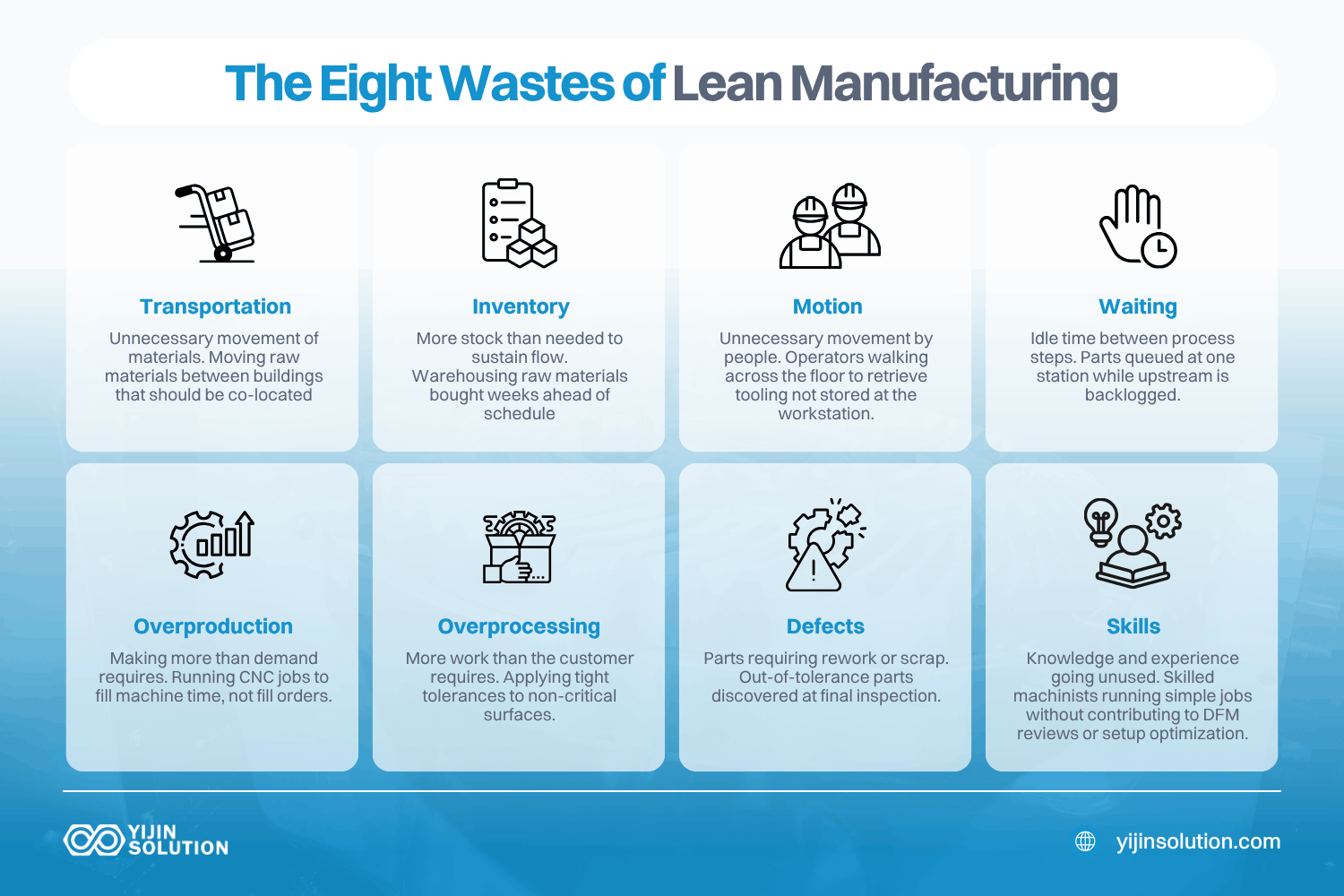
Taiichi Ohno identificó originalmente siete categorías de desperdicio dentro del Sistema de Producción de Toyota. Una octava, el talento no utilizado, se añadió cuando los fabricantes occidentales adoptaron el lean en la década de 1990. Las ocho categorías de desperdicio se recuerdan habitualmente con el acrónimo TIMWOODS: Transporte, Inventario, Movimiento, Esperas, Sobreproducción, Sobreprocesado, Defectos y Talento. Reconocer estos desperdicios es el primer paso para eliminarlos de cualquier proceso de fabricación.
| Tipo de residuo | Definición | Ejemplo de fabricación | Herramienta Lean | Impacto práctico |
|---|---|---|---|---|
| Transporte | Movimiento innecesario de materiales | Mover materias primas entre naves que deberían estar juntas | Rediseño de la distribución, 5S | Más tiempo de manipulación, riesgo de daños y mayor tiempo de ciclo |
| Inventario | Más stock del necesario para mantener el flujo | Almacenamiento de materias primas compradas con semanas de antelación | JIT, kanban | Capital inmovilizado, riesgos de calidad por el almacenamiento, defectos ocultos que se acumulan |
| Movimiento | Movimientos innecesarios de las personas | Operarios que cruzan la nave para buscar utillaje que no se guarda en el puesto de trabajo | 5S, diseño de puestos de trabajo | Tiempo de producción perdido por operario y turno |
| En espera | Tiempo de inactividad entre fases del proceso | Piezas en cola en una estación mientras la anterior va acumulando trabajo | Equilibrado del flujo, VSM | Plazos de entrega más largos y menor rendimiento en todos los pedidos |
| Sobreproducción | Producir más de lo que exige la demanda | Ejecutar trabajos CNC para llenar el tiempo de máquina, no para completar pedidos | Kanban, takt time | Exceso de inventario en curso, costes de almacenamiento, efectivo inmovilizado en piezas sin terminar |
| Sobreprocesamiento | Más trabajo del que el cliente necesita | Aplicar tolerancias ajustadas a superficies no críticas | Revisión DFM, revisión de diseño | Mayor tiempo de mecanizado y coste por pieza sin ninguna ventaja de calidad |
| Defectos | Piezas que requieren retrabajo o se desechan | Piezas fuera de tolerancia detectadas en la inspección final | Poka-yoke, SPC | Coste de retrabajo, tasa de rechazo, retrasos en la entrega |
| Competencias | Conocimientos y experiencia sin aprovechar | Operarios de mecanizado cualificados que ejecutan trabajos sencillos sin aportar en las revisiones de DFM ni en la optimización del amarre | Kaizen, empoderamiento | Ciclos de mejora desaprovechados, resolución de defectos lenta |
El sobretratamiento es el desperdicio más difícil de detectar en el mecanizado de precisión porque las tolerancias ajustadas parecen sinónimo de mayor calidad. No lo son si el diseño no las exige. Aplicar una tolerancia de 0,01 mm a una superficie no funcional que el montaje solo necesita a 0,10 mm añade tiempo de mecanizado, aumenta el desgaste de la herramienta y eleva el coste por pieza sin mejorar el rendimiento de la pieza.
Un proveedor ágil con un buen proceso de revisión DFM detecta esto antes de que el trabajo entre en producción, no después de que la inspección de primera pieza revele que la pieza es técnicamente correcta pero comercialmente sobredimensionada.
Los ocho desperdicios están interconectados. La sobreproducción genera exceso de inventario. El exceso de inventario oculta defectos al permitir que las piezas defectuosas permanezcan sin detectar hasta que una operación posterior las revele. Atajar una categoría de desperdicio suele mejorar las demás.
Herramientas y técnicas clave de Lean Manufacturing
La fabricación lean utiliza un conjunto de herramientas prácticas para trasladar sus principios a la práctica diaria del taller. Cada herramienta se centra en un tipo concreto de desperdicio o en un paso específico del ciclo de mejora. Las seis herramientas que se describen a continuación son las que un comprador tiene más probabilidades de encontrar al evaluar o trabajar con un fabricante de precisión lean.
Value stream mapping
El VSM es un diagrama que traza cada paso de un proceso de producción para una familia de piezas concreta, desde el mecanizado y la inspección hasta las esperas y el transporte, y distingue los pasos que aportan valor de los que no. Un ejercicio de VSM en un taller de mecanizado CNC típico puede revelar que solo el 8% del plazo de entrega total es tiempo real de corte. El 92% restante es tiempo en cola, tiempo de amarre, tiempo de inspección y movimiento de material. Esa visibilidad es lo que hace posible la mejora.
Para los compradores, la disposición de un proveedor a compartir un VSM del estado actual es una señal de transparencia. Si no pueden elaborarlo, el lean es aspiracional más que operativo.
5S: clasificar, ordenar, limpiar, estandarizar y mantener
5S es un sistema de organización del puesto de trabajo que establece estándares sobre dónde va cada cosa, cómo se mantienen los puestos de trabajo y cómo se sostienen esos estándares a lo largo del tiempo. En un entorno de mecanizado de precisión, 5S significa que el utillaje se guarda correctamente, los utillajes están etiquetados y accesibles, y las estaciones de inspección están limpias y calibradas. Los entornos de trabajo desorganizados generan desperdicio por movimiento y aumentan la probabilidad de errores de amarre.
Las 5S suelen ser el punto de entrada para la implementación del lean. Son visibles, medibles y establecen la base de comportamiento para herramientas más sofisticadas como el kanban y el VSM.
Kanban: señales visuales de flujo
Kanban es un sistema de señalización visual que controla el flujo de producción. Cuando un proceso posterior consume una pieza o un material, una señal (una tarjeta, un contenedor o un aviso digital) autoriza el reabastecimiento desde el proceso anterior. Kanban evita la sobreproducción y mantiene el inventario en curso en niveles controlados. El exceso de trabajo en curso se hace visible rápidamente, lo que es el primer paso para eliminarlo.
Un proveedor que utiliza kanban tiene un enfoque disciplinado del flujo de materiales. Es poco probable que fabrique un pedido antes de plazo y lo almacene en un entorno no controlado, lo que conlleva riesgos de calidad y trazabilidad.
Kaizen: eventos de mejora continua
Los eventos kaizen son actividades de mejora focalizadas, normalmente de tres a cinco días, en las que un equipo multidisciplinar analiza un proceso concreto, identifica desperdicios, prueba soluciones e implanta mejoras estandarizadas. El ciclo PDCA aporta la estructura del kaizen. Permite probar cambios sin interrumpir el sistema de producción completo e incorpora una rutina de revisión en las operaciones continuas.
Un proveedor que realiza eventos kaizen periódicos trata la mejora de procesos como una práctica empresarial, no como una respuesta a incidentes de defectos. Pregunte a los proveedores potenciales cuántos eventos kaizen realizaron en los últimos 12 meses y qué mejoraron.
Poka-yoke: a prueba de errores
Poka-yoke se refiere a controles de proceso o características de diseño que evitan defectos haciendo que los errores sean imposibles o inmediatamente visibles. El término es japonés y significa “a prueba de errores”. En mecanizado, el poka-yoke puede ser un utillaje que solo acepta una pieza en la orientación correcta, evitando un error de amarre común. En inspección, puede ser un calibre pasa/no pasa que elimina la subjetividad de la medición.
El poka-yoke traslada la calidad de la inspección a la prevención, lo que reduce el coste de retrabajo y mejora el rendimiento en la primera pasada. Ambos factores afectan al coste por pieza y a la fiabilidad de entrega.
Producción justo a tiempo
El JIT es la estrategia de inventario que sustenta el sistema pull del lean. Las piezas y los materiales llegan a producción exactamente cuando se necesitan, no días o semanas antes. El JIT reduce los costes de almacenamiento, recorta el capital inmovilizado en inventario de materia prima y obliga a producción a mantener una disciplina de planificación fiable.
El JIT funciona bien en entornos de demanda estable. Conlleva un riesgo real en cadenas de suministro con plazos de entrega poco fiables. Un proveedor lean que opere con JIT en materiales críticos debería poder explicar su plan de contingencia para la variabilidad de los plazos de entrega de sus proveedores. Si no puede, es un riesgo de aprovisionamiento que conviene señalar.
¿Qué aporta realmente la fabricación Lean?
Lean no es un ejercicio teórico. Las empresas lo implantan porque produce resultados medibles en coste, calidad, plazo de entrega y capacidad operativa. Cada beneficio que se indica a continuación está respaldado por datos o una lógica operativa que el comprador puede verificar.
Reducción de costes: de dónde vienen los ahorros
Lean reduce el coste principalmente eliminando las actividades que no aportan valor. Plazos de amarre más cortos, menos inventario en curso, menos chatarra y menos ciclos de retrabajo reducen el coste por pieza sin tocar los precios de los materiales.
El mercado digital de fabricación lean, que abarca las tecnologías que permiten la visibilidad de datos lean, se valoró en aproximadamente 30.900 millones de dólares en 2024 y se prevé que alcance los 79.900 millones de dólares en 2032 con una CAGR del 12,6%. La escala de la inversión refleja la prioridad que los fabricantes conceden a la infraestructura que permite implantar el lean manufacturing.
Para el comprador, los ahorros del lean se traducen de dos formas: precios unitarios presupuestados más bajos y menos costes ocultos por retrabajos, reinspecciones y recargos por entregas tardías.
Reducción del plazo de entrega
El plazo de entrega es uno de los resultados lean más claros. Al eliminar las esperas, reducir los tamaños de lote y mejorar el flujo, los fabricantes lean comprimen la distancia entre la realización del pedido y la entrega. El caso de Daman Products citado anteriormente también registró plazos de entrega que pasaron de 4 a 8 semanas a 5 a 10 días tras la implantación del lean, una reducción de más del 80%. Los resultados varían según la operación y la situación de partida, pero el mecanismo es constante: el lean elimina el tiempo de cola, no el tiempo de mecanizado.
Para los compradores con plazos de desarrollo ajustados, el historial de plazos de entrega de un proveedor es un indicador directo de disciplina operativa. Solicite datos históricos de entregas a tiempo, no solo los plazos de entrega presupuestados.
Mejora de la calidad
Lean mejora la calidad integrando la inspección en cada fase del proceso en lugar de confiar en el control al final de la línea. El poka-yoke, la medición en proceso y el registro de defectos en el punto de producción detectan los problemas antes de que se acumulen.
Lean también ataca las causas raíz de los defectos (puestos de trabajo mal organizados, utillaje inconsistente, trabajo estandarizado inadecuado) en lugar de limitarse a contener sus efectos aguas abajo. Para los compradores de piezas de precisión, el sistema de calidad de un proveedor lean debe incluir inspección de primera pieza, verificación en proceso con CMM y respuestas documentadas de causa raíz ante cualquier pieza fuera de especificación.
Mayor capacidad de respuesta ante cambios en la demanda
La producción ajustada basada en la demanda se adapta mejor a los cambios de demanda que la producción en serie basada en la oferta. Cuando baja el volumen de pedidos, una fábrica ajustada reduce la producción sin acumular trabajo en curso innecesario. Cuando el volumen aumenta, escala con la misma lógica de tiempo de ciclo.
Esta flexibilidad es importante en sectores con ciclos de demanda variable. Los programas aeroespaciales, las tandas de desarrollo de dispositivos médicos y los cambios de modelo en automoción se benefician de proveedores capaces de ajustarse sin plazos de entrega excesivos ni presión de pedido mínimo.
Lean Manufacturing en la práctica: más allá de la automoción
Toyota sigue evolucionando la fabricación lean integrándola con herramientas de producción digitales, lo que demuestra que el lean es un sistema vivo y no una metodología fija. La analítica predictiva, la visión artificial y los gemelos digitales complementan la lógica de takt time y flujo de valor que siempre ha sido central en el TPS.
Más allá de la automoción, el lean se ha aplicado en sanidad, en el desarrollo de software a través de las raíces lean del Agile, y en logística. La lógica subyacente (eliminar las actividades que no aportan valor, producir según la demanda, mejorar de forma continua) es independiente del sector. Un estudio revisado por pares publicado en la National Library of Medicine el impacto medible y documentado de lean en la eficiencia, el coste y los resultados en pacientes en entornos sanitarios.
En la fabricación de piezas de precisión, los mismos principios dan lugar a plazos de entrega más cortos, procesos de calidad documentados y estructuras de coste por pieza que reflejan la eficiencia productiva y no solo las economías de escala.
Cómo se implanta el Lean Manufacturing
La implantación de lean sigue una secuencia estructurada. Para los compradores que evalúan a un proveedor, entender estos pasos ayuda a distinguir una práctica lean genuina de una adopción superficial.
Pasos habituales en una implantación lean
Paso 1: Evalúe el estado actual: Realice un mapa de flujo de valor de las líneas de producción clave. Documente los tiempos de ciclo, los tiempos de espera, las tasas de defectos y los niveles de inventario.
Paso 2: Identifique los desperdicios prioritarios: Clasifique los desperdicios por coste e impacto en la frecuencia. La espera y la sobreproducción suelen conllevar las consecuencias económicas más graves en entornos de fabricación de alta variedad.
Paso 3: Implantar 5S: Establecer la organización del puesto de trabajo como base del comportamiento. La gestión visual y los puestos de trabajo estandarizados van antes que herramientas de nivel superior como el kanban.
Paso 4: Ejecute eventos kaizen piloto: Pruebe las herramientas lean en una sola familia de productos antes de escalar. Documente los resultados con datos medibles, no solo con la actividad.
Paso 5: Estandarice y mantenga. Consolide las mejoras con instrucciones de trabajo estandarizadas. Integre ciclos de revisión PDCA en el plan de producción. El lean se mantiene con disciplina, no con inercia.
Retos habituales en la implementación lean
Resistencia cultural: La fabricación lean exige que los trabajadores cambien hábitos establecidos y comuniquen los problemas con transparencia. Las organizaciones sin seguridad psicológica tienen dificultades para mantener el kaizen.
Elegir herramientas sin entender el sistema: Investigación de McKinsey señala que las empresas suelen implantar herramientas lean individuales sin la filosofía subyacente, logrando mejoras a corto plazo que se diluyen en pocos meses.
Dependencia de la cadena de suministro: La producción JIT exige plazos de entrega fiables por parte de los proveedores. Los proveedores que no entregan de forma constante obligan a los compradores a mantener inventario de seguridad, lo que anula por completo la lógica del sistema pull.
Lean no es un programa de recorte de costes: Cuando el lean se plantea como reducción de plantilla, el compromiso de los empleados se derrumba y la cultura de mejora continua no llega a arraigar.
Cómo evaluar si un proveedor es realmente lean
Esta es la pregunta más práctica que un comprador puede responder antes de hacer un pedido. Los criterios que figuran a continuación separan el lean operativo del lean de marketing.
- Solicite mapas de flujo de valor: Un proveedor realmente lean dispone de VSM del estado actual de sus principales líneas de producción. Si no puede elaborar uno, lo de lean es una aspiración.
- Busque gestión visual en el taller: La implantación de 5S, los tableros de producción, las señales andon y los estantes kanban son indicadores visibles de una infraestructura lean. Solicite una visita a las instalaciones o fotos.
- Pregunte por los datos de evolución de la tasa de defectos: Los proveedores lean hacen un seguimiento del rendimiento a la primera, la tasa de rechazo y la frecuencia de retrabajos a lo largo del tiempo. La tendencia importa; debería mejorar, no mantenerse plana.
- Consulte sobre el soporte DFM: Un proveedor lean revisa los diseños antes de la producción para identificar riesgos de sobreprocesado. Un proveedor lean inicia la conversación sobre la revisión DFM en lugar de esperar a que se lo pidan.
Trabajar con un fabricante de precisión Lean
Lean es un sistema de disciplinas, no una etiqueta de marketing, y la forma más fiable de confirmar que un proveedor lo aplica es pedir los artefactos de la práctica: VSM, tendencias de tasa de defectos y proceso de revisión DFM. En Yijin Solution aplicamos la fabricación lean desde la revisión DFM hasta la inspección final, con asesoramiento técnico gratuito que detecta riesgos de sobreprocesado antes de que empiece el mecanizado.
Envíe un archivo CAD para una revisión DFM y un presupuesto en 24 horas.
Preguntas frecuentes sobre Lean Manufacturing
¿Cuál es la diferencia entre fabricación lean y Six Sigma?
La fabricación lean se centra en eliminar el desperdicio del proceso de producción para mejorar el flujo y reducir el plazo de entrega. Six Sigma se centra en reducir la variación y los defectos mediante métodos estadísticos como DMAIC. Son complementarios: lean elimina los pasos que no aportan valor y Six Sigma reduce la variabilidad en los pasos restantes. Muchos fabricantes combinan ambos bajo el marco Lean Six Sigma.
¿El lean manufacturing solo es adecuado para la producción en serie?
No, los principios lean se aplican a cualquier entorno de producción donde exista desperdicio. En la fabricación a medida, los principales objetivos de desperdicio son el tiempo de amarre, la manipulación de materiales y el inventario en curso entre operaciones. Herramientas como SMED, la fabricación celular y el kanban son eficaces con volúmenes tan bajos como la producción de una sola pieza. Lean es cuestión de disciplina de procesos, no de volumen de producción.
¿Cuánto se tarda en implantar la fabricación lean?
La fabricación lean no es un proyecto con fecha de finalización. Las mejoras iniciales de 5S y kaizen pueden mostrar resultados medibles en pocas semanas. Una cultura lean sostenible requiere de 12 a 24 meses de práctica constante a nivel de planta. Los proveedores que afirman haber “implantado lean” en un solo trimestre probablemente completaron un programa de formación, no una transformación cultural.
¿Cuál es la diferencia entre la fabricación ajustada y el Sistema de Producción Toyota?
El Sistema de Producción Toyota es el sistema operativo específico de Toyota, desarrollado por Taiichi Ohno a partir de finales de la década de 1940. La fabricación lean es el marco generalizado derivado del TPS, formalizado por James Womack y Daniel Jones y adoptado en sectores de todo el mundo. El TPS es el sistema de origen; el lean es la aplicación transferible de sus principios.
¿Cómo se relaciona la fabricación lean con la sostenibilidad y el impacto ambiental?
Lean y sostenibilidad ambiental comparten una lógica central: eliminar el desperdicio. Reducir la sobreproducción disminuye el consumo de material. Reducir el transporte disminuye el uso de energía. Reducir los defectos disminuye la chatarra enviada a vertedero. La Agencia de Protección Ambiental de Estados Unidos documenta esta coincidencia en su Kit de herramientas Lean y Medio Ambiente. Los fabricantes que persiguen tanto la ISO 14001 como el lean suelen comprobar que ambos sistemas se refuerzan mutuamente en lugar de competir por recursos.
Volver arriba: ¿Qué es el lean manufacturing? Principios, herramientas y cómo funciona






 English
  Spanish
  German
  French