


An electronics housing can match the CAD model exactly and still run hot, lose EMI contact at a seam, or change between the approved sample and the production lot. Each problem traces back to one of three details in the parts around the board: flat thermal faces, grounding points kept conductive after finishing, or dimensions held from sample to production.
An electronics parts manufacturer makes those mechanical parts: housings, enclosures, heat sinks, busbars, and connector bodies built to the OEM’s drawings. The category sits apart from semiconductor makers, passive component suppliers, PCB fabricators, and EMS assemblers, which make or populate the electronics themselves.
For OEMs sourcing from China, supplier evaluation starts with how a fabricator controls those three details on the drawing and on the shop floor.
What Does an Electronics Parts Manufacturer Make?
Mechanical parts in electronics carry structural, thermal, and electrical loads at once. A housing can also be the heat path and the chassis ground, so its drawing needs to state function and geometry.
Seven part families cover most of the mechanical content in an electronics product, each with its own cost-driving callouts.
| Part family | Usual process | Usual material | What the drawing should state |
|---|---|---|---|
| Machined housing | Fresado CNC | Aluminio 6061 | Wall thickness, sealing face flatness, finish, and masking |
| Sheet metal enclosure or chassis | Laser cutting, CNC bending | Cold-rolled steel, Aluminum 5052 | Bend radius, hardware inserts, finish |
| Heat sink | Mecanizado CNC | Aluminum 6061, copper | Base flatness, fin pitch, contact area |
| Busbar | CNC machining, or punching and forming | Copper C11000 | Hole position, plating, conductivity grade |
| Connector body | Torneado CNC | Latón C36000 | Threads, plating, critical diameters |
| Shielding cover | Fabricación de chapas metálicas | Stainless Steel 304 or aluminum | Contact flanges, gasket seats, finish |
| Insulator or spacer | Mecanizado CNC | PEEK | Critical dimensions, edge condition |
A drawing that shows geometry alone leaves out which faces must stay conductive or flat. Without that note, a finish can cover a grounding point and still pass dimensional inspection, and the issue surfaces in EMC testing of the finished product.
Why Do Electronics OEMs Source Mechanical Parts from China?
The case for China sourcing rests on process breadth and production scale more than unit price. Shenzhen and the wider Pearl River Delta hold dense clusters of CNC machining, sheet metal fabrication, finishing, and hardware suppliers.
That density shortens the loop between a drawing change and a revised part because sheet stock, finishing lines, and fastener suppliers sit close by. Many suppliers also hold the capacity to take a part from prototype quantities into production lots on the same factory floor.
Machined and fabricated parts under one quality system
A housing, its sheet metal cover, and its busbars often ship as one kit. When CNC machining and sheet metal fabrication run under the same quality system, drawing revisions and inspection records stay aligned across the entire kit.
Trade-offs to plan for
Three trade-offs come with China sourcing, and each is easier to manage when planned early.
- Ocean freight adds weeks to each production lot, so safety stock planning matters.
- Time-zone gaps slow drawing questions between engineering teams.
- Drawing release exposes design IP, which makes confidentiality terms part of supplier selection.
Which Materials Suit Electronic Parts?
Material sets heat path, current capacity, weight, and machining cost before any process choice. Thermal and electrical figures narrow the shortlist, and machining cost then decides between the remaining grades.
Copper leads on heat and current, aluminum balances both at lower cost, and PEEK insulates. Copper and brass figures come from Copper Development Association property data.
| Material | Thermal conductivity, W/m·K | Electrical role | Cost and machining note | Typical parts |
|---|---|---|---|---|
| Aluminio 6061-T6 | About 167 | Good conductor; common chassis ground | Fast to machine; low material cost | Housings & heat sinks |
| Aluminio 5052 | About 138 | Chassis ground | Bends well; suit-formed parts | Enclosures & covers |
| Acero laminado en frío | About 50 | Ground through plated or masked contacts | Low material cost; needs a finish against rust | Enclosures & chassis |
| Copper C11000 | About 390 | Primary conductor, about 100% IACS | Gummy chips and burrs raise cycle time | Busbars & heat spreaders |
| Latón C36000 | About 115 | Contact body, about 26% IACS | Free-machining; fast on lathes | Connector bodies & terminals |
| Acero inoxidable 304 | About 16 | Low conductivity | Slower machining; high durability | Brackets & rugged covers |
| PEEK | About 0.25 | Insulator | High material cost | Insulators & spacers |
Aluminum for housings and heat sinks
Aluminum 6061 balances heat transfer, weight, and machining speed, so mecanizado CNC de aluminio is the usual starting route for housings and machined heat sinks.
Aluminum 5052 takes over for formed enclosures because it bends to tight radii without cracking. Aluminum 6061-T6 forms cleanly only at larger bend radii.
Copper and brass for current-carrying parts
Copper C11000 moves more than twice the heat of Aluminum 6061, at a higher material cost. Busbars use it because it carries high current through a smaller cross-section than aluminum would need.
Brass C36000 gives up conductivity for lathe speed, which fits turned connector bodies.
Stainless steel and PEEK for durability and insulation
Stainless Steel 304 fits brackets and covers exposed to handling or cleaning chemicals.
PEEK insulates between conductive parts that a metal spacer would short, and it holds its shape at temperatures that soften most commodity plastics.
Which Processes Make Electronic Parts?
Most electronics programs use both CNC machining and sheet metal fabrication. The split between them sets much of the unit cost, so it belongs in the first DFM discussion.
CNC machining suits complex geometry and built-in heat paths, while sheet metal fabrication suits electronic enclosures with uniform walls at higher volume.
| Factor | CNC machined housing | Sheet metal enclosure |
|---|---|---|
| Geometría | Pockets, bosses, integrated fins, sealing grooves | Folded boxes, flat panels, covers |
| Grosor de la pared | Varies inside one part | Uniform, set by sheet gauge |
| Volume fit | Prototypes to mid-volume | Prototypes to high volume |
| Principal factor de coste | Machine time and material removed | Bends, hardware inserts, welding |
| Thermal role | Housing can double as the heat sink | Often paired with a separate heat sink |
| EMI detail | Machined gasket grooves | Overlapping flanges and gasket seats |
Mecanizado CNC
Fresado cuts housings and heat sinks from solid stock, and girando produces connector bodies from brass bar.
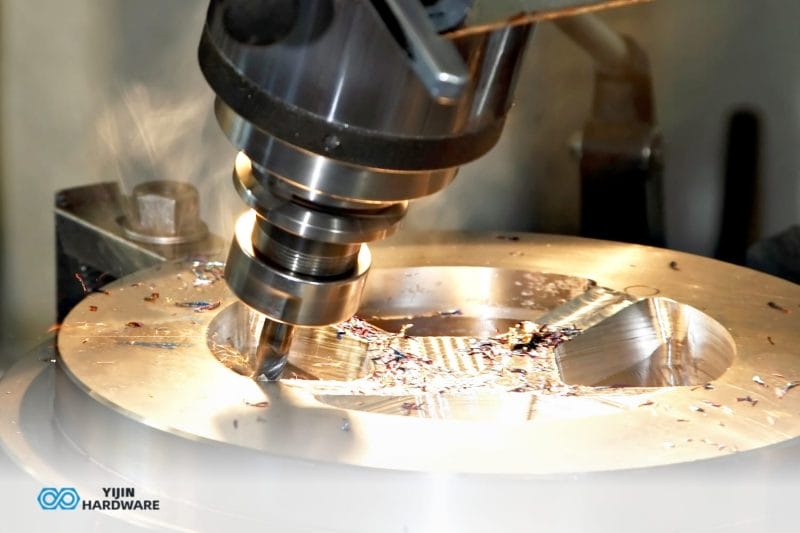
Face milling sets how flat a heat sink base ends up, so the drawing should give a flatness callout over the contact area. An uneven base thickens the thermal interface layer and traps air, which raises component temperature.
Fabricación de chapas metálicas
Laser cutting, bending, and self-clinching hardware insertion produce chassis, covers, and carcasas de chapa metálica.
Self-clinching nuts and studs need a panel softer than the fastener. Stainless steel enclosures therefore call for hardened 400-series stainless fasteners, which belong on the drawing before quoting.
Acabado de superficies
Surface finishing applies to machined and fabricated parts alike, and not every part needs it. Each finish changes conductivity, fit, or both, so the choice follows the electrical role of each face.
| Acabado | Qué aporta | Electronics consideration | Specify when |
|---|---|---|---|
| Anodizado | Corrosion resistance & color | Insulates the surface; masks grounding points | Cosmetic housings |
| Trivalent chromate conversion coating | Resistencia a la corrosión | Stays conductive; scratches easily | EMI and ground contact faces |
| Recubrimiento en polvo | Durable color | Insulates and adds thickness; masks grounding points and threads | Enclosures and covers |
| Nickel or tin plating | Stable contact resistance | Slows galvanic corrosion at copper-to-aluminum joints | Busbars, terminals |
What Quality Standards Do Electronics Buyers Expect?
Buyers should judge a parts supplier by the records it ships, not by its claims on their website. Three references come up in electronics sourcing: ISO 9001, RoHS, and ISO 2768.
Quality management under ISO 9001
ISO 9001 certification shows a documented quality system covering process control, calibration, and records. The certificate scope should name each process the buyer needs because a machining-only scope leaves sheet metal fabrication and finishing outside the audit.
Material compliance and RoHS declarations
RoHS restricts substances such as lead, cadmium, and hexavalent chromium in finished electrical and electronic equipment. Limits apply to each homogeneous material, so a plating layer counts on its own. The OEM carries product compliance, and the parts supplier supports it with material and finish declarations on request.
Free-machining Brass C36000 contains lead, so specifying it calls for a check against the exemptions the OEM relies on. Chromate conversion coatings need to be trivalent because the hexavalent type falls under the restriction.
General tolerances under ISO 2768
ISO 2768-1 general tolerances apply to every linear and angular dimension without its own tolerance once the drawing names a class such as fine or medium. Tighter callouts belong on thermal faces, grounding points, and mating features, and the achievable band depends on material and part size.
How Should OEMs Evaluate an Electronics Parts Manufacturer in China?
A five-step check narrows the supplier list before money goes into samples. Each step names a record the buyer can request and file.
1. Confirming both processes run in-house
An equipment list shows whether CNC machining and sheet metal fabrication run on the supplier’s own floor. Finishing steps such as anodizing, plating, and powder coating are commonly sent to outside shops.
For each outsourced step, the supplier should name the subcontractor and state who issues the coating thickness and material records. Those records show whether masked grounding points stayed conductive through finishing. When finishing also runs in-house, every record comes from one quality system.
2. Requesting a written DFM review
A useful DFM review flags thin walls, cost-adding tolerances, and masking gaps before the quote is final and production starts. Written answers keep decisions traceable across time zones.
3. Approving first articles against a dimensional report
The first article report pairs a ballooned drawing with measured values for thermal faces and grounding points, not only overall size. Coating thickness readings on finished parts belong in the same package since a finish changes the dimensions of the bare part.
4. Locking finish and masking on the drawing
Conductive zones, masked threads, and coating limits belong on the drawing, so each revision carries them. Incoming inspection checks every lot against those callouts, and a finishing line change should come with a written change notice.
5. Protecting drawings and planning the volume ramp
Before full drawings are released, the OEM and supplier should sign an NNN agreement covering non-disclosure, non-use, and non-circumvention, drafted to be enforceable in China.
The supplier should also confirm that prototype and production lots run on the same process route. A switch from CNC machining to stamping at volume can change edge condition, flatness, and tolerances.
How Yijin Solution Supports Electronics OEMs
Mechanical parts decide how an electronics product handles heat, grounding, and fit long after the board design is frozen. The drawing carries most of that control, and the supplier’s records show whether it held through production.
Solución Yijin machines housings, heat sinks, and busbars and fabricates enclosures, covers, and shielding parts to customer drawings, from prototype to production in one Shenzhen facility. Finishing also runs in-house, so anodizing, plating, and powder coating, along with their masking and thickness records, sit under the same quality system as the parts.
For one AI server program, the company laser cut, bent, punched, and black powder coated heat sink enclosure housings in Aluminum 6061-T6. CMM first article inspection verified the parts against the drawing, as the precision sheet metal case study documents. The ISO 9001-certified quality system draws on 281 inspection instruments, including Zeiss CMMs and X-ray testers that measure plating thickness.
Hardware teams can upload a drawing set for a free DFM review and a quote at prototype or production quantities. The review covers thermal faces, grounding points, and finish callouts before pricing.
Electronics Parts Manufacturer in China FAQs
Is aluminum or steel better for EMI shielding?
Aluminum shields high-frequency EMI more effectively than steel because of its higher conductivity, while steel performs better against low-frequency magnetic fields. Seams, gaskets, and contact faces usually decide shielding performance more than the base metal.
What is the minimum order quantity for custom electronic housings?
Custom electronic housings from an on-demand manufacturer typically have no fixed minimum order quantity, so single prototypes can be quoted. Unit price falls as quantity rises because setup and programming costs spread across more parts.
Which file formats work best for quoting electronic parts?
A STEP file plus a PDF drawing gives the fastest quote. The drawing carries tolerances, finish callouts, and masking zones that the 3D model cannot.
How long does a custom electronics housing take to make?
A custom electronics housing typically takes 3 to 7 days as a prototype and 2 to 4 weeks in production, depending on complexity. Finishing and inspection packages add time, so each quote confirms the schedule.
Volver arriba: Electronics Parts Manufacturer in China: Mechanical Parts Sourcing Guide



Gavin Yi
Gavin Yi es un destacado líder en fabricación de precisión y tecnología CNC. Como colaborador habitual de las revistas Modern Machine Shop y American Machinist, comparte sus conocimientos sobre procesos de mecanizado avanzados e integración de Industria 4.0. Sus investigaciones sobre optimización de procesos se han publicado en Journal of Manufacturing Science and Engineering e International Journal of Machine Tools and Manufacture.
Gavin forma parte de la junta de la National Tooling & Machining Association (NTMA) y con frecuencia realiza presentaciones en la International Manufacturing Technology Show (IMTS). Cuenta con certificaciones de las principales instituciones de formación en CNC, incluido el programa de fabricación avanzada de la Goodwin University. Bajo su dirección, Shenzhen Yijin Solution colabora con DMG Mori y Haas Automation para impulsar la innovación en la fabricación de precisión.



 English
 Spanish
 German
 French