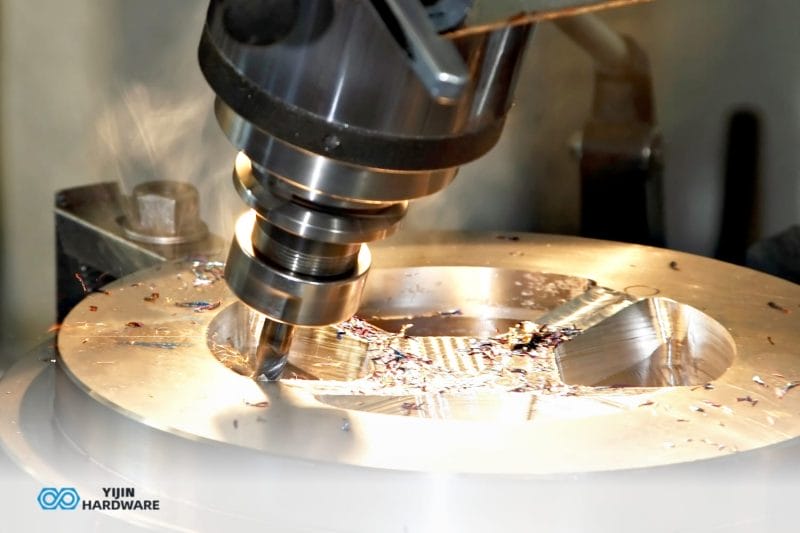

When tolerances are measured in microns, a small deviation can fail an assembly or scrap an entire batch. That is precision CNC machining territory.
This guide covers the key factors behind precision CNC machining, including tolerance requirements, material selection, and manufacturing capabilities. It also explains what to review when evaluating a supplier for precision parts.
What are Precision CNC Machining Parts?
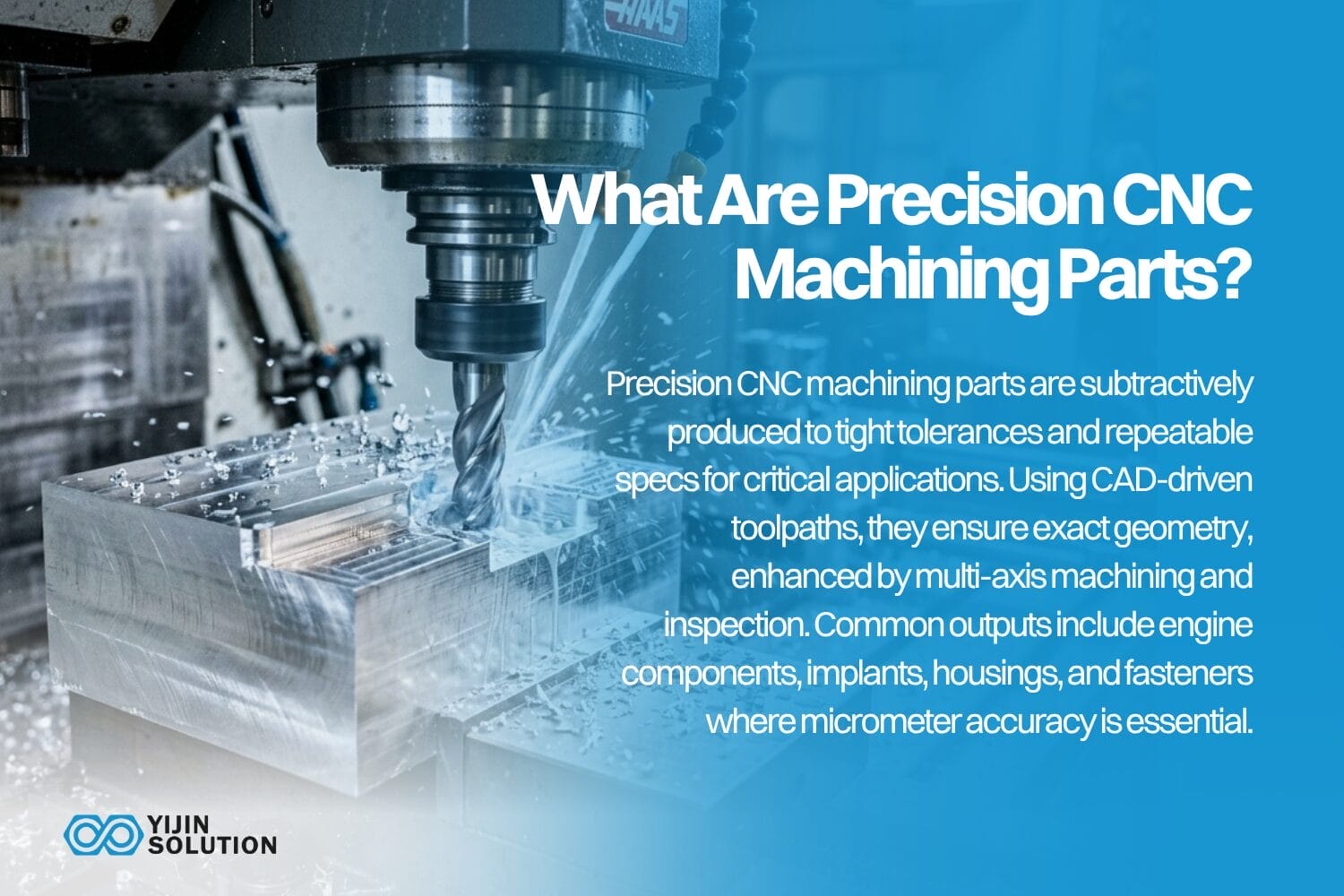
Precision CNC machined parts are components made by removing material from a solid workpiece to hit tight dimensional specs across every unit in a batch. The entire process follows a programmed toolpath from your CAD file.
Standard CNC machining gets you to within ±0.05 to 0.1 mm, but precision machining tightens that considerably: typically ±0.01 mm, and sometimes tighter. This tolerance difference goes beyond the parts themselves; it extends to the tooling, fixturing, inspection, and process controls, all working together.
Common outputs include complex engine components, surgical implants, sensor housings, optical mounts, and custom fasteners. In each case, a deviation of micrometers determines whether a part passes qualification or fails in service.
Precision vs. Accuracy in CNC Machining
These two terms are often used interchangeably on supplier datasheets, but in manufacturing, they describe two different things, and both matter for high-performance applications.
What is accuracy?
Accuracy describes how closely a machined feature matches its intended nominal dimension. A bore specified at 25.000 mm is accurate when the measured bore is 25.000 mm or within the specified tolerance band around it.
Accuracy depends on machine calibration, thermal stability in the machining environment, and the quality of the tooling. A machine can drift out of accuracy over time if temperatures fluctuate or if calibration intervals are too wide.
What is precision?
Precision refers to consistency and repeatability across multiple parts or repeated measurements. A machine that cuts a bore at 24.985 mm every single time is precise, but if the target was 25.000 mm, it is not accurate.
In a production run, precision is what makes the 500th part match the first. Without it, parts that measure close to the nominal dimension but not exactly on it introduce fit problems downstream. Small deviations compound across an assembly.
Why do both matter for high-performance parts?
Hitting tolerance once is one thing. Hitting it consistently across the full run is what a precision process needs to do. One good part tells you little if the next twenty drift.
This is especially important in industries such as aerospace and medical manufacturing, where small variations can affect part fit, surface performance, or downstream validation. A bore, sealing surface, or mating feature must not only meet its specified tolerance, but do so consistently across every part in the batch.
Inspection plays a central role in verifying both part accuracy and process consistency. Common methods include CMM inspection for dimensional verification, surface roughness measurement for finish requirements, and in-process or final inspection systems used to monitor repeatability throughout production.
Standard CNC vs. Precision CNC Machining
The table below summarizes how precision CNC machining compares to standard CNC production across the factors that matter most for your project.
| Attribute | Mecanizado CNC de precisión | Standard CNC Machining |
|---|---|---|
| Typical tolerances | ±0.01 mm for precision; ±0.005 mm for high-precision | ±0.05 to 0.1 mm |
| Acabado superficial | 0.4 to 1.6 µm as-machined | 1.6 to 6.3 µm as-machined |
| Axis capability | 3-, 4-, 5-axis machining centers | 3-axis standard |
| Inspection method | Zeiss CMM, optical sorting, VMS | Calipers, gauges |
| Repositioning setups | Reduced, 4/5-axis consolidates ops | Multiple setups typical |
| Part complexity | Complex geometries, undercuts, deep features | Simple to moderate |
| Typical applications | Aerospace, medical, EV powertrains, sensors | General industrial parts |
| Lead time | 10 to 15 days; 7 days expedited | 5 to 10 days |
| DFM review | Included at no extra cost | Often extra |
| QA documentation | FAI, PPAP Level 3, material certs | Varies by supplier |
Common Applications of Precision CNC Machined Parts
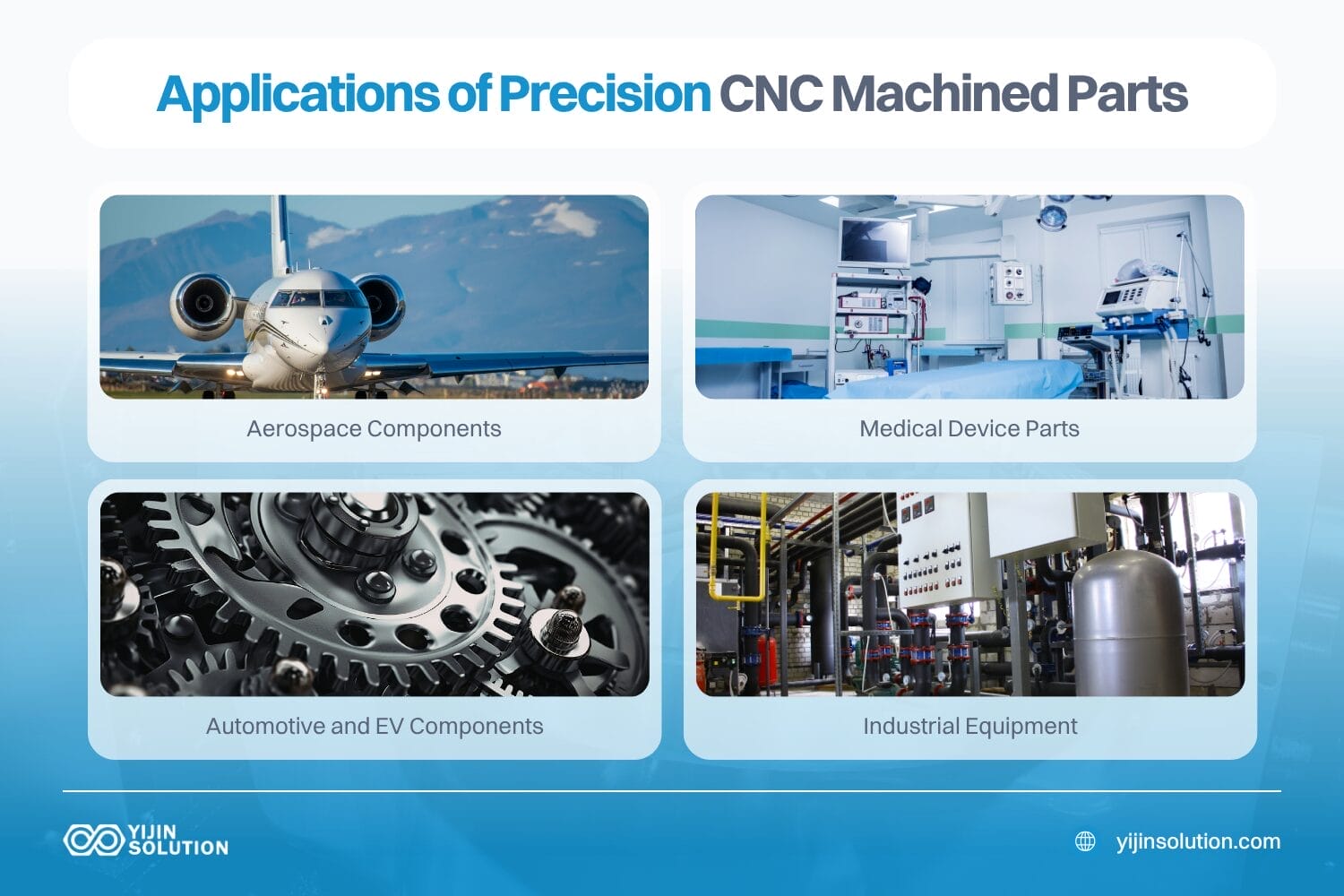
Precision CNC machined parts are common in industries that demand tight control over part accuracy, surface quality, and material consistency. Aerospace, medical, electronics, and industrial equipment all rely on these parts, since small variations can create problems in fit, function, or assembly.
Componentes aeroespaciales
Structural brackets, turbine blade attachments, actuator housings, and landing gear components all depend on tight tolerances and consistent mechanical performance.
Aluminum 7075 and Titanium Grade 5 are common material choices. They both respond well to multi-axis CNC machining and meet the strength-to-weight requirements of flight hardware.
Medical device parts
Surgical implants, instrument housings, catheter components, and imaging system parts require high dimensional stability, controlled surface finishes, and strict material traceability. Titanium Grade 5 and Stainless Steel 316L are the staples of medical CNC machining. This is because both of them are biocompatible and resistant to sterilization environments.
Automotive and EV components
Precision CNC machining supports powertrain housings, sensor brackets, valve bodies, and EV battery module components. As electric vehicle programs continue to push weight reduction targets, aluminum alloys machined to tight tolerances are increasingly replacing heavier castings in structural roles.
Industrial equipment and custom hardware
Fixtures, shafts, valves, sensor housings, and fijaciones personalizadas all rely on precision machining when standard catalog parts do not meet application requirements. A custom shaft for an industrial robot arm needs consistent runout across the full part length. A valve body for a high-pressure hydraulic system needs bore diameters held to ±0.02 mm or tighter to guarantee sealing performance. These examples represent the everyday precision work that keeps industrial equipment running.
For custom industrial fasteners or anything safety-critical, ask for material certs, dimensional inspection records, and a First Article Inspection report. If a failure in service carries real downtime or safety risk, traceability back to the raw material source is imperative.
Material Selection for Precision CNC Machined Parts
Material choice affects both part performance and how easily a part can be machined. It also influences cost, surface finish, and dimensional stability, so it needs to be evaluated against the demands of the application, not just the drawing.
The table below outlines common metals and plastics used in precision CNC machining, along with their main properties and typical uses.
| Material | Propiedades clave | Lo mejor para |
|---|---|---|
| Aluminio 6061 | Good strength-to-weight ratio, excellent machinability | Aerospace brackets, housings, structural frames |
| Aluminio 7075 | Higher tensile strength, less ductile | High-stress aerospace and defense parts |
| Stainless Steel 304/316L | Corrosion resistance, moderate machinability | Medical implants, marine components, food-grade parts |
| Titanio Grado 5 | Excellent strength-to-weight, biocompatible, low thermal conductivity | Surgical implants, aerospace structural parts |
| Latón | Free-machining, good electrical conductivity | Connectors, valves, precision fittings |
| Bronce | Wear resistance, good bearing properties | Bushings, bearings, marine hardware |
| Cobre | High thermal and electrical conductivity | Heat sinks, bus bars, electrical contacts |
| PTFE | Low friction, chemical resistance, wide temp range | Seals, bearings, medical components |
| Nylon | Lightweight, good mechanical strength | Gears, spacers, low-load structural parts |
| ABS | Impact-resistant, easy to machine | Enclosures, prototypes, light-duty parts |
| Acrílico | Optical clarity, good surface finish | Optical windows, display components |
| HDPE | Chemical resistance, low friction | Chemical tanks, food-contact parts, liners |
Metal materials for precision CNC machined parts
Aluminum 6061 and 7075
These are the two most common aluminum grades in precision machining. 6061 offers a tensile strength of roughly 310 MPa with excellent machinability and anodizing compatibility.
7075 delivers tensile strength up to 572 MPa and suits high-stress aerospace and defense applications. Its lower ductility requires tighter process control during machining to avoid surface cracking.
Stainless Steel 304 and 316L
If corrosion resistance is the main driver, 304 covers most non-aggressive environments at lower cost. However, when chloride exposure is involved, 316L is typically the better call. Thel molybdenum addition gives it better resistance to pitting.
Titanio Grado 5
Titanium Grade 5 offers exceptional strength-to-weight with full biocompatibility, which is why it appears on surgical implants and aerospace structural parts. It machines harder than aluminum, so lower cutting speeds and high-pressure coolant are typically needed to hold tolerances.
For implant-grade work, that trade-off is usually worth it. It is biocompatible and does not provoke adverse reactions in the body.
Brass, Bronze, and Copper
These materials all machine freely and hold good surface finishes. Brass is particularly useful for precision connectors, valves, and fittings. Copper’s thermal and electrical conductivity is hard to match, which is why it shows up in bus bars and heat sink components.
Plastic materials for precision CNC machined parts
PTFE
This material handles a wide temperature range from -330°F to +500°F and offers low-friction performance. It is soft enough to machine easily but requires careful fixturing because it creeps under sustained load. Medical seals and chemical-resistant components are its primary application.
Nylon
Nylon offers good mechanical strength and wear resistance for gears, spacers, and low-load structural parts. However, moisture absorption is a dimensional concern. Nylon absorbs water from the environment and expands, so parts machined to tight tolerances need to account for humidity in their intended operating environment.
ABS, Acrylic, and HDPE
Each of these materials serves specific purposes. ABS machines cleanly and handles impact well for enclosures and prototypes. Acrylic’s optical clarity makes it useful for display windows and optical components. HDPE resists most chemicals and is approved for food-contact applications.
Achieving Tight Tolerances in Precision Manufacturing
Holding tight tolerances goes beyond buying a capable machine and running parts. It requires controlling the full system at every stage. A tolerance of ±0.01 mm leaves 20 microns of total permissible variation. At that level, thermal expansion, vibration, and tool wear all become visible in the measurement data.
Advanced machining centers and tooling
For complex geometries, five-axis CNC machining centers do the heavy lifting. By moving across five degrees of freedom, a single setup can cover features that would otherwise take three or four separate repositionings on a 3-axis machine.
This suggests that the machines and tool selections matter just as much as the materials used. For instance, carbide end mills with tight runout specs can hold a consistent edge through a run. When the tool gets worn, it introduces chatter and dimensional drift before you can see it happening. Good precision shops schedule tool changes proactively rather than waiting for something to go wrong.
Multi-axis machining and reduced repositioning error
Each time a part is repositioned and re-fixtured, a small error is introduced. On a 3-axis machine producing a complex housing with features on multiple faces, that part might change hands three or four times. Each move accumulates positional uncertainty.
Four-axis and 5-axis machining centers eliminate most of those repositionings. The machine rotates the part rather than the operator re-clamping it. For aerospace and medical components, this reduction in setup count has a direct impact on yield.
Metrology and quality assurance
Measurement is where precision is verified and where deviations are identified. Dimensional inspection typically relies on coordinate measuring machines (CMMs), which probe defined points on a part and compare the measured geometry against the nominal CAD model. This process provides documented confirmation that components meet specified tolerances before shipment.
For high-volume production, optical inspection systems are used to detect surface defects and identify dimensional outliers efficiently. First Article Inspection (FAI) reports validate the first component produced from a new setup, confirming that the process is capable before full-scale production begins. In automotive applications, the Production Part Approval Process (PPAP) Level 3 documentation may be required to demonstrate that parts and processes meet customer and regulatory requirements prior to approval.
Process control and repeatability across batches
A batch of precision parts is only as reliable as the process controls that maintain consistency across every unit.
Inspection systems must be regularly calibrated and recertified to ensure measurement accuracy over time. Tool wear should be monitored against defined part counts or machining time thresholds, rather than addressed only after quality deviations occur. Fixturing must also be standardized and repeatable, ensuring each part is located and secured identically so that dimensional consistency is maintained from the first component to the last.
Design for Manufacturability for Precision Parts
Good DFM thinking reduces machining difficulty, shortens cycle time, and keeps per-part cost from growing unnecessarily. The goal is not to limit design freedom, but to ensure the design can be manufactured reliably with standard cutting tools.
Corner radii and tool access
Internal corners in machined pockets cannot be perfectly sharp, as round cutting tools always leave a radius. To improve manufacturability, internal corner radii should be designed to match standard tool sizes wherever possible, reducing the need for small-diameter tools that increase machining time and wear more quickly.
As a general guideline, specifying a corner radius of 1 mm or larger allows for efficient machining on most CNC equipment. Where sharp internal corners are functionally required, additional processes such as EDM or secondary finishing operations may be necessary, increasing both cost and lead time. Designing with appropriate radii from the outset helps avoid these constraints and supports more efficient, repeatable production.
Wall thickness and structural stability
Very thin walls flex during machining, which introduces vibration and dimensional inconsistency. A wall that moves as the cutting tool passes it will not hold the same dimension as a rigid section.
For aluminum, wall thicknesses below 0.8 mm can introduce chatter and reduce dimensional stability. Stainless steel and titanium typically require thicker minimum wall sections because of their lower rigidity during machining.
To improve manufacturability, designers should specify wall thicknesses above these minimums wherever possible. Where thin walls are functionally required, stability can be maintained by optimizing machining sequences, using appropriate support during cutting, and applying robust fixturing strategies.
Hole depth, diameter ratio, and feature complexity
Deep holes present challenges for chip evacuation, coolant delivery, and tool deflection, which can reduce straightness and dimensional accuracy as depth increases. To improve manufacturability, hole depth-to-diameter ratios should be kept within practical limits wherever possible, and standard drill sizes should be prioritized.
Where deep holes with tight tolerances are required, additional operations such as gundrilling or reaming may be necessary to achieve the desired accuracy, increasing process complexity and cost.
Similarly, complex internal geometries, narrow slots, and undercuts should be minimized or simplified where function allows, as they require additional tool changes and setups. Designing with simpler, more accessible features helps reduce cycle time, improve consistency, and lower overall production cost.
Surface finish, tolerance stacking, and cost impact
Tighter tolerances and finer surface finishes should be specified only where functionally necessary. Critical mating surfaces, sealing interfaces, and precision assemblies may require ±0.01 mm tolerances or smoother finishes to ensure proper fit and performance. Non-critical surfaces, however, do not benefit from excessive precision, and specifying tighter tolerances unnecessarily increases machining time, inspection effort, and scrap risk.
The same is true of surface finish callouts. Ra 0.4 µm on a non-sealing surface requires additional finishing operations with no functional return. Over-specification on one feature creates tolerance stacking risk in assemblies, where multiple tight-tolerance features combine their variation in ways that reduce fit yield. Specifying tolerance and finish requirements by function rather than by preference keeps per-part cost under control.
How to Assess a Precision CNC Machining Supplier
Most capable shops have similar equipment. What separates precision suppliers sits around the machines: inspection capability, process control, and engineering input at the design stage. The criteria below are the ones that matter in that comparison.
Inspection capability and traceability
A supplier’s inspection capability should match the tolerance requirements of the parts being produced. CMM measurement, surface profilometry, and optical verification systems are necessary for parts with tolerances below ±0.05 mm.
Material traceability is required for aerospace and medical programs. Ask for First Article Inspection reports and material composition documentation before committing to a supplier for critical applications.
Multi-axis machining and engineering support
Five-axis (or multi-axis) machining enables the production of complex geometries that would be difficult or impossible with traditional three-axis equipment. Features such as angled holes, contoured surfaces, and undercuts can be machined in a single setup, reducing part handling, improving dimensional accuracy, and shortening cycle times.
Equally important is engineering support. A supplier with strong DFM capability will identify potential tolerance issues, geometry conflicts, and material challenges before they cause production rejects. Early collaboration allows the engineering team to recommend design adjustments that optimize machining efficiency and yield, all while preserving the original design intent.
Quality systems and process discipline
Certifications tell you what a supplier has committed to maintaining. AS9100D covers aerospace quality management. IATF 16949 covers automotive. ISO 13485 covers medical devices. Each standard requires documented procedures, calibration records, and regular audits. A certified supplier has demonstrated that their quality system meets a defined standard, not just that they own capable equipment. Where regulatory or customer-mandated quality requirements apply, certification is a threshold, not a bonus.
Prototype-to-production continuity
A supplier that changes processes, equipment, or inspection methods between prototype and production introduces risk. The prototype confirms the design, and if the production process differs from the prototype process, the production parts may not behave the same way or have the same quality.
Prototype and production parts that have been through the same facility, same machines, and the same inspection setup are what you’re looking for. When those processes stay consistent, what you learn at prototype actually carries into production.
Streamline Your Precision Part Sourcing with Yijin Solution
Precision part sourcing is more than choosing a capable machine shop. Engineering review, machining, and inspection need to sit under one process and one quality record, so prototype tolerances carry into production and documentation stays traceable for regulated programs.
Yijin Solution’s Servicios de mecanizado CNC handle prototype and production orders with a DFM review at the quote stage, 5-axis machining in-house, and Zeiss CMM verification before shipment.
For precision work with strict tolerance or documentation requirements, upload your CAD files for a DFM review and quote within 24 hours.
Precision CNC Machining Parts FAQs
What is the standard lead time for precision CNC parts?
Standard production lead time for precision CNC machined parts at Yijin Solution is 10 to 15 days. Expedited turnaround is available for smaller orders, with low-volume orders being delivered in as few as 7 working days. Prototype parts can often be delivered even faster, allowing designers to validate and iterate on their designs before full-scale production begins. Complex multi-axis parts with full CMM inspection documentation take longer than simpler turned components.
How do you verify the dimensional accuracy of precision parts?
At Yijin Solution, dimensional accuracy is verified using 281 sets of testing instruments, with Zeiss Coordinate Measuring Machines as the primary inspection tool for tight-tolerance features. CMMs contact the part surface at specified measurement points and compare the actual geometry against the nominal CAD model.
First Article Inspection reports provide full dimensional documentation for the first part of a new production setup. For customers requiring full production documentation, PPAP Level 3 packages are available.
Can precision CNC machining handle complex geometries?
Yes, complex geometries including undercuts, compound curves, deep pockets, and fine internal features are produced using 4-axis and 5-axis machining centers. These machines reduce the number of part setups required for complex work. Fewer repositionings mean fewer opportunities for positional error to accumulate.
Parts that would need four setups on a 3-axis machine can typically be completed in one or two setups on a 5-axis center, improving both dimensional consistency and cycle time.
What tolerances can precision CNC machining achieve?
Achievable tolerances depend on part design, material, feature size, and machining strategy. At Yijin Solution, standard CNC machining holds to ±0.05 mm, with precision machining tightening that to ±0.01 mm, and high-precision operations reaching down to ±0.005 mm on favorable materials and geometries. Custom fasteners run between ±0.05 mm and ±0.02 mm, depending on thread form and feature. The right tolerance for a feature should be specified by its function.
Volver arriba: Precision CNC Machining Parts: Tolerances, Materials, and Capabilities