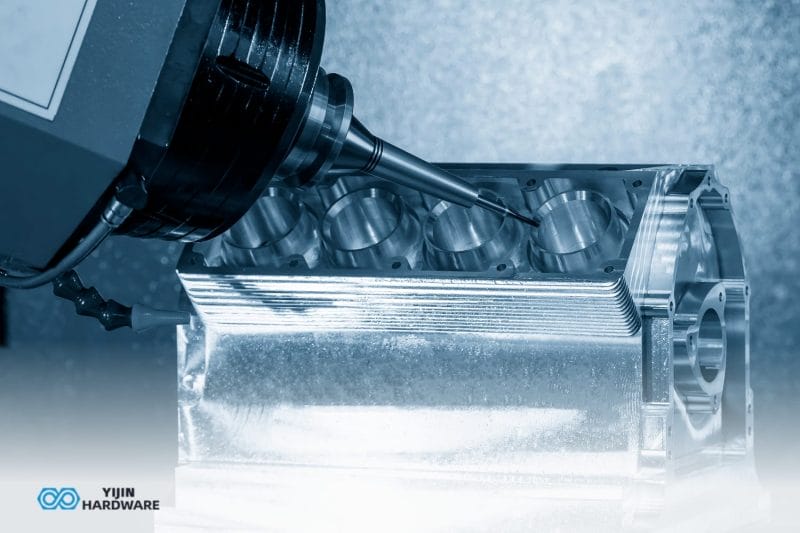
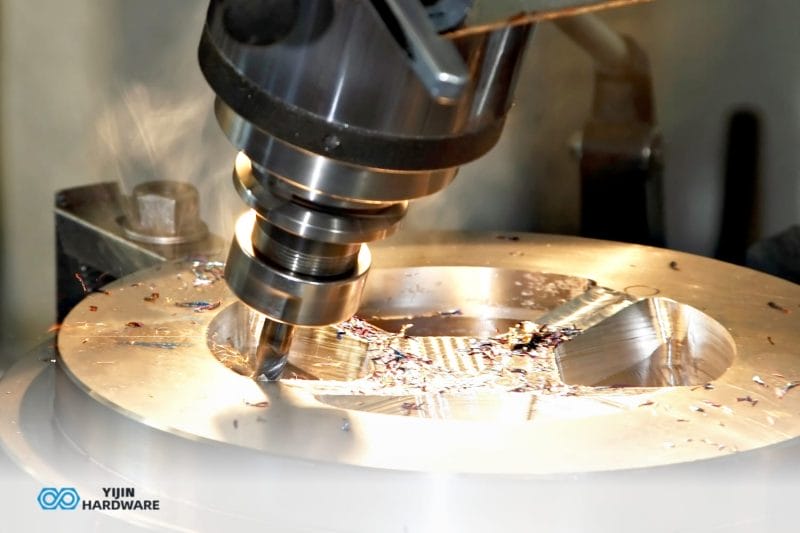

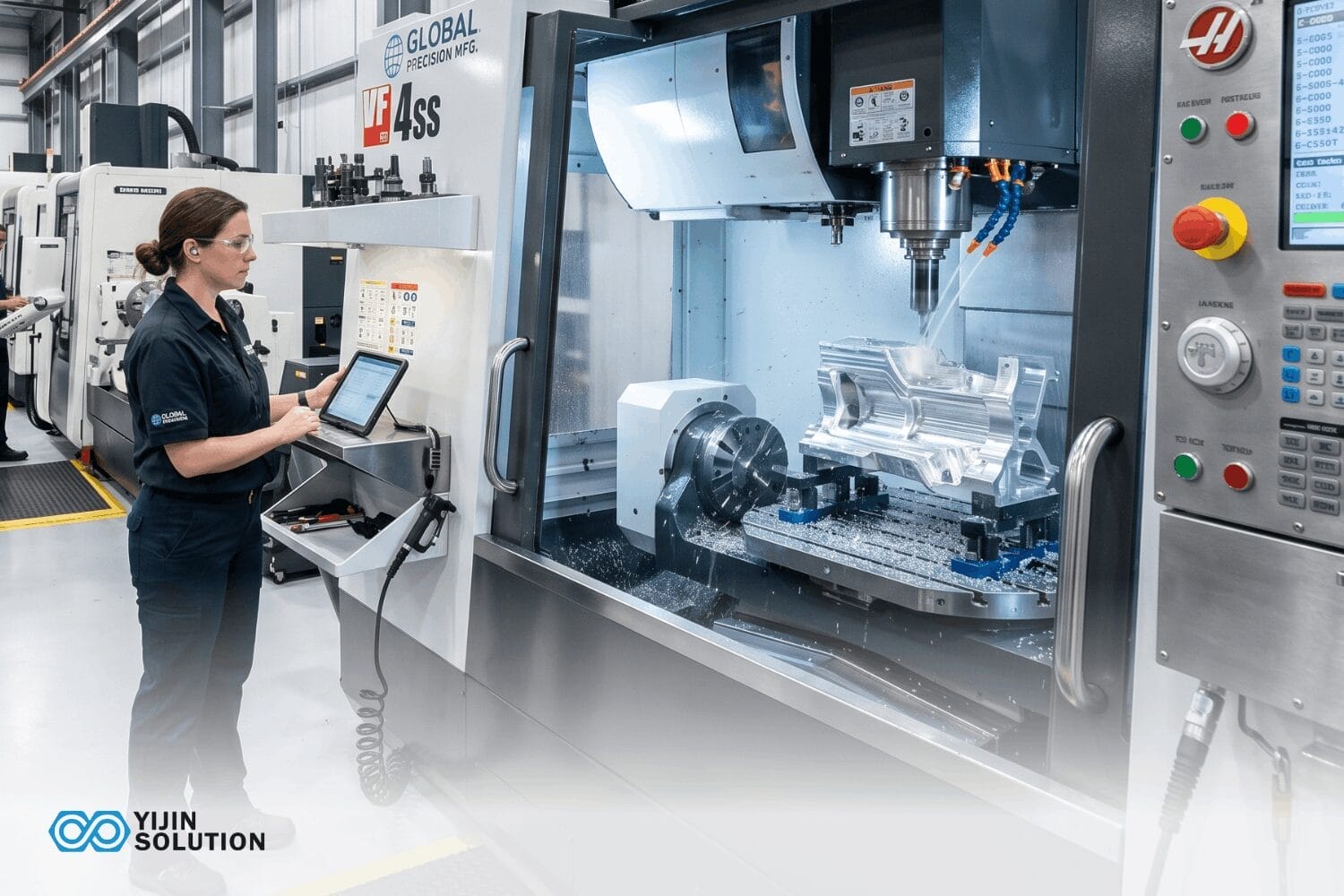
Most precision metal and plastic parts in production today started as a CAD file and ended as chips on a shop floor. The steps between those two points, and the decisions made at each one, determine whether the finished part holds its tolerances, fits its assembly, and survives its service life.
This guide covers the core concepts: how the process works, what the main machine types do, what precision actually means on the shop floor, and how to start building CNC knowledge from scratch. Whether you’re specifying parts for a supplier or learning to run a machine yourself, the fundamentals are the same.
¿Qué es el mecanizado CNC?
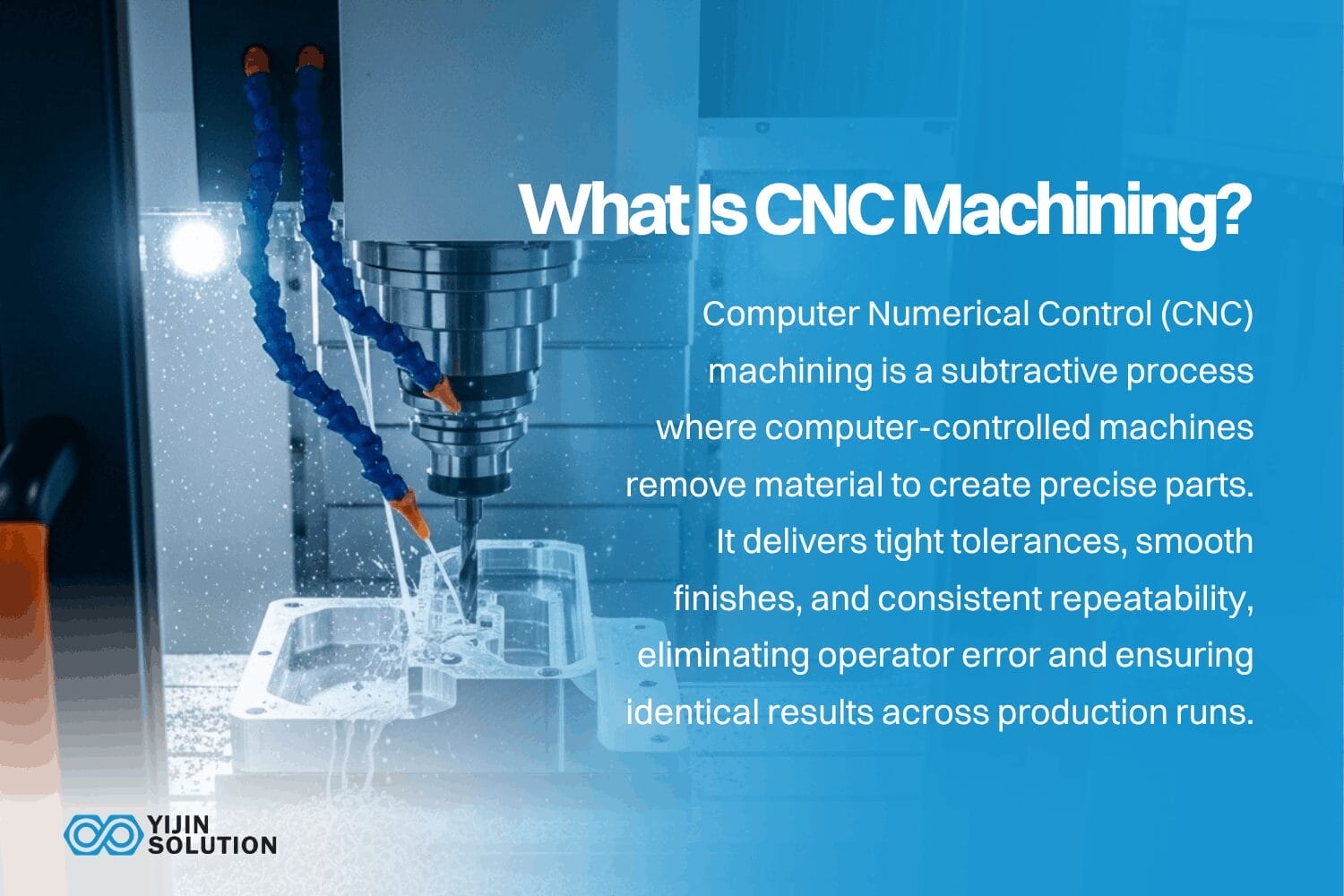
Computer Numerical Control (CNC) machining is a subtractive manufacturing process in which computer-controlled machines remove material from a solid workpiece to produce parts to a programmed specification.
Parts produced this way hold tight tolerances, carry smooth surface finishes, and repeat identically across a run without manual intervention on each cycle. When compared to manual machining, CNC eliminates operator error on each cut and repeats the same operation identically, consistently.
¿Cómo funciona el mecanizado CNC?
CNC machining follows a consistent workflow across most operations. Cycle time, setup complexity, and inspection requirements may vary by machine type and material, but the underlying sequence stays the same.
| Escenario | What Happens | Buyer / Quality Implication |
|---|---|---|
| CAD Design | An engineer creates a 3D model or 2D drawing specifying geometry and dimensions. | Tolerances and critical dimensions are locked here – errors at this stage carry through to the finished part. |
| Programación CAM | CAM software converts the CAD model into toolpaths and G-code instructions. | Toolpath strategy directly determines surface finish quality and cycle time. |
| Configuración de la máquina | The operator installs tooling, fixtures the workpiece, and loads the G-code program. | Correct workholding is essential – movement during cutting causes dimensional errors regardless of toolpath quality. |
| Machining / Cutting | The machine executes the program, removing material to the programmed toolpaths. | Cutting parameters, such as speed, feed, and depth, affect surface finish, tool wear, and dimensional accuracy. |
| Inspección | Parts are measured against the design specification using gauges, CMMs, or optical systems. | Inspection confirms whether the programmed geometry was actually achieved – this check is critical for tight-tolerance parts. |
| Operaciones secundarias | Deburring, surface finishing, anodizing, heat treatment, or assembly as required. | Secondary operations add lead time and cost – design them in from the start, not as afterthoughts. |
Every decision made at the CAD stage travels through the entire workflow. Getting the design right before production begins is the highest-leverage action available.
What does Precision Mean in CNC Machining?
Precision means different things depending on your role. For a buyer, it determines whether parts fit and function as designed. For someone learning CNC, it’s the foundation you need to understand any tolerance number.
However, precision isn’t a single machine specification; it’s a system outcome. Six factors determine whether a CNC machine actually produces accurate parts: machine stability, fixturing and workholding; tooling condition, material behavior, machining strategy, and measurement and verification.
A machine rated for ±0.005 mm won’t hit that figure if the workholding is poor, the tooling is worn, or the material deflects under cutting forces.
The tolerance a shop quotes is only achievable when all six factors are managed together. When evaluating a supplier, follow up your tolerance questions by asking the conditions that produce that tolerance on your specific part.
What are the Main Types of CNC Machines?
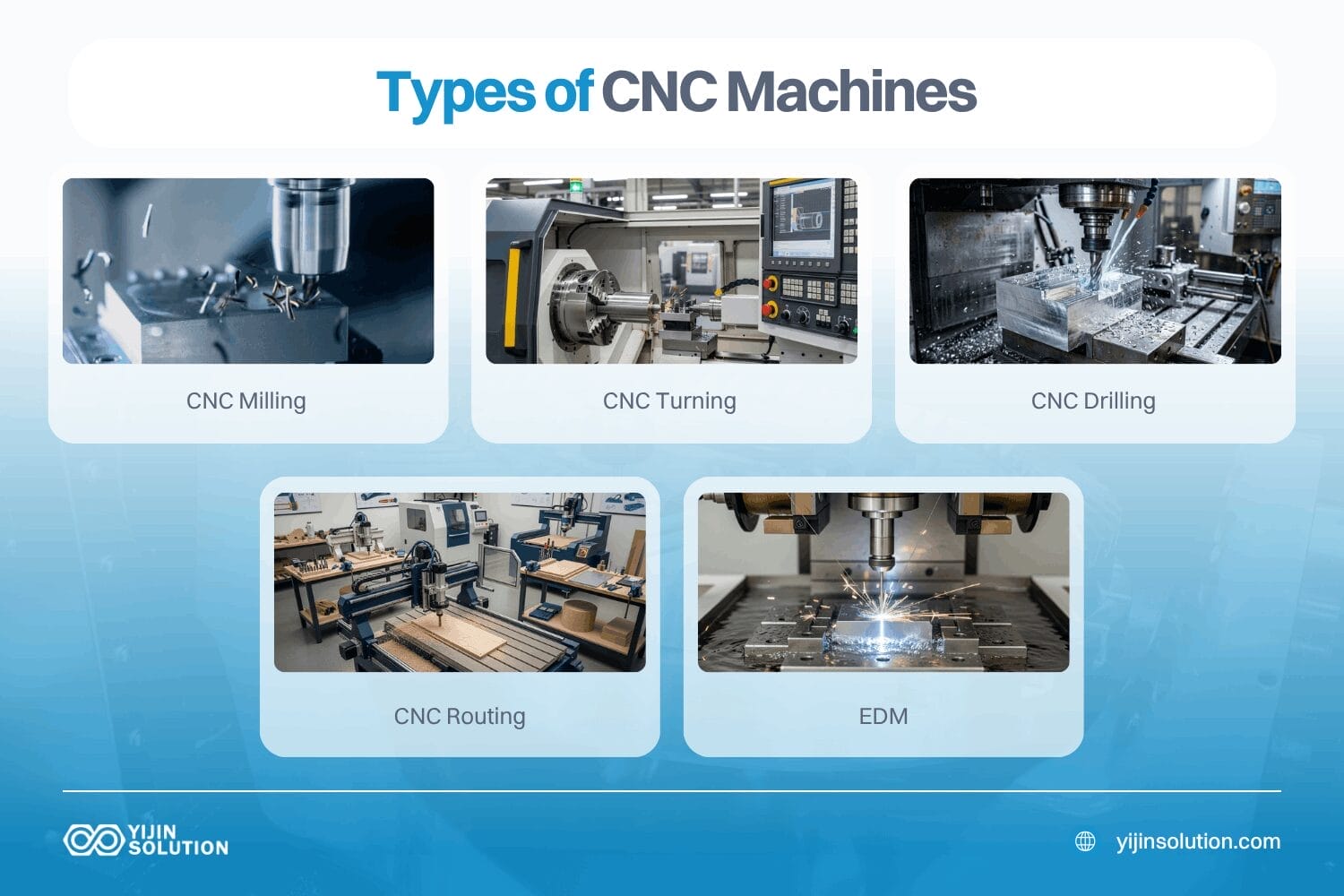
Not all CNC machines work the same way. The type of machine determines what geometries you can cut, what materials you can work with, and what tolerances you can hold.
Fresado CNC
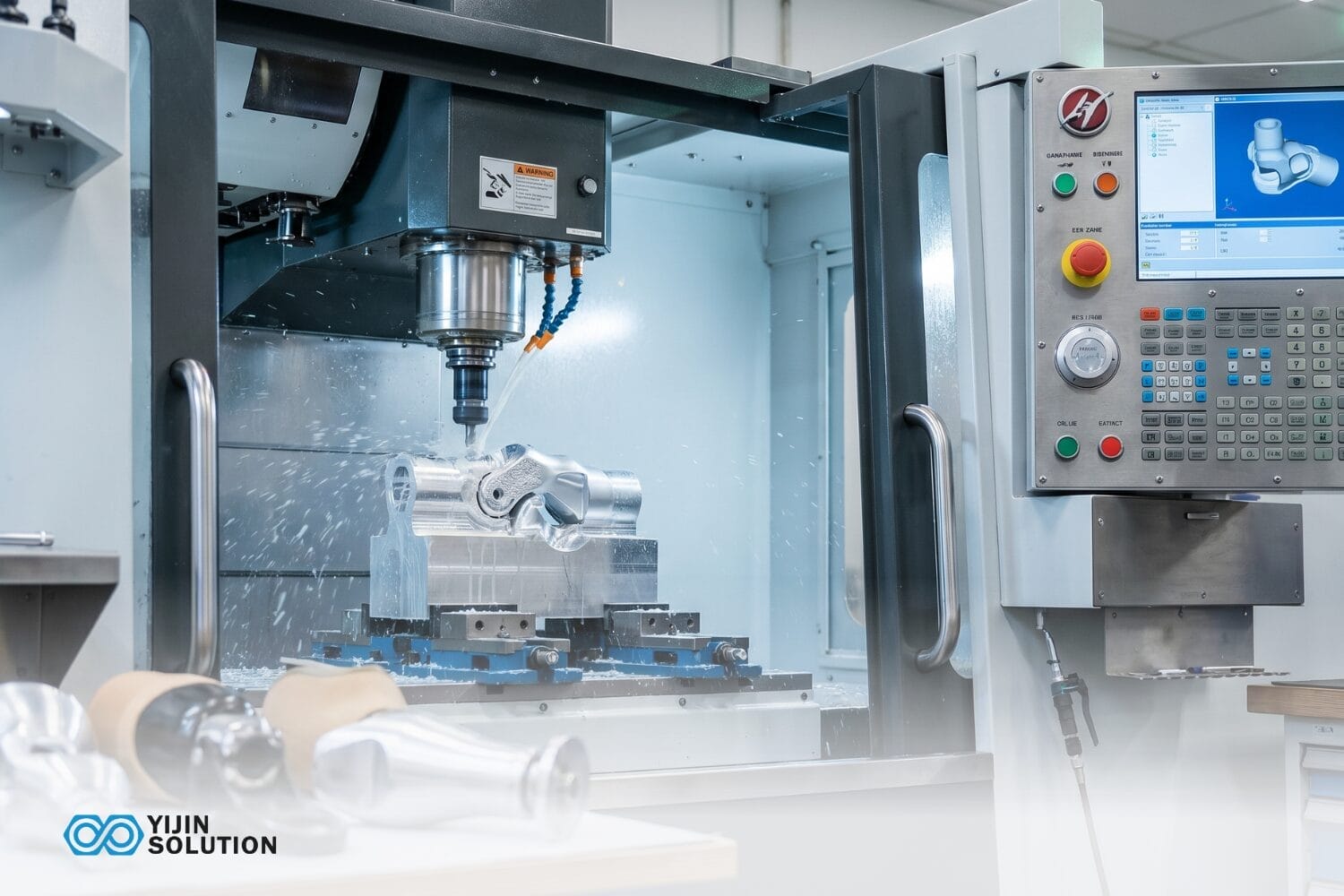
CNC milling uses a rotating multi-point cutting tool to remove material from a fixed or repositionable workpiece. It handles flat surfaces, pockets, slots, and complex 3D profiles. Configurations range from 3-axis machines up to 5-axis centers capable of cutting on multiple planes in a single setup.
5-axis CNC machining centers produce complex geometries with fewer setups, which reduces lead time and minimizes the risk of accumulated dimensional error.
Torneado CNC
In CNC turning, the workpiece rotates against a stationary cutting tool. Turning handles cylindrical and symmetrical parts like shafts, bushings, threaded fittings, and similar rotational forms. Swiss-type lathes extend this capability to long, slender parts requiring tight concentricity, such as medical pins and precision fasteners.
Taladrado CNC
CNC drilling produces precise hole locations and depths. It’s commonly combined with milling operations in a single setup, allowing holes to be positioned and sized without repositioning the workpiece.
Fresado CNC
CNC routers use a bridge-style frame that spans the work surface, with the cutting tool mounted overhead and moving across a large flat bed. This gives them a much larger working area than a standard milling center, which is why they suit sheet goods and large flat workpieces rather than the compact, rigid setups milling uses for metal.
EDM
EDM uses electrical spark erosion to remove material from hardened metals and complex cavities. It’s essential for tooling inserts and tight-tolerance aerospace features.
The five machine types below cover the majority of CNC production work. Each operates on a different motion principle, suits different part geometries, and holds different tolerance ranges.
| Tipo de máquina | Motion Principle | Lo mejor para | Typical Tolerance Range | Axis Range |
|---|---|---|---|---|
| Fresado CNC | Rotating tool, fixed/moving workpiece | Prismatic parts, complex 3D profiles, pockets, slots | ±0.01–0.10 mm (varies by material and geometry) | De 3 a 5 ejes |
| Torneado CNC | Rotating workpiece, stationary tool | Cylindrical parts — shafts, bushings, fittings | ±0.01–0.05 mm on diameter | 2-axis; Swiss up to 9-axis |
| Taladrado CNC | Rotating drill, linear plunge | Precise hole placement and depth | Position: ±0.02–0.10 mm | 2–3 axis |
| Fresado CNC | Rotating tool, moving gantry | Sheet goods, plastics, composites, large flat parts | ±0.10–0.30 mm typical | 3-axis standard |
| EDM | Electrical spark erosion | Hardened metals, complex cavities, tooling | ±0.005–0.02 mm achievable under controlled conditions | 2–5 axis depending on type |
How to Learn CNC Machining from Scratch
CNC machining follows a learnable progression from software fundamentals to live-machine operation. Whether you’re operating a machine, programming one, or designing parts for CNC production, the foundation is the same.
The learning path to build your CNC machining skills
- Learn CAD basics: Start with Fusion 360, SolidWorks, or FreeCAD. Reading and creating 3D models is the entry point for everything else in CNC machining.
- Learn CAM fundamentals: CAM software translates CAD geometry into machine instructions. Understand toolpath types and what drives surface finish and cycle time. Fusion 360 CAM is a practical starting point.
- Understand G-code at a conceptual level: Modern CAM generates it automatically. Knowing what G-code is, how to read a line of it, and how to diagnose a basic error saves time when something goes wrong.
- Get hands-on machine time: Simulators help, but actual machine time is different and necessary. Community college CNC labs, makerspaces, and manufacturer demo centers are accessible entry points.
- Learn DFM principles: Parts designed for efficient machining require fewer setups, less tooling cost, and shorter lead times. Understanding why certain features are expensive or risky to machine makes you a more effective designer and buyer.
Education and certification routes
Vocational programs are one of the most direct routes to machine operator roles. Community college CNC certificates typically run one to two semesters and include hands-on training. For self-paced learning, Tooling U-SME offers structured CNC and CAM courses widely recognized across the industry.
Haas Automation and Mazak both provide free simulator software and training resources. For those targeting professional roles, NIMS credentials are recognized by employers for machining and CNC programming positions.
CNC safety basics for every beginner
Before operating any CNC machine, a few safety fundamentals apply regardless of experience level:
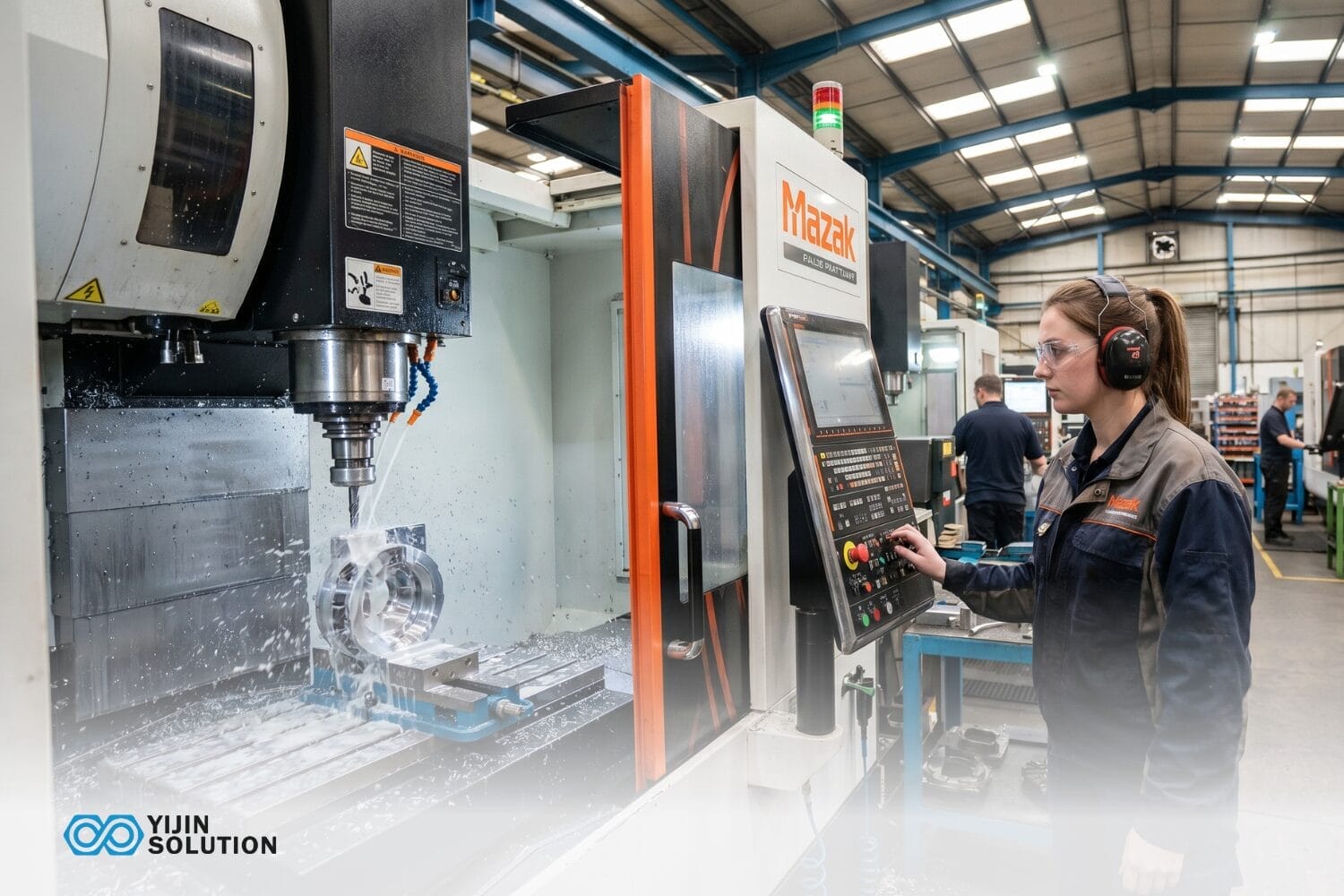
- Personal protective equipment (PPE): Safety glasses are required. Chip ejection is a constant risk during cutting. Use hearing protection for sustained operation. Never wear loose clothing, gloves, or jewelry near rotating spindles.
- Machine guarding: Understand the function of the machine’s enclosure before operating. Never reach into the work envelope during a running program.
- Workholding checks: A part that comes loose during machining becomes a projectile. Verify fixturing before starting any program.
- Emergency stop familiarity: Locate the E-stop before starting any machine. Find it first on every unfamiliar setup.
- Program verification: Simulate or dry-run a new program before cutting. A toolpath that looks correct in CAM can still contain errors that cause crashes or scrap.
Advice for your first CNC project
Start with Aluminum 6061. It machines cleanly, tolerates beginner toolpath errors well, and delivers predictable results. Keep the geometry simple. A flat plate with a few pockets and holes covers CAD, CAM, setup, and inspection in one project. No undercuts, no tight-tolerance bores, no complex 3D contours.
Designing your first CNC part? Upload your CAD file and our engineers will review it for machinability at no cost.
What Materials Can CNC Machining Process?
CNC machining handles metals, plastics, and composites. Material choice determines the cutting approach, tooling cost, and achievable tolerances.
Metals are the most common CNC material family:
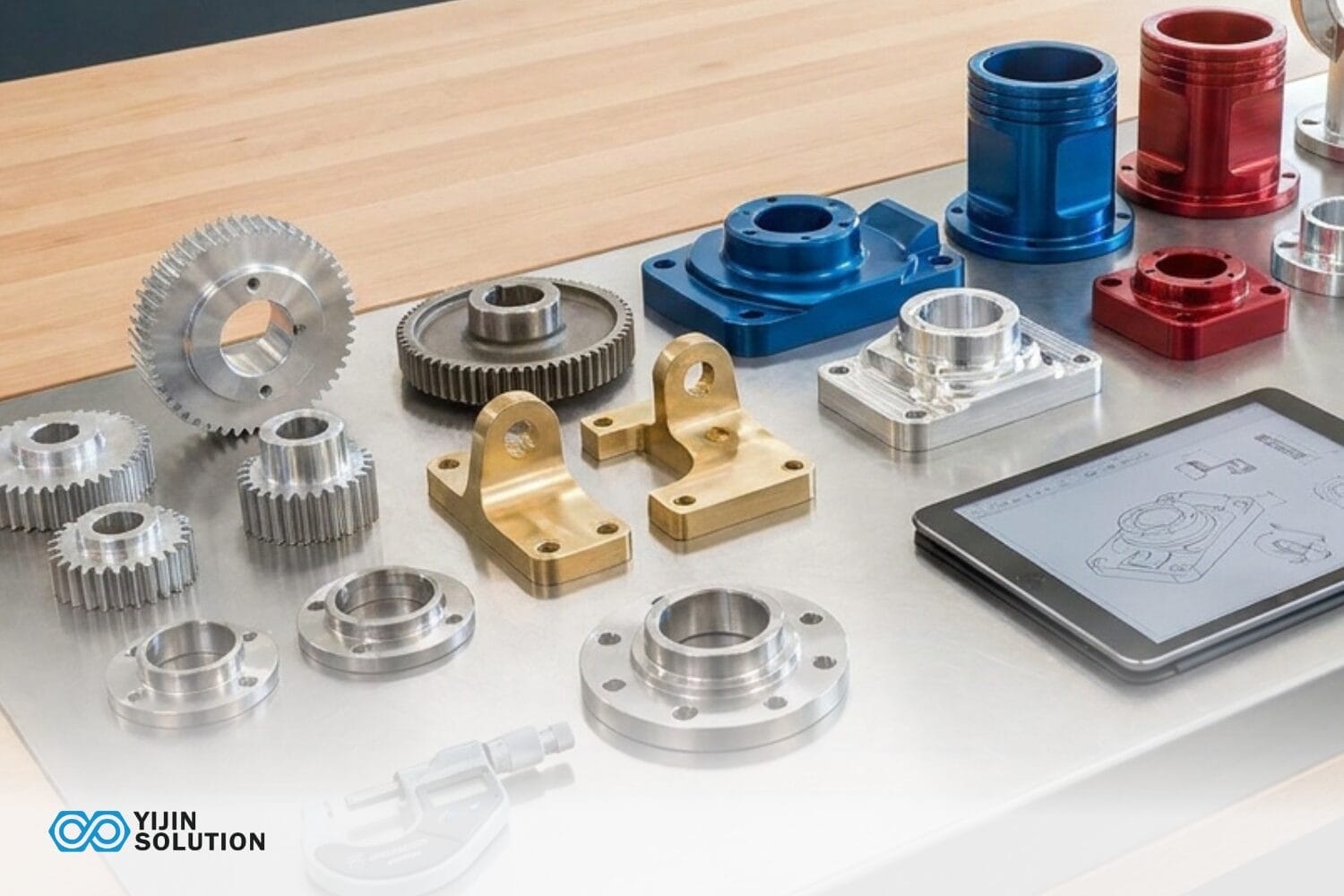
- Aluminum 6061 and 7075: lightweight, excellent machinability, widely used across aerospace and consumer products.
- Stainless Steel 304 and 316L: corrosion-resistant, harder to machine than aluminum, standard for medical and marine applications.
- Titanio Grado 5: high strength-to-weight ratio, demanding on tooling and cycle time, required for aerospace structural parts.
- Latón y cobre: excellent machinability, used in electrical components and fluid system fittings.
Plastics serve applications where weight reduction or chemical resistance matters more than metal-level strength. PEEK, Nylon, Delrin (acetal), and PTFE all machine well on standard CNC equipment.
Composites such as carbon fiber reinforced polymer (CFRP) are machinable but abrasive. They require diamond-coated tooling and careful chip management.
Softer materials like Aluminum 6061 machine faster and at lower tool wear than hardened steels or titanium. This directly affects per-part cost and achievable tolerances, which is worth factoring in early when working to a tight budget or schedule.
CNC Tolerances and Surface Finish: What Beginners Need to Know
Every dimension on a part drawing has a target value and an acceptable range around it. That range is the tolerance. A shaft specified at 25 mm ±0.05 mm can measure anywhere from 24.95 mm to 25.05 mm and still be considered correct. Anything outside that range is a non-conforming part.
The tolerance value determines machining time, setup complexity, and cost. Tighter tolerances cost more, as they require slower cutting speeds, additional setups, and more precise inspection.
Understanding that relationship is part of becoming a more effective CNC programmer, designer, or buyer:
| Tipo de tolerancia | Alcance típico | When It’s Used | Cost Implication |
|---|---|---|---|
| Estándar | ±0.10–0.30 mm | Non-critical features: clearance fits, general geometry | Lowest machining cost: faster speeds, minimal inspection |
| Precisión | ±0.025–0.10 mm | Mating surfaces, functional features, bearing fits | Moderate cost increase: additional passes, closer inspection |
| Alta precisión | ±0.005–0.025 mm | Press fits, precision assemblies, aerospace/medical features | Significant cost: slow speeds, dedicated inspection, specialist fixturing |
Surface finish is measured by Ra (roughness average), a value describing how smooth a machined surface is. A lower Ra means a smoother surface. As-machined CNC surfaces typically fall in the Ra 0.8–3.2 µm range. Secondary operations like grinding or polishing push Ra lower, at added cost and lead time.
Only specify tight tolerances and fine finishes where the part’s function requires them. Over-tolerancing is one of the most common and avoidable cost drivers in custom part manufacturing.
Advantages and Limitations of CNC Machining
Across a production run of thousands of parts, CNC machining delivers dimensional accuracy and repeatability that manual processes can’t match at scale. Advantages of CNC machining include:
- The same G-code program runs on part one and part ten thousand.
- Tolerances don’t drift between operators or shifts.
- The process scales from a single prototype to mass production without switching suppliers, quality systems, or tooling setups.
The limitations are worth stating plainly.
Per-part cost is higher at very low volumes. Setup time, fixturing, and programming effort are fixed costs that spread across the order quantity. A single prototype absorbs all of that overhead alone. At ten parts the cost per unit drops significantly. At a hundred it drops further. Understanding that curve helps you structure orders and time production runs more effectively.
CNC is also a subtractive process. Every chip that comes off the workpiece is raw material you paid for and won’t recover. For aluminum this is a minor consideration. For titanium or Inconel, where raw material cost is high and removal rates are slower, waste management and near-net-shape starting stock become meaningful cost levers.
Complex internal geometries present a physical constraint that software can’t solve. A standard end mill needs a straight path to reach a feature. Deep narrow pockets, undercuts, and internal channels that change direction can be impossible to reach with conventional tooling. Hybrid manufacturing, which combines additive deposition with CNC finishing, exists partly to address this limitation for high-value parts.
Common Applications of CNC Machining
CNC machining operates across virtually every industry that requires precise metal or plastic parts. The industries below rely on it specifically because tolerances, material traceability, and certification requirements rule out most alternative processes.
| Industria | Representative Part Type | Key CNC Requirement |
|---|---|---|
| Aeroespacial | Turbine blades, structural brackets, housings | Tight tolerances, certified materials, full traceability |
| Productos sanitarios | Surgical instruments, implant components, diagnostic housings | Biocompatible materials, high precision, ISO 13485 quality system |
| Automoción | Engine components, transmission parts, chassis brackets | High volume, consistent repeatability, IATF 16949 compliance |
| Electrónica | Heat sinks, connector housings, sensor mounts | Complex geometry, tight fits, surface finish consistency |
| Equipamiento industrial | Hydraulic manifolds, gearbox components, tooling | Functional accuracy under load, material strength |
| Defensa | Weapon system components, UAV structural parts, optical mounts | Certified processes, material documentation, security protocols |
Why Partner with Yijin Solution for CNC Machined Parts?
Understanding CNC machining makes you a better buyer. You know which tolerances are worth specifying and which add cost without function. You know what questions to ask a supplier before committing to a design, and what to check when parts arrive. That knowledge changes the quality of every supplier conversation you have.
At Yijin Solution, we work well with engineers and buyers at every stage of that learning curve. If you have a first part to quote, our engineering team will review your CAD file for free and flag anything that would affect machinability, cost, or lead time before production begins. That DFM feedback is useful whether you place an order or not.
For those further along, our 136+ CNC machining centers span 3-, 4-, and 5-axis configurations across a 25,000+ m² facility in Shenzhen. We hold tolerances to ±0.01 mm verified against Zeiss CMM data, and our AS9100D, IATF 16949, ISO 13485, ISO 9001, and ISO 14001 certifications cover the quality and traceability requirements of aerospace, automotive, and medical programs.
Whether you’re quoting your first prototype or sourcing for a regulated production program, the starting point is the same.
Upload your CAD file and receive a free DFM review within 24 hours.
CNC Machining for Beginners FAQs
How much does CNC machining cost for a beginner project?
Cost depends on part complexity, tolerances, material, and quantity. A simple aluminum prototype can range from tens to a few hundred dollars. Setup costs spread across the order, with higher volumes reducing per-part cost significantly.
Getting a free DFM quote before committing to a design is the most reliable way to understand pricing for your specific part.
Do I need to know G-code to get started with CNC machining?
Modern CAM software generates G-code automatically from a CAD model, so hands-on G-code writing isn’t a requirement for getting started. However, a working knowledge of G-code is useful for troubleshooting and optimization.
How long does it take to get CNC machined parts made?
Lead time depends on part complexity, order size, and supplier capacity. Simple prototype parts turn around in one to three working days at a well-equipped shop. Standard production orders typically take seven to fifteen working days. Confirm lead time requirements during the quoting stage for the most reliable schedule.
What file formats do CNC machine shops accept?
Most CNC machine shops accept STEP and IGES files for 3D geometry, with STEP being the most widely preferred format. A detailed 2D drawing in PDF or DWG format should accompany the 3D model to avoid ambiguity during machining and inspection.
How long does it take to learn CNC machining?
The timeline depends on the goal and the learning route. Basic machine operation and simple CNC programming can be learned in a few months through a focused vocational program or structured self-study.
Proficiency in 3- to 5-axis programming for complex parts typically takes one to three years of combined study and hands-on experience. The foundation can be built in weeks using free software and online resources before machine access is needed.
Volver arriba: CNC Machining for Beginners: A Complete Starter Guide