

Introduction
Your drawing may specify “anodize per MIL-A-8625” leaving out whether it’s Type II or Type III. That single missing callout determines whether the part gets a thin decorative oxide or a thick engineered wear surface. For most cosmetic parts that need color and corrosion protection, Type II is the finish to specify. Once a surface contacts another component in operation, the part usually needs Type III instead.
The choice affects hardness, dimensional fit, color range, cost per part, and lead time. This article compares both finishes across oxide thickness, wear resistance, alloy compatibility, tolerance impact, cost, and drawing callout format so you can specify the right one before production starts.
Type II vs Type III Anodizing: Quick Answer
Type II anodizing produces a thin oxide layer suited to corrosion protection, cosmetic color matching, and general-purpose aluminum finishing. Type III anodizing builds a dense, hard oxide designed for mechanical wear, sliding contact, and harsh operating environments.
If the part surface touches another component during operation, specify Type III. If the part needs color, corrosion resistance, and minimal dimensional change, Type II is the appropriate finish. Alloy selection and tight tolerances also influence the decision, covered in detail below.
Type II vs Type III Anodizing: At a Glance
The table below summarizes the practical differences between Type II and Type III anodizing across the attributes that shape most specification decisions.
| Attribut | Type II Anodizing | Type III Anodizing |
|---|---|---|
| Also known as | Conventional sulfuric acid anodize, decorative anodize | Hardcoat anodize, hard anodize, engineered anodize |
| MIL-A-8625 designation | Type II, Class 1 or Class 2 | Type III, Class 1 or Class 2 |
| Oxide layer thickness | 5 to 25 μm, or 0.2 to 1.0 mil | 25 to 75+ μm, or 1.0 to 3.0+ mil |
| Surface hardness | 200 to 400 HV, alloy-dependent | 300 to 500+ HV, alloy-dependent |
| Abrasion resistance | Modéré | High to very high per MIL-A-8625 wear index |
| Résistance à la corrosion | Good for indoor and moderate outdoor exposure | Excellent for harsh and industrial environments |
| Options de couleur | Wide range: black, red, blue, gold, green, custom matches | Limited: typically black or natural dark gray |
| Dimensional change | Minimal, roughly 50% growth outward and 50% inward | Significant, plan for 0.001 to 0.003 in. total growth on tight features |
| Isolation électrique | Moderate dielectric properties | Strong dielectric insulation, used in electronic housings |
| Process temperature | 68 to 72 °F, room temperature bath | 28 to 36 °F, near-freezing bath |
| Best alloys | Most aluminum alloys; 6061 and 5052 produce even finishes | 5000, 6000, 7000 series best; 2000 series and high-Si castings perform poorly |
| Relative cost | $: lower cost per part | $$ to $$$: higher due to energy, temperature control, longer cycle |
| Applications typiques | Consumer enclosures, architectural trim, medical housings, electronics bezels | Hydraulic cylinders, firearm receivers, valve bodies, aerospace wear surfaces |
What is Type II Anodizing?
Type II anodizing is a sulfuric acid electrolytic process that converts the surface of an aluminum part into a porous aluminum oxide layer, typically 5 to 25 micrometers thick, or 0.2 to 1.0 mil. The process runs at room temperature, around 68 to 72 °F, with DC current applied at 12 to 24 volts. The aluminum part serves as the anode, and the oxide grows in both directions: roughly half into the base metal and half outward from the original surface. MIL-A-8625F governs Type II anodizing. Class 1 designates an undyed finish. Class 2 designates a dyed finish.
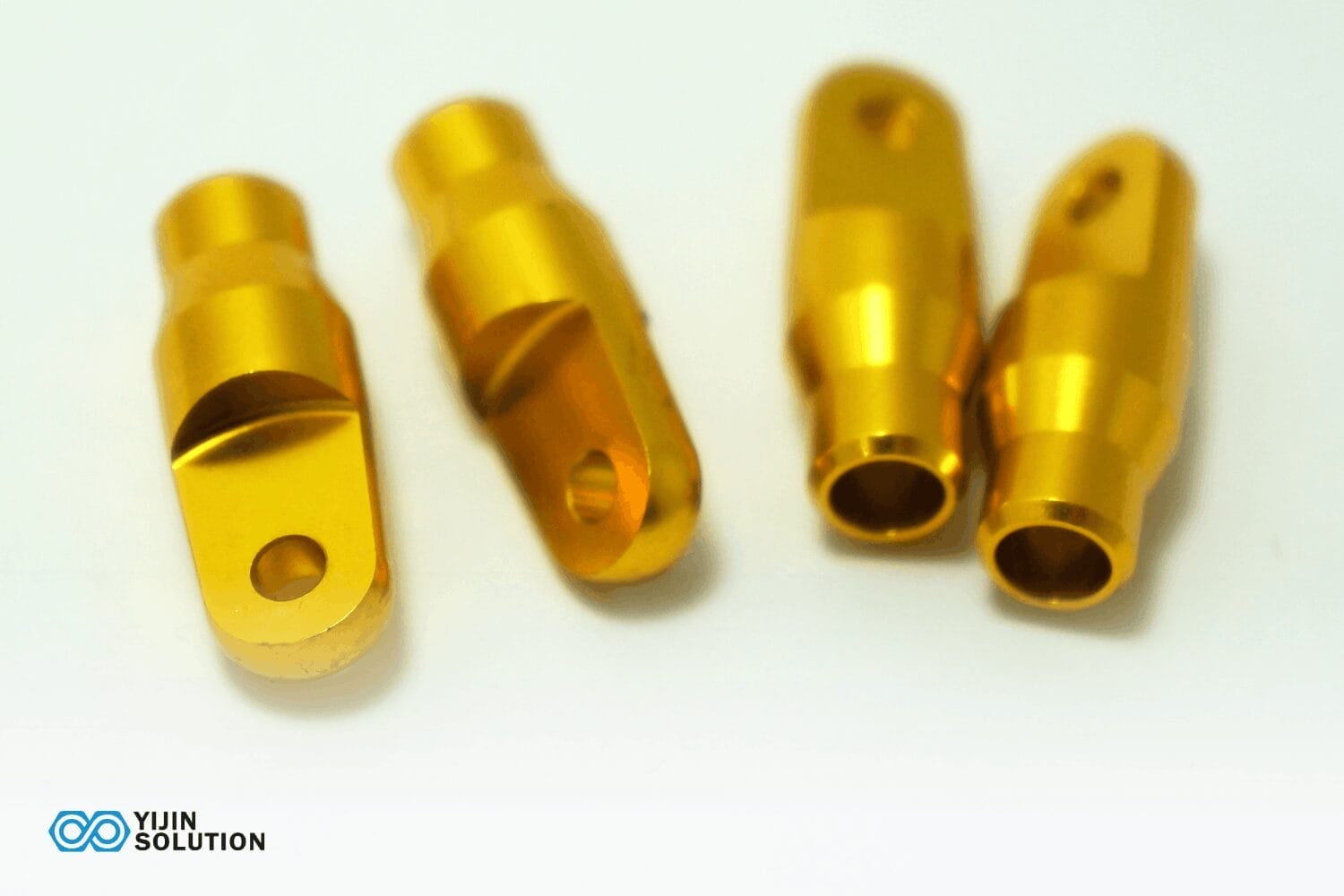
What makes Type II the default specification for decorative aluminum parts is the porous structure of the oxide layer. Before sealing, those pores absorb organic and inorganic dyes, producing a wide color range from black and red to blue, gold, green, and custom color matches. This dye absorption capability, combined with low cost and minimal dimensional impact, makes Type II the standard finish for consumer electronics enclosures, medical device housings, architectural trim, and automotive interior components.
For parts where abrasion or sliding contact is expected, Type II does not provide sufficient hardness. Its wear resistance is limited compared to Type III. For a deeper look at how anodizing transforms aluminum surfaces, the guide to anodized aluminum covers the electrochemistry, color options, and sealing methods in detail.
What is Type III Anodizing?
Type III anodizing is a hardcoat anodizing process that produces a dense aluminum oxide layer of 25 to 75+ micrometers, significantly thicker and harder than Type II. The process uses the same sulfuric acid electrolyte but at a much lower bath temperature, 28 to 36 °F, with higher voltage and current density. The near-freezing bath temperature slows oxide dissolution during growth, resulting in a tighter, denser crystal structure. For a full breakdown of coating properties, process controls, and sealing options, the hard coat anodizing guide covers the specification requirements in detail.
The defining property of Type III is hardness. The oxide reaches 300 to 500+ HV, depending on alloy and coating thickness. This makes it suitable for mechanical wear surfaces, sliding and rotating contact, thermal cycling, and dielectric insulation applications. MIL-A-8625F Type III requires a maximum wear index of 3.5 mg per 1,000 cycles on the Taber abraser test for alloys with copper content above 2%.
Alloy selection matters more with Type III than with Type II. Aluminum 6061 and 7075 produce dense, uniform hardcoat. The 5000 series takes a sound hardcoat as well. However, 2000 series alloys like 2024 and 2011, which contain higher copper content, produce softer, more porous coatings that may not meet the MIL-A-8625 wear index. High-silicon casting alloys such as A380 produce poor hardcoat results.
Color is limited to natural dark gray or black because the denser oxide does not absorb dye as readily as Type II. Typical applications include hydraulic cylinders, firearm receivers, valve bodies, aerospace wear components, and semiconductor equipment housings.
Key Differences Between Type II and Type III Anodizing
The differences below shape every practical decision about specifying Type II versus Type III, from how tight a tolerance the part can hold to how it will perform in service. Each comparison ends with a directional verdict to help narrow the specification.
Thickness and hardness: how much oxide does each process build?
Type II builds a 5 to 25 micrometer oxide layer with hardness in the range of 200 to 400 HV, depending on alloy. This is sufficient for corrosion protection and cosmetic finish but not for surfaces that experience mechanical contact.
Type III builds a 25 to 75+ micrometer oxide layer with hardness reaching 300 to 500+ HV. The denser crystal structure handles abrasion, sliding contact, and repeated mechanical load without degrading. If the part contacts another surface in operation, Type III is the functional requirement. A Type II coating on a wear surface will break down in service.
Verdict: Type III for any surface subject to mechanical contact. Type II for protected or decorative surfaces.
Dimensional impact: what anodizing does to your tolerances
This is where many engineers run into problems, and it is the comparison point most competitor articles underexplain. Anodized oxide grows in both directions: roughly 50% into the base metal and 50% outward from the original surface.
On a bore or shaft with a tolerance of ±0.001 in., a 2 mil Type III coating adds approximately 1 mil of dimensional growth per side. That can push the feature out of specification. Type II coatings at 0.5 mil or less produce dimensional growth of roughly 0.25 mil per side, which typically falls within standard machining tolerances.
For Type III on tight-tolerance features, machine the part undersized by half the target coating thickness per side. At Yijin Solution, our engineering team coordinates this offset with the anodizer during DFM review, because exact growth varies with alloy composition, current density, and bath chemistry. A blanket offset number does not replace that conversation with your finishing vendor.
Verdict: Type II is generally compatible with standard machining tolerances. Type III requires dimensional planning between the machinist and the anodizer before the part goes to finishing.
Color and appearance: decorative range vs functional finish
Type II produces a porous oxide that absorbs organic and inorganic dyes before sealing. Colors range from black, red, blue, and gold to green and custom matches. Clear anodize preserves the natural aluminum appearance. This makes Type II the specification for any part that is customer-facing or requires brand-specific color matching.
Type III is limited to natural dark gray or black. The denser oxide structure does not absorb dye the way Type II does. Some anodizers offer limited color on thinner hardcoat builds, but reducing thickness to improve dye absorption reduces abrasion performance, which defeats the purpose of specifying Type III.
Verdict: If the part is customer-facing and needs specific color matching, specify Type II. If appearance is secondary to function, Type III.
Cost and lead time: what drives the price difference?
Type III costs more per part than Type II. The drivers are straightforward: lower bath temperature requires chilling equipment and higher energy consumption, longer cycle times reduce throughput, and alloy-specific process tuning adds setup time. Type II runs at room temperature with higher throughput, keeping per-part cost lower.
For batch finishing turnaround, Type II typically turns in one to three days. Type III may add one to two additional days due to lower bath capacity and tighter process controls.
On a production run of CNC-machined aluminum housings, switching from Type II to Type III typically adds 30 to 50% to the finishing cost, depending on part geometry, alloy, and batch size. That premium is justified when the application demands wear resistance. It is not justified when the part only needs corrosion protection and color.
Verdict: Type II for cost-sensitive decorative parts. Type III when the application demands it and the finishing cost is justified by performance requirements.
Corrosion and wear resistance: how each finish performs in service
Type II provides good corrosion resistance for indoor and moderate outdoor exposure. Sealed Type II coatings typically pass 336-hour salt spray testing on most aluminum alloys. However, its wear resistance is limited. A Type II coating will not hold up under sliding or rotating contact.
Type III provides both corrosion and wear resistance. The thicker, denser oxide resists abrasion, chemical exposure, and thermal cycling. It is suited for marine, industrial, and military environments where parts face both corrosive conditions and mechanical load.
Verdict: Type II protects against corrosion. Type III protects against corrosion and mechanical wear. If the part only needs corrosion resistance, Type II is sufficient and more cost-effective.
Alloy suitability: which aluminum grades work best?
Type II anodizes evenly across nearly all wrought aluminum alloys. Aluminum 6061, 5052, and 7075 produce consistent, even finishes. High-copper Aluminum 2024 can produce a yellowish tint but remains functional for most applications.
Type III is alloy-sensitive. Aluminum 6061 and 7075 produce dense, hard coatings that reliably meet MIL-A-8625 requirements. The 5000 series holds a sound hardcoat. The 2000 series, including 2024 and 2011, produces softer, more porous hardcoat due to copper content. High-silicon casting alloys like A380 produce results that may not pass the specification wear index.
If the design specifies Type III, choose the alloy accordingly. Switching from 6061 to 2024 for added strength may compromise the hardcoat quality. This is a design for manufacturability conversation, not an afterthought to address during finishing.
Verdict: Alloy selection should be coordinated with the anodizing requirement, especially for Type III. Compatibility should be confirmed with your anodizer before committing to the material specification.
How to Choose Between Type II and Type III Anodizing
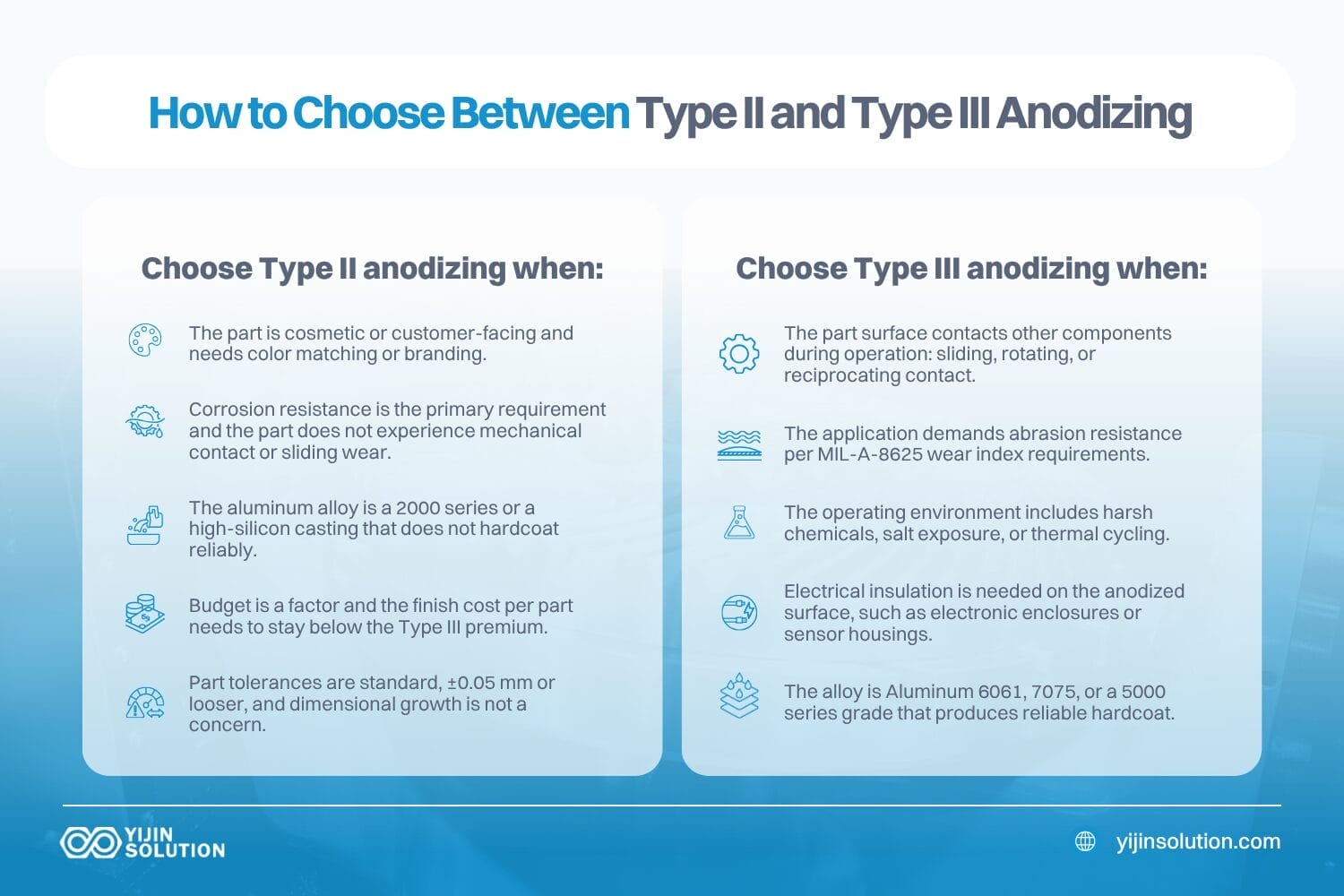
The comparison above covers the technical differences. This section translates those differences into specific buyer scenarios to simplify the specification decision.
Choose Type II anodizing when…
- The part is cosmetic or customer-facing and needs color matching or branding.
- Corrosion resistance is the primary requirement and the part does not experience mechanical contact or sliding wear.
- The aluminum alloy is a 2000 series or a high-silicon casting that does not hardcoat reliably.
- Budget is a factor and the finish cost per part needs to stay below the Type III premium.
- Part tolerances are standard, ±0.05 mm or looser, and dimensional growth is not a concern.
Choose Type III anodizing when…
- The part surface contacts other components during operation: sliding, rotating, or reciprocating contact.
- The application demands abrasion resistance per MIL-A-8625 wear index requirements.
- The operating environment includes harsh chemicals, salt exposure, or thermal cycling.
- Electrical insulation is needed on the anodized surface, such as electronic enclosures or sensor housings.
- The alloy is Aluminum 6061, 7075, or a 5000 series grade that produces reliable hardcoat.
How to Call Out Anodizing on an Engineering Drawing
A complete anodizing callout references the specification, type, class, and thickness. The current revision is MIL-A-8625F. The Aluminum Anodizers Council’s specification guide provides a useful reference for anyone specifying finishes on aluminum parts. The standard callout format is: “Anodize per MIL-A-8625F, Type [II or III], Class [1 or 2], [thickness if specified].” Class 1 means undyed. Class 2 means dyed, with the color specified after.
For a functional hardcoat application: “MIL-A-8625F, Type III, Class 1, 2.0 mil coating thickness.” For a decorative finish: “MIL-A-8625F, Type II, Class 2, Black.”
For commercial applications outside military contracts,ASTM B580 is the common reference standard. Some buyers specify both MIL-A-8625F and ASTM B580 on the same drawing. Always specify thickness on Type III callouts. Without a thickness callout, the anodizer defaults to their standard process range, which may not align with the tolerance plan on the part.
Getting the Right Anodized Finish for Your Parts
The Type II or Type III decision is settled most cleanly while the part is still on the drawing, since the choice ripples into alloy, tolerance, and cost. Yijin Solution anodizes custom aluminum parts in both types and checks the callout against the tolerance plan and alloy during a free DFM review.
Upload your design with your anodizing requirement and we’ll return a quote and DFM feedback within one to two business days.
Type II vs Type III Anodizing FAQs
Can anodized aluminum parts be welded after finishing?
Anodizing creates an electrically insulating oxide layer that interferes with the welding arc. The coating must be stripped or mechanically removed in the weld zone before welding, and the exposed area re-finished afterward. Type III coatings are particularly difficult to remove without damaging the base metal, so masking and finishing sequence should be planned carefully if the part requires both welding and anodizing.
Does anodizing affect the fatigue strength of aluminum?
Type III hardcoat anodizing can reduce the fatigue strength of high-strength aluminum alloys, notably 7075, by 30 to 50% on rotating-bending tests. The thick, brittle oxide layer acts as a crack initiation site under cyclic loading. Type II has a much smaller fatigue impact due to its thinner, less rigid oxide. For fatigue-critical aerospace components, evaluate the trade-off with the design engineer or specify shot peening before anodizing to introduce compressive residual stress at the surface.
Is Type II anodized aluminum safe for food contact?
Undyed Type II anodized aluminum, Class 1, is widely accepted for indirect food contact applications when properly sealed. The inert aluminum oxide surface does not leach into food under normal conditions. However, some dyes used in Class 2 finishes may not meet FDA compliance requirements. For direct food contact or medical-grade applications, confirm the sealing method and dye compliance with the anodizer before production.
Can damaged anodized parts be stripped and re-anodized?
Anodized parts can be stripped chemically, typically in a sodium hydroxide or nitric acid bath, and then re-anodized. Each strip-and-re-anodize cycle removes a small amount of base aluminum, which can affect dimensions on tight-tolerance features. Re-anodizing is feasible for low-volume rework but is not a substitute for getting the original finish specification and process right the first time.
How does Type III anodize compare to hard chrome plating?
Type III hardcoat anodize and hard chrome plating both produce wear-resistant surfaces, but they differ in hardness, thickness buildup, and environmental impact. Hard chrome is harder, around 1,000 HV, and supports thicker deposits, but uses hexavalent chromium, which faces increasing regulatory restrictions under REACH and EPA guidelines. Type III anodize is lighter, integrated with the aluminum substrate rather than plated on top, and does not carry the same environmental compliance burden. For aluminum parts, Type III is typically the more practical and environmentally acceptable option.
Does anodizing protect aluminum in saltwater or marine environments?
Properly sealed Type II anodizing provides moderate marine corrosion resistance suitable for short-term or intermittent saltwater exposure. For prolonged saltwater service, Type III hardcoat or sulfuric acid anodizing with nickel acetate sealing performs better. For continuous immersion or high-chloride environments, consider sealed Type III combined with additional protective coatings or sealants at joints and fastener interfaces.
Retour en haut de la page : Type II vs Type III Anodizing: Which Finish does Your Part Actually Need?






 English
  Spanish
  German
  French