


Choosing between anodizing and powder coating comes down to one question: does your part need a finish that becomes part of the metal, or one that sits on top of it?
Anodizing converts the aluminum surface into a hard oxide layer. It is thinner, more dimensionally precise, and better suited for tight-tolerance parts. Powder coating applies a polymer film over the surface. It is thicker, available in a wider color range, and more cost-effective for large or decorative components.
Neither finish is universally better. This guide breaks down both options so you can choose the right finish for your parts.
Anodizing vs Powder Coating: The Quick Answer
Anodizing converts the aluminum surface into a durable oxide layer that becomes part of the metal. Powder coating applies a cured polymer film over the metal. Anodizing adds 5 to 25 μm with minimal dimensional change, resists scratching at up to 600+ HV on hard anodize, and is inherently UV-stable. It works on aluminum only and offers a narrow color range.
Powder coating adds 50 to 150 μm, offers virtually unlimited colors, and works on steel, stainless, and other metals. It requires masking on precision features and can chalk under prolonged UV exposure. Choose anodizing for tight-tolerance aluminum assemblies. Choose powder coating for color flexibility, multi-metal compatibility, or large parts where dimensional growth is acceptable.
Anodizing vs Powder Coating: At a Glance
The table below compares the two finishes across the factors that shape most specification decisions.
| Attribut | Anodisation | Revêtement par poudre |
|---|---|---|
| Process type | Electrochemical oxide conversion | Electrostatic dry powder application, heat-cured |
| Compatible materials | Aluminum and aluminum alloys only | Aluminum, carbon steel, stainless steel, zinc, brass, and other substrates that tolerate 190 to 232 °C curing |
| Coating thickness | Type II: 5 to 25 μm; Type III: 25 to 100 μm | 50 to 150 μm typical |
| Dimensional impact | Minimal: approximately 50% grows inward, 50% outward. A 20 μm Type II coating adds approximately 10 μm per surface. | Measurable: 50 to 150 μm added per surface. Threads, holes, and mating faces require masking or allowance. |
| Surface hardness | Type II: 200 to 400 HV; Type III: 300 to 600+ HV, alloy-dependent | Moderate: typically 2H to 4H pencil hardness. Resists impact but scratches more readily than Type III anodize. |
| Résistance à la corrosion | Excellent. Oxide is integral to the metal; no peeling. Sealed Type II passes 336+ hours salt spray on most alloys. | Very good. Sealed barrier protects underlying metal as long as coating is intact; chips expose bare metal. |
| UV and weather resistance | Inherently UV-stable. Does not fade or chalk. | Outdoor-rated polyester powders resist UV well; may chalk after years of direct exposure depending on resin. |
| Options de couleur | Limited dyed tones: black, bronze, gold, red, blue. Alloy affects final color. | Virtually unlimited: any RAL color, metallics, textures, gloss levels. |
| Apparence | Translucent metallic finish; base metal visible through oxide. | Opaque; fully covers substrate and conceals surface imperfections. |
| Repairability | Cannot be spot-repaired; must be stripped and re-anodized. | Can be spot-sanded and recoated. |
| Service temperature | Substrate-limited. Aluminum softens around 200 °C; oxide itself is stable much higher. | Limited by polymer. Most thermosets degrade above 200 °C. |
| Cure/process temperature | Bath process at 0 to 25 °C for Type II or near-freezing for Type III. Substrate not heated. | Cures at 190 to 232 °C. Heat-sensitive components may be affected. |
| Environmental impact | No VOCs. Acid bath waste requires treatment. | No VOCs. Overspray recyclable. No solvents. |
| Relative cost | $$: higher per-part cost, especially for hard anodize. | $: lower per-part cost, especially at volume on large parts. |
| Meilleur pour | Precision aluminum parts, tight-tolerance assemblies, aerospace, medical, electronics housings. | Large panels, outdoor furniture, architectural facades, automotive trim, multi-metal assemblies. |
What is Anodizing?
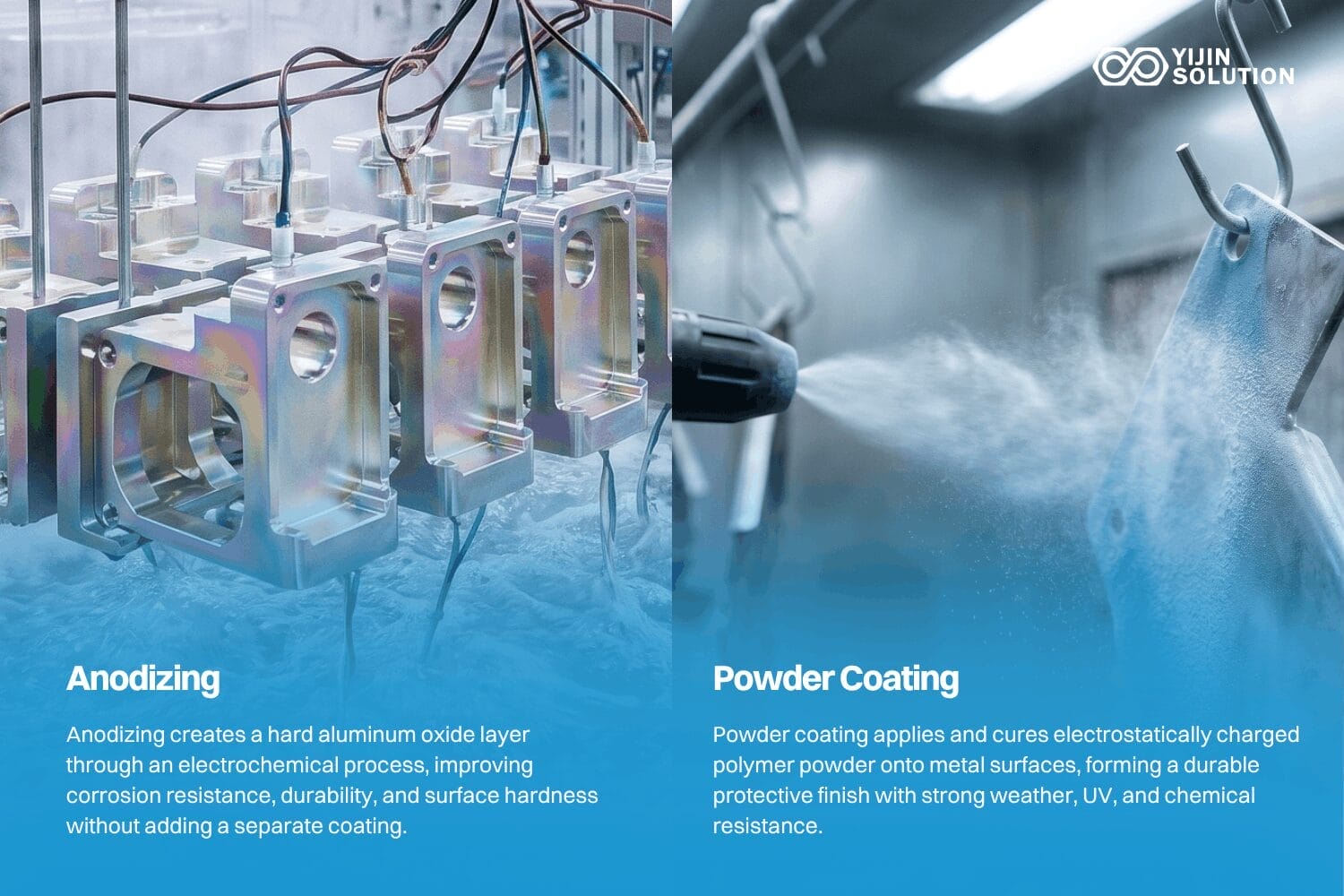
Anodizing is an electrochemical process that converts the surface of an aluminum part into a hard aluminum oxide layer. The part acts as the anode in an acid electrolyte bath. Electric current drives oxygen ions into the surface, and the oxide grows from the metal itself. This is the fundamental difference from powder coating, paint, or plating: the finish is the metal, with nothing applied on top.
Three types define the range of what anodizing can do, each classified under MIL-A-8625, the military specification that governs anodic coatings for aluminum.
- Type I (chromic acid): 0.5 to 2.5 μm. Adds almost no external dimension. Used for precision components where even a few microns matter.
- Type II (sulfuric acid): 5 to 25 μm. The most common type. Accepts dye well and provides moderate corrosion resistance for general-purpose applications.
- Type III (hard anodizing): 25 to 100 μm. Surface hardness of 300 to 600+ HV depending on alloy and process conditions. Used for wear surfaces and high-abrasion environments.
Dimensional behavior follows what the industry calls the 50/50 rule: approximately half the oxide grows inward into the aluminum, and half builds outward. A 20 μm Type II coating adds roughly 10 μm to external dimensions per surface under typical conditions.
For parts with tolerances of ±0.05 mm or tighter, this growth is manageable when coating thickness is specified on the drawing and machined dimensions are adjusted accordingly. Hard anodize at 50 μm total adds approximately 25 μm per surface, so pre-machining allowance is standard. For a deeper comparison of Type II and Type III, see our Type II vs Type III Anodizing guide.
Anodizing is common on aerospace brackets and housings that require MIL-A-8625 compliance, consumer electronics enclosures where scratch resistance and a metallic finish matter, and medical device housings where biocompatibility and surface cleanliness are specification requirements.
Advantages:
- Finish integrates with the metal and does not peel
- Inherently UV-stable with no fading or chalking
- Preserves tight tolerances when coating thickness is specified on the drawing
- Type III hard anodize reaches 300 to 600+ HV — comparable to tool steel
- Accepts dye for decorative color options
Compromis :
- Works on aluminum only
- Color palette is narrow compared to powder coating
- Color consistency varies between alloys
- Damaged areas require a full strip and re-process rather than spot repair
- Per-part cost is higher than powder coating for equivalent coverage
What is Powder Coating?
Powder coating is a dry finishing process that applies a cured polymer film to a metal surface. A spray gun gives dry powder particles an electrostatic charge. The charged particles adhere to the grounded metal part, and the assembly enters a curing oven at 190 to 232 °C. Heat melts the powder and flows it into a continuous, sealed film.
The powder itself comes in several resin families, each suited to different service conditions:
- Epoxy: Strong chemical resistance and adhesion, but degrades under UV exposure. Best for indoor or concealed surfaces.
- Polyester: Resists UV and weathering well. Dominates outdoor architectural and automotive applications.
- Hybrid epoxy-polyester: Balances both properties. Used for general-purpose indoor applications.
- Thermoplastic (nylon, PVDF): Serves niche performance needs where standard thermosets are not suitable.
For exterior aluminum facades and extrusions, AAMA 2604 and AAMA 2605 are the architectural performance standards that define minimum coating thickness, adhesion, and weathering requirements.
Coating thickness runs 50 to 150 μm, depending on powder type, spray technique, and part geometry. This thickness fully conceals surface imperfections from welding, grinding, or machining, producing a uniform appearance even on rough substrates. It also adds measurable material to every coated surface. On a bore, 100 μm per side means 200 μm less clearance. On threads, the added thickness can prevent assembly. Masking critical features before coating is standard practice on precision parts.
Powder coating is common across a wide range of applications: outdoor architectural panels, automotive trim and wheels, industrial equipment housings, consumer appliances, furniture, and guardrails. It works on aluminum, carbon steel, stainless steel, zinc, brass, and any electrically conductive substrate that tolerates the cure temperature.
Advantages:
- Virtually unlimited color options across the full RAL system, plus metallics, textures, and custom gloss levels
- Overspray powder is recyclable and the process produces no VOCs
- Damaged areas can be spot-sanded and re-coated in the field
Compromis :
- The 50 to 150 μm coating thickness affects fit on precision parts and requires masking on threads and mating surfaces
- Heat tolerance tops out at roughly 200 °C
- Color may chalk under prolonged UV exposure depending on resin type
- Scratch hardness does not match Type III hard anodize
What are the Key Differences Between Anodizing and Powder Coating?

The differences below shape every practical decision between the two finishes, from how tight a tolerance the part can hold to whether the part can survive the cure cycle.
Dimensional impact and tolerance compatibility
On a Type II process, roughly 10 μm builds outward per surface on a 20 μm coating. For parts with tolerances of ±0.05 mm or tighter, this growth is manageable when specified on the drawing and compensated at the machining stage. Type III hard anodize at 50 μm total puts approximately 25 μm on the external surface, so pre-machining allowance is standard on wear-critical features.
Powder coating adds 50 to 150 μm per surface. On a bore or thread, 100 μm per side means 200 μm reduction in clearance. Parts with tolerances tighter than ±0.1 mm on mating features require masking or post-coating machining. The Faraday cage effect can also cause uneven thickness in recessed features and inside corners, adding another variable to dimensional control.
Consider a CNC-machined aluminum faceplate with ±0.05 mm mating surfaces. Anodizing at Type II thickness keeps all features within spec. Powder coating the same part without masking pushes mating surfaces outside tolerance and can prevent assembly.
Verdict: Anodizing is the specification-safe choice for precision parts. Powder coating requires tolerance review and masking for tight-feature assemblies.
Durability, hardness, and wear resistance
Type III hard anodize reaches 300 to 600+ HV, depending on alloy and process conditions. That range is comparable to tool steel. The oxide is ceramic, resists abrasion and sliding wear, and cannot peel because it is part of the metal. A scratch on an anodized surface does not cause film lifting the way it does on a coating.
Powder coating produces a softer surface, typically in the 2H to 4H pencil hardness range. It absorbs impact and resists light abrasion well, but scratches more readily than hard anodize under repeated contact. A deep chip exposes bare metal, and corrosion can start at the exposed area if moisture reaches it.
Verdict: For parts exposed to repeated sliding contact, abrasion, or high-traffic handling, hard anodizing provides measurably superior surface hardness. Powder coating suits impact resistance on parts where scratching is not the primary concern.
Résistance à la corrosion
The anodized oxide is integral to the aluminum. Even when scratched, the remaining oxide still protects the surrounding area. Properly sealed Type II anodize passes 336+ hours of salt spray testing per ASTM B117 on most wrought alloys. Type III sealed coatings can exceed 1,000 hours under the same test protocol.
Powder coating creates a sealed barrier that prevents moisture and chemicals from contacting the metal. The protection holds as long as the film stays intact. A chip or scratch breaks the barrier and allows localized corrosion underneath. Edge coverage on sharp features can be inconsistent because electrostatic deposition naturally thins at edges, a phenomenon known as the Faraday cage effect.
Verdict: Both provide strong corrosion protection. Anodizing offers more consistent protection on complex geometries and tolerates surface damage better. Powder coating provides effective barrier protection when film integrity is maintained.
Color options, appearance, and aesthetics
Anodizing produces a translucent metallic finish. The base aluminum is visible through the oxide layer, giving a distinctive depth that no opaque coating can replicate. Colors are limited to dyed tones: black, bronze, gold, red, blue, and clear. Color consistency depends on alloy composition. Aluminum 6061 and 7075 produce noticeably different tones from the same dye bath.
Powder coating offers virtually any color in the RAL system, plus custom formulations, textures, and gloss levels from high-gloss to dead matte. The finish is opaque and fully conceals the substrate, making it effective for hiding machining marks, weld lines, or surface imperfections that anodizing would reveal.
Verdict: Powder coating for color variety and decorative flexibility. Anodizing for a premium metallic appearance where the aluminum itself is part of the aesthetic.
How do the costs compare?
Standard Type II clear anodizing typically runs $0.20 to $0.50 per square inch, depending on batch size, part geometry, color requirements, and supplier region. Hard anodize adds 15 to 30% under similar conditions. Small batches and complex racking increase per-part cost. Color anodizing costs more than clear.
Powder coating typically runs $0.15 to $0.40 per square inch for a standard single coat. Large, flat parts cost less per square inch than small, complex geometries. The process scales well for high-volume runs, and color changes between batches add only minor cost.
Verdict: Powder coating for cost-driven, high-volume applications on larger parts. Anodizing for precision parts where masking labor and rework risk make the per-part cost comparison less clear-cut.
Compatibilité des matériaux
Anodizing works on aluminum and aluminum alloys only. It cannot be applied to steel, stainless steel, copper, or non-conductive substrates. Wrought alloys like 6061 anodize more consistently than high-silicon cast alloys, which can produce uneven oxide thickness and mottled color.
Powder coating works on any electrically conductive substrate that tolerates 190 to 232 °C curing temperatures. Common substrates include aluminum, carbon steel, stainless steel, zinc, and brass. The cure temperature itself requires attention: heat-sensitive components, pre-installed electronics, plastic inserts, and pre-heat-treated aluminum in T6 temper may be affected by the cure cycle. Plan the finishing sequence accordingly on assemblies with heat-sensitive subcomponents.
Verdict: If the part is not aluminum, powder coating is the only option. For mixed-metal assemblies, it provides a single finishing process across all components, with cure-temperature compatibility to verify first.
Heat tolerance and service temperature
The anodized oxide layer is ceramic aluminum oxide, stable at temperatures well above the aluminum substrate’s limits. However, aluminum itself softens around 200 °C and melts at 660 °C. The part’s service temperature is substrate-limited, not oxide-limited. For continuous service, anodized aluminum is typically rated to roughly 200 °C.
Most thermoset powder coatings begin to degrade, discolor, or soften above 200 °C as well. Neither finish extends the aluminum substrate’s service temperature range. The practical difference is in the process itself: anodizing is a room-temperature or near-freezing bath process that does not heat the part, while powder coating cures at 190 to 232 °C and exposes the part to sustained heat. Anodized surfaces also have higher thermal emissivity than bare aluminum, which can improve passive heat dissipation in electronics enclosures.
Verdict: For sustained high-temperature service, both finishes are limited by the aluminum substrate. For passive thermal management at moderate temperatures, anodizing offers an emissivity advantage. For heat-sensitive assemblies that cannot tolerate the cure cycle, anodizing is the lower-risk choice.
Repairability
Anodizing cannot be spot-repaired. A damaged anodized part must be stripped and re-anodized in full. Each strip-and-reprocess cycle removes a small amount of base aluminum, which may affect critical dimensions over multiple repairs.
Powder coating can be spot-sanded and re-coated in the field. Touch-up repair is straightforward, though matching the exact color on an aged coating can be difficult. For parts in maintenance-heavy environments, this is a real lifecycle advantage.
Verdict: Powder coating suits parts in environments where in-field repair is a realistic requirement. Anodizing works on the assumption that the original finish will last the service life of the part.
How to Choose Between Anodizing and Powder Coating
The comparison above covers what each finish does. The decision framework below covers when to specify each one.
Choose anodizing when…
- The part is aluminum and has tolerances of ±0.05 mm or tighter on critical mating surfaces.
- The application requires MIL-A-8625 compliance: aerospace brackets, defense housings, or medical device components.
- Surface hardness matters. The part is exposed to sliding wear, abrasion, or repeated handling, and Type III hard anodize at 300 to 600+ HV is required.
- A metallic, translucent finish is the desired aesthetic: consumer electronics enclosures, premium industrial controls, or optical instrument housings.
- The part will be bonded or glued after finishing. Anodized surfaces accept structural adhesives and primers more readily than powder-coated surfaces because the porous oxide provides mechanical keying.
- Heat-sensitive components are pre-installed in the assembly, ruling out the 190 to 232 °C powder cure cycle.
Choose powder coating when…
- The part is not aluminum: steel, stainless steel, zinc, brass, or mixed-metal assemblies that need a single finishing process.
- Color specification requires a specific RAL color, custom texture, or high-gloss decorative finish that anodizing cannot achieve.
- The part is large with simple geometry: architectural panels, outdoor furniture, guardrails. Powder coating’s cost efficiency at scale outweighs the dimensional consideration.
- Surface imperfections from welding, grinding, or fabrication need to be concealed. The 50 to 150 μm coating hides what anodizing would reveal.
- Tolerances on the part are ±0.1 mm or looser, and masking is straightforward.
- Repairability matters. The coating can be spot-sanded and re-coated in the field.
Need Help Choosing Between Anodizing and Powder Coating?
Yijin Solution provides anodizing and powder coating for custom metal parts. We can review your material, tolerance, color, surface texture, and use environment to recommend a suitable finish.
Upload your design file and share your finish requirements. Our team will return a quote and DFM feedback based on your project needs.
Anodizing vs Powder Coating FAQs
Is anodizing more durable than powder coating?
Durability depends on the type of wear. Hard anodizing, or Type III, produces a ceramic oxide surface at 300 to 600+ HV, significantly harder than the cured polymer of a powder coat. It resists scratching and abrasion under repeated contact. Powder coating resists impact and chipping better in applications where blunt force is the primary concern. Abrasion favors anodizing. Impact favors powder coating.
Can you powder coat over anodized aluminum?
Yes, with proper surface preparation. The anodized layer must be cleaned and lightly abraded to provide a key for the powder. However, this approach is rarely cost-effective. The anodized layer’s benefits, including corrosion resistance and scratch hardness, are largely overridden by the powder coating on top. Choosing one process from the start usually produces better results at lower cost.
Which finish performs better for outdoor aluminum parts?
Both perform well outdoors for different reasons. Anodizing is inherently UV-stable and does not fade, chalk, or peel. Outdoor-rated polyester powder coatings also provide strong weather resistance, plus a wider color range. For architectural facades, AAMA 2604 and AAMA 2605 rated powder coatings are the industry standard for long-term exterior performance. For precision outdoor hardware where scratch resistance and dimensional stability matter more than color range, anodizing is typically preferred.
Does powder coating affect part dimensions?
Yes, powder coating adds 50 to 150 μm per surface, which can reduce hole clearances, interfere with threaded fits, and push mating surfaces outside tolerance on precision parts. Masking critical features before coating is standard practice. For parts with tolerances tighter than ±0.1 mm on assembly interfaces, discuss finish allowance with the manufacturer at the quoting stage.
Which finish performs better when parts need to be bonded or glued after finishing?
Anodized aluminum surfaces accept structural adhesives and primers more readily than powder-coated surfaces. The porous oxide layer provides mechanical keying for the adhesive. Powder-coated surfaces are smoother and chemically inert, requiring surface abrasion or specialty primers before bonding. For assemblies that rely on adhesive joints, anodizing is the simpler specification.
Can heat-sensitive components survive the powder coating cure?
Powder coating cures at 190 to 232 °C, which can affect pre-installed electronics, plastic inserts, and pre-heat-treated aluminum tempers, especially T6 condition. Sequence the finishing step before installing heat-sensitive subcomponents, or specify a low-temperature-cure powder where available. Confirm cure temperature compatibility with the supplier before finalizing the production sequence.
Retour en haut de la page : Anodizing vs. Powder Coating: Which Finish Is Right for Your Parts?






 English
  Spanish
  German
  French