
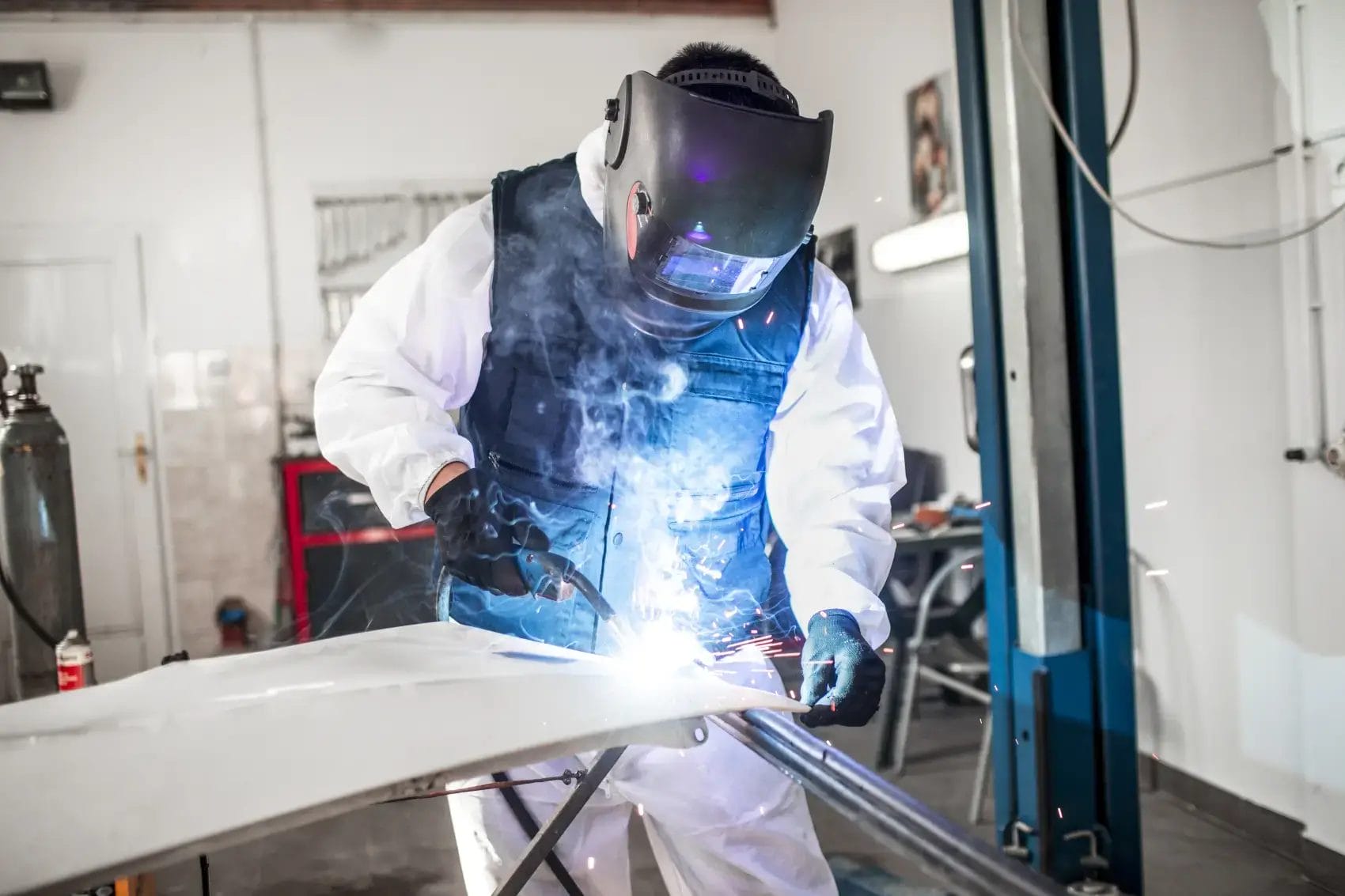
MIG welding – which stands for Metal Inert Gas welding, though it’s officially called Gas Metal Arc Welding or GMAW – is probably the most straightforward welding process you’ll come across. It works by continuously feeding electrode wire through a gun while an electric arc melts both that wire and your base metal, creating a solid joint between the pieces. The whole thing happens under a protective blanket of shielding gas (usually argon or CO2 mixtures) that keeps atmospheric junk from contaminating your weld.
This isn’t some brand-new technology, either – it was developed back in the 1940s at Battelle Memorial Institute and has been refined over the decades into what we use today. The process runs on direct current with the electrode positive (that’s DCEP if you want to sound technical), which gives you good penetration and decent welding speed. It’s become popular because it’s relatively easy to learn and produces clean, strong welds when you get the settings right.
Основные выводы
- Uses consumable wire electrodes with protective shielding gas to keep welds clean and strong
- Wire feeds anywhere from 2 to 30 meters per minute, which means you can move pretty fast on production work
- Four different transfer modes (short-circuit, globular, spray, and pulsed-spray) let you handle different material thicknesses properly
- Works on carbon steel, stainless, aluminum, and specialty alloys from 0.6 mm up to 12.7 mm thick
- Beats most other welding methods for deposition speed when you’re doing manufacturing runs
How does MIG Welding Work?
Welding MIG creates an electric arc between a continuously fed wire electrode and the workpiece, generating temperatures around 6,500 °F to melt and join both materials. The electrode wire feeds through a welding gun at controlled speeds while gas flows around the arc to protect the molten metal from oxygen and nitrogen contamination. This welding technique relies on a constant voltage power supply that maintains stable arc characteristics.
The global MIG welders market was nearly $2 billion in 2021 and is expected to grow steadily to about $2.4 billion by 2025 and then to over $3.3 billion by 2033, growing at around 4.4% each year between 2025 and 2033.
Arc Formation and Heat Distribution
Direct current electrode positive (DCEP) polarity provides optimal heat distribution, with approximately 70% of heat generated at the workpiece and 30% at the tip of the electrode. This heat balance ensures adequate weld penetration while maintaining efficient wire melting rates. The arc length operates at 17–22 volts for short-circuit welding, and current and voltage combinations vary based on material thickness.
Shielding Gas Functions
Inert gas serves multiple functions in this welding metal process:
- Protects weld puddle from atmospheric contamination
- Controls stable arc characteristics and penetration depth
- Influences metal transfer modes between electrode and workpiece
- Affects weld bead profile and appearance quality
What Equipment do You Need for MIG Welding?
MIG welding equipment requires five essential components working together for successful operation. The welding power source provides constant voltage output ranging from 15-32V depending on material thickness and wire diameter. Wire feed units control filler wire delivery at precise rates from 2-30 m/min for automated systems and 2-10 m/min for manual applications.
| Компонент | Технические характеристики | Функция |
|---|---|---|
| Power Source | 15-32V constant voltage | Maintains stable arc |
| Wire Feed Unit | 2-30 m/min variable speed | Controls electrode delivery |
| Welding Gun | Air or water cooled | Delivers wire and gas |
| Gas Supply | 10-25 L/min flow rate | Protects weld pool |
Contact Tips and Gas Diffusers
Contact tips transfer welding current to filler metal electrodes and must match wire diameter precisely. Standard wire diameters range from 0.7 mm to 2.4 mm, with smaller diameters providing better control for welding thin materials. Gas diffusers control argon gas flow patterns around the weld area, ensuring complete protection during the welding process.
Wire Electrode Specifications
Consumable wire electrodes match base material compositions:
- ER70S-6 for carbon steel fabrication projects
- ER4043 and ER5356 for aluminum sheet metal applications
- ER308L and ER316L for welding stainless steel grades
Which Metal Transfer Modes does MIG Welding Use?
A mig welder employs four distinct transfer modes based on current levels and arc characteristics. Short-circuit transfer occurs at low currents where the filler wire physically touches the weld pool, creating momentary short circuits. This mode operates at 100-200 amperes and suits thin materials below 6 mm thickness with minimal spatter generation.
Advanced Transfer Modes
Spray Transfer: Begins above transition current (typically 250–300 amperes for steel), creating smooth droplet streams with deep penetration. Requires materials above 6 mm thickness and flat position welding applications.
Pulsed-Spray Transfer: Uses programmed current pulsing to achieve spray characteristics at lower heat input levels, enabling thin sheet welding with superior quality.
Cold Metal Transfer (CMT): Advanced process variant using controlled current drops, allowing welding of thin aluminum with minimal distortion and lower heat input requirements.
What Materials Can Be MIG Welded?
Wire-fed welding accommodates materials from 24 gauge sheet metal (0.6 mm) up to 12.7 mm thick sections in single-pass applications. Carbon steel represents the most common application, using carbon dioxide or mixtures of argon with 25% carbon dioxide shielding gases. The global automotive sector drives significant demand for this welding technique in manufacturing environments.
Material-Specific Requirements
| Материал | Экранирующий газ | Wire Type | Температура плавления |
|---|---|---|---|
| Углеродистая сталь | CO2 or Ar/CO2 mix | ER70S-6 | 2,600-2,800°F |
| Нержавеющая сталь | Tri-mix | ER308L, ER316L | 2,500-2,650°F |
| Алюминий | Pure Argon | ER4043, ER5356 | 1,220 °F |
Challenging Materials
Алюминий: High thermal conductivity and rapid oxide formation create narrow working windows. Requires push gun position techniques and specialized methods to prevent porosity from hydrogen absorption in hot metal applications.
Медь: Exceptional thermal conductivity demands high heat input and often preheating for thick sections above 3 mm.
Никель: While relatively easy to weld, nickel alloys may develop porosity over time, requiring careful gas flow control and proper filler selection.
How do Welding Parameters Affect MIG Quality?
Welding parameters directly control penetration depth, bead profile, and joint strength characteristics. Voltage controls arc length, with higher settings producing wider, flatter beads and increased penetration. Wire feed speed determines current levels, typically matched to voltage settings for stable operation.
Critical Parameter Relationships
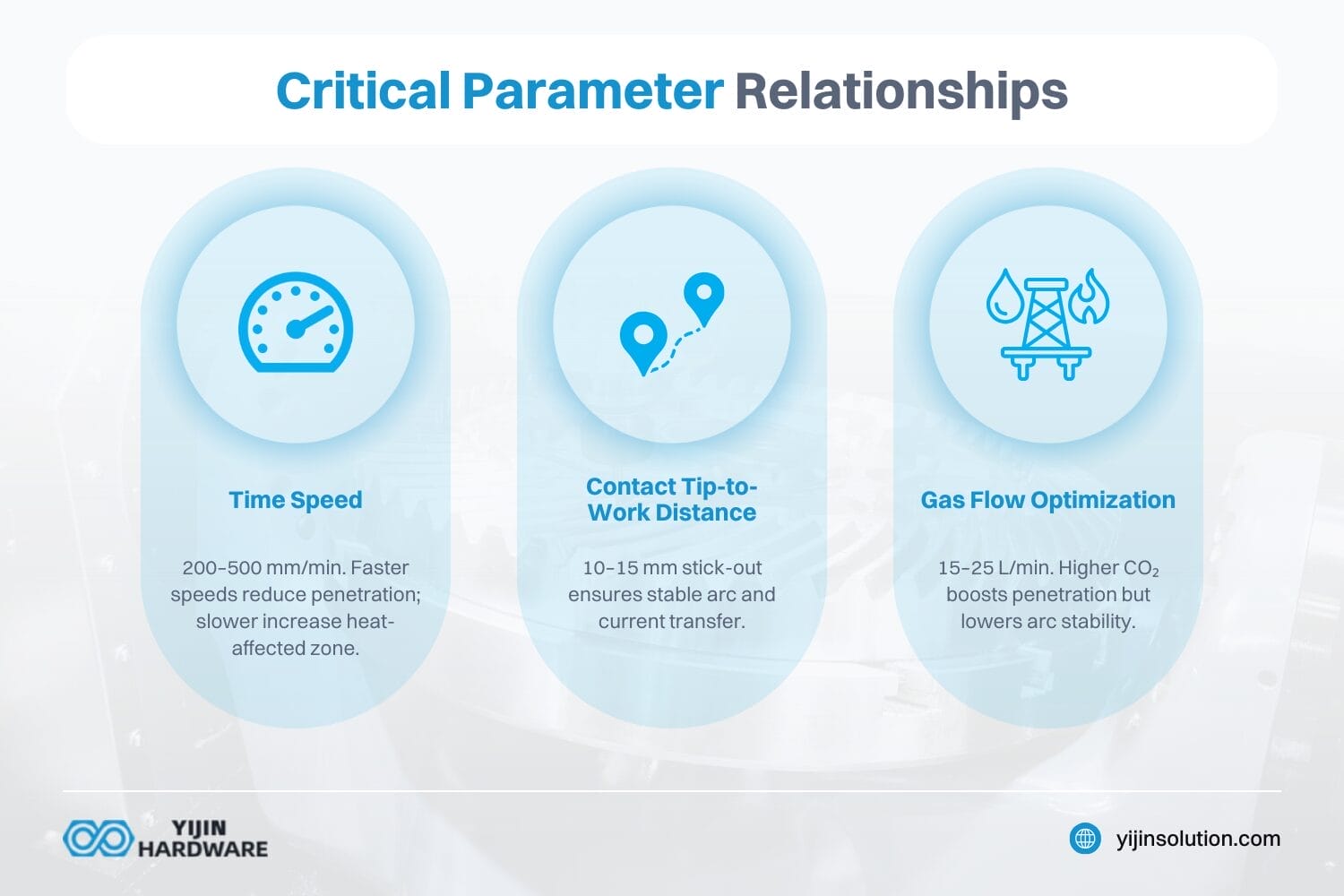
Travel Speed: Affects weld heat input per unit length, typically ranging 200-500 mm/min depending on material thickness. Faster speeds reduce penetration, while slower speeds increase heat-affected zone width.
Contact Tip-to-Work Distance: Standard stick-out distance of 10-15 mm provides optimal current transfer and arc stability for consistent results.
Gas Flow Optimization: Flow rates of 15-25 L/min balance coverage with turbulence prevention. Higher carbon dioxide content increases penetration but reduces arc stability in the welding table setup.
What are MIG Welding’s Manufacturing Advantages?
MIG welding information shows deposition rates reaching high deposition rate levels compared to TIG welding applications, providing significantly higher productivity. The continuous wire feed eliminates electrode changes, maintaining consistent production flow in manufacturing environments. Automation compatibility enables robotic applications with programmable parameters for repeatable quality.
Production Benefits
- No slag removal requirements reduce finishing time
- Relatively simple operation reduces training costs for any welder
- Suitable for vertical and overhead positions with proper technique
- Compatible with mechanized and robotic systems for fabrication
- Wide availability of consumable materials and welding equipment
We utilize advanced robotic systems, achieving consistent quality while maximizing throughput in our manufacturing operations.
What Limitations Should You Consider with MIG Welding?
Gas sensitivity to wind currents above 8 km/hr can disperse shielding coverage, creating porosity and oxidation defects in the weld. Equipment complexity increases initial investment compared to basic welding methods. Surface preparation demands clean, contamination-free materials for optimal fusion and strength.
Technical Limitations
- Burn-through risks on materials below 1.5 mm thickness
- Spatter generation with certain transfer modes requiring cleanup
- Limited outdoor application due to gas sensitivity issues
- Higher equipment costs than basic arc welding processes
How does MIG Compare to Other Welding Processes?
Inert gas welding provides significantly faster speeds than TIG welding while maintaining good quality for production applications. Compared to stick welding, this process produces cleaner results without slag removal and enables better thin material control. Arc stability surpasses stick welding, especially for out-of-position work applications.
Process Comparison Summary
vs TIG: Higher speed, easier operation, different tungsten electrode requirements
vs Stick: Cleaner operation, better thin material capability, indoor preference
vs Flux-Core: External gas required versus flux-cored wire internal protection
Which Industries Benefit Most from MIG Welding?
Automotive manufacturing represents significant global demand for body panels, frames, and exhaust systems requiring precise metal welding capabilities. Construction projects utilize this technique for structural steel, building frames, and infrastructure applications. Shipbuilding benefits from efficiency on thick steel plates, while aerospace applications leverage precision on aluminum and exotic materials.
Отраслевые применения
- Производство: High-volume production welding applications
- Инфраструктура: Bridge and building construction projects
- Морской: Heavy steel fabrication and assembly
- Энергия: Pipeline and structural welding applications
We serve these demanding industries with precision capabilities and comprehensive quality control systems for diverse welding applications.
What Safety Considerations Are Critical for MIG Welding?
This welding process generates ultraviolet and infrared radiation, requiring shade 10-13 filter lenses and complete body coverage. Welding fumes containing metal oxides and ozone demand adequate ventilation with local exhaust systems. AWS and OSHA compliance requires proper grounding, electrical safety protocols, and fire prevention measures around any welding area.
Essential Safety Equipment
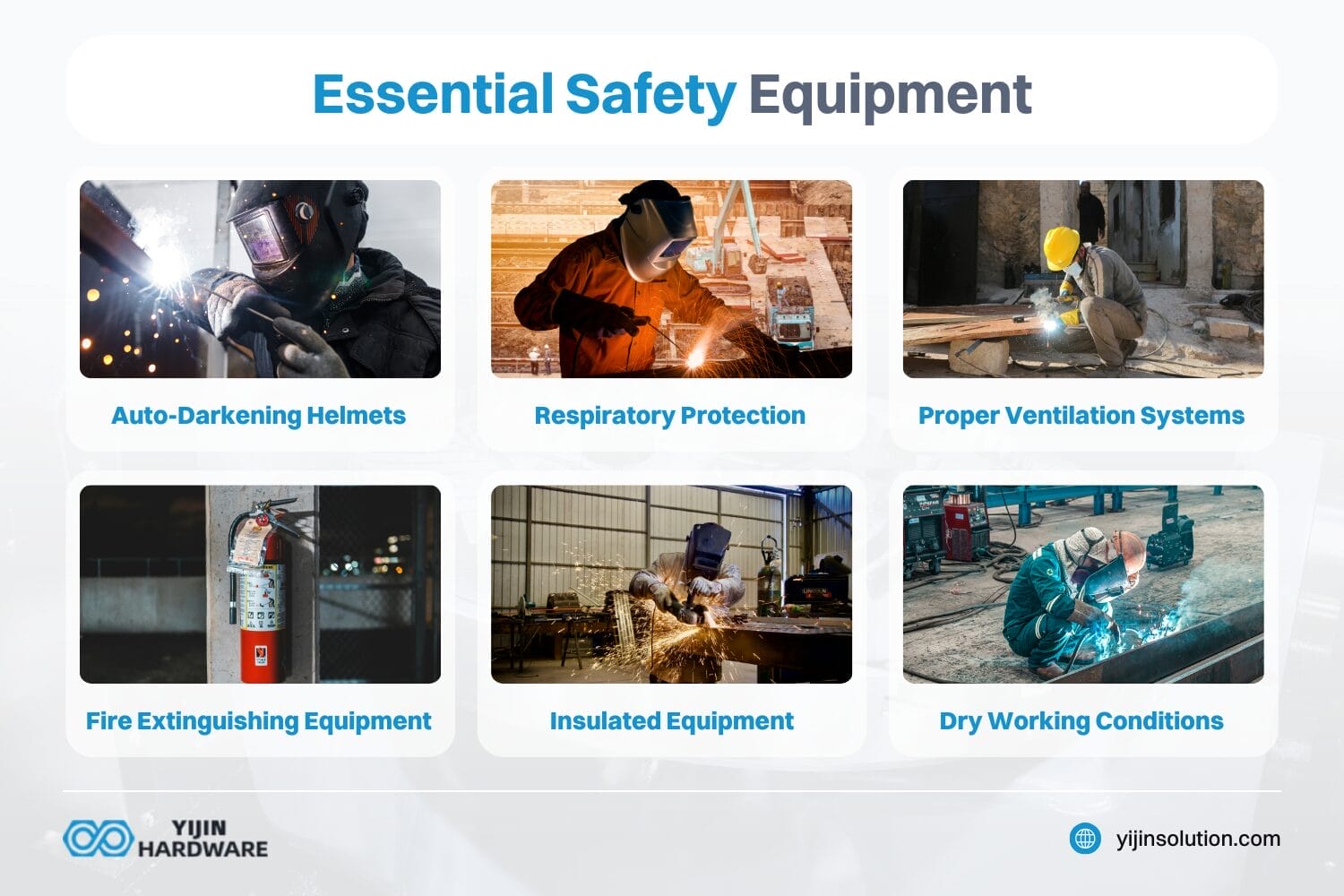
- Auto-darkening helmets with appropriate shade ratings for arc protection
- Respiratory protection for hazardous material applications
- Proper ventilation systems for fume removal and safety
- Fire extinguishing equipment and combustible material removal protocols
- Insulated equipment and dry working conditions for electrical safety
Ready to Start Your MIG Welding Project?
Understanding MIG welding fundamentals helps you make informed decisions about your manufacturing needs. From thick and thin materials to complex alloy requirements, proper technique selection and parameter control determine project success. The angle of the gun, argon and helium gas mixtures, and carbon dioxide and oxygen combinations all influence final weld quality and strength.
We provide comprehensive MIG welding solutions using advanced equipment and decades of experience. Our team understands the complexities of different materials, from basic carbon steel to challenging exotic alloys requiring specialized techniques. Whether you need high-volume production runs or precision prototype development, we deliver consistent quality results that meet your specifications and timeline requirements.
Свяжитесь с нами сегодня to discuss your welding requirements and discover how our expertise can fuse your project vision with manufacturing reality.
FAQs on What is MIG Welding?
What is the difference between TIG and MIG?
TIG welding uses a non-consumable tungsten electrode requiring separate filler rod manipulation, while MIG feeds consumable wire automatically through the gun. TIG demands two-handed coordination and produces higher quality welds suitable for critical applications, whereas MIG offers faster welding speeds with single-handed operation better suited for production environments where efficiency matters more than visual perfection.
Is MIG welding for beginners?
MIG welding suits beginners better than most processes due to automatic wire feeding and straightforward gun operation requiring only trigger control, gun angle, and travel speed management. The continuous process eliminates stops for electrode changes, allowing beginners to focus on technique development, though proper parameter selection and surface preparation still require training to achieve professional results.
What are the 4 types of welding?
The four primary welding processes are MIG (consumable wire with external shielding gas), TIG (tungsten electrode with inert gas), stick welding (flux-coated electrodes), and flux-cored (tubular wire containing flux compounds). Each offers distinct advantages, with MIG providing speed and automation, TIG delivering precision, stick offering portability, and flux-cored enabling outdoor applications without external gas requirements.
Вернуться к началу: Что такое MIG-сварка? Полное руководство по газовой дуговой сварке