

Chaque pièce de tôle est d'abord un matériau plat. Ce qui la transforme en support, en boîtier ou en panneau structurel, c'est l'équipement de fabrication de tôle utilisé par l'atelier. Les machines elles-mêmes déterminent les paramètres techniques réalisables, la rapidité d'expédition des pièces et le coût par pièce en fonction des différents volumes de l'atelier.
Pour les ingénieurs qui spécifient les pièces ou les équipes d'achat qui évaluent les fournisseurs, l'équipement qu'un atelier utilise réellement est un indicateur de capacité plus fiable que les discours marketing sur la précision ou la qualité.
Ce guide couvre les principales catégories d'équipement, explique comment chacune d'entre elles affecte votre production de pièces et vous aide à adapter les capacités de l'équipement aux exigences de votre projet.
Qu'est-ce qu'un équipement de fabrication de tôles ?
L'équipement de fabrication de tôles est la catégorie de machines utilisées pour couper, former, assembler et finir des pièces métalliques plates en composants de précision. Ce terme recouvre des machines individuelles telles que les découpeuses laser et les presses plieuses, ainsi que des lignes automatisées intégrées qui gèrent plusieurs opérations en séquence.
Ces machines produisent des pièces avec des tolérances contrôlées, une finition de surface cohérente et une répétabilité adaptée au processus. La tolérance réalisable et la qualité de la production dépendent à la fois du type de machine et des variables qui la régissent, notamment le matériau, l'épaisseur de la tôle, l'état d'étalonnage et la géométrie de la pièce.
Liste d'équipement pour la fabrication de tôles : Référence rapide
Le tableau ci-dessous donne une vue d'ensemble des principaux types d'équipements, orientée vers l'acheteur.
| Equipement | Fonction principale | Niveau d'automatisation | Industries typiques |
|---|---|---|---|
| Machine de découpe laser | Découpe thermique de précision de feuilles et de plaques | Haute, CNC + chargement automatique des feuilles | Aérospatiale, automobile, électronique |
| Presse plieuse | Pliage des tôles en angles et en formes | Moyenne à élevée, cellule CNC ou robotisée | Enceintes, supports, HVAC |
| Poinçonneuse / poinçonneuse à tourelle | Poinçonnage, formage et découpage de trous | Tourelle haute, CNC | Électronique, télécommunications, panneaux |
| Découpeur plasma | Découpe thermique d'une plaque conductrice épaisse | Moyen à élevé, table CNC | Structures, équipements lourds |
| Découpeur à jet d'eau | Coupe à froid sans zone affectée thermiquement | Haut, CNC | Aérospatiale, médecine, composites |
| Poste de soudage MIG/TIG | Assemblage de composants en tôle | Du manuel au robotique | Automobile, structurel, médical |
| Cisaille / Guillotine à métaux | Coupe en ligne droite de tôles | Manuel à CNC | Fabrication générale, découpage |
| Formeuse de rouleaux / Ligne de bobines | Formage en continu de profilés longs | Haut, alimenté par bobine automatisée | Construction, CVC, automobile |
| Soudeur par points | Assemblage par résistance de feuilles minces se chevauchant | Du manuel au robotique | Panneaux de carrosserie automobile, boîtiers |
| Machine d'ébavurage / de finition | Lissage des bords et traitement de surface | Semi-automatique à automatisé | Tous les secteurs nécessitant des bords finis |
Les découpeurs laser, les presses plieuses à commande numérique et les postes de soudage constituent l'équipement de base de la plupart des ateliers de fabrication générale. Les presses à estamper et les découpeurs au plasma permettent de réaliser des travaux de découpage et de tôlerie en grande série. Les profileuses et les équipements de finition automatisés sont des équipements supplémentaires pour les ateliers qui desservent des marchés spécialisés ou de gros volumes.
Comment le choix de l'équipement affecte-t-il la production de pièces ?
La même machine peut produire des résultats très différents selon la manière dont elle est réglée, le matériau qu'elle traite et la géométrie de la pièce. Les spécifications de l'équipement décrivent une capacité globale, et non le résultat que l'acheteur obtiendra sur une pièce spécifique.
Tolérance réalisable
La tolérance d'une pièce de tôle finie n'est pas un nombre fixe lié au modèle de la machine. Elle dépend du type et de l'épaisseur du matériau, de l'état d'étalonnage de la machine, de la complexité de la géométrie de la pièce et du nombre d'opérations dans la chaîne de traitement.
Un laser à fibre découpant une simple pièce rectangulaire en acier doux de 1 mm aura des dimensions plus serrées que le même laser découpant un profil complexe en acier inoxydable de 6 mm. Les tolérances citées pour tout type d'équipement sont des fourchettes indicatives et non des garanties pour une pièce spécifique.
Qualité des bords et finition de la surface
La qualité du bord est déterminée par le type de processus, le matériau découpé, la vitesse de coupe et toute opération de finition secondaire spécifiée. Un bord découpé au laser sur de l'acier fin peut être prêt à être soudé dès sa sortie de la machine. Un bord découpé au plasma sur une plaque de 20 mm doit généralement être meulé avant les opérations en aval. Les acheteurs qui spécifient des exigences en matière de finition de surface doivent les confirmer lors de l'examen DFM, et non après l'inspection du premier article.
Comment le volume de production modifie l'économie
Le choix de l'équipement est aussi une décision de volume. Un laser à fibre est efficace sur une large gamme de volumes, des prototypes aux séries de milliers d'exemplaires. Une cellule de presse plieuse robotisée ne justifie son coût d'investissement qu'à partir d'un certain seuil.
Le profilage n'est rentable qu'à grande échelle, lorsque l'investissement dans l'outillage peut être réparti sur une longue période. Le bon équipement pour un prototype n'est pas toujours adapté à la production, et votre partenaire de fabrication doit être en mesure de vous conseiller sur le moment où il faut passer à autre chose.
Conducteurs de véhicules à délai d'exécution
Les délais ne dépendent pas seulement de la vitesse des équipements. Le temps de préparation entre les travaux, l'approvisionnement en matériaux, la longueur de la file d'attente à l'atelier, le nombre d'opérations dans la chaîne de traitement et la finition secondaire sont autant de facteurs qui y contribuent.
Un atelier disposant d'un laser rapide mais d'une file d'attente de deux semaines livre plus lentement qu'un atelier disposant d'une machine légèrement plus lente et d'une capacité ouverte. Les estimations des délais doivent refléter l'ensemble de la chaîne de processus, et pas seulement le temps de cycle d'une seule opération.
Équipement de découpe de la tôle : Laser, plasma et jet d'eau

Machines de découpe laser
La découpe au laser utilise un faisceau focalisé pour faire fondre ou vaporiser le matériau le long d'une trajectoire programmée par la CNC, un gaz d'assistance éliminant le matériau fondu du trait de coupe. Il s'agit du procédé de découpe le plus utilisé dans la fabrication de tôles sur mesure.
Deux types de laser dominent le marché. Les lasers à fibre fonctionnent à une longueur d'onde de 1,06 μm qui est absorbée efficacement par les métaux, ce qui en fait la norme dans la plupart des ateliers de fabrication modernes pour les tôles fines à moyennes. Les lasers CO2, qui fonctionnent à 10,6 μm, conservent leurs avantages pour les plaques d'acier épaisses de plus de 20 mm et pour les matériaux non métalliques tels que l'acrylique et le bois. Une troisième catégorie, les lasers Nd:YAG et les lasers à disque, sert des applications de précision de niche, mais est moins répandue dans la fabrication générale.
La découpe laser de tôles permet d'obtenir des tolérances de l'ordre de ±0,05 à 0,15 mm, en fonction du type de matériau, de l'épaisseur de la tôle, de l'étalonnage de la machine, du choix du gaz d'assistance et de la géométrie de la pièce. Les tôles plus fines et les profils plus simples permettent généralement d'obtenir des résultats plus serrés. Les matériaux plus épais ou les géométries complexes élargissent la plage.
Comparaison des types de laser :
| Type de laser | Gamme de puissance typique | Meilleure adéquation des matériaux | Compromis clé |
|---|---|---|---|
| Fibre | 1 à 40 kW | Métaux : acier, acier inoxydable, aluminium, cuivre, laiton | Plus rapide sur les tôles fines à moyennes ; la qualité des bords peut se dégrader sur les tôles épaisses |
| CO2 | 1 à 6 kW | Non-métaux, tôles d'acier épaisses supérieures à 20 mm | Plus lent sur le métal fin ; coût d'exploitation plus élevé ; qualité supérieure des bords des tôles épaisses |
| Nd:YAG / Disque | 0,5 à 6 kW | Métaux spéciaux, micro-découpe, découpe 3D | Coût d'équipement plus élevé ; utilisé pour les travaux de précision de niche |
Les lasers à fibre représentent aujourd'hui environ 60% du marché de la découpe laser. La plupart des nouveaux ateliers de fabrication qui se consacrent à la tôlerie installent des systèmes à fibre optique comme principale plate-forme de découpe. Les machines à CO2 restent pertinentes pour les ateliers qui traitent un mélange de métaux et de non-métaux, ou qui se spécialisent dans les tôles lourdes.
Découpe au plasma
La découpe au plasma utilise un gaz ionisé pour découper les métaux conducteurs d'électricité. Il est plus rapide et plus économique que le laser pour les tôles épaisses de plus de 12 mm, mais il produit un trait de scie plus large et une précision dimensionnelle moindre. Le plasma haute définition (HD) réduit l'écart de tolérance avec le laser sur les tôles plus épaisses, mais n'est pas comparable au laser sur les tôles minces.
Le plasma s'inscrit dans la décision de l'acheteur lorsque l'application implique un travail structurel lourd, tel que des plaques d'acier au carbone. C'est également le bon choix dans les situations où les exigences de tolérance de la pièce sont compatibles avec la plage réalisable du plasma. Pour les supports, les cadres et les goussets en acier de construction découpés dans des plaques de 12 à 50 mm, le plasma est souvent le procédé le plus rentable.
Découpe au jet d'eau
La découpe au jet d'eau est un procédé de découpe à froid. De l'eau à haute pression mélangée à du grenat abrasif découpe le matériau sans générer de zone affectée thermiquement, ce qui convient aux matériaux sensibles à la chaleur, aux composites et aux plaques épaisses pour lesquels la distorsion thermique est inacceptable.
La découpe au jet d'eau permet d'obtenir des tolérances comparables à celles des lasers sur de nombreux matériaux, bien que les résultats réels dépendent du type de matériau, de l'épaisseur et de la vitesse de découpe. Des vitesses de coupe plus lentes permettent généralement d'obtenir des tolérances plus étroites. Le compromis est le temps de cycle et le coût d'exploitation : le jet d'eau est plus lent et plus coûteux par pièce que le laser pour les tôles d'acier standard. Le jet d'eau est plus rentable pour les matériaux sensibles à la chaleur, où l'apport de chaleur entraînerait une déformation ou un changement métallurgique.
Tableau comparatif des procédés de coupe
Le tableau ci-dessous est une référence de sélection consultative et non une garantie de performance. Les résultats obtenus dépendent de l'équipement, du matériel et de la configuration spécifiques.
| Processus | Plage de tolérance typique* | Épaisseur maximale | Qualité des bords | Coût de la mise en place | Meilleure application |
|---|---|---|---|---|---|
| Laser | ±0,05 à 0,15 mm | 25 mm acier doux, 15 mm inox sur fibre 6 kW | Propre, souvent prêt à être soudé | Faible à modéré | Pièces de tôle de précision, du prototype à la production |
| Plasma | ±0,5 à 1,5 mm, plus serré avec HD | Métaux conducteurs 50+ mm | Plus rugueux, peut nécessiter un meulage | Faible | Tôle structurale épaisse, acier au carbone |
| Jet d'eau | ±0,05 à 0,15 mm à vitesse lente | 150+ mm sur certains matériaux | Lisse, sans HAZ | Modéré à élevé | Matériaux sensibles à la chaleur, composites, plaques épaisses |
| Presse à découper | ±0,05 à 0,10 mm | 6 mm typique | Bords nets et formés | Modérée, dépendante de l'outillage | Perçages en grande quantité, découpage |
Les fourchettes de tolérances sont données à titre indicatif. Les tolérances réalisables dépendent du matériau, de l'épaisseur de la tôle, de l'étalonnage de la machine, de la géométrie de la pièce et de la configuration du processus. Confirmez les exigences spécifiques avec votre partenaire de fabrication.
Équipement de formage de la tôle : Presses plieuses et profileuses
Presses plieuses
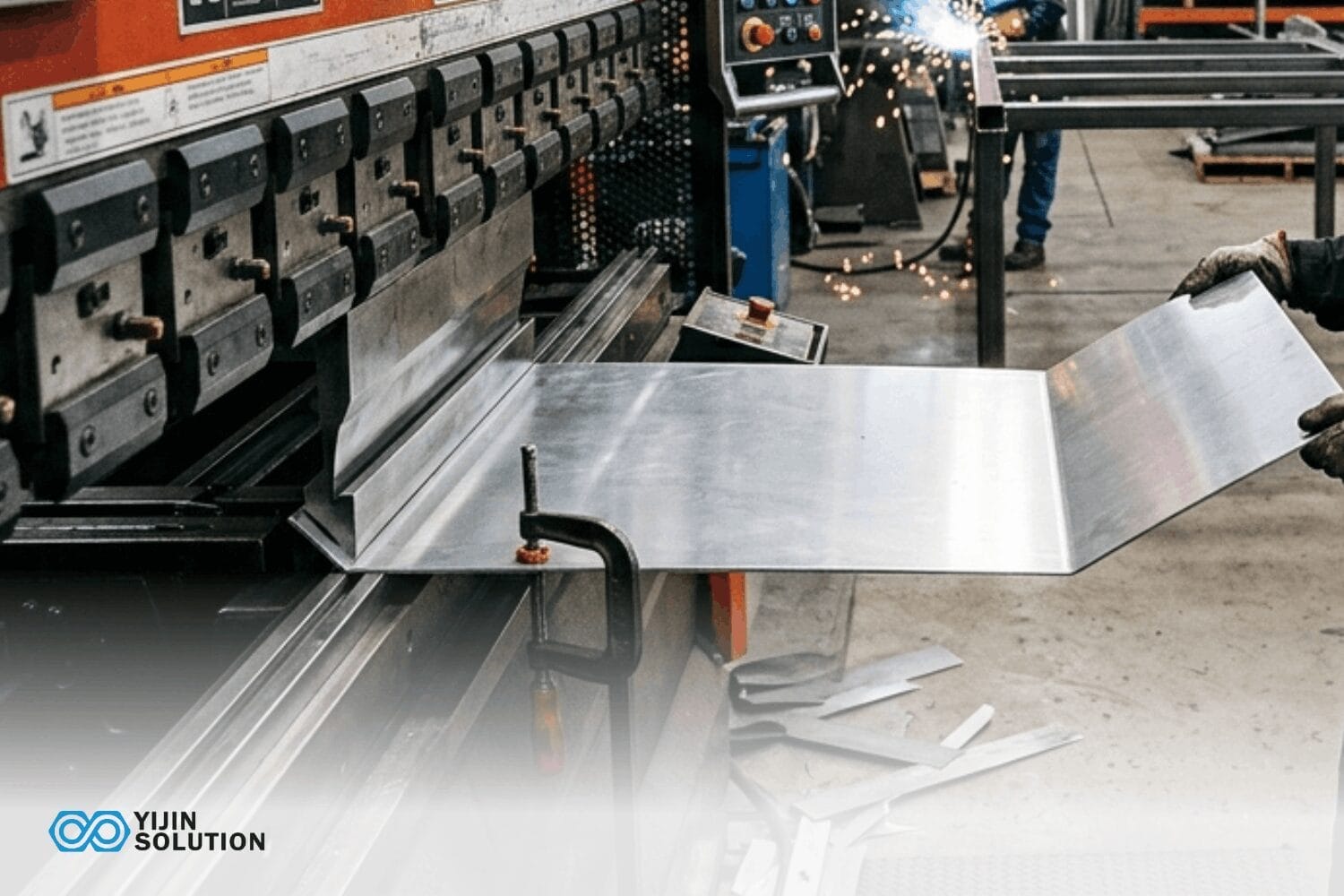
Une presse plieuse plie la tôle entre un poinçon et une matrice selon un angle précis. C'est la machine de formage centrale de tout atelier de tôlerie, et le type de presse plieuse utilisé par un atelier a une incidence directe sur la précision, la répétabilité et le rendement du pliage.
Quatre types principaux répondent à différents scénarios de production. Les presses plieuses manuelles conviennent pour les pliages simples et les faibles volumes. Les presses plieuses hydrauliques à commande numérique offrent une précision programmable et une capacité de tonnage élevée, ce qui en fait le cheval de bataille de la plupart des ateliers de fabrication. Les systèmes servo électriques et hybrides offrent une plus grande précision de répétition et consomment jusqu'à 50% d'énergie en moins que les modèles hydrauliques, ce qui est idéal pour les travaux de précision sur des tôles plus fines. Les cellules de presses plieuses robotisées combinent une presse plieuse à commande numérique avec un système de chargement et de déchargement robotisé pour une production en volume sans interruption.
Les presses plieuses hydrauliques CNC modernes ont une tolérance d'angle de pliage d'environ ±0,5° dans des conditions standard. Les systèmes servoélectriques permettent d'obtenir une précision de répétition plus élevée. Les résultats réels dépendent du type et de l'épaisseur du matériau, de l'état de l'outillage, de l'étalonnage de la jauge arrière et de la séquence de pliage. Le comportement du retour élastique varie considérablement d'un matériau à l'autre : à épaisseur égale, l'aluminium revient plus que l'acier doux, et les aciers à haute résistance présentent leurs propres complexités.
Comparaison des types de presses plieuses :
| Type de presse plieuse | Comment ça marche | Meilleur pour | Compromis |
|---|---|---|---|
| Manuel | Coulisseau contrôlé par l'opérateur avec butée arrière manuelle | Courbes simples, faible volume, courts tirages | La précision dépend entièrement de la compétence de l'opérateur |
| CNC hydraulique | Vérin hydraulique à commande CNC avec butée arrière programmable | Fabrication générale, volume moyen à élevé | Nécessite l'entretien du fluide hydraulique ; dérive thermique sur de longues durées |
| Électrique / hybride | Coulisseau entraîné par servomoteur via une vis à billes ou une vis à rouleaux | Pliage de précision, tôles fines, ateliers sensibles à l'énergie | Capacité de tonnage inférieure à celle des grands systèmes hydrauliques |
| Cellule robotisée | Presse plieuse CNC avec manutention robotisée | Production en grande quantité, fabrication à l'abri des regards | Investissement en capital plus élevé, nécessite des tailles d'ébauche constantes |
Pour la plupart des travaux de fabrication sur mesure, une presse plieuse hydraulique à commande numérique couvre la plus large gamme d'applications. Les systèmes servoélectriques méritent d'être évalués pour les ateliers qui privilégient la précision pour les travaux de faible épaisseur ou qui ont besoin de réduire les coûts énergétiques. Les cellules robotisées conviennent aux environnements de production où le volume justifie l'investissement.
Formes de rouleaux et lignes de bobines
Le profilage plie les tôles plates ou les bobines à travers une série de matrices à rouleaux pour produire des profils longs et uniformes. Les produits typiques sont les canaux, les cornières, les tubes et les profils personnalisés pour la construction, l'automobile et les applications de chauffage, de ventilation et de climatisation.
Le profilage devient rentable lorsque les volumes sont élevés et que l'investissement dans l'outillage est amorti sur une longue période de production. Il n'est pas adapté aux travaux sur mesure de faible volume. Pour les acheteurs qui évaluent un partenaire de fabrication, la capacité de profilage signale un atelier capable de produire des profilés en grande quantité, mais c'est rarement le facteur décisif pour les pièces de tôlerie personnalisées.
Équipement d'assemblage de la tôle : Systèmes de soudage et de fixation
Soudage MIG et TIG
Le soudage MIG, ou soudage à l'arc sous gaz métallique, utilise un fil-électrode alimenté en continu. Il est plus rapide que le TIG et convient aux matériaux plus épais et aux joints structurels. La finition cosmétique est inférieure à celle du TIG, c'est pourquoi le MIG est la norme dans la fabrication automobile et structurelle à grand volume, y compris dans les cellules MIG robotisées.
Le soudage TIG, ou soudage à l'arc au gaz tungstène, produit un cordon de soudure précis et propre. Il est préféré pour les tôles fines, l'acier inoxydable, l'aluminium et les joints visibles d'un point de vue esthétique. Les cellules TIG robotisées sont utilisées dans des applications aérospatiales et médicales de précision où la qualité de la soudure est contrôlée et documentée.
Le choix de la méthode de soudage influe autant sur la déformation des pièces que sur la solidité des joints, en particulier sur les tôles minces. L'apport de chaleur plus faible du TIG réduit la distorsion sur les panneaux minces en acier inoxydable, mais augmente la durée du cycle. La méthode de soudage appropriée doit être confirmée lors de l'examen DFM en fonction du matériau de la pièce, de son épaisseur, des exigences en matière de joints et des spécifications esthétiques.
Soudage par points et par résistance
Le soudage par résistance par points permet d'assembler des panneaux de tôle mince à des endroits précis en utilisant la chaleur générée par la résistance électrique. Aucun matériau d'apport n'est nécessaire. Le temps de cycle rapide et le faible coût des consommables en font la principale méthode d'assemblage pour les panneaux de carrosserie, les boîtiers et les supports automobiles en volume.
La limite est le champ d'application : le soudage par points convient aux feuilles minces qui se chevauchent, et non aux joints structurels ou aux matériaux épais. L'emplacement du point de soudure influe sur la répartition de la rigidité de la pièce, ce qui devrait être pris en compte dès le stade de la conception plutôt que d'être laissé à l'atelier de production.
Équipement de finition des tôles
Les équipements de finition assurent la dernière étape avant l'inspection et l'expédition : ils éliminent les bavures, cassent les arêtes vives et préparent les surfaces pour le revêtement ou l'assemblage. Contrairement à la découpe et au formage, la finition est souvent invisible dans la fiche technique, mais elle devient visible lorsqu'une pièce peinte présente des défaillances au niveau des arêtes ou qu'un assembleur se coupe la main sur une arête non traitée.
Machines d'ébavurage et de finition
Les équipements d'ébavurage et de finition éliminent les arêtes vives, les scories et les résidus affectés par la chaleur laissés par les opérations de découpage et de poinçonnage. Le résultat est une pièce dont les arêtes sont de qualité constante, qui peut être manipulée en toute sécurité et dont la surface est prête à être peinte, recouverte d'une couche de poudre ou assemblée en aval. Pour toute pièce qui entre en contact avec un opérateur, s'accouple avec un autre composant ou passe par une ligne de revêtement, la finition est une étape indispensable de la chaîne de traitement.
Plusieurs types de machines répondent à des besoins différents :
- Les machines d'ébavurage à large bande font passer des feuilles plates par des bandes abrasives et des brosses pour éliminer les bavures et les scories des deux côtés en un seul passage, ce qui en fait la norme dans les ateliers qui effectuent des travaux au laser ou à l'emporte-pièce en grande quantité.
- Les machines à arrondir les bords ajoutent un rayon contrôlé aux bords de coupe, ce qui est généralement nécessaire pour assurer une bonne adhérence de la peinture en poudre sur les angles vifs.
- Les tonneaux vibrants et les finisseurs centrifuges traitent des pièces plus petites par lots. Ils conviennent pour les supports, la quincaillerie et les composants pour lesquels la rupture des arêtes et le lissage des surfaces sont importants, mais le contrôle exact des dimensions n'est pas aussi critique.
- Les cellules de ponçage et de meulage robotisées permettent de traiter des géométries plus grandes ou plus complexes qui ne peuvent pas passer par une ligne d'ébavurage plate.
Les niveaux d'automatisation vont des meuleuses manuelles d'établi pour les travaux ponctuels à la finition en ligne entièrement automatisée qui alimente directement un laser ou une table de poinçonnage. Un atelier qui fabrique des pièces peintes ou revêtues de poudre doit disposer d'une capacité d'ébavurage et d'arrondi des bords dédiée, car les bords irréguliers se traduisent par des défaillances du revêtement en aval.
Pour les pièces non peintes en acier inoxydable ou en aluminium dont la finition cosmétique est importante, il convient de s'informer sur le support abrasif utilisé, car des grains et des types de bandes différents produisent des finitions de surface différentes sur le même matériau de base.
Équipement de fabrication automatisée de tôles
L'automatisation dans la fabrication de tôles désigne les équipements à commande numérique, les cellules de manutention robotisées et les systèmes intégrés qui réduisent les interventions manuelles entre les opérations. Cette catégorie comprend les tables laser et plasma à commande numérique, les cellules de presses plieuses automatisées avec chargement robotisé, les lignes de poinçonnage et de formage automatisées et les lignes de découpage et de formage entièrement intégrées alimentées par bobine.
Pour les acheteurs, l'équipement automatisé de fabrication de tôles offre trois avantages : un coût par pièce inférieur au volume, une meilleure cohérence dimensionnelle sur l'ensemble d'un lot et la possibilité de produire à plein régime sur des commandes répétées. Ces avantages sont particulièrement importants pour les productions en grande série, où la régularité et le débit sont des facteurs économiques déterminants.
Le compromis est l'investissement en capital. Les lignes automatisées sont rentables à partir de certains seuils de volume. Les travaux personnalisés ou de faible volume, qui comprennent la plupart des commandes de prototypes et de petites séries, sont souvent exécutés plus efficacement sur des cellules CNC flexibles où le temps de préparation par tâche est plus court.
Comment le choix de l'équipement affecte la conception des pièces
L'équipement de fabrication lui-même impose des contraintes sur les choix de conception. Chaque point ci-dessous est lié à un type d'équipement spécifique ou à une caractéristique du processus, et ne constitue pas un conseil générique en matière de DFM.
- Taille minimale de l'élément : La découpe au laser peut maintenir les rayons internes à un niveau correspondant approximativement à la largeur du trait de scie du faisceau sur les systèmes à fibre, généralement de 0,1 à 0,3 mm. Les presses à poinçonner ont besoin d'une distance minimale entre le trou et le bord d'au moins 1× l'épaisseur du matériau. La taille minimale réelle de la caractéristique dépend du matériau, de l'épaisseur et de la configuration de la machine.
- Rayon de courbure et retour élastique du matériau : L'outillage de la presse-plieuse détermine le rayon de courbure intérieur minimum. En règle générale, le rayon de courbure intérieur minimum pour l'acier doux est d'environ 1× l'épaisseur du matériau. L'aluminium nécessite généralement un ratio plus large en raison d'un retour élastique plus important. Le comportement du retour élastique varie en fonction de l'alliage, de la trempe et de la direction du pliage par rapport au grain. Les rayons de courbure doivent être confirmés avec le partenaire de fabrication lors de la révision DFM.
- Distorsion de la soudure sur une tôle fine : Le soudage TIG sur de l'acier inoxydable fin introduit de la chaleur qui peut déformer les panneaux plats si la séquence de soudage et la fixation ne sont pas intégrées dans la révision DFM. Le risque de déformation augmente avec la taille du panneau et diminue avec une stratégie de fixation efficace.
- L'empilement des tolérances entre les opérations : Les pièces qui passent par plusieurs opérations, telles que couper, plier, puis souder, accumulent des tolérances à chaque étape. L'examen DFM doit permettre d'identifier les dimensions critiques pour la fonction et de s'assurer qu'elles sont maintenues dans l'opération finale où la précision réalisable est la plus élevée.
- Compatibilité avec l'automatisation : Les pièces conçues avec des tailles de flans cohérentes, une géométrie symétrique et des séquences de pliage standard sont plus faciles à exécuter sur des cellules de presses plieuses automatisées avec chargement robotisé. Cela permet de réduire le temps de cycle et d'améliorer l'homogénéité des lots.
Parlez à Yijin de votre projet de tôlerie
Le bon choix d'équipement se résume à l'adéquation entre la capacité du processus et la tolérance, le volume, le matériau et ce qui se passe en aval. Le laser, le plasma et le jet d'eau ont chacun des fenêtres où ils constituent la bonne réponse. Les presses plieuses, les profileuses, les cellules de soudage et les équipements de finition ajoutent leurs propres contraintes à la pièce finale. Un partenaire de fabrication qui peut vous guider dans ces compromis au stade de la DFM vous évitera des retouches, des rebuts et des dates de livraison manquées plus tard dans le programme.
Yijin Solution gère la découpe laser, les presses plieuses, le poinçonnage, le soudage, l'ébavurage et la finition sous un même toit et dans une seule installation. Notre équipe d'ingénieurs examine chaque pièce entrante pour vérifier la sélection des matériaux, la faisabilité des tolérances, le rayon de courbure, le risque de distorsion des soudures et les exigences de finition avant d'établir un devis, de sorte que le nombre que nous renvoyons reflète ce que l'atelier peut réellement livrer.
Téléchargez vos fichiers CAO pour une Examen gratuit de la DFM et un devis dans les 24 heures.
FAQ sur l'équipement de fabrication de tôles
Est-il possible d'utiliser différents procédés de découpe sur une même pièce ?
Oui. Il est courant d'utiliser la découpe laser pour les caractéristiques de précision et le plasma ou le jet d'eau pour les sections plus épaisses de la même pièce, bien que cela ajoute des étapes de manipulation et puisse affecter l'alignement des tolérances. Si votre pièce comporte des zones d'épaisseur mixte ou nécessite une découpe thermique et une découpe à froid, soulevez la question lors de l'examen DFM afin que le partenaire de fabrication puisse planifier la séquence du processus et fixer des tolérances réalistes pour chaque section.
Comment puis-je savoir si l'équipement de mon partenaire de fabrication est bien entretenu ?
Renseignez-vous sur les calendriers d'étalonnage, les registres de maintenance préventive et demandez si l'atelier suit la dérive de la machine au fil du temps. Une presse plieuse à commande numérique qui n'a pas été étalonnée récemment produira des angles de pliage différents de ceux indiqués sur la fiche technique. Les ateliers qui entretiennent ISO 9001 ou des systèmes de qualité équivalents disposent généralement de programmes de maintenance documentés, mais il est raisonnable de poser directement la question.
L'âge de l'équipement affecte-t-il la qualité des pièces ?
C'est possible. Les machines plus anciennes peuvent avoir des guides usés, des vis à billes dégradées ou un logiciel de commande obsolète qui limite la précision du positionnement. Toutefois, une machine ancienne bien entretenue et étalonnée récemment peut être plus performante qu'une machine plus récente qui a été négligée. L'indicateur clé est la capacité de l'atelier à démontrer un rendement constant par le biais des registres d'inspection, et non pas simplement l'âge de l'équipement en place.
Quand dois-je changer de méthode de fabrication entre le prototypage et la production ?
L'élément déclencheur est généralement le volume, le resserrement des tolérances ou le coût. Un prototype découpé au laser et plié manuellement peut fonctionner parfaitement pour cinq unités, mais à 500 unités, la même pièce pourrait bénéficier d'une cellule de presse plieuse robotisée ou même d'une installation dédiée au poinçonnage et au formage. Demandez à votre partenaire de fabrication de vous proposer les deux approches une fois que vos volumes sont confirmés. Le point de recoupement varie en fonction de la géométrie de la pièce, mais la conversation doit avoir lieu avant l'engagement de la production, et non après.
Quelles questions dois-je poser à un atelier de fabrication au sujet de son équipement ?
Concentrez-vous sur la correspondance des capacités plutôt que sur les noms de marque. Les questions utiles portent sur le type de laser et sa puissance, le fait de savoir si les presses plieuses sont à commande numérique ou manuelle, la taille maximale des tôles et la capacité de production, les capacités de soudage et de finition en interne et la manière dont l'atelier gère la vérification des tolérances. Un atelier qui peut vous expliquer comment sa gamme d'équipements correspond à votre pièce spécifique a plus de valeur qu'un atelier qui se contente de dresser une liste de machines.
Retour en haut de la page : Équipement de fabrication de tôles : Types, fonctions et choix






 English
  Spanish
  German
  French