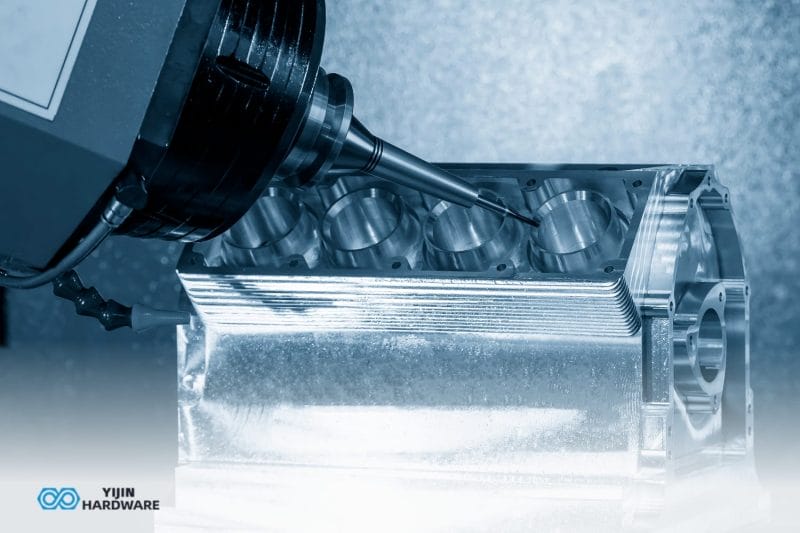
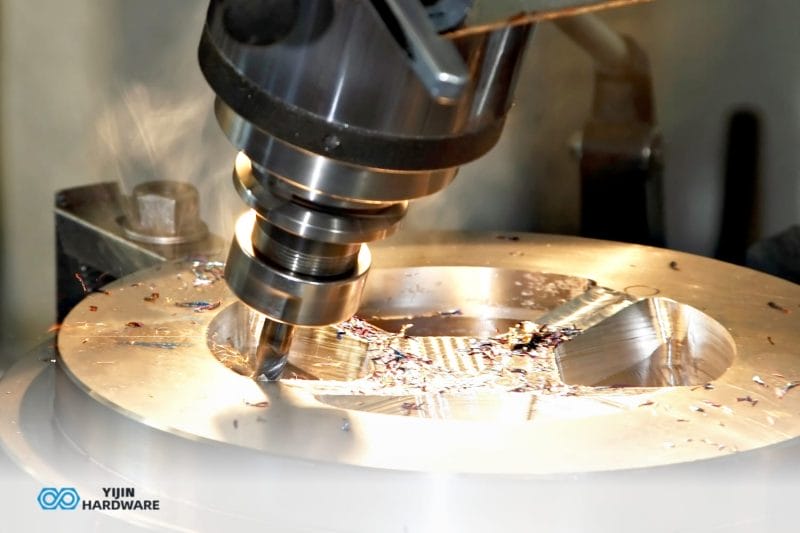

Die casting supplier selection comes down to process fit, certification tier, and whether the supplier can scale with your program. The US die casting market is substantial, with the high-pressure die casting segment alone valued at $42.5 billion in 2026. That scale reflects real differences in capability, documentation, and buyer fit across competing suppliers.
The 10 companies below were selected for process capability, certification tier, alloy range, and buyer fit. Some are direct die casters running their own presses. Others operate managed digital platforms that route jobs through vetted supplier networks.
Use the profiles below to match each supplier to the alloy, certification tier, and production scale your program actually requires.
How We Selected the Top 10 Die Casting Companies in the USA
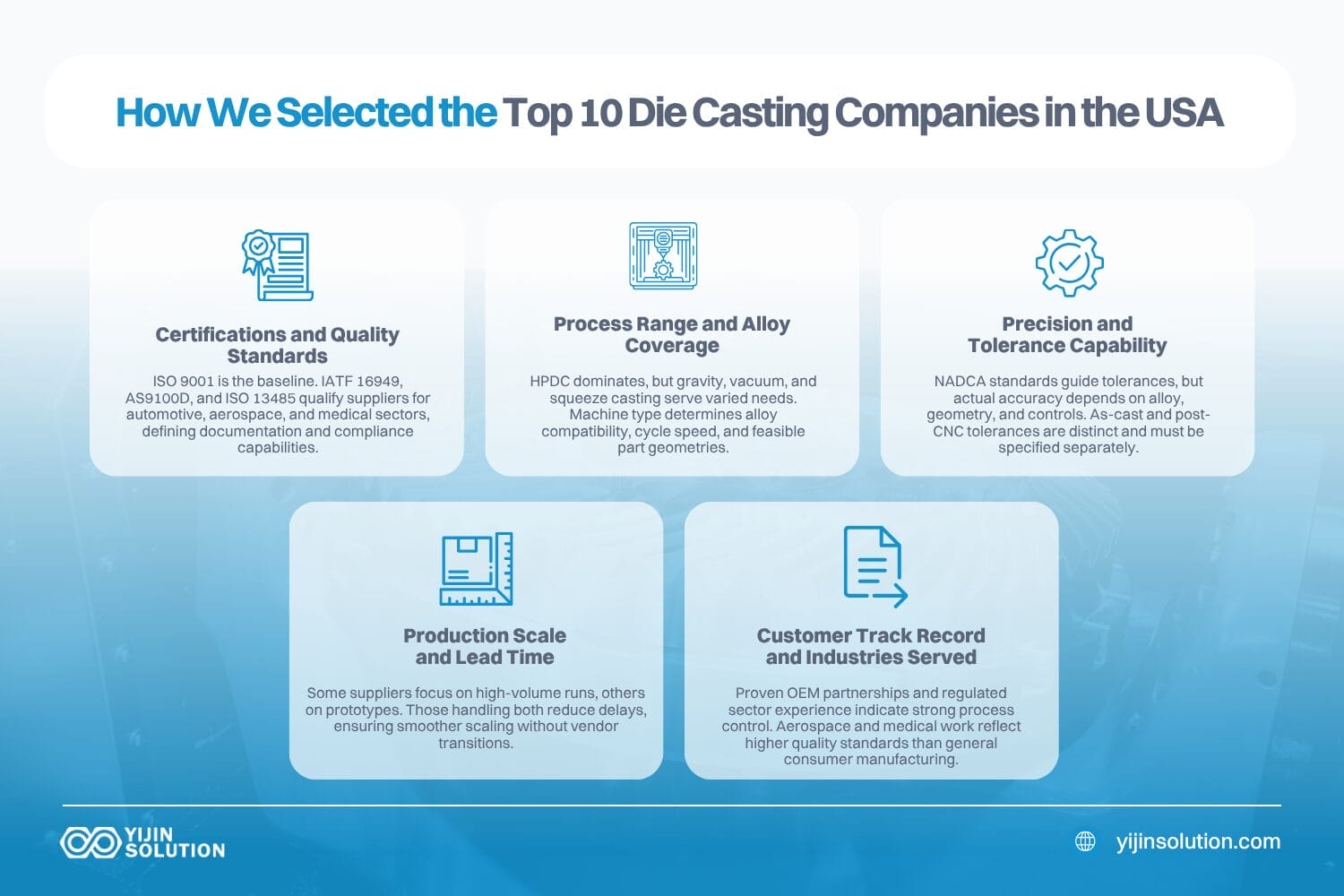
The criteria below go beyond company names and press sizes. Each one reflects a factor that shapes real procurement decisions: which regulated sectors a supplier can serve, which alloys their equipment handles, and whether they can support a program from prototype through production
Certifications and quality standards
ISO 9001 is the baseline for any die casting supplier. IATF 16949 qualifies a company for automotive production supply chains. AS9100D opens the door to aerospace programs. ISO 13485 covers medical device components. Certification tier determines which regulated sectors a supplier can serve and which documentation packages it can deliver.
Process range and alloy coverage
High-Pressure Die Casting (HPDC) is the most common process on this list, but gravity, vacuum, and squeeze casting each serve different part requirements. Cold-chamber machines handle aluminum and its higher melting point. Hot-chamber machines run zinc and magnesium at faster cycle times. A supplier’s machine fleet determines which alloys are available and which part geometries are practical.
Точность и допуск capability
NADCA standard tolerances serve as the industry reference for die casting, but achievable accuracy for a specific part depends on alloy selection, wall thickness, part geometry, and the supplier’s process controls. Buyers should request tolerance data specific to their part geometry and alloy rather than relying on a single published figure. As-cast tolerance and post-CNC tolerance measure different process stages and should not be compared as if they describe the same capability.
Production scale and lead time
Some die casters focus on high-volume OEM supply of 50,000+ parts per year. Others offer rapid tooling for prototype and bridge production. A supplier that handles both within the same quality system eliminates the risk and delay of handing off between vendors when a project scales.
Customer track record and industries served
Documented OEM relationships, published case studies, and sector diversity indicate sustained process control. Companies serving aerospace and medical carry higher quality accountability than those serving only consumer applications. A supplier’s track record in regulated sectors is the most practical evidence that their process can meet yours.
Quick Comparison Table: Top Die Casting Companies in the USA at a Glance
Use this table to compare suppliers by alloy capability, certification tier, and production scale before reading the full profiles below. Lead times and tolerances reflect published capability ranges and will vary by part geometry, alloy, and order volume.
| Rank | Компания | Лучшее для | As-Cast Tol. | Post-CNC | Scale | Сертификаты |
|---|---|---|---|---|---|---|
| #1 | Решение Yijin | Full-cert partner, DFM-first workflow | ~±0.10 mm std | ±0.01 mm on specific features | Proto to mass | AS9100D, IATF 16949, ISO 13485, ISO 9001 |
| #2 | Xometry | Instant quoting, broad cert access | Network-dependent | Network-dependent | Proto to mid-volume | ISO 9001, AS9100D, IATF 16949, ITAR |
| #3 | Fictiv | BOM integration, managed DFM | ~±0.10 mm per 25 mm | ±0.05 mm on qualifying surfaces | Proto to production | ISO 9001, AS9100D via network, ITAR |
| #4 | PHB Corp | Large OEM programs, zinc leadership | NADCA standard | In-house CNC | Большой объем | IATF 16949, ITAR |
| #5 | Chicago White Metal | Complex geometry, Mg capability | NADCA standard | Contact for details | Mid to high volume | ISO 9001, IATF 16949, ISO 14001 |
| #6 | Dynacast | High-volume precision zinc | NADCA standard | Contact for details | Большой объем | ISO 9001, IATF 16949, ISO 14001, ITAR |
| #7 | TFG USA | Process breadth, leak-free castings | NADCA standard | Contact for details | Mid to large OEM | ISO 9001:2015 |
| #8 | Le Sueur Inc. | Heavy-section Al, porosity control | NADCA standard | Contact for details | Mid-volume | ISO certified |
| #9 | KenWalt Die Casting | ITAR, defense-adjacent | NADCA standard | In-house CNC | Low to mid volume | ISO 9001, ITAR |
| #10 | SKS Die Casting | Assembly feature integration | NADCA standard | In-house CNC | Low to mid volume | Contact for details |
Note: The Post-CNC column reflects secondary CNC machining, a separate operation performed after casting that tightens specific critical features. It is not an as-cast die casting tolerance and should not be compared directly to NADCA casting tolerances.
Top 10 Die Casting Companies in the USA: The Ranked List
#1: Yijin Solution
A free DFM review before any tooling commitment is the most buyer-protective feature of Yijin Solution’s die casting workflow. That review covers draft angles, wall thickness risks, and alloy-specific shrinkage concerns, catching issues that become costly once steel is cut. The company is a Shenzhen-based direct factory with over 20 years delivering aluminum, zinc, and magnesium die castings for aerospace, automotive, and medical applications.
As-cast accuracy follows NADCA guidelines, reaching approximately +-0.10 mm on standard features for qualifying geometries. For critical-to-function features, in-house secondary CNC machining achieves +-0.01 mm on those specific surfaces. These are two distinct process stages, and the tighter figure applies only to machined features, not the entire casting.
Triple-sector certification means documentation packages for aerospace, automotive, and medical are built into the quality system rather than added after the fact. Zeiss CMMs and 281 testing instruments handle incoming material verification and final inspection under one roof.
- Key differentiator: Triple-sector certification (AS9100D, IATF 16949, ISO 13485) paired with free pre-tooling DFM review, Zeiss CMM inspection, and full documentation including PPAP Level 3 and FAI.
- Consideration: China-based facility. Buyers with DFARS or ITAR restrictions should confirm compliance requirements directly at the quoting stage.
- Best for: Buyers sourcing aluminum, zinc, or magnesium die castings for aerospace, medical, or automotive programs who need prototype-to-production scaling with full documentation from a single direct-factory supplier.
#2: Xometry
Xometry’s primary advantage for die casting buyers is instant pricing without committing to a single-factory supplier. Upload a CAD file and the AI-powered quoting system delivers cost, lead time, and DFM feedback in minutes across a network of vetted US die casting suppliers covering aluminum, zinc, and magnesium alloys. Tooling is buyer-owned after production, which matters if moving production later is a consideration.
Certification coverage at the platform level includes AS9100D, ISO 13485, IATF 16949, and ITAR. Per-part cost at high volume may not match a dedicated die caster with its own presses.
- Key differentiator: Instant AI-powered quoting with no minimum order quantity, platform-level AS9100D and IATF 16949 certification, and buyer-owned tooling after production.
- Consideration: Marketplace model means the fulfilling supplier varies by order. Traceability and quality consistency depend on which network partner manufactures the parts. Buyers running regulated programs should confirm supplier-level credentials at the quoting stage rather than assuming platform-level certification applies uniformly.
- Best for: Buyers needing rapid pricing across multiple die casting processes, or early-stage programs without committed tooling investment.
#3: Fictiv
Fictiv integrates DFM software and mold flow analysis directly into its quoting workflow, shortening the feedback loop for buyers managing multi-part assemblies across suppliers. Bill of materials integration and managed program support make it a practical fit for design teams coordinating components from multiple sources. Sample parts typically arrive in 10 to 15 days, which is competitive for a platform model.
As-cast accuracy follows HPDC standard tolerances at approximately +-0.10 mm per 25 mm. Post-CNC machined features can reach +-0.05 mm on qualifying surfaces. Inspection options include CMM, XRF, X-ray, salt spray, and hardness testing. Fictiv also offers vacuum casting and Density Index Control for porosity management.
- Key differentiator: DFM software and mold flow analysis built into quoting, BOM integration for multi-part programs, and 10 to 15 day sample lead times for a platform model.
- Consideration: Platform pricing reflects the overhead of a managed service and is not suited for buyers optimizing per-part cost at high volume. A dedicated die caster will typically deliver better unit economics at scale.
- Best for: Design teams coordinating multi-part assemblies who need managed DFM, mold flow analysis, and program support alongside die casting supply.
#4: PHB Corp
PHB Corp holds a designation from the International Zinc Association as the largest zinc die caster in the United States, backed by press capacity reaching 2,000 tons. That capacity handles large and complex castings that smaller shops cannot run. MAGMAsoft mold flow simulation validates tooling before first shots, reducing trial-and-error costs during die qualification.
In-house CNC machining runs from a dedicated 158,000-square-foot facility, keeping secondary operations under the same quality system as the casting. IATF 16949 and ITAR registration cover automotive production and defense-adjacent applications.
- Key differentiator: IZA-confirmed status as the largest US zinc die caster, 2,000-ton press capacity, and in-house MAGMAsoft mold flow simulation.
- Consideration: PHB focuses on high-volume OEM supply. Prototype-stage or low-volume buyers should confirm minimum order thresholds before committing to a detailed quoting process.
- Best for: Automotive and defense-adjacent OEM programs requiring high-volume zinc die casting with IATF 16949 certification and large-part press capability.
#5: Chicago White Metal
Chicago White Metal was the first North American custom die caster to adopt fast-cycling hot-chamber magnesium die casting, a process that offers a 75% weight reduction over zinc with faster cycle times than cold-chamber aluminum. That process leadership extends to miniature zinc and ZA-8 multi-slide components produced in flash-free, net-shape form, eliminating trimming and reducing post-cast operations. The company has operated since 1937.
Process-controlled, six-sigma production with real-time monitoring runs across their ISO 9001, IATF 16949, and ISO 14001 certified facility. Their free Design Center provides over 100 technical papers and engineering video resources, giving buyers practical pre-engagement support for evaluating process options before tooling commitment.
- Key differentiator: First North American custom die caster to adopt hot-chamber magnesium die casting, with flash-free multi-slide capability for miniature zinc components and six-sigma production monitoring.
- Consideration: Production capacity targets mid-to-large volume OEM programs. Buyers at concept stage should confirm prototype service availability before engaging the full quoting process.
- Best for: OEM programs requiring magnesium die casting for weight-critical applications, or miniature zinc multi-slide components where flash-free net shape reduces post-cast operations.
#6: Dynacast
Dynacast’s Elgin, Illinois facility produces over 1 million components daily, which reflects the company’s core process: multi-slide zinc die casting at high volume. Multi-slide technology produces flash-free, net-shape components that reduce or eliminate secondary finishing operations, compressing lead time and per-part cost at volume. The company operates as part of Form Technologies.
Multiple International Die Casting Design Award wins document the precision claims with published results rather than marketing assertions alone. IATF 16949, ISO 14001, and ITAR registration cover automotive, environmental, and defense-adjacent requirements.
- Key differentiator: 1 million+ components daily from the Elgin facility, flash-free net-shape multi-slide technology, and documented IDCA Design Award results.
- Consideration: Dynacast is built for high-volume precision production. Buyers at the prototyping stage or requiring low volumes should look for a supplier with a dedicated rapid-tooling program.
- Best for: High-volume automotive and industrial programs requiring zinc multi-slide die casting with documented precision output and IATF 16949 coverage.
#7: The Federal Group USA
The Federal Group USA offers the widest process range on this list: hot chamber, cold chamber, vacuum, and squeeze die casting under one roof. That breadth allows TFG to match the right process to each part rather than forcing a design into available equipment. Machines range from 600 to 1,200 tons for mid-to-large castings.
Their documented тематическое исследование of as-литой алюминий parts delivered leak-free without secondary machining is a specific, verifiable differentiator in a market where leak-free claims are common but rarely supported with data. Automated process monitoring runs throughout production.
- Key differentiator: Widest process range on this list (hot chamber, cold chamber, vacuum, squeeze) with documented as-cast leak-free aluminum results.
- Consideration: TFG focuses on mid-to-large OEM programs. Very low-volume prototype orders may fall outside their standard workflow. Minimum order thresholds should be confirmed at inquiry.
- Best for: Mid-to-large OEM programs where process flexibility matters, or buyers requiring leak-free as-cast performance without secondary machining costs.
#8: Le Sueur Incorporated
Le Sueur’s proprietary Squeeze Pin Technology addresses a problem standard HPDC does not handle well: porosity in heavy-section areas. By applying localized pressure during solidification, the process eliminates shrinkage voids where thick walls and bosses would otherwise trap gas. The result is certified leak-free performance without secondary impregnation cost. The company has been casting aluminum since 1946.
Vacuum Assist runs as standard across their 12-machine production floor, spanning 250 to 1,600 tons. In-house X-ray and metallurgical lab testing verify internal quality before parts ship.
- Key differentiator: Proprietary Squeeze Pin Technology for porosity-free heavy-section aluminum castings, with Vacuum Assist standard on all machines and in-house X-ray verification.
- Consideration: Le Sueur works exclusively with aluminum. Buyers requiring zinc or magnesium castings will need to source from a different supplier. International buyers should factor in US coordination logistics for lead time planning.
- Best for: Buyers requiring porosity-controlled, heavy-section aluminum die castings where certified leak-free performance is a qualification requirement.
#9: KenWalt Die Casting
KenWalt combines ITAR registration with ISO 9001 and in-house CNC machining, giving defense-adjacent buyers a domestic die caster with verified compliance credentials and machining capability under one quality system. Vacuum-assist production delivers higher-density castings with tighter dimensional control than standard HPDC, which is relevant for structural and pressure-containing components.
A Kan-Ban inventory program supports lean supply chain requirements for repeat production programs. Automated production with programmable controllers maintains cycle consistency across long runs.
- Key differentiator: ITAR registration combined with vacuum-assist capability and in-house CNC machining under one domestic quality system.
- Consideration: At 26,000 square feet, KenWalt is one of the smaller facilities on this list. Buyers running very large programs should confirm capacity at quoting to ensure the volume fits their production schedule.
- Best for: Defense-adjacent buyers needing a domestic ITAR-registered die caster with vacuum-assist capability and CNC machining under one roof.
#10: SKS Die Casting
SKS Die Casting involves design teams early, before tooling begins, which reduces downstream secondary operation costs for buyers whose parts feed directly into assembly lines. Cast-in pins, machined external threads, and helicoil inserts are standard assembly feature integration capabilities. Cold-chamber die casting reduces the corrosion risk on aluminum components.
SKS serves roughly 80 customers and produces over 500 unique parts in a typical year, spanning aerospace, semiconductor, automotive, and medical applications. Their custom quote process includes DFM engagement from the first inquiry.
- Key differentiator: Early design engagement and assembly feature integration (cast-in pins, machined threads, helicoil inserts) that reduce secondary operation costs for assembly-ready parts.
- Consideration: Smaller footprint than platform suppliers on this list. Buyers with high-volume requirements or strict AS9100D or IATF 16949 compliance needs should verify certification status directly before engaging.
- Best for: Buyers whose parts need assembly-ready features integrated at the casting stage, reducing post-cast secondary operations.
How to Choose the Right Die Casting Company for Your Project
Step 1: Match process type to volume
HPDC is cost-effective at volumes of 5,000+ parts per year, allowing tooling cost to amortize across the production run. Gravity die casting suits lower-volume programs from roughly 500 to 1,000 parts per year at a lower tooling investment. Buyers at the prototype stage should look for suppliers offering rapid-tool or soft-tool programs before committing to hardened production tooling.
Step 2: Verify certification tier
Match the supplier’s certifications to the part’s regulated sector. Aerospace programs require AS9100D. Automotive production supply chains require IATF 16949. Medical housings require ISO 13485. ISO 9001 alone is insufficient for regulated procurement. Confirm the specific certification scope at the quote stage, not after tooling is committed.
Step 3: Confirm alloy range
Not all die casters work across aluminum, zinc, and magnesium. Cold-chamber machines handle aluminum. Hot-chamber machines run zinc and magnesium at faster cycle times. A supplier’s machine fleet determines which alloys are available. Confirm alloy capability before requesting a detailed quote.
Step 4: Assess secondary operations
Die cast parts frequently need secondary CNC machining for tight-tolerance features such as mating surfaces, bearing bores, and seal grooves. A supplier handling casting and machining under one roof eliminates tolerance stack-up risk and documentation gaps between vendors.
Step 5: Evaluate documentation and traceability
Regulated sectors require material certifications, First Article Inspection reports, and PPAP Level 3 documentation packages. Documentation capability should be confirmed before committing tooling investment, not discovered after parts are delivered. Suppliers serving aerospace and medical have these systems in place; others may need to build them, which adds time and cost to the program.
Source Custom Die Casting Parts with Yijin Solution
Die casting selection comes down to three things: whether the supplier’s alloy and process range matches the part, whether their certification scope covers the regulated sector, and whether DFM input is available before tooling steel is cut. Getting any of those wrong at the start of a program is expensive to fix.
Yijin Solution runs aluminum, zinc, and magnesium die casting from a direct-factory facility in Shenzhen, with triple-sector certification covering AS9100D, IATF 16949, and ISO 13485, free DFM review before any tooling commitment, and Zeiss CMM inspection on every production run.
Upload your CAD files to receive a free DFM review and die casting quote within 24 hours.
Transparency Note
Yijin Solution is the publisher of this article and appears in the ranked list. All other companies were selected based on the editorial criteria described in the How We Selected section. Company information was sourced from publicly available websites and verified independently.
FAQs on Die Casting Companies in the USA
What is the difference between HPDC and gravity die casting?
HPDC injects molten metal at 10 to 175 MPa into hardened steel dies, producing thin-wall, high-volume parts with fast cycle times. Gravity die casting fills the die under gravity alone, producing denser, lower-porosity parts suited to medium volumes and thicker wall sections. The choice depends on part geometry, required mechanical properties, and annual volume.
Which certifications should I look for in a US die casting company?
ISO 9001 is the baseline quality management standard. IATF 16949 is required for automotive production. AS9100D covers aerospace applications. ISO 13485 applies to medical device components. A supplier’s certification scope determines which sectors it can serve and which documentation packages it can deliver. Always confirm the specific scope at the quoting stage.
What alloys can US die casting companies typically work with?
Most US die casters work with алюминиевые сплавы per ASTM B85 specifications, using cold-chamber HPDC. Aluminum accounts for roughly 70% of die casting revenue globally. Zinc and magnesium are also common: zinc runs via hot-chamber machines, magnesium via hot or cold-chamber depending on the supplier’s equipment. Alloy range should be confirmed before requesting a quote, since not every die caster runs all three families.
How long does die casting tooling typically take?
Tooling lead time depends on die complexity, slide and core count, and cavity configuration. Simple single-cavity tools can be ready in 8 to 12 weeks. Multi-cavity production dies with complex cooling systems take 12 to 20 weeks.
Can US die casting companies handle both prototyping and mass production?
Not all suppliers cover both stages equally. Some specialize in rapid tooling for low-volume prototyping. Others focus on high-volume HPDC runs of 50,000+ parts per year. Buyers scaling from prototype to production benefit most from a supplier that handles both stages within the same quality system, eliminating the cost and risk of a vendor handoff.
Вернуться к началу: Top 10 Die Casting Companies in the USA (2026 Edition)