
A CNC machining certification is a documented standard that defines how a machining supplier operates. It covers process control, material traceability, inspection requirements, and regulatory alignment.
The global CNC machining market was valued at over $100 billion in 2023 and continues to grow in high-reliability sectors where certified supply chains are the baseline expectation, not the exception.
When procurement managers and design engineers source components for aerospace, medical, or automotive applications, a supplier’s certification status isn’t merely a marketing detail. It’s a verifiable indicator of quality system maturity.
This article covers what CNC machining certifications are, which types apply to which industries, and how to evaluate a certified supplier.
What is a CNC Machining Certification?
A CNC machining certification is an independently verified standard confirming that a manufacturer’s quality management system meets defined requirements for process control, documentation, and inspection.
Two distinct categories exist: company-level quality management system certifications and individual operator skill credentials issued by bodies like the National Institute for Metalworking Skills. Company-level certifications tell you how a facility operates. Operator credentials tell you how individual machinists are trained.
A certified supplier has passed an independent third-party audit verifying that its quality management system meets a defined standard. It’s a process guarantee, not a product guarantee.
The table below provides a quick-reference overview of the major certification types.
| Certification | Тип | Sector Focus | Issued By |
|---|---|---|---|
| ISO 9001 | Company / QMS | All manufacturing sectors, foundational baseline | Accredited registrars |
| AS9100D | Company / QMS | Aerospace and defense supply chains | SAE International / IAQG-approved registrars |
| IATF 16949 | Company / QMS | Automotive OEM and Tier 1/2 supply chains | IATF-approved registrars |
| ISO 13485 | Company / QMS | Medical device manufacturing and supply | Accredited registrars |
| ISO 14001 | Company / QMS | Environmental management, all sectors | Accredited registrars |
| NIMS | Individual operator credential | CNC machining workforce competency | National Institute for Metalworking Skills |
What does CNC Machining Certification Involve?
Most buyers think of certification as a certificate on a supplier’s wall. Rather, it’s an operating system of procedures, records, controls, and review loops that must be implemented, audited, and maintained continuously. The certificate is evidence that the system exists and is functioning.
What a quality management system is
A Quality Management System (QMS) is a documented framework covering how a manufacturer controls every stage of its production process, from raw material receipt through finished part delivery. It defines who is responsible for each step, what inspection records must be kept, how nonconforming parts are handled, and how corrective actions are tracked and closed.
. A supplier operating under a certified QMS can’t accept a batch of out-of-spec material or run a production job without inspection records. This is the practical difference between a certified supplier and an uncertified one.
The initial certification audit process
Certification begins with implementation. A manufacturer first conducts a gap assessment against the target standard, then builds or revises its documented procedures, trains its workforce, and runs the QMS for a defined period before the first audit.
The certification audit itself has two stages. A Stage 1 documentation review checks whether the QMS documentation meets the standard’s requirements. A Stage 2 on-site audit verifies that those documented procedures are actually being followed on the production floor, in the inspection lab, and in management review meetings. A supplier that has achieved initial certification has passed both stages. That’s the starting point, not the finish line.
Ongoing surveillance
All QMS certifications require annual surveillance audits and full recertification every three years. Surveillance audits verify that the quality system hasn’t degraded and that procedures are still being followed, corrective actions are being closed, and records are being maintained.
Always verify certification status independently through the registrar’s portal before qualifying a supplier. A supplier that can’t produce its current certification certificate and registrar name on request may not be maintaining active surveillance.
Certification scope
Every certification has a defined scope: the specific processes, product families, facility locations, and customer segments covered under the certificate. A machine shop may hold AS9100D for its milling and turning operations but not for any other distinct processes. A multi-site manufacturer may hold ISO 13485 at one facility but not another.
A buyer who asks only ‘are you AS9100D certified?’ without asking ‘what is the scope of your certificate?’ may qualify a supplier whose certification doesn’t cover the specific process they need. Scope verification belongs in the qualification checklist alongside the certification status itself.
Why is CNC Machining Certification Important?
Certification matters to buyers not because it’s a contractual checkbox, but because of what a certified system produces: documented traceability, audit-ready records, and a corrective action process that catches issues before they reach delivery.
Process traceability
Certified suppliers maintain documented inspection records, material certifications, and job travelers that enable full part traceability from raw material to shipment. In aerospace and medical supply chains, a part without a traceable history can’t be used regardless of whether it passes visual inspection.
Audit-ready documentation
Certification means a supplier’s quality system has passed third-party scrutiny, not just internal self-assessment. First Article Inspection (FAI) reports, CMM dimensional outputs, and material test certificates are standard deliverables. A buyer working with certified suppliers doesn’t need to negotiate for documentation that should already exist. When an auditor or customer requests documentation mid-program, the supplier can pull them within hours rather than reconstructing files after the fact.
Risk reduction in supplier qualification
Specifying a certified supplier reduces the buyer’s own qualification burden. A third-party auditor has already verified that documented procedures exist and are being followed, which shortens the buyer’s initial supplier approval process and narrows incoming audits to part-specific process capability rather than the underlying quality system.
Regulatory and contractual alignment
AS9100D in aerospace, ISO 13485 in medical, and IATF 16949 in automotive are supply chain requirements that flow down from OEMs and prime contractors. A machining supplier without the right certification isn’t a qualified option in those supply chains, regardless of capability.
What Types of CNC Machining Certifications Exist?
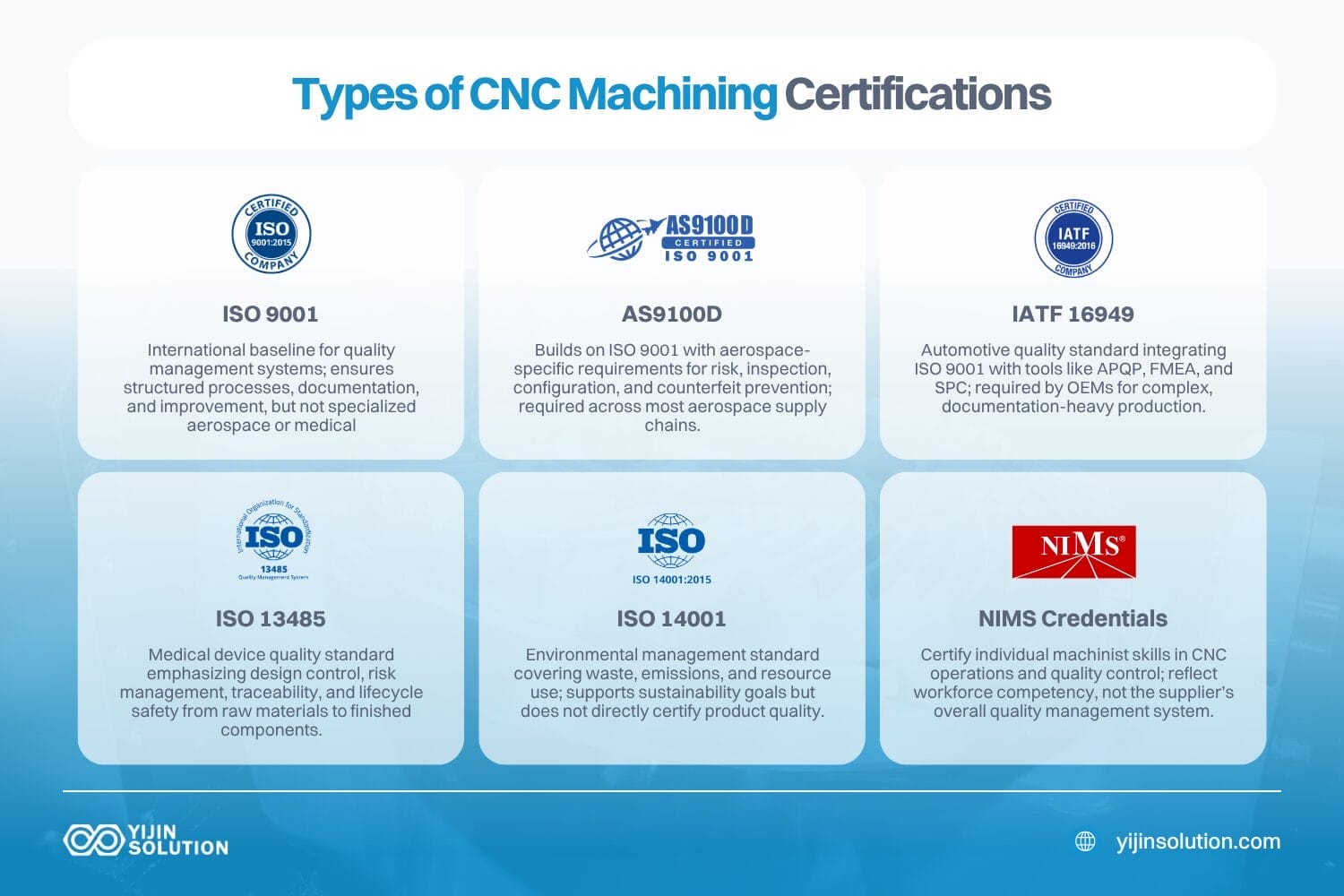
CNC machining certifications fall into two categories: company-level quality management system certifications and individual operator credentials. Each type answers a different question for a buyer.
ISO 9001
ISO 9001 is the international baseline for quality management systems, covering documentation, process control, corrective action, and continual improvement across all manufacturing sectors. ISO 9001 signals that a supplier has a structured quality system. However, it doesn’t by itself guarantee aerospace or medical-grade traceability. It’s the minimum entry point for verified quality.
AS9100D
AS9100D adds approximately 100+ aerospace-specific requirements on top of ISO 9001, covering risk management, First Article Inspection, configuration management, and counterfeit parts prevention.
It’s a requirement for most Tier 1 and Tier 2 aerospace supply chains, and is standard for parts used in aircraft structures, avionics, propulsion systems, and defense hardware. Certifying bodies include SAE International and IAQG-approved registrars.
IATF 16949
IATF 16949 governs quality management for the automotive supply chain, incorporating ISO 9001 and adding automotive-specific tools: Advanced Product Quality Planning, Failure Mode and Effects Analysis, Measurement System Analysis, Statistical Process Control, and Production Part Approval Process.
OEMs and Tier 1 suppliers require this certification. Parts for powertrain, chassis, safety systems, and EV battery assemblies typically require IATF 16949-certified suppliers. From a buyer’s perspective, IATF 16949 certification signals that a supplier can manage the documentation-heavy automotive approval process without slowing production launch timelines.
ISO 13485
ISO 13485 is the quality management system standard for medical device manufacturing. It emphasizes design controls, risk management aligned with ISO 14971, traceability, and post-market surveillance requirements. Precision components used in surgical instruments, implantables, imaging systems, and diagnostic equipment require this certification.
ISO 13485 certification means the supplier operates under a system designed to maintain product safety across the full component lifecycle, from raw material receipt to finished part delivery. Every process control, documentation requirement, and traceability record in the system ultimately traces back to a single objective: that the finished part performs safely in the patient.
ISO 14001
ISO 14001 certifies that a manufacturer has a formal environmental management system covering waste, emissions, and resource consumption within a documented, auditable framework. It’s increasingly relevant if you have ESG commitments or supply chain sustainability reporting requirements. It’s not a quality standard, but it demonstrates environmentally conscious and responsible manufacturing practices alongside quality certifications.
NIMS credentials
NIMS credentials certify individual machinist competency, covering CNC turning, CNC milling, measurement and quality control, and CNC setup. NIMS-certified operators signal a workforce trained to documented skill standards. This is useful when evaluating smaller shops or assessing the depth of a supplier’s internal training culture.
NIMS credentials apply to individual machinists, not the facility’s quality management system. A shop can hold AS9100D without NIMS-certified operators, and vice versa.
The table below consolidates the major certifications for buyers comparing suppliers across industries.
| Certification | Sector Focus | Audit Frequency | Ключевые требования | Required By |
|---|---|---|---|---|
| ISO 9001 | All manufacturing | Annual + 3-year recert. | Process control, corrective action, documentation | General procurement baseline |
| AS9100D | Aerospace & defense | Annual + 3-year recert. | Risk mgmt, FAI, counterfeit prevention, all ISO 9001 requirements | Aerospace OEMs, defense primes, Tier 1/2 suppliers |
| IATF 16949 | Автомобили | Annual + 3-year recert. | APQP, FMEA, MSA, SPC, PPAP, all ISO 9001 requirements | Automotive OEMs and Tier 1 suppliers |
| ISO 13485 | Медицинские изделия | Annual + 3-year recert. | Design controls, risk mgmt, traceability, post-market surveillance | Medical device OEMs and supply chains |
| ISO 14001 | Environmental, all sectors | Annual + 3-year recert. | Environmental aspects, legal compliance, continual improvement | ESG-committed buyers; some regulated industries |
| NIMS | CNC machining workforce | Per-credential testing; periodic renewal | CNC turning, milling, measurement, setup competency | No mandate, used as hiring and evaluation indicator |
What does the Certification Process Tell You About a Supplier?
Understanding how suppliers obtain and maintain their certifications helps buyers interpret what a certificate actually represents. A supplier that achieved initial certification two years ago and has maintained annual surveillance is in a different position from one that certified last month. The process itself reveals quality system maturity.
The implementation period signals commitment
Initial certification requires a supplier to build and operate a QMS before any external auditor arrives. For ISO 9001, this typically takes three to 12 months. For AS9100D or IATF 16949, the implementation period can run 12 to 18 months or longer, and the system must be demonstrably functional before Stage 2. A supplier that recently achieved certification invested significant time and internal resources to get there.
Surveillance history reveals consistency
A supplier with three or more annual surveillance cycles without major nonconformances has demonstrated that its QMS functions under production conditions. Buyers can ask for a supplier’s certification history and current surveillance status directly from the registrar portal. A long track record of clean surveillance audits is more meaningful than a recently issued certificate.
Recertification cycles reveal QMS health
Full recertification every three years requires a complete reassessment of the quality system. A supplier that has completed multiple recertification cycles without significant findings has a mature, stable system. A supplier in its first certification cycle is still proving its system holds under production pressure. Neither disqualifies a supplier, but the distinction matters when the buyer is making a critical-part sourcing decision.
How do You Evaluate a Certified CNC Machining Supplier?
Certification status is the starting point, not the endpoint, of supplier evaluation. What matters is whether the certification is current, in-scope, and backed by real capability.
Verify the certification scope
Ask which processes, product families, and facility locations are covered under the certificate. A certificate issued for one product line may not cover the process you need. Scope verification should happen before any technical evaluation begins.
Request the certificate number and registrar name
Legitimate certifications are issued by accredited registrars such as Bureau Veritas, DNV, SGS, or BSI, and are publicly verifiable through each registrar’s online portal. Certificate numbers should be independently confirmed before a supplier is qualified, not just taken at face value from a company’s website or sales presentation.
Assess documentation capability
Ask for a sample FAI report or a Certificate of Conformance. A capable, certified supplier produces these routinely. If a supplier hesitates or describes this as a special request, that’s worth noting during the qualification process.
Confirm inspection equipment
Certification tells a buyer that a quality system is in place, but the equipment behind it matters. Ask what instruments are calibrated and traceable to national standards. Coordinate Measuring Machines, vision measurement systems, and surface profilometers support tight-tolerance verification in ways that manual gauging doesn’t.
Evaluate DFM support
A certified supplier should catch tolerance risks, material conflicts, and process constraints before production begins. Free DFM review is a meaningful differentiator, as it reduces late-stage design changes and keeps per-part cost predictable.
Source Your CNC Programs Through One Certified Supplier
Most machining shops specialize into a single certification track. Aerospace shops carry AS9100D. Automotive shops carry IATF 16949. Medical shops carry ISO 13485. A buyer sourcing precision components across more than one end-use industry usually ends up qualifying and managing a separate supplier for each – with duplicated audits, separate supplier agreements, and three different ways of handling FAI, PPAP, and DHR paperwork.
Решение Yijin holds AS9100D, IATF 16949, ISO 13485, ISO 9001, and ISO 14001 under a single quality management system at one facility. This means one supplier qualification, one audit cycle, and one documentation format across your aerospace, automotive, medical, and general industrial work. First Article Inspection reports and material certifications ship as standard deliverables on qualifying orders.
Verify our certificates through the relevant registrar portals, then upload your CAD files for a free DFM review and quote within 24 hours.
FAQs on What is a CNC Machining Certification?
What is the difference between certification and accreditation?
Certification applies to a company’s quality management system and is issued by a registrar after an audit. Accreditation applies to the registrar itself, confirming it has been approved to issue certifications under a given standard. When verifying a supplier’s certificate, checking that the registrar is accredited confirms the audit was conducted to the required standard.
Can a supplier lose its certification?
Yes. A registrar can suspend or withdraw certification if a surveillance audit reveals major nonconformances that aren’t resolved within the required timeframe. Buyers with active supplier relationships should build periodic certificate verification into their supplier management process rather than checking status only at initial qualification.
What is a major versus minor nonconformance in a certification audit?
A major nonconformance indicates a systemic failure or complete absence of a required process. A minor nonconformance indicates an isolated lapse within an otherwise functioning system. Asking a supplier about its nonconformance history and how findings were resolved gives a more complete picture of QMS health than the certificate alone.
How does NADCAP relate to CNC machining certification?
NADCAP is an industry-managed accreditation program for special processes used in aerospace and defense, covering heat treatment, non-destructive testing, welding, and surface treatment. It sits alongside the AS9100D rather than replacing it. A CNC supplier holding AS9100D may still need NADCAP accreditation for specific processes, depending on the prime contractor’s flow-down requirements.
Does the certification scope cover subcontractors a supplier uses?
Not automatically. If a certified supplier outsources any part of the work covered under your order, the certification may not extend to that subcontracted process. Qualified suppliers under AS9100D and IATF 16949 are required to manage and monitor their supply chains, but buyers sourcing critical components should ask explicitly whether any processes are subcontracted and whether those suppliers are themselves certified.
Вернуться к началу: What is a CNC Machining Certification? Types, Requirements & Industry Standards