
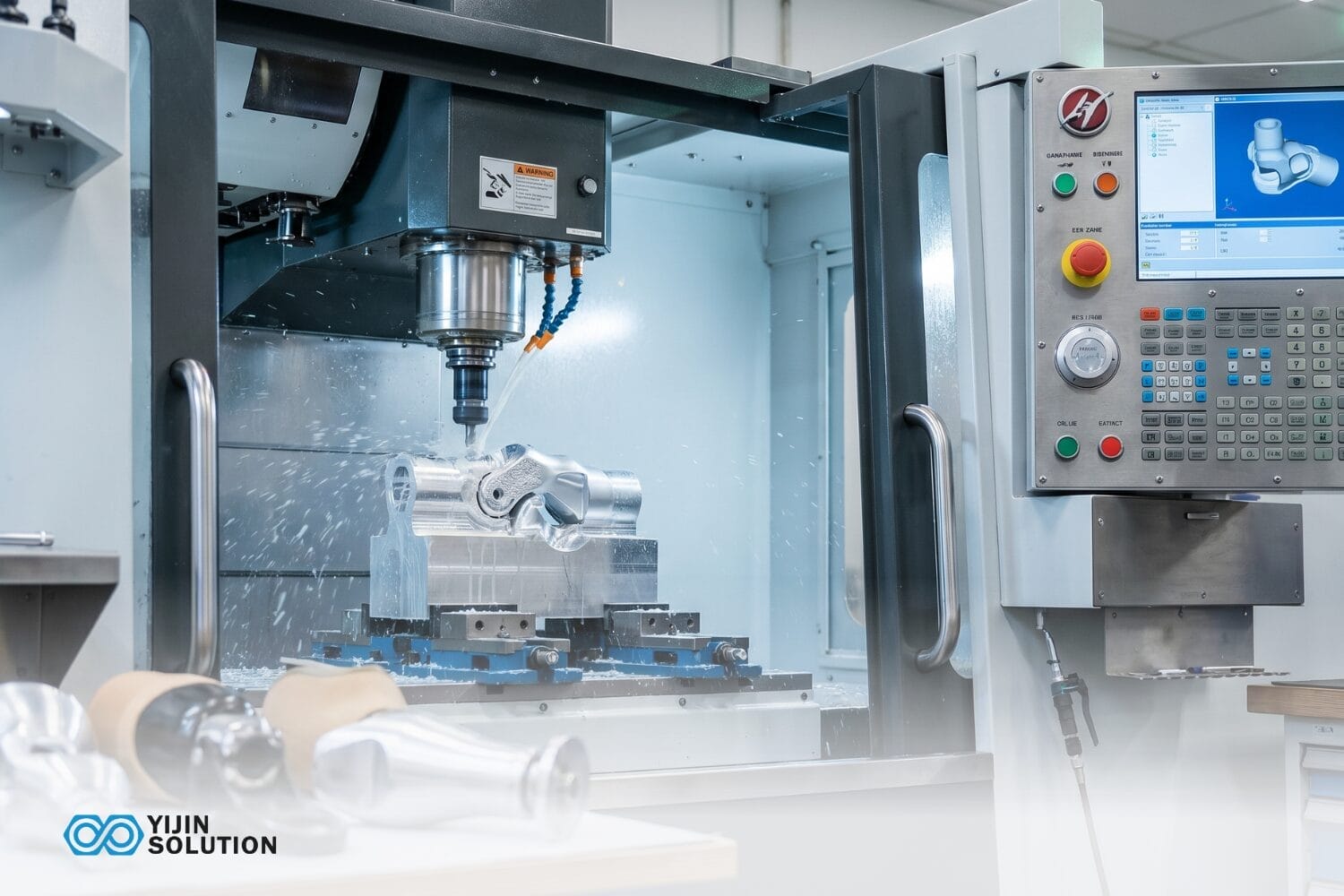
Computer Numerical Control (CNC) machining is the primary manufacturing method for precision medical components. No other subtractive process combines the material range, geometric flexibility, and batch-to-batch repeatability that regulated medical production demands.
Medical device manufacturing operates under requirements that go beyond standard industrial production. Biocompatibility, regulatory traceability, and validated process control are baseline expectations, not quality upgrades. A machining supplier working in this space operates within a quality system that connects every finished part back to its raw material, its process records, and its inspection data.
This guide covers how CNC machining functions within that environment. It considers material selection, compliance standards, and the shop-floor realities that separate general precision machining from medical-grade production.
What is CNC Machining for Medical Devices?
CNC machining for medical devices is subtractive manufacturing used to produce implants, surgical instruments, prosthetics, and diagnostic housings from validated, biocompatible materials.
What distinguishes it from general industrial CNC is the quality system built around every production step: stricter material traceability requirements, documented process validation, and regulatory compliance at each stage.
Why is CNC Machining Widely Used in Medical Device Manufacturing?
CNC machining’s adoption in medical device production is driven by a specific combination of properties that align with the industry’s technical and regulatory requirements. Each advantage connects directly to a compliance or production outcome.
Precision and repeatability
Dimensional consistency across a batch matters as much as the dimension itself. A part that holds ±0.02 mm on the first piece but drifts on the fiftieth is a compliance failure. Batch repeatability is the relevant metric in regulated production.
Material compatibility
CNC handles the full range of validated medical-grade materials without requiring dedicated tooling per material. A design team can move from titanium prototypes to PEEK production runs with the same supplier and quality system intact.
No hard tooling for geometry changes
Unlike casting or injection molding, CNC doesn’t require retooling for design revisions. During device development, where design iterations are frequent, this directly affects program timelines and cost-per-iteration, a significant advantage when regulatory pathways depend on design freeze dates.
Traceability and documentation
CNC operations are recordable at each stage: material certificates, in-process records, dimensional reports, and First Article Inspection (FAI) outputs. This enables traceability from raw material to finished component, supporting ISO 13485 quality system requirements and FDA device history records.
Surface finish control
Surface finish is a functional requirement in medical devices, not an aesthetic one. Implant surfaces affect osseointegration. Fluid-path surfaces affect sterilization. Instrument surfaces affect cleanability and re-use durability. CNC machining allows the surface finish to be specified and controlled as part of the manufacturing process, not treated as a post-machining afterthought.
Which Materials are Used in Medical CNC Machining?
Material selection in medical device manufacturing is tightly regulated because it connects directly to biocompatibility requirements, sterilization resistance, mechanical performance under load, and applicable regulatory standards.
| Материал | Основные свойства | Общие приложения | Relevant Standards |
|---|---|---|---|
| Titanium Grade 5 (Ti-6Al-4V) | High strength-to-weight ratio, excellent biocompatibility, corrosion resistance, osseointegration | Orthopedic implants, bone screws, spinal cages, dental implants | ASTM F136, ISO 5832-3 |
| Нержавеющая сталь 316L | Corrosion resistance, strength, ease of machining, sterilization compatibility | Surgical instruments, forceps, retractors, structural housings | ASTM F138, ISO 5832-1 |
| PEEK | Radiolucency, chemical resistance, load-bearing capability, MRI compatibility | Spinal implants, dental components, device housings | ASTM F2026, ISO 10993 |
| Aluminum 6061 & 7075 | Lightweight, good machinability, non-implant applications | Diagnostic device housings, imaging equipment brackets, structural frames | ASTM B209 |
| Delrin (POM) | Low friction, chemical resistance, dimensional stability | Fluid control components, valve bodies, small device housings | ISO 10993 (contact-specific) |
| Cobalt-Chrome (CoCr) | Wear resistance, strength, and biocompatibility for load-bearing implants | Hip and knee joint components, dental crowns | ASTM F75, ASTM F1537 |
Material selection should always be confirmed against device classification, intended operating environment, and applicable standards. ISO 10993 governs biocompatibility for any device with patient contact. Material choice also affects achievable tolerances and surface finish. These considerations should be addressed during the Design for Manufacturability (DFM) review.
What Tolerances and Surface Finishes Does Medical CNC Machining Achieve?
Tolerance requirements in medical CNC machining vary by component class. The ranges below represent achievable tolerances.
| Тип компонента | Типичный диапазон допусков | Surface Finish (Ra) | Примечания |
|---|---|---|---|
| Ортопедические имплантаты | ±0.01 to 0.025 mm on critical features | Ra 0.1 to 0.8 µm depending on surface function | Bone-contact surfaces require tighter Ra; osseointegration surfaces may be intentionally textured |
| Surgical instrument shafts | ±0.01 to 0.05 mm | Ra 0.4 to 1.6 µm | High-volume batches require consistent dimensional repeatability through the full run |
| Diagnostic device housings | ±0.05 to 0.10 mm | Ra 0.8 to 3.2 µm | Non-implant structural parts; tighter tolerances on mating and mounting features |
| Bone screws and cannulas | ±0.01 to 0.03 mm on thread geometry | Ra 0.2 to 0.8 µm | Thread geometry and root finish are critical for load transfer and fatigue life |
| Fluid control components | ±0.01 to 0.025 mm on bore diameter | Ra 0.1 to 0.4 µm on flow surfaces | Internal surface finish directly affects sterilization compatibility and flow consistency |
Critical-to-function dimensions are identified during DFM and controlled through the inspection process. A tolerance number on a spec sheet is only meaningful when the surrounding system is stable enough to hold it. Tooling, fixturing, measurement, and calibration all need to stay in control across a full production run, not just on a single first article.
Regulatory and Quality Standards for Medical CNC Machining
Medical device components are subject to regulatory requirements that go beyond typical industrial quality systems. A machining partner’s certification status directly affects the buyer’s own compliance position. When evaluating a supplier, the relevant question isn’t only ‘do they hold tight tolerances?’ It’s also ‘does their quality system support our regulatory submission?’
ISO 13485: medical device quality management
ISO 13485 is the internationally recognized quality management standard for medical device manufacturing. It covers design control, risk management, traceability, and process validation beyond ISO 9001. A supplier operating under ISO 13485 audits its production records, material traceability, and documentation protocols to medical device standards.
FDA 21 CFR Part 820: quality system regulation
For devices sold in the US, FDA requires suppliers to operate under a Quality System Regulation covering design controls, Corrective and Preventive Action, and production records. A machining partner operating under ISO 13485 aligns closely with these requirements and supports the device manufacturer’s supply chain documentation needs.
EU MDR and IVDR
The EU Medical Device Regulation and the In Vitro Diagnostic Regulation require documented supply chain traceability. Machined components require material and process records feeding into the Technical File and Declaration of Conformity. Suppliers without robust documentation systems create gaps in the device manufacturer’s regulatory submission.
Material standards
Medical-grade material selection aligns with ASTM standards. F136 for Titanium Grade 5, F138 for Stainless Steel 316L, F2026 for PEEK, and ISO 10993 biocompatibility requirements where implant contact is involved. Material certificates should be available before machining begins, not requested after parts are delivered.
Common Applications of CNC Machining in the Medical Industry
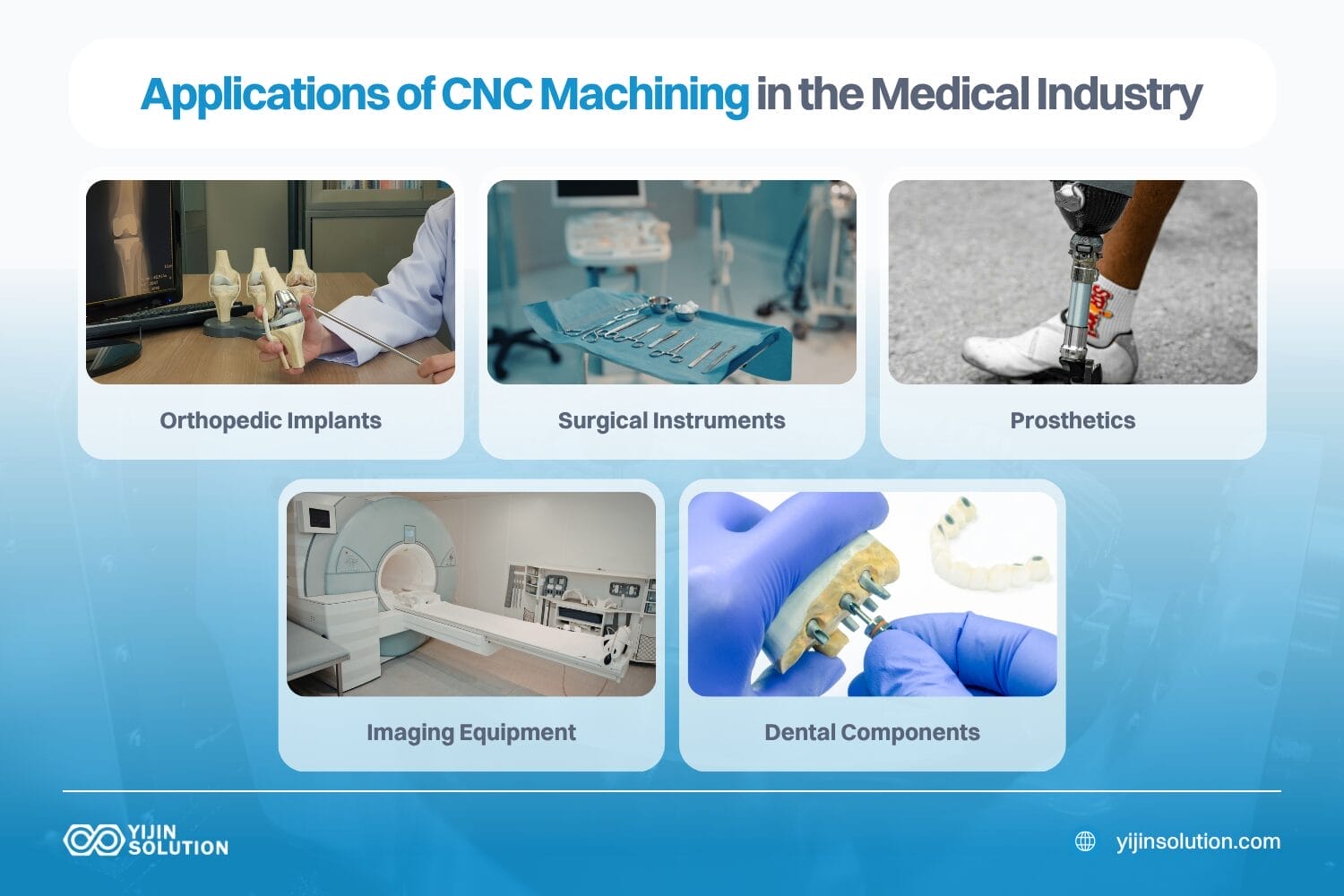
CNC machining serves every major segment of medical device production. The part types below represent where precision subtractive manufacturing is either the standard method or the preferred one.
Orthopedic and spinal implants
Bone screws, spinal cages, hip stems, knee components, and trauma plates. Machined from titanium or cobalt-chrome to tight tolerances with documented surface finish control. Bone-contact surfaces require specific Ra targets and, in many cases, intentional surface texturing to support osseointegration.
Хирургические инструменты
Forceps, retractors, scissors, clamps, and laparoscopic tool components. Stainless Steel 316L is the standard material for its corrosion resistance, sterilization compatibility, and long service life. High-volume batches require consistent dimensional repeatability throughout the full run, not just the first article.
Prosthetics and orthotics
Structural components for limb prostheses and orthotic bracing systems. Aluminum and titanium alloys are used for their combination of lightweight and load-bearing performance. Dimensional accuracy on interface features is critical; these parts connect to both the patient and downstream mechanical assemblies.
Diagnostic and imaging equipment
Housings, brackets, and structural frames for MRI components, CT scanner assemblies, and ultrasound transducer housings. Aluminum and engineering plastics handle non-implant structural requirements. MRI-compatible materials (non-ferromagnetic) are a specific selection constraint for this application class.
Fluid control and drug delivery
Pump housings, valve bodies, manifolds, and syringe components. Tight bore tolerances and a smooth internal surface finish are critical for flow control and sterilization compatibility.
Зубные компоненты
Implant abutments, crowns, and surgical guides. Typically milled from titanium or zirconia with high surface quality requirements. Dental CNC machining often combines tight dimensional tolerances on interface geometry with surface finish requirements that directly affect osseointegration and aesthetic outcomes.
What Separates Medical Machining From General CNC Work?
Most precision machining shops hold tight tolerances and produce clean parts. Medical machining asks for something different: not just tighter numbers, but a different relationship between the manufacturer and the part. When the part ends up inside a patient, every process decision carries consequences that extend beyond the production floor.
Documentation that weighs more than the part
In a general machining shop, documentation proves that the part was made correctly. In a medical machining shop, documentation proves the part was made correctly, with certified material from a traced heat number, using a validated process, with in-process inspection records, and a final dimensional report, all retrievable within hours of an audit request.
When a field failure occurs post-implant, lot traceability determines whether a recall covers 200 specific parts or an open-ended batch of unknown size. The difference in cost and patient exposure is substantial. Every material lot receives a unique identifier that follows the component through every manufacturing step, and material certificates document chemical composition and mechanical properties before any machining begins.
Coolant is a patient safety decision
Cutting fluid selection in medical machining is a biocompatibility decision. Documented cases exist in which microscopic coolant residue in the microstructure of titanium implants prevented tissue integration, requiring surgical removal. Medical machining shops typically use biocompatible water-based synthetic coolants formulated to leave no harmful residue after cleaning.
Many shops maintain individual coolant tanks per machine rather than a central system. If contamination occurs, a single tank can be isolated and replaced without halting production across the entire facility. High-pressure coolant systems are generally avoided for implantable parts: forced coolant can be deposited in the metal microstructure, complicating the post-machining cleaning process.
Scrap is not just a cost event
In general manufacturing, a scrapped batch is a financial loss and a productivity problem. In medical manufacturing, a non-conforming batch is a potential patient safety event. First-run scrap rates on medical CNC parts are higher than general machining. Process qualification reduces this significantly in production, but the front-end investment in process development, tooling qualification, and first-article inspection is heavier than in most general industrial work.
A machining partner’s Cpk data on similar part families matters more than their machine list. A validated process with documented capability studies and production scrap data by part family is a more reliable indicator of actual delivery risk than the presence of a 5-axis machine.
Surface finish goes beyond the Ra number
The Ra specification on a medical print is the starting point. What happens at and below that surface determines whether the part performs safely in the body. Residual cutting fluid in thread roots, micro-burrs that pass CMM inspection but spring back under cyclic loading, and passivation integrity after ASTM F86 processing are failure modes that dimensional inspection doesn’t catch.
Parts that meet dimensional and surface finish specifications can still fail ISO 10993-5 cytotoxicity testing if surface contamination at the 0.5 µm level is present. Medical machining shops run ultrasonic cleaning and passivation or electropolishing as standard post-machining steps, not optional upgrades.
Validated processes are locked
Once a machining process is validated under ISO 13485, changing the process means changing control documentation and potentially full revalidation. This applies to tooling grades, coolant formulation, feeds and speeds, and fixturing approaches. A general machining shop swaps insert grades when a supplier discontinues a product. A medical machining shop files a change control request, assesses the impact on validated process parameters, and may need to run a new first-article inspection cycle before production can resume.
Buyers evaluating a machining partner for medical work should ask not just ‘are you ISO 13485 certified?’ but ‘what is your change control process when a tooling supplier discontinues a grade?’ The answer reveals whether the quality management system is a certification document or an operational system.
Titanium is unforgiving, and experienced shops know it
Titanium alloys have properties that require process-specific knowledge to machine reliably. Poor thermal conductivity means heat concentrates at the cutting edge rather than dissipating into chips.
Work hardening occurs rapidly on passes with insufficient chip load. Spring-back after cutting affects achievable tolerances on thin-wall features. Stringy chips that aren’t evacuated cleanly damage surface finish on subsequent tool passes.
These are daily production realities that govern tooling selection, coolant strategy, depth of cut, and fixturing decisions. The same pattern applies to PEEK: continuous roughing on thin-walled PEEK without staged thermal management introduces residual stress that produces micro-cracks in thread roots and thin walls, detectable only at magnification. Your supplier’s process knowledge prevents this failure mode; machine capability alone doesn’t.
Talk to Yijin About Your Medical Project
CNC machining for medical devices relies on traceability. A dimension that passes CMM inspection means nothing to a regulator if the material cert, the operator log, the calibration record, and the inspection report cannot be pulled together into a single file two years later. This is where most shops that machine “medical-grade” parts quietly fall short – the tolerances are there, the paperwork is not.
Решение Yijin is built around that audit trail. Every medical job is run under our ISO 13485 and AS9100D quality systems, with full material traceability from mill cert to finished part, FAIR documentation on request, and retained inspection records aligned to customer PPAP or equivalent protocols.
Our engineering team reviews each drawing against material biocompatibility, tolerance feasibility, surface finish requirements, and cleaning and packaging specifications before quoting.
Submit your drawings for a free DFM review and quote within 24 hours.
CNC Machining for Medical Devices FAQs
How does CNC machining compare to metal injection molding for small medical components?
Metal injection molding (MIM) is cost-effective at high volumes for small, complex geometries like orthodontic brackets or minimally invasive tool tips. CNC machining produces fully dense parts with tighter dimensional control and a cleaner material audit trail.
For low-to-mid volumes or components where structural integrity is critical, CNC is the lower-risk choice. MIM becomes competitive when annual volumes exceed the point where per-part machining cost outweighs tooling amortization.
At what production volume does CNC machining become less economical than other manufacturing methods?
CNC machining carries no hard tooling cost, which makes it cost-effective from prototype through medium production volumes. The economics typically shift when annual volumes reach tens of thousands of identical parts and geometric complexity is low enough to suit casting or MIM.
For most medical device applications, volumes rarely reach the threshold where the savings from alternative processes justify the requalification burden of switching suppliers mid-device lifecycle.
How is a First Article Inspection different from standard incoming inspection?
Standard incoming inspection verifies that delivered parts meet the purchase order specification, typically through sampling. First Article Inspection (FAI) is performed before a production run is approved and serves as the baseline record that subsequent batches are compared against. For medical device supply chains, FAI outputs feed into the device history record and are referenced during regulatory audits.
Can a CNC machining supplier be audited as part of a device manufacturer’s supplier qualification process?
Yes, and for Class II and Class III devices this is expected rather than optional.
ISO 13485 requires medical device manufacturers to evaluate and monitor their suppliers. In practice this means the device manufacturer conducts an initial supplier audit before approving the supplier for production, reviews quality system documentation, and may perform periodic re-audits or request annual re-qualification records.
Вернуться к началу: CNC Machining for Medical Devices: Process, Materials & Standards Explained