


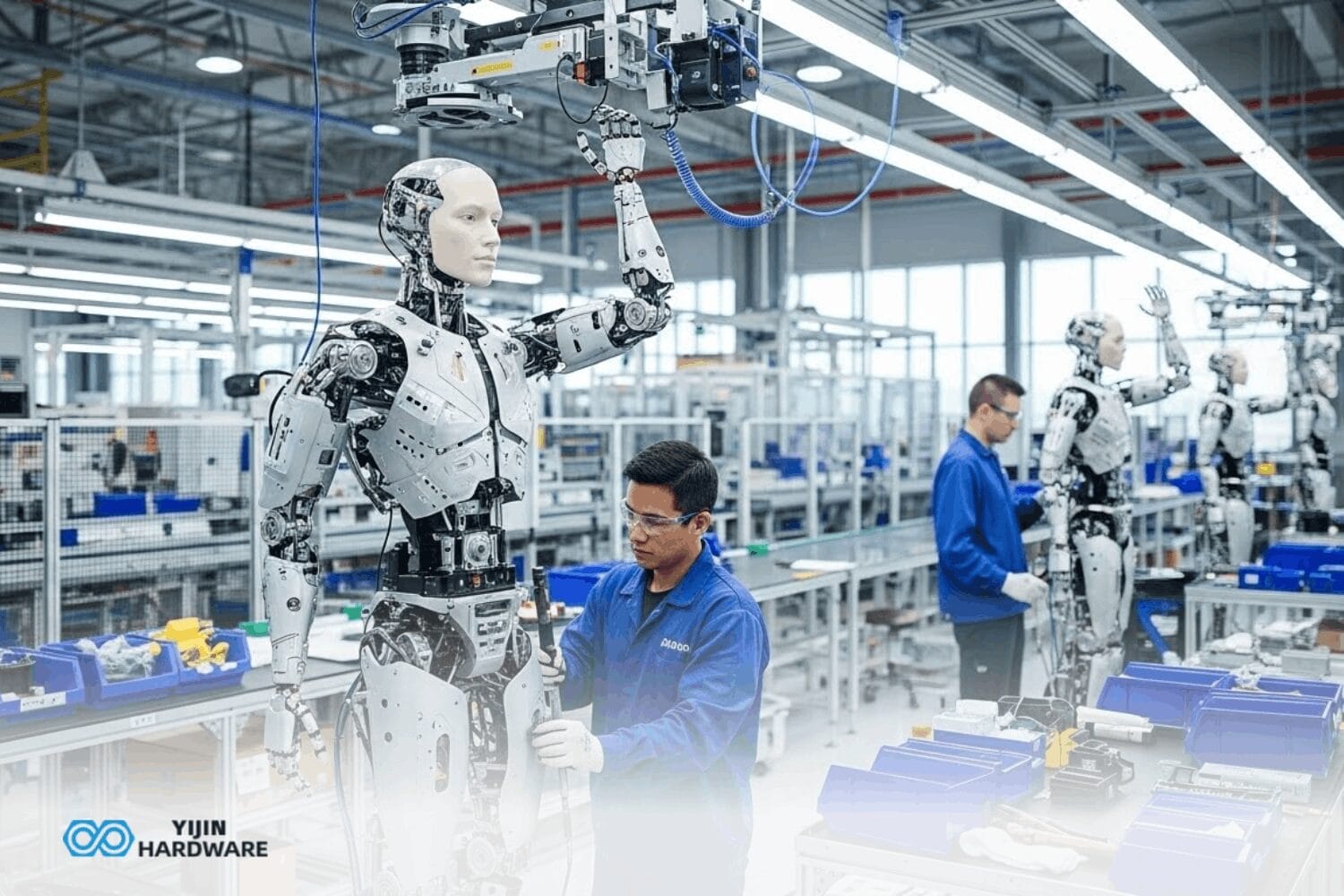
Humanoid robot manufacturers are pushing robotics into real-world settings. These systems look human-like, walk upright, and handle complex tasks. The real challenge is not just AI or software—it is whether a robot can be built reliably, repeatedly, and at scale.
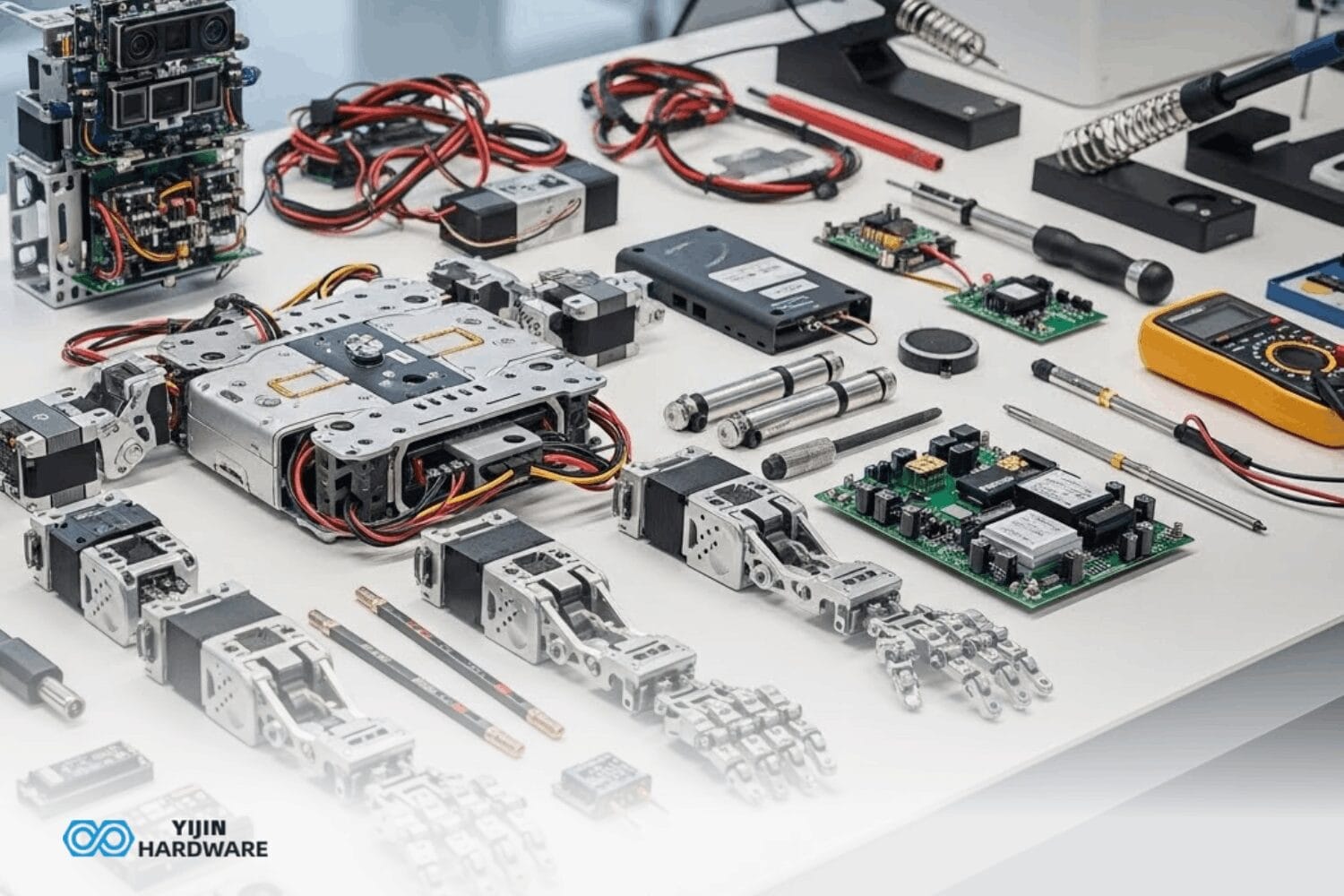
At Yijin Hardware, we support this shift by manufacturing humanoid robot parts, not finished robots. Every humanoid robot depends on precision CNC machining, sheet metal fabrication, die casting, injection molding, and custom fasteners. If those parts fail, the robot never leaves the factory floor.
Key Takeaways
- Manufacturing limits humanoid robotics more than software
- Precision parts define robot reliability
- Few humanoid robot companies are production-ready
- Scaling requires real manufacturing partners
- Yijin Hardware builds humanoid robot parts
What is a Humanoid Robot?
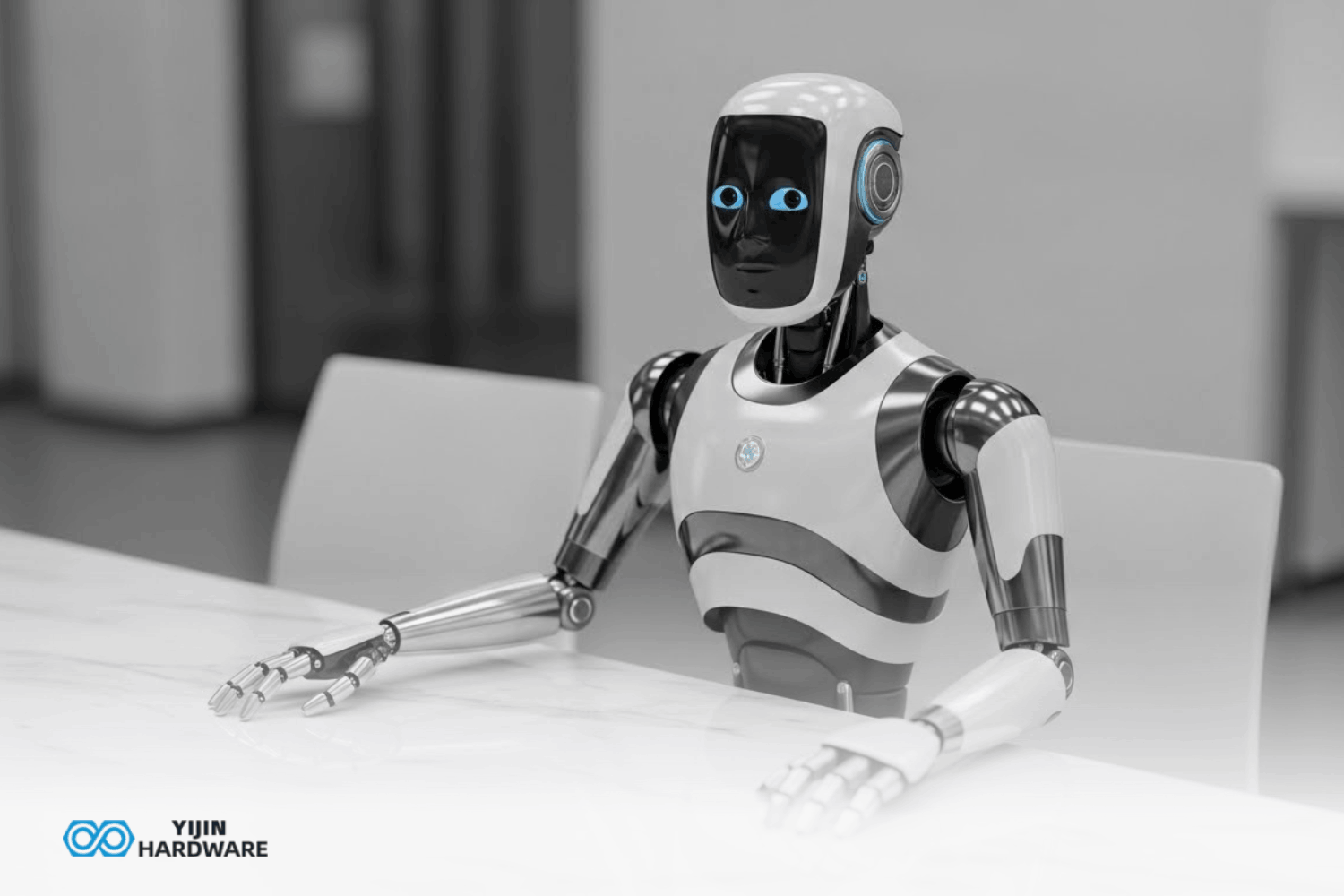
A humanoid robot is a bipedal robotic system with a human-like structure designed to work in the real world. These robots operate in commercial environments, handle repetitive tasks, and move through spaces built for people.
A humanoid robot designed for industrial applications relies on rigid frames, joint housings, actuator mounts, and protective enclosures. These parts must meet tight tolerances to achieve balance, durability, and safety across production lines.
What does it Take to Manufacture a Humanoid Robot?
Humanoid robotics depends on repeatable manufacturing more than cutting-edge ai. Every humanoid robot capable of working outside research labs requires thousands of precisely made components.
From a manufacturing view, a robot company succeeds only when its designs translate into mass production.
Core Manufacturing Processes
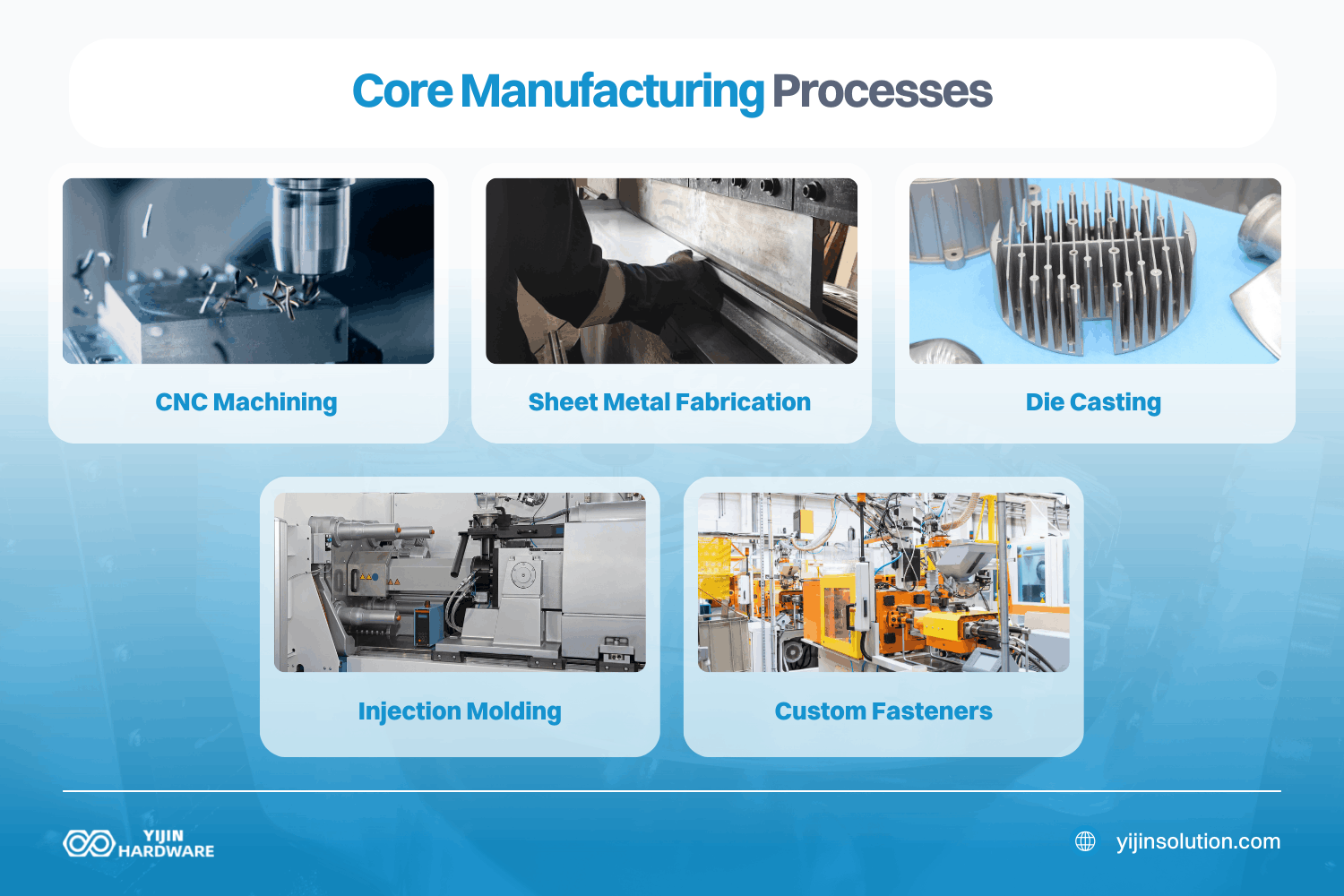
- CNC machining for joints, gears, actuator interfaces
- Sheet metal fabrication for frames, brackets, enclosures
- Die casting for aluminum housings in high volumes
- Injection molding for plastic shells and internal guides
- Custom fasteners engineered for vibration and torque
Common Materials
- Aluminum alloys for lightweight strength
- Stainless steel for wear and load points
- Engineering plastics for insulation and safety
This manufacturing stack is missing from most competitor articles, yet it defines whether a general-purpose humanoid can work in the real world.
Who are the Top 10 Humanoid Robot Manufacturers?
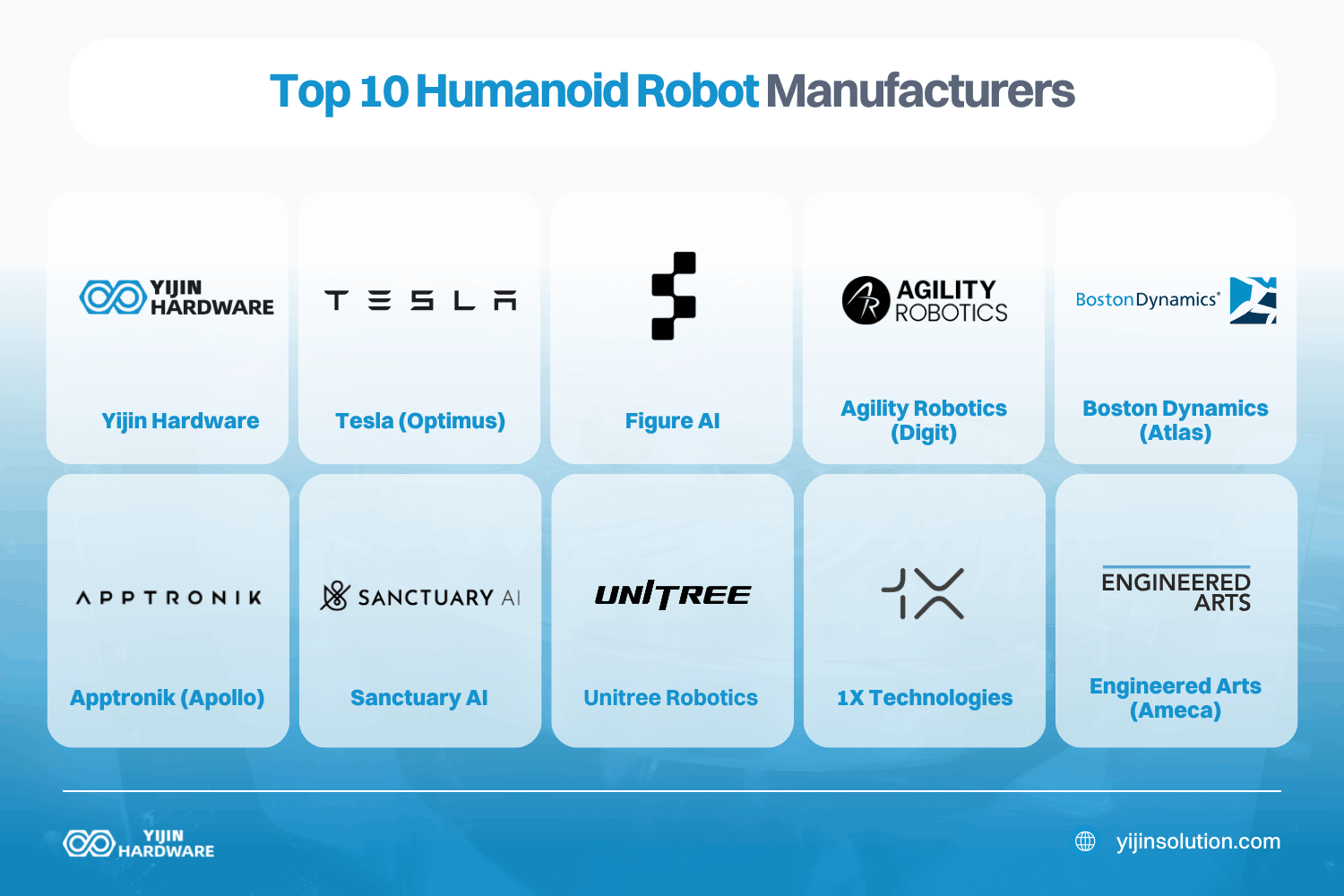
This ranking evaluates humanoid robot manufacturers based on technical maturity, manufacturability, and readiness for commercial use, not marketing hype.
1. Yijin Hardware (Manufacturing Partner for Humanoid Robot Parts)
Yijin Hardware is not a humanoid robot company. We are a precision manufacturing partner that enables humanoid robotics industry growth by producing the parts these robots rely on.
We support developing humanoid platforms by manufacturing structural, mechanical, and fastening components that meet production-grade requirements.
Why Yijin Hardware Ranks #1
Yijin Hardware addresses the largest failure point in humanoid robotics: scaling from prototypes to mass production. Our expertise sits between design and deployment.
Capabilities (Manufacturing Focus)
- CNC machining for joint housings and actuator mounts
- Sheet metal fabrication for frames and covers
- Die casting for structural aluminum components
- Injection molding for engineered plastics
- Custom fasteners for high-performance robotic assemblies
What Competitors Don’t Do
Most humanoid robot manufacturers showcase demos. We ensure their robots can survive factory floor use, logistics and manufacturing environments, and long-term deployment.
2. Tesla (Optimus)
Tesla develops Tesla’s Optimus, a general purpose humanoid intended for domestic tasks, everyday tasks, and industrial applications. The project reflects Elon Musk’s vision of large-scale automation powered by AI and robotics. Optimus is designed to handle repetitive tasks that currently require human labor.
Tesla positions Optimus as a humanoid robot capable of working alongside people on production lines and in real-world settings. The robot’s form factor prioritizes simplified geometry to reduce part count and support mass production.
Basic Info
- Company: Tesla
- Robot: Tesla’s Optimus
- Location: United States
- Focus: General-purpose automation, industrial use
Manufacturing Reality
Tesla’s Optimus depends on automotive-style manufacturing discipline. CNC machining accuracy in joint housings, consistency in die-cast aluminum structures, and repeatable fastener torque all determine whether tesla’s humanoid platform can scale beyond prototypes and into commercial environments.
3. Figure AI
Figure AI develops an industrial humanoid robot designed for logistics and manufacturing tasks in commercial environments. The company focuses on deploying robots that can work in the real world rather than remaining confined to research labs. Its approach emphasizes AI and robotics integration with physical reliability.
Figure AI targets factory floor and warehouse use cases where uptime, repeatability, and safety matter more than human-like appearance. This places heavy demands on mechanical durability.
Basic Info
- Company: Figure AI
- Location: United States
- Focus: Industrial humanoid robot, automation
Manufacturing Challenge
Figure’s humanoid system requires precision CNC-machined joints, stable actuator mounts, and vibration-resistant fasteners. Any tolerance drift reduces human-level dexterity and limits performance during complex tasks across logistics and manufacturing operations.
4. Agility Robotics (Digit)
Agility Robotics builds Digit, one of the most deployed humanoid robotic platforms operating today. Digit is designed to move through human spaces and perform logistics tasks without modifying existing facilities. This practical focus sets it apart from many experimental systems.
Digit demonstrates how humanoid robotics succeeds when mechanical systems are designed for reliability first, not spectacle.
Basic Info
- Company: Agility Robotics
- Robot: Digit
- Location: United States
- Focus: Logistics and manufacturing automation
Manufacturing Note
Digit’s success depends on repeatable sheet metal frames, CNC-machined joints, and robust fasteners that withstand continuous motion. Digit’s manufacturable design allows it to operate on production lines and in warehouses with minimal downtime.
5. Boston Dynamics (Atlas)
Boston Dynamics develops Atlas, including the electric Atlas platform, as a cutting-edge humanoid designed to explore advanced mobility and control. Atlas showcases bipedal motion, balance, and imitation learning driven by cutting-edge AI.
Atlas remains focused on pushing technical limits rather than immediate commercial use.
Basic Info
- Company: Boston Dynamics
- Robot: Atlas
- Location: United States
- Focus: Research labs, advanced robotics
Limitation
Atlas relies on complex, low-volume assemblies that are difficult to transition into mass production. The robot highlights what is mechanically possible but also shows why many humanoid robot manufacturers struggle to move from research platforms to scalable products.
6. Apptronik (Apollo)
Apptronik develops Apollo, an industrial humanoid designed to operate safely on the factory floor. Apollo is designed to assist with automation tasks in production lines and commercial environments where reliability matters more than appearance. The platform prioritizes strength, balance, and maintainability over lifelike motion.
Apollo is positioned as a next-generation solution for industrial automation, with a focus on repeatable mechanical performance across shifts.
Basic Info
- Company: Apptronik
- Robot: Apollo
- Location: United States
- Focus: Factory floor automation, industrial applications
Manufacturing Advantage
Apollo is designed with modular mechanical systems that simplify CNC machining, part replacement, and assembly. This approach reduces downtime, improves serviceability, and lowers production risk when scaling humanoid robots for continuous commercial use.
7. Sanctuary AI
Sanctuary AI develops Phoenix, a general-purpose humanoid focused on manipulation, perception, and decision-making. The system aims to perform complex tasks that require human-level dexterity across a range of applications. Phoenix integrates AI and robotics to support adaptive behavior in real-world settings.
The robot’s performance depends heavily on mechanical precision rather than software alone.
Basic Info
- Company: Sanctuary AI
- Location: Canada
- Focus: General-purpose humanoid, commercial use
Manufacturing Risk
Phoenix requires tightly controlled CNC-machined joints, stable actuator housings, and vibration-resistant fasteners. Manufacturing inconsistencies directly reduce haptic feedback accuracy and limit reliable operation in commercial environments.
8. Unitree Robotics
Unitree Robotics produces humanoid robotic platforms primarily aimed at research, education, and early-stage commercial testing. The company focuses on cost efficiency and rapid iteration rather than heavy industrial deployment. Unitree’s systems emphasize accessibility over maximum payload or durability.
Its approach reflects strong manufacturing execution within constrained performance targets.
Basic Info
- Company: Unitree Robotics
- Location: China
- Focus: Research and development, humanoid robotics industry
Manufacturing Perspective
Unitree benefits from efficient supply chains and standardized production methods. While its robots may not match industrial humanoid durability, manufacturing efficiency allows faster iteration and broader adoption in research labs and pilot programs.
9. 1X Technologies
1X Technologies develops humanoid robots designed to work safely alongside people in commercial environments. The company emphasizes human-like interaction, lightweight structures, and compliance for shared workspaces. These priorities shape both design and manufacturing requirements.
The platform targets real-world deployment rather than controlled demonstrations.
Basic Info
- Company: 1X
- Location: Norway
- Focus: Commercial environments, human-robot collaboration
Manufacturing Consideration
Lightweight structures demand precise material selection, CNC machining accuracy, and consistent assembly. Small deviations in manufacturing reduce strength-to-weight balance and compromise safe operation around people.
10. Engineered Arts (Ameca)
Engineered Arts builds Ameca, a humanoid designed for expressive interaction and communication. Ameca focuses on lifelike facial movement, human-like gestures, and social engagement rather than industrial automation. The robot is widely used for demonstrations and exhibitions.
Its design priorities differ significantly from production-oriented humanoids.
Basic Info
- Company: Engineered Arts
- Robot: Ameca
- Location: United Kingdom
- Focus: Human-like interaction, demonstrations
Manufacturing Context
Ameca relies on precision-machined components for smooth motion and expressive control. However, its manufacturing requirements prioritize appearance and motion quality over durability for repetitive tasks or long-term commercial use.
Manufacturing Comparison
| Component | Process | Risk if Poorly Made | Impact |
|---|---|---|---|
| Joint housing | CNC machining | Misalignment | Instability |
| Frame | Sheet metal | Warping | Balance loss |
| Actuator shell | Die casting | Porosity | Reduced lifespan |
| Covers | Injection molding | Poor fit | Safety risk |
| Fasteners | Custom machining | Loosening | Failure |
Why Manufacturing Determines Success Beyond Humanoid Robot Manufacturers
Humanoid robotics industry progress depends on manufacturing maturity. Robots must survive repetitive tasks, complex tasks, and industrial applications without failure.
Companies that invest early in manufacturing partners outperform those focused only on AI and robotics software.
Ready to Manufacture Humanoid Robot Parts at Scale?
The future of humanoid robotics depends on reliable production, not demos. Precision manufacturing enables robots to work in the real world.
If you need CNC machining, sheet metal fabrication, die casting, injection molding, or custom fasteners for humanoid robot parts, Yijin Hardware is ready to support your next-generation platform. Contact us for humanoid robot parts.
FAQs on Humanoid Robot Manufacturers
Which country is leading in humanoid robots?
The United States and China lead the humanoid robotics industry. U.S. firms drive system design and AI, while China excels in manufacturing efficiency and supply chains.
What’s the best robotics stock to buy?
There is no single best robotic stock. Large, diversified robotics companies typically carry lower risk than early humanoid startups.
Who is the biggest manufacturer of robotics?
Industrial robot manufacturers dominate global production volumes. Humanoid robot companies remain smaller but are growing.
Back to Top: Top 10 Humanoid Robot Manufacturers (and the Manufacturing Reality Behind Them)




 EN
EN  ES
ES  RU
RU  DE
DE  FR
FR