

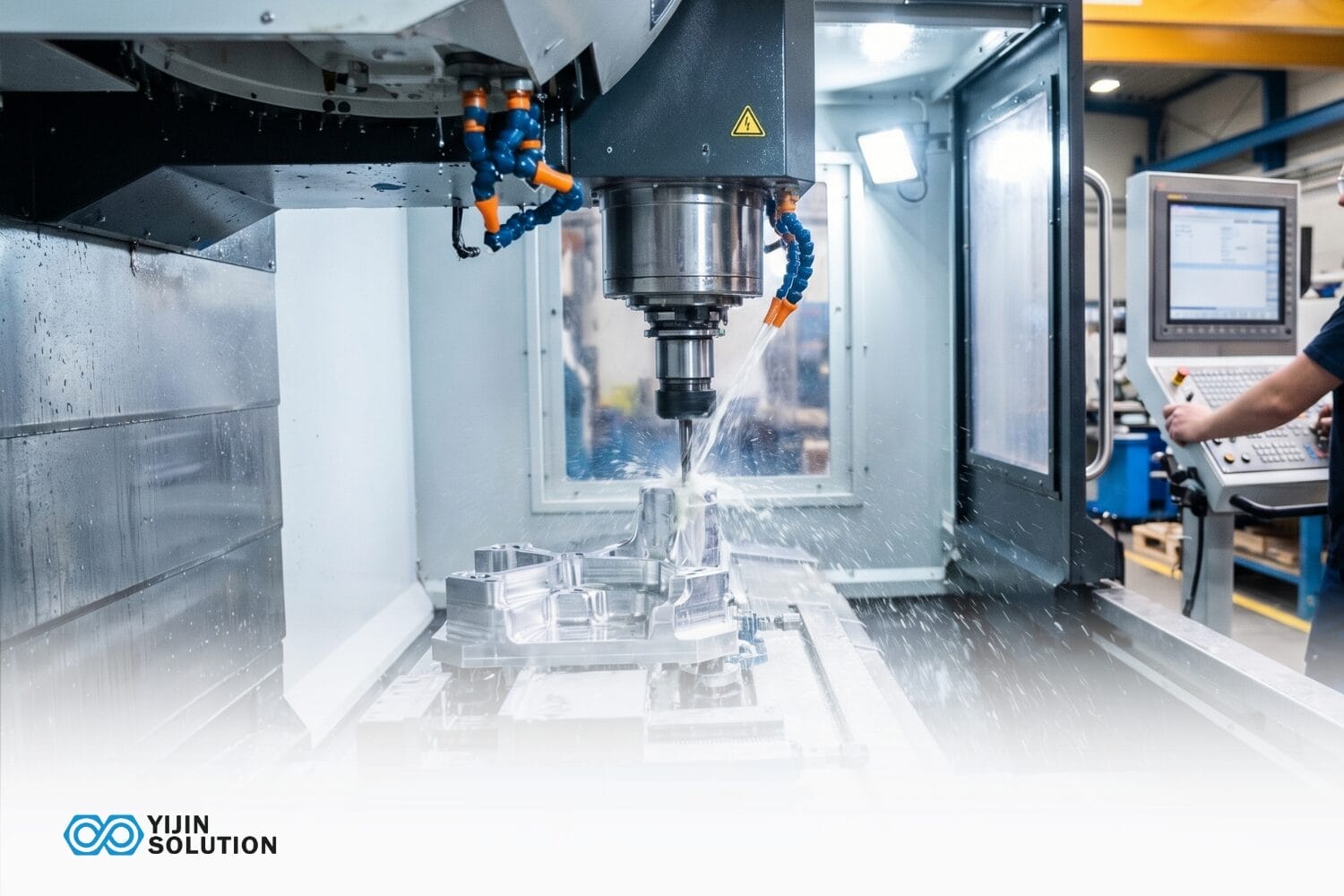
The global CNC machining market is valued at $108.58 billion in 2025 and is on track to reach $251.61 billion by 2035. This is an 11.10% compound annual growth rate driven mainly by the demand from the automotive, aerospace, and medical sectors.
These numbers reflect something practical: CNC machining is expanding in both volume and technical complexity, and shops equipped for that complexity are producing better parts, faster.
The market is expanding because the technology itself is changing quickly. AI-optimized toolpaths are reducing cycle times by 15–25% in production environments. Multi-axis adoption is accelerating across sectors that previously ran 3-axis equipment by default. Sustainability data is also becoming a supplier qualification requirement, not a marketing differentiator.
Below, we cover the eight trends defining CNC machining in 2026, with data, context, and what each shift means for your sourcing decisions.
At a Glance: 2026 CNC Machining Trends
The table below maps each trend to its key driver, industry impact, and what it means for your sourcing decisions. Use it to identify which shifts are relevant to your part families before reading the full breakdown.
| Trend | Key Driver | Влияние на промышленность | Buyer Relevance |
|---|---|---|---|
| 1. AI-Driven Machining | Real-time sensor feedback, adaptive control | 15–25% cycle time reduction; fewer unplanned stoppages | More consistent quality, faster delivery |
| 2. 5-Axis & Multi-Axis Expansion | Complex part demand; EV & aerospace growth | 5-axis growing at 10.8% CAGR | Single-setup machining reduces lead times |
| 3. Digital Twins & Smart Connectivity | Industry 4.0 integration | Virtual validation before the first cut | Fewer setup errors, better cost estimates |
| 4. Lights-Out & Robotic Automation | Labor costs, skills shortages | Spindle utilization up from 50% to 85% | More predictable lead times |
| 5. Reshoring & Supply Chain Localization | Geopolitical risk, tariffs | North America = fastest-growing CNC region | Diversification of sourcing geography |
| 6. Hybrid Manufacturing | Complex geometry demand | Near-net-shape parts, precision finishing | Fewer machining steps per part |
| 7. Sustainable Machining | ESG mandates, cost efficiency | MQL, dry cutting, energy-efficient tooling | Carbon data per part increasingly requested |
| 8. Workforce Evolution | Automation, skills gap | 2.1M projected US manufacturing job shortfall by 2030 | Skilled-labor availability affects lead times |
What “Trends in CNC Machining” Actually Means for Buyers
Not every CNC machining trend affects your current production timeline. Some shifts are operational, affecting lead times, per-part cost, and first-article quality today. Others are structural, shaping which suppliers remain competitive partners 12–24 months from now.
Operational trends are the ones to act on now. Structural trends are the ones to use when deciding who belongs and will remain on your approved vendor list in two years. Knowing the difference is how you qualify and keep the right machining partners.
AI integration and 5-axis adoption fall into the operational side of things. Shops that have deployed these technologies are delivering faster first-article turnaround, tighter tolerances across long runs, and fewer unplanned delays. These capabilities are assessable and verifiable today through lead time data, inspection reports, and DFM response quality.
Sustainability reporting and workforce development fall into the structural side of things. A supplier’s carbon tracking capability won’t change the price of your next batch of parts. However, if your supply chain has or is adding ESG reporting requirements, that capability will determine which suppliers stay qualified for your projects.
Workforce investment works the same way. Shops building internal training programs today are insulating themselves from a skilled-labor shortfall that will affect capacity and lead times across the industry.
How Big is the CNC Machining Market in 2026?
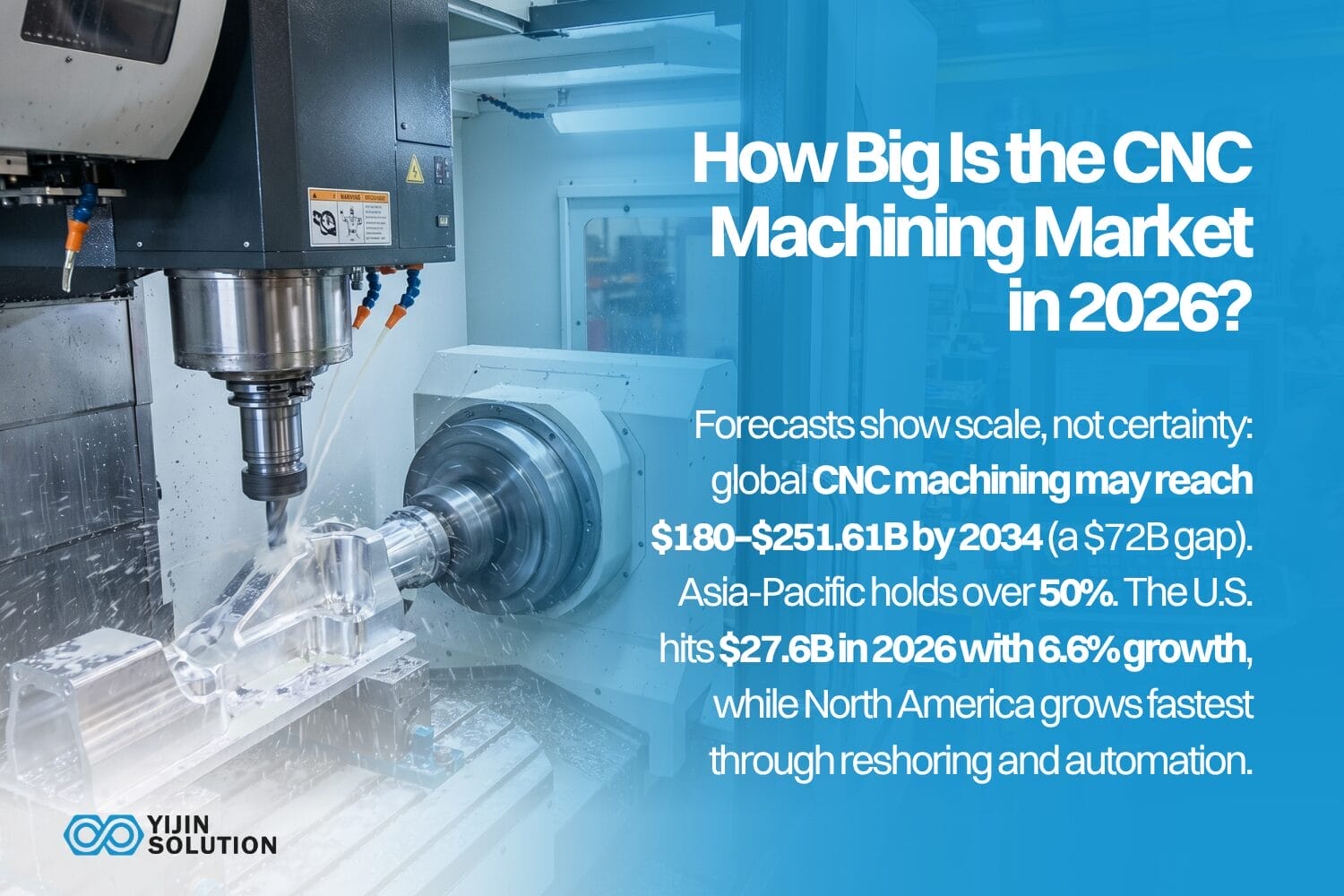
Financial forecasts exist to demonstrate a market’s scale rather than promising certain metrics. Certain sources say that the global CNC machining market will reach $251.61 billion by 2034, while others put the number closer to $180 billion.
The $72 billion difference between top projections for the next decade is proof of a global market evolving too quickly to be neatly categorized. Plus, there are certain nuances to consider.
Asia-Pacific holds over 50% of the global CNC machining output and is valued at approximately $56 billion in 2025, growing at around 8.5% CAGR through the decade. The United States enters 2026 at $27.6 billion with a 6.6% growth rate. The US share is smaller, but it reflects a deliberate shift toward high-value, automation-intensive production rather than competing on volume.
For buyers, that split has a practical meaning. Asia-Pacific is where you source for cost efficiency and volume capacity. North America is where defense localization requirements, reshoring incentives, and EV production investment are concentrating new automation spending. Understanding which region applies to which part family in your supply chain is more useful than treating either as a blanket preference.
Which Industries Drive CNC Machining Demand?
The automotive industry accounts for roughly 33–38% of global CNC machining demand, making it the largest single sector for CNC machining. EV production is the primary growth driver: battery enclosures, motor housings, and structural chassis components all require multi-axis machining and sealing tolerances that 3-axis setups cannot consistently achieve at volume.
Aerospace and medical devices follow as the second and third largest sectors. Both prioritize tight tolerances, full dimensional traceability, and certified supply chains as contractual and regulatory requirements. Aerospace suppliers must demonstrate AS9100D compliance. Medical device manufacturers are subject to ISO 13485 and FDA 21 CFR Part 820 requirements. These certifications define the supplier pool, giving certified machining partners a meaningful competitive advantage in both sectors.
Industrial equipment and semiconductor manufacturing round out the top five. Both sectors are driving increased demand for multi-axis precision parts as product complexity and miniaturization requirements intensify.
Trend 1: AI Moves from Pilot to Production Floor
AI in CNC machining was experimental through 2024. By 2026, it’s operational and embedded directly into machine controllers, CAM systems, and quality inspection workflows at shops serving volume production programs.
A machining cell is a group of machines, robotic loading equipment, and inspection tools operating as a coordinated production unit. AI is what ties these components together in real time, adjusting parameters and flagging anomalies across the cell rather than reacting to problems on individual machines in isolation.
AI covers three core applications in CNC machining:
- Adaptive feed rate and speed control: Embedded sensors monitor spindle load and vibration in real time, adjusting cutting parameters automatically to maintain optimal conditions without operator intervention.
- Predictive tool wear monitoring: Machine learning models analyze wear patterns and predict spindle failure with approximately 95% accuracy, allowing planned tool changes before a bad part is cut.
- AI-assisted CAM toolpath generation: These reduce programming time by up to 40% and deliver cycle time reductions of 15–25% on qualifying parts.
AI performance depends on the environment it runs in. Sensor quality, machine controller compatibility, data infrastructure, and operator skill all affect real-world results. An AI-assisted cell doesn’t deliver theoretical gains without end-to-end integration. A shop with good hardware but poor data hygiene won’t see the same results as one with end-to-end integration. This is worth understanding when evaluating supplier claims about AI capability.
The machinist role is shifting alongside automation toward data interpretation, exception management, and algorithm tuning, rather than repetitive machine loading. The headcount per cell may decrease, but the skill requirement per head is rising.
What does that mean for you,? AI-equipped suppliers can offer you more consistent quality across long runs and fewer unplanned stoppages affecting delivery schedules. When qualifying a new machining partner, ask whether their machine controllers are AI-enabled and what inspection data they capture at the cell level.
Trend 2: 5-Axis Machining Becomes the Standard, Not the Premium
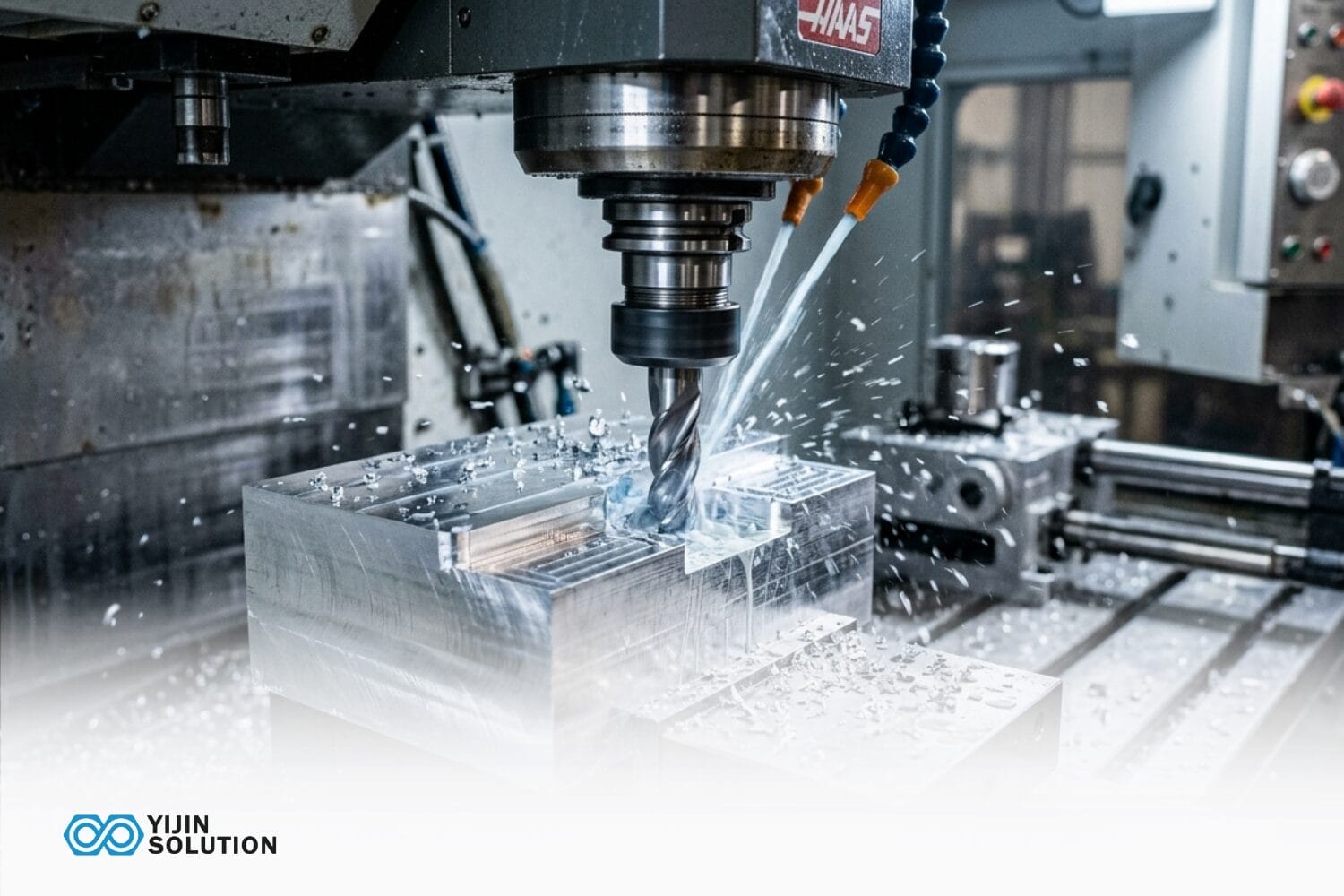
5-axis machining is no longer a premium capability reserved for aerospace OEMs. It’s becoming the standard route for complex geometries across the automotive, medical, and industrial sectors. This change is driven by the part complexities that 3-axis setups can’t address efficiently.
The market data reflects this: 5-axis and above CNC configurations are growing at a 10.8% CAGR, roughly twice the rate of 3-axis systems. EV production is a specific accelerant, with battery enclosure machining requiring sealing tolerances achievable only with multi-axis precision.
However, 5-axis capability is a system outcome, not a machine specification. The benefits depend on fixturing strategy, datum scheme, part geometry, and programming expertise. That means a well-executed 3-axis setup can outperform a poorly programmed 5-axis run for certain geometries.
Verify that your machining partner can recommend the right axis configuration for your geometry. A partner who recommends 3-axis where it’s sufficient is demonstrating engineering judgment, not a capability gap.
Trend 3: Digital Twins and Connected Factories
Digital twins are no longer simulation tools used during design review. By 2026, they’re live, continuously updated mirrors of the actual machining process. They validate every complex sequence virtually before a single chip is cut.
The 2026 digital twin integrates toolpath simulation, collision detection, kinematic validation, mechanical stress modeling, thermal effects, and cost estimation. It performs the entire pre-production run, moving from aerospace-only to standard practice at shops running high-complexity programs in other sectors.
IoT-enabled machine monitoring allows sensors to track spindle health, vibration signatures, and tool wear, which feeds real-time data into scheduling and maintenance systems. The real benefit is the reduction in unplanned downtime by 30–50% in facilities with condition monitoring deployed across their machine fleet.
These two capabilities of digital validation before machining and real-time monitoring separate suppliers with predictable quality from those relying on end-of-run inspection. When evaluating a machining partner, ask whether their machines feed live production data into planning and inspection systems, and whether traceability documentation is auto-generated or manually assembled.
Suppliers with mature process control generate traceability documentation automatically and feed live machine data into planning systems. Those that rely on manual inspection and end-of-run paperwork can’t offer the same consistency or predictability.
Trend 4: Lights-Out Machining and Robotic Cell Integration
Lights-out machining refers to continuous, unmanned CNC production running through nights and weekends without constant human supervision. It requires robotic part loading, automated pallet changers, in-process inspection, and smart scheduling software coordinating across multiple machines.
The productivity impact is significant. A conventional machining cell operates roughly 40 productive hours per week on a single shift. A lights-out cell can run up to 168 hours, which is every hour of the week. That extended runtime pushes spindle utilization from around 50% under standard operation to 85% or above. That directly affects per-part cost on repeat production programs, with fixed overhead spreading across significantly more parts per week.
What’s also changing in 2026 is the scope of automation. Progress isn’t limited to machine-tending robots. The surrounding workflow that previously required manual handling is being integrated into automated cells. Shops that previously ran robotic loading on a single machine type are now building multi-process automated sequences.
For buyers, automation-equipped shops offer more predictable lead times and lower per-part costs on repeat production runs. If you have high-mix, low-volume work, ask how automation is applied. Not all cells handle short-run flexibility well, and a lights-out cell optimized for high-volume repeat programs may introduce setup overhead that doesn’t suit prototype or small-batch orders.
Trend 5: Reshoring and the Rebalancing of Global Supply Chains
Reshoring in 2026 is driven by compounding pressures, not a single policy decision. Section 232 tariffs on steel and aluminum imports and geopolitical risk from single-region supply concentration are all pulling production decisions toward domestic capacity.
North America is the fastest-growing CNC equipment market in 2026. Growth is supported by the CHIPS Act, EV manufacturing incentives under the Inflation Reduction Act, and defense localization requirements that effectively prevent offshore sourcing for certain part families.
However, reshoring is better described as supply chain diversification than wholesale relocation. That’s the counterbalance worth understanding.
China holds over 35% of the Asia-Pacific CNC market and remains competitive for prototype and mid-volume precision parts. North American buyer searches for China-based CNC machining grew 212% between 2023 and 2025. The procurement trend is that you shouldn’t depend exclusively on any single geography.
The practical question for procurement teams is which part families benefit from domestic sourcing and which are better served by Asia-Pacific capacity.
Critical defense components and parts under strict localization requirements belong in domestic sourcing. Complex precision parts in which tolerance capability and cost efficiency are the primary drivers often belong in Asia-Pacific sourcing.
To offset higher domestic labor costs, reshored facilities are investing heavily in lights-out automation. This makes automation and reshoring structurally linked trends.
Ask your machining partners how their automation investments affect pricing on repeat production programs. Suppliers who haven’t invested in automation are absorbing rising labor costs somewhere, usually in margin, quality, or lead time reliability.
Trend 6: Hybrid Manufacturing
Hybrid manufacturing combines additive manufacturing with precision CNC machining in a single production workflow. A near-net-shape part is built additively, then finished with CNC to achieve critical tolerances on functional surfaces.
The practical value is geometric. Complex internal geometries that would require extensive multi-setup machining can be built additively, then brought to tolerance on the external features that matter. Real application exists in aerospace structural brackets, medical implant geometries, and tooling production, in which the conventional route is either too slow or too expensive.
However, hybridization is not a universal solution. It’s cost-justified for parts where conventional machining alone would require excessive material removal, or in instances of internal geometry demanding additive deposition. But for standard prismatic parts, conventional CNC remains the more efficient route.
Hybrid is most relevant for prototype and low-volume production of complex geometries. When evaluating a machining partner for this type of work, ask whether they offer hybrid process routing or partner with additive facilities as part of their supply chain.
Trend 7: Sustainable Machining
In 2026, sustainability in CNC machining is measured with the same discipline as dimensional tolerances. Customers in aerospace and medical supply chains increasingly request carbon-footprint data per part as a supplier qualification requirement.
The operational changes are already widespread. Minimum Quantity Lubrication, dry cutting where alloys permit, coolant recycling, and lower-idle-power machine redesigns are moving from optional upgrades to standard practice at shops serving major OEM programs. The economics support adoption independent of mandate. Optimized tool paths reduce energy consumption, reduced rework lowers material waste, and coolant recovery cuts ongoing operating cost.
The materials angle is particularly relevant for aerospace suppliers: titanium and nickel alloy recycling is becoming standard practice. Material cost is one driver; sustainability mandates embedded in OEM supply chain programs are the other. Scrap management at the chip level is now a documented process requirement rather than a shop-floor judgment call.
If your supply chain has ESG reporting requirements, verify that machining partners can provide energy use, coolant volume, and material waste data alongside dimensional inspection reports. Suppliers who have invested in MQL and coolant recovery are now running tighter, lower-waste operations that translate to better material yield and more consistent quality.
Trend 8: The Skills Gap and the Evolving Machinist Role
The US manufacturing sector is projected to face a shortfall of 2.1 million skilled workers by 2030. Today, 65% of CNC machine shops already report difficulty finding qualified operators. That gap is a live constraint affecting capacity, lead times, and quality consistency across the industry.
The machinist role is changing. The 2026 machinist spends less time on repetitive machine loading and more time validating data patterns, programming multi-axis sequences, supervising automated cells, and interpreting predictive analytics outputs. CNC programmer hourly wages average $30.50 in the US, with experienced multi-axis programmers commanding $60,000–$80,000+ annually.
Leading shops are responding with internal training programs, apprenticeships, and systematic upskilling. They are treating workforce development as a competitive capability rather than an HR function. Shops that develop talent internally are building a capability that the open labor market can’t easily replicate.
When qualifying a machining partner, ask three things: whether the shop invests in internal training, what their operator retention looks like over 12–24 months, and how automated their cell loading is for repeat programs. High retention and structured training are leading indicators of consistent quality and reliable lead time performance.
How Yijin Solution is Positioned for These Trends
The eight trends covered in this article are a practical evaluation framework. Suppliers who have invested in AI-enabled machine control, multi-axis capability, and digital process traceability are delivering measurably different outcomes than those who haven’t. The difference shows up in first-article quality, lead time reliability, and tolerance consistency across production runs.
At Yijin Solution, our response to these shifts is operational. Our 25,000+ m² facility in Shenzhen runs 136+ CNC machining centers configured across multi-axis setups, supported by 281 inspection instruments including Zeiss CMMs and automated optical measurement systems. AS9100D, IATF 16949, and ISO 13485 certifications reflect the process discipline required by aerospace, automotive, and medical supply chains. We are backed by a documented quality system covering supplier qualification, process control, inspection, and non-conformance management.
On traceability, we provide material composition documentation, dimensional inspection reports, and process records as standard deliverables for regulated supply chains. On sustainability, we can supply energy use and material waste data for programs with ESG reporting requirements. Sample parts ship in 1–3 working days; bulk orders in 3–7 working days, depending on part complexity, material, and order volume.
If you want to assess how these capabilities apply to your specific program, our engineers will review your design, flag any tolerance or manufacturability risks, and return a process recommendation and quote within 24 hours.
Upload your CAD files and request a free DFM review.
Trends in CNC Machining FAQs
What should I ask a CNC machining supplier to assess their technology level?
Ask whether their machine controllers are AI-enabled and whether they capture in-process sensor data during production. Also ask whether the traceability documentation is auto-generated or manually assembled. Suppliers with end-to-end digital process control provide this data as standard; those relying on manual inspection and paper-based records cannot.
How does the global skills shortage affect CNC machining lead times?
Shops with high operator turnover or undertrained staff take longer to set up complex jobs and produce more non-conforming parts. They’re also more likely to push lead times when capacity is under pressure.
A shop with structured training programs and stable, experienced operators delivers more consistent output, particularly on multi-axis programs and tight-tolerance work.
Is China-based CNC machining still viable given reshoring trends?
Yes, for most precision machining applications, China-based sourcing remains technically capable and cost-competitive. The reshoring trend reflects supply chain risk diversification, not a wholesale shift away from Asia-Pacific manufacturing.
For complex precision components where tolerance capability and cost efficiency drive the decision, qualified China-based precision manufacturing remains highly competitive.
What sustainability documentation can I request from a CNC machining supplier?
For programs with ESG reporting requirements, ask suppliers for energy consumption data per production run, coolant usage and recycling records, material waste and chip recovery documentation, and carbon footprint data per part.
Suppliers serving major aerospace and automotive OEM programs are increasingly required to provide this as a condition of supply chain qualification. If a supplier cannot provide it, their process monitoring is not at the level required for regulated supply chains.
Вернуться к началу: Trends in CNC Machining: What’s Shaping the Industry in 2026