



6-axis CNC machining represents the pinnacle of computer numerical control technology, adding a third rotational axis (C-axis) to the 5-axis configuration. This advanced manufacturing process enables simultaneous movement along the X, Y, and Z linear axes while rotating around three axes (A, B, C), allowing the cutting tool to produce complex parts in a single setup with unmatched efficiency.
Key Takeaways
- 6-axis CNC reduces production times by up to 75% compared to 5-axis configurations, according to Kingsbury
- Precision tolerances reach ±0.01 mm, significantly better than standard 3-axis machines
- Complex workpieces requiring machining from multiple angles are completed without repositioning
- Primary applications include aerospace components, automotive parts, and medical devices
- The 6-axis machine can automate drilling, milling, and turning operations in one setup
What is 6-Axis CNC Machining?
6-axis CNC machining is a sophisticated manufacturing technology combining three linear movements (X, Y, Z) with three rotational movements (A, B, C) for complete workpiece manipulation. What distinguishes 6-axis CNC from 5-axis machining is the addition of the C-axis—rotation around the Z-axis, which enables faster transitions between operations and maintains optimal tool orientation throughout the machining process.
The cutting tool in a 6-axis mill can access virtually any angle of the workpiece without manual repositioning, creating unmatched versatility for complex geometries. This technology represents the evolution of CNC machinery, enabling manufacturers to create parts that would be impossible using conventional methods.
Axis Configuration Breakdown
While 3-axis machines move only in straight lines (requiring multiple setups), 4-axis systems add rotation around one axis (typically for cylindrical parts), and 5-axis machines incorporate rotation around two axes (usually A and B), the 6-axis configuration completes this evolution by adding C-axis rotation.
This final axis enables the cutting tool to approach the workpiece from any direction, dramatically reducing cycle times and improving surface finishes.
| Axis | Movement Type | Function | Application Example |
|---|---|---|---|
| X | Linear | Horizontal movement (left/right) | Positioning for side features |
| Y | Linear | Horizontal movement (forward/backward) | Positioning for front/back features |
| Z | Linear | Vertical movement (up/down) | Controlling cut depth and tool height |
| A | Rotational | Rotation around the X-axis | Tilting for undercuts on the sides |
| B | Rotational | Rotation around the Y-axis | Tilting for front/back undercuts |
| C | Rotational | Rotation around the Z-axis | Spinning for complex curved surfaces |
How does 6-Axis CNC Machining Work?
6-axis CNC machines function through sophisticated controllers that coordinate all six axes simultaneously during the machining process. The heart of the system is a specialized milling head with multiple degrees of freedom that can execute complex toolpaths with microsecond-level precision. The controller interprets G-code instructions generated from CAD models to coordinate these movements, allowing the cutting tool to approach the workpiece from any angle required.
The machining process begins with material secured in a fixture before the CNC system executes the programmed toolpaths. According to Zimmermann, their FZ100 Portal milling machine maintains optimal tool angles throughout the process by utilizing vector-based calculations that monitor cutter positions 4,000 times per second. This enables seamless creation of complex curved surfaces and undercuts that would require multiple setups on conventional machines.
Key technical components include:
- Advanced Controller Software: Programs like Siemens SINUMERIK and HEIDENHAIN TNC 640 manage complex axis interplay with collision monitoring
- Real-time Monitoring Systems: Integrated sensors provide continuous feedback on position and cutting forces
- Adaptive Control Algorithms: Algorithms adjust feeds and speeds in real-time to maintain optimal cutting conditions
For complex multi-axis operations, advanced CAM software features real-time 3D toolpath simulation to prevent costly collisions before machining begins.
What are the Technical Capabilities of 6-Axis CNC Machines?
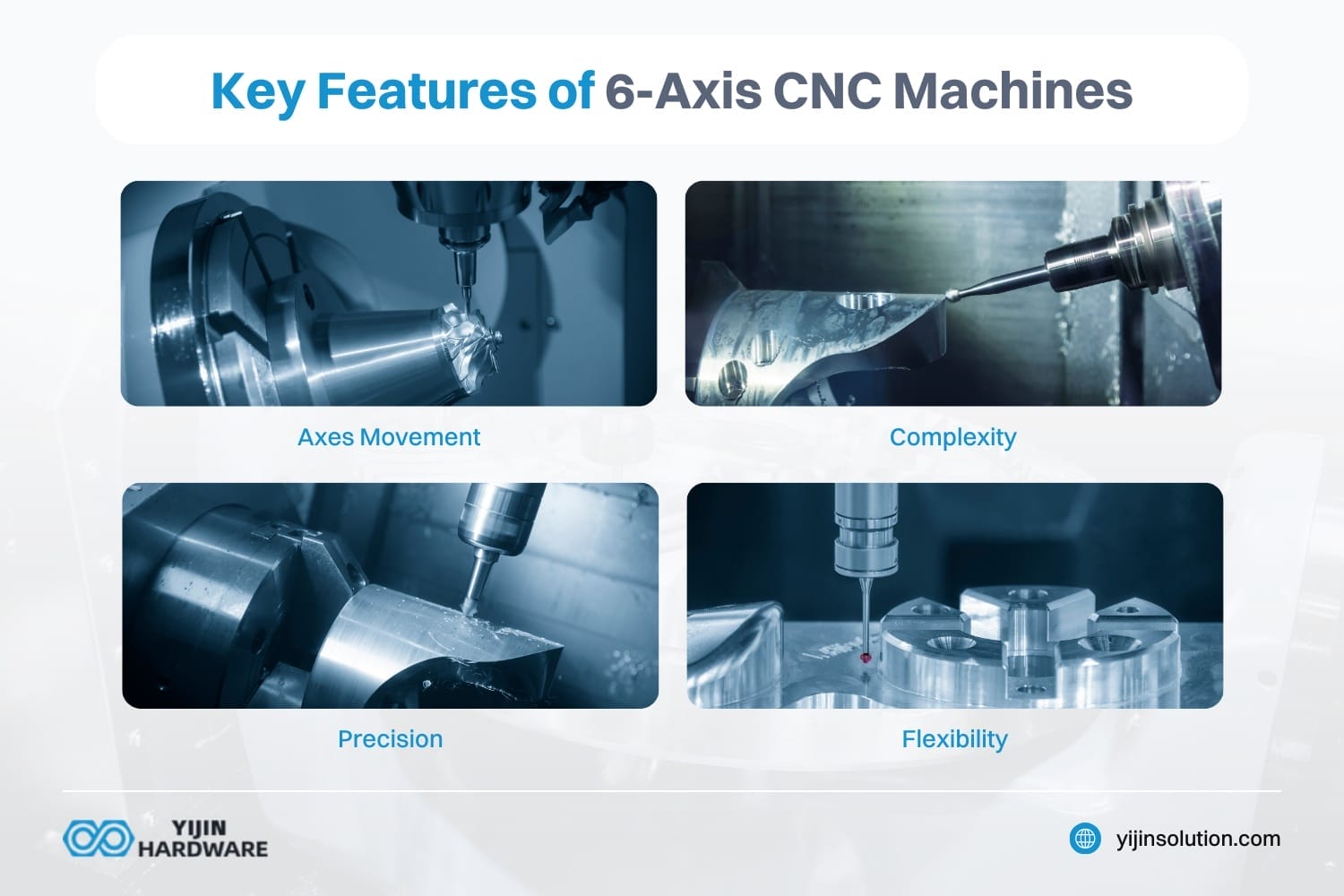
Modern 6-axis CNC milling machines offer precision tolerances as fine as ±0.01 mm, enabling exceptional dimensional accuracy that surpasses conventional manufacturing methods. Testing conducted by MATEC demonstrates that their machines maintain this precision even when machining hardened tool steels and exotic materials like Inconel and titanium alloys.
These top-tier machine tools can process virtually any machinable material, with industrial models handling components up to 80 feet long for complex aerospace parts.
| Capability | 3-Axis CNC | 5-Axis CNC | 6-Axis CNC |
|---|---|---|---|
| Axes | X, Y, Z | X, Y, Z, A, B | X, Y, Z, A, B, C |
| Precision | ±0.05 mm | ±0.02 mm | ±0.01 mm |
| Setup Requirements | Multiple | Few | Single setup |
| Complex Geometry | Limited | Good | Excellent |
| Production Speed | Baseline | 2x faster | Up to 4x faster |
| Surface Finish | Good | Very Good | Excellent |
How does 6-Axis CNC Compare to Other Machining Methods?
6-axis CNC machining offers complete freedom of movement through three translational and three rotational axes, providing significantly greater flexibility than other machining configurations. This comprehensive movement capability translates directly into efficiency gains and quality improvements impossible with simpler setups.
3-axis CNC machines, which move only along X, Y, and Z axes, require multiple setups for complex parts.
For example, a turbine blade might need 5-7 different fixtures. Each setup introduces potential alignment errors and increases production time. These machines cannot machine undercuts without specialized fixtures, limiting their application for complex aerospace or automotive components.
5-axis machines (adding A and B rotation) offer good versatility but still lack the complete freedom of movement that 6-axis provide. For components with spiral features like orthopedic implants, a 5-axis machine must reposition multiple times, while a 6-axis machine can maintain optimal tool orientation throughout with a single C-axis rotation.
What are the Benefits of 6-Axis CNC Machining?
The primary benefit of 6-axis machining is cycle time reduction, with documented cases showing production times decreased by up to 75% compared to conventional machining processes.
Kingsbury has demonstrated that for complex aerospace components, the efficiency gains come from three factors: elimination of multiple setups (saving 30-40% of time), maintaining optimal cutting conditions (improving material removal rates by 20-25%), and enabling more efficient toolpaths (reducing cutting time by 15-20%).
Key Efficiency Advantages
- Setup Reduction: Complete machining in one fixture eliminates alignment errors. Spirit AeroSystems showed that reducing setups from six to one for titanium components improved dimensional accuracy by 28% while cutting labor costs by 45%.
- Tool Life Optimization: Maintaining ideal tool angles extends cutting tool life by 30-50% according to testing by Sandvik Coromant, reducing tooling costs.
- Transition Speed: C-axis enables faster movement between operations, reducing non-cutting time by up to 40% compared to 5-axis machines.
- Surface Quality: Consistent cutting conditions enhance finish quality. Zimmermann’s research shows 6-axis configurations maintain constant surface speed more effectively than 5-axis alternatives, improving surface finish by 30-35%.
While initial investment in a 6-axis CNC machine exceeds simpler configurations by 25-40%, manufacturers report ROI periods of 12–18 months based on reduced labor costs, higher production rates, and improved part quality.
Which Industries Benefit Most from 6-Axis CNC Machining?
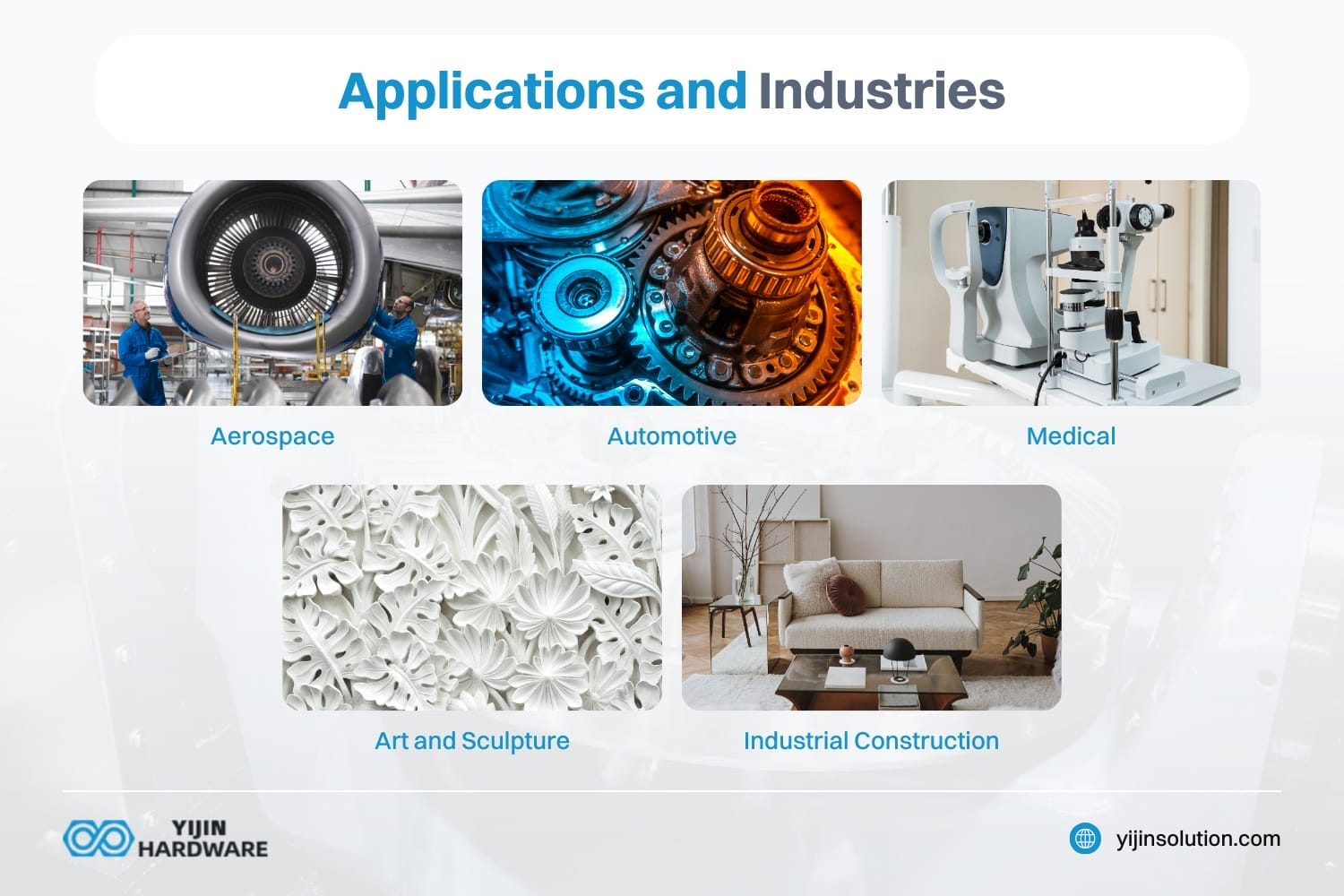
The aerospace industry benefits significantly from 6-axis CNC machining for manufacturing complex components. Triumph Structures uses this technology to fabricate critical components from titanium and specialized alloys, reducing cycle time by 35% while improving surface finish quality by 28%.
Industry-Specific Applications
6-axis machines find use across many industries, including aerospace, medical, and automotive.
- Turbine blades with complex airfoil geometries requiring continuous 5-sided machining
- Structural components with compound curved surfaces and variable wall thicknesses
- Engine combustion chambers with internal features requiring specialized tool access angles
- Custom dental implants with biomimetic surface structures
- Orthopedic implants with porous surfaces for osseointegration
- Surgical instruments with complex articulation mechanisms requiring high precision
Automotive Industry:
- Formula 1 transmission cases are machined from solid billet material
- Racing engine blocks with optimized cooling passages
- Lightweight structural components with variable wall thicknesses
The alternative energy sector also employs 6-axis machining for wind turbine components and nuclear applications. Wind energy manufacturer Vestas uses 6-axis CNC to create precision mold components for their V150 turbine blades, citing 22% production efficiency improvements.
What Types of Parts are Best Suited for 6-Axis CNC Machining?
Parts with complex geometries requiring machining from multiple angles are ideally suited for 6-axis CNC mill manufacturing. These include components with organic shapes, undercuts, and internal features that would be difficult to access with conventional machining approaches. The 6-axis technology maintains optimal cutting tool orientation throughout, ensuring consistent quality across all surfaces.
Ideal Component Characteristics
- Complex Curved Surfaces: Parts with organic or aerodynamic geometries, like turbine blades, where surface continuity directly impacts performance.
- Multiple Feature Angles: Components such as aircraft structural fittings that require machining from various directions. Testing at Boeing showed that parts with features at more than four different angles saw setup time reductions of 60-80% with 6-axis machining.
- Deep Pockets with Variable Wall Thicknesses: Components like aluminum housings for satellite systems that require maintaining precise wall thickness throughout complex interior cavities.
- Undercuts and Internal Features: Medical devices with undercut attachment points or internal channels that can’t be accessed with standard tooling approaches. The C-axis rotation enables specialized tools to reach these features without fixture changes.
High-value parts where material costs are significant also benefit from 6-axis capabilities. Aerospace manufacturers working with expensive materials like titanium alloys report material utilization improvements of 15-20% due to near-net-shape machining capabilities.
What Challenges Come with 6-Axis CNC Machining?
The primary challenge with 6-axis machining is the significant investment required. Industrial-grade machines typically cost between $350,000 and $750,000, representing a premium of 30-50% over comparable 5-axis systems. This substantial capital expenditure requires careful financial justification based on anticipated productivity gains.
Technical Challenges:
- Programming Complexity: Creating efficient toolpaths requires advanced computer-aided manufacturing (CAM) software and expertise. Programmers must understand the interactions between all six axes to prevent potential collisions and optimize machining sequences.
- Collision Avoidance: The increased motion freedom creates more potential for tool/fixture interference. Modern systems incorporate simulation tools for collision detection before machining begins.
- Operator Training: Setup and operation require higher skill levels than conventional machines. Manufacturers report training periods of 4–6 weeks for experienced machinists transitioning to 6-axis systems.
According to Sage Journals, motion errors along the X, Y, and Z axes can affect overall precision, regardless of the complexity of the machine and its rotary axes. Despite these challenges, manufacturers with appropriate applications consistently report positive return on investment, particularly when machining high-value components with complex geometries. It’s also still a much more advanced option compared to different types of CNC machines, such as some lathe machines and CNC routers.
How to Choose Between 5-Axis and 6-Axis CNC Machining?
Choosing between 5-axis and 6-axis CNC machining requires analyzing part complexity, production volume, and economic factors. This decision significantly impacts both manufacturing capabilities and financial outcomes.
Select 5-axis CNC milling for components with moderate complexity that don’t need C-axis rotation for optimal tool orientation. The 5-axis machine offers excellent capabilities for most complex parts while having 30-40% lower costs than 6-axis alternatives.
| Decision Factor | Choose 5-Axis | Choose 6-Axis |
|---|---|---|
| Geometry Complexity | Parts with features at multiple angles but no spiral surfaces | Parts with complex organic shapes requiring optimized tool angles |
| Production Volume | Low to medium volumes (50 to 500 units annually) | Medium to high volumes where setup reduction delivers significant savings |
| Surface Requirements | Standard finishes meet requirements | Premium surface quality is critical for performance |
| Budget Constraints | Cost is primary consideration | Performance requirements outweigh cost concerns |
Choose 6-axis CNC for extremely complex geometries that benefit from complete tool orientation freedom. The additional axis becomes particularly valuable for components with flowing shapes requiring continuous tool adjustment. Zimmermann’s 6-axis mills achieve up to 30% better surface finish quality on complex contoured surfaces than 5-axis alternatives, particularly for titanium and nickel-based superalloys.
Yijin Hardware’s 6-Axis CNC Machining Services
Yijin Hardware offers industry-leading 6-axis CNC machining services with state-of-the-art machinery from premier German manufacturers, including Zimmermann’s FZ40 portal milling center and MATEC’s 30HV machining system. Our manufacturing capabilities handle components from medical devices to aerospace structures up to 65 feet in length.
Our engineering team provides comprehensive support throughout the manufacturing process, beginning with detailed design for manufacturability analysis to optimize part designs specifically for 6-axis production. This collaborative approach has helped our aerospace clients reduce component weight by an average of 17% while maintaining structural requirements.
Yijin Hardware maintains IATF 16949, AS9100D, and ISO 13485 certifications, with quality assurance including Zeiss Coordinate Measuring Machines accurate to 0.002 mm. We’ve achieved 99.7% quality acceptance rates while maintaining 98.5% on-time delivery for three consecutive years.
Contact our engineering team for a consultation to learn how our advanced 6-axis CNC machining services can benefit your next project.
Frequently Asked Questions
What control software is used for programming 6-axis CNC machines?
Leading CAM software packages for programming 6-axis CNC machines include Siemens NX, Mastercam, CATIA, and Hypermill, each offering specialized modules for multi-axis machining with comprehensive simulation capabilities. Siemens NX CAM, preferred by aerospace manufacturers, provides automatic collision avoidance, tool axis optimization, and Digital Twin functionality that creates a virtual representation of the entire manufacturing process accurate to within 0.001 mm.
These programs work with machine control systems like SINUMERIK 840D, FANUC 30i-B, and HEIDENHAIN TNC 640, which manage real-time execution with sophisticated algorithms that prevent collisions while optimizing motion between operations.
What is the difference between 6-axis CNC machining and robotic machining?
The primary differences between 6-axis CNC machines and robotic machining centers are rigidity, precision, and application focus. Traditional 6-axis CNC machines feature a fixed structural design with high rigidity (typically 50-100 N/μm), enabling precision tolerances of ±0.01 mm even under heavy cutting loads, while robotic arms achieve lower precision (typically ±0.1 mm) due to their articulated structure with lower rigidity.
CNC machining excels at high-precision material removal from metals and hard materials, while robotic systems better suit operations requiring extensive reach or lower precision applications like trimming and deburring. Many modern facilities combine both technologies, with CNC machines handling precision cutting and robots managing material handling and secondary operations.
What innovations are emerging in 6-axis CNC technology?
Recent innovations in 6-axis CNC technology include AI-enhanced adaptive machining systems from DMG MORI and Makino that optimize cutting parameters based on real-time sensor data, reducing cycle times by 15-25% while improving surface finishes. Hybrid manufacturing systems now combine 6-axis machining with additive manufacturing in a single platform, enabling the production of components with internal features impossible to create through machining alone.
Other advancements include digital twin integration for completely verified programs before cutting begins (reducing programming time by 40%), in-process measurement systems that verify dimensions without removing parts from the machine, and collaborative manufacturing ecosystems that connect machine performance, maintenance needs, and production metrics into comprehensive factory management systems.
Back to Top: What is 6-Axis CNC Machining?




 EN
EN  ES
ES  RU
RU  DE
DE  FR
FR