


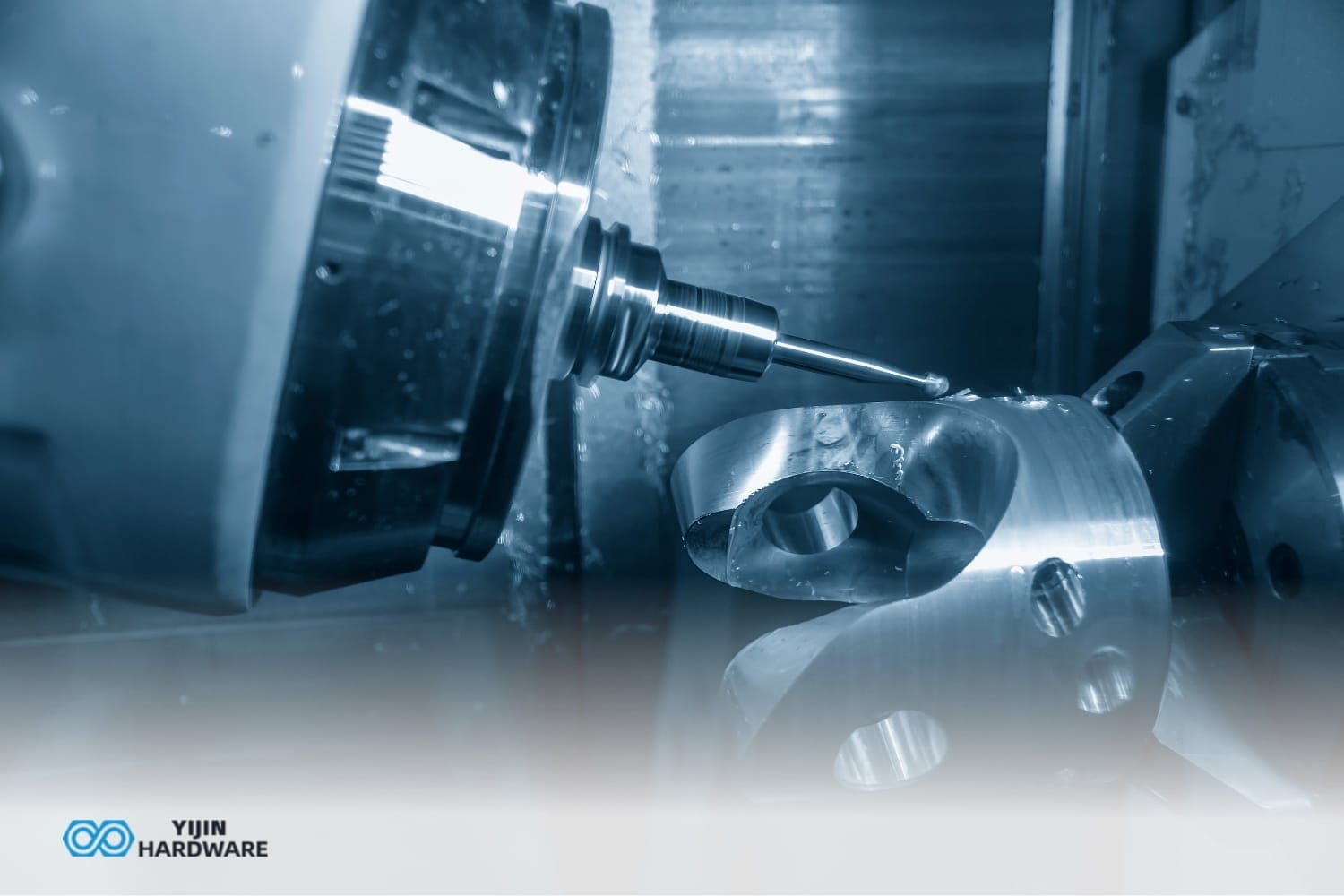
When manufacturing metal parts, choosing between casting and CNC machining significantly impacts your project’s cost, quality, and timeline. Casting involves pouring molten metal into a mold where it solidifies into the desired shape, while CNC machining is a subtractive process that uses computer-controlled cutting tools to remove material from a solid block. This guide helps you determine which manufacturing process best suits your specific production needs.
Key Takeaways
- CNC machining delivers higher precision (±0.025 mm tolerance) than casting (±0.1 mm tolerance)
- Casting is more cost-effective for high-volume production, while CNC machining excels for low quantities
- CNC machining offers wider material compatibility with virtually all metals and many non-metals
- Casting creates less material waste and is better for parts with complex internal geometries
- Hybrid approaches combining both methods often provide optimal results for complex projects
What’s the Difference Between Casting and CNC Machining?
Casting is a formative manufacturing process where liquid metal fills a mold cavity and solidifies into shape, dating back over 6,000 years. CNC machining is a subtractive manufacturing process that removes material from a solid block using computer-guided cutting tools, representing more recent technological innovation.
Casting and CNC machining represent fundamentally different manufacturing approaches in metal fabrication.
| Feature | Casting | CNC Machining |
|---|---|---|
| Process Type | Formative (adding) | Subtractive (removing) |
| Basic Method | Molten metal fills the mold | Computer-guided cutting tool |
| Material State | Starts as a liquid | Starts as a solid block |
| Design Approach | Mold-based production | Digital design-driven |
How does the Casting Process Work?
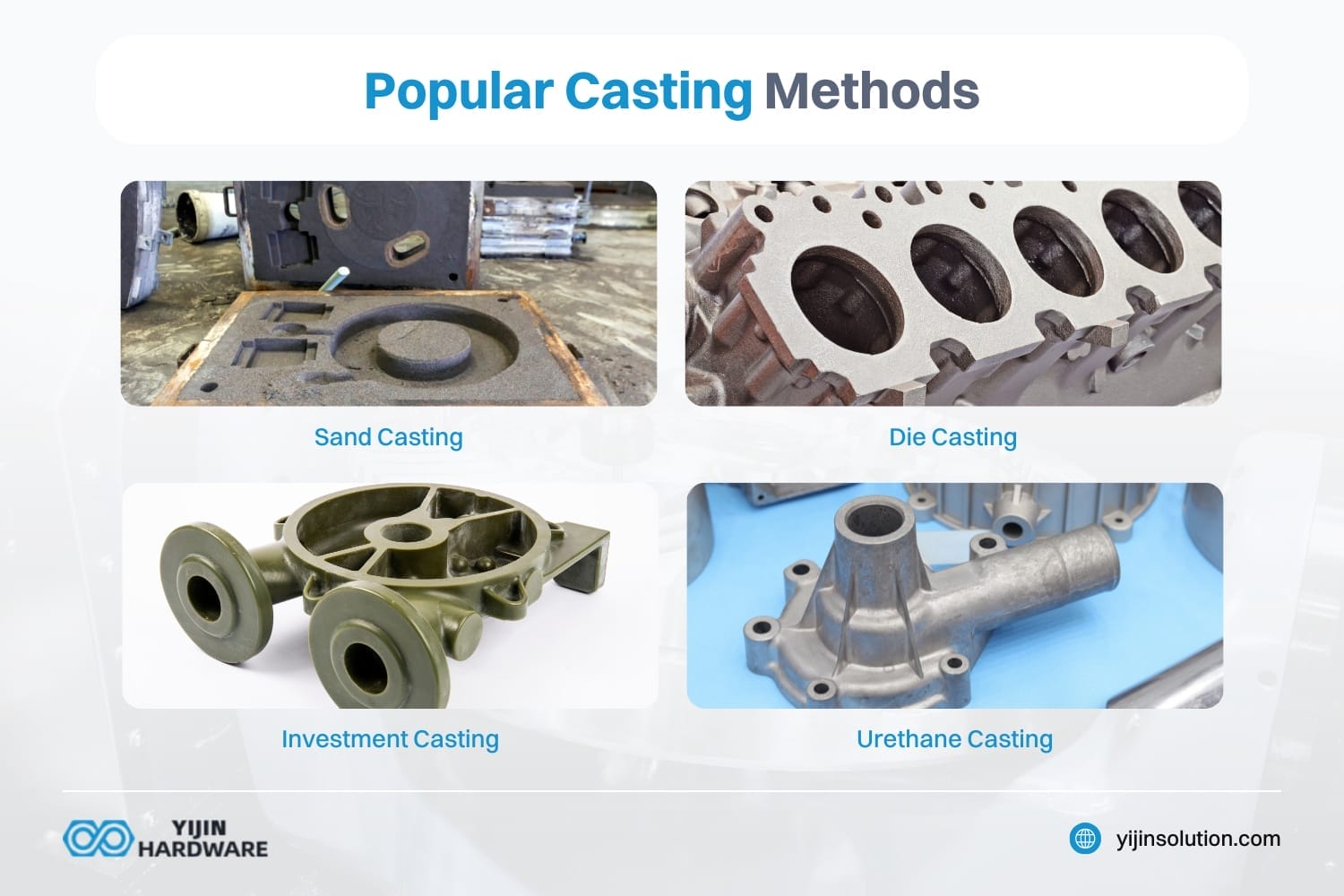
The casting process begins with creating a mold of the desired part shape. Metal is melted in a furnace until completely liquid, then poured or injected into the prepared mold cavity where it cools and solidifies. After cooling, the part is removed from the mold through breaking, ejection, or disassembly, followed by finishing operations.
Types of Casting Methods
| Method | Mold Type | Best Applications |
|---|---|---|
| Die Casting | Permanent metal dies | High-volume, thin walls |
| Sand Casting | Expendable sand molds | Large parts, ferrous metals |
| Investment Casting | Expendable ceramic | Complex details, good finish |
| Permanent Mold | Reusable metal molds | Medium volume, good finish |
Die-cast parts require proper design consideration for optimal results. Unlike CNC machining, the die casting process, which involves injecting molten metal under pressure, can produce complex parts economically when manufactured in sufficient quantities.
How does CNC Machining Work?
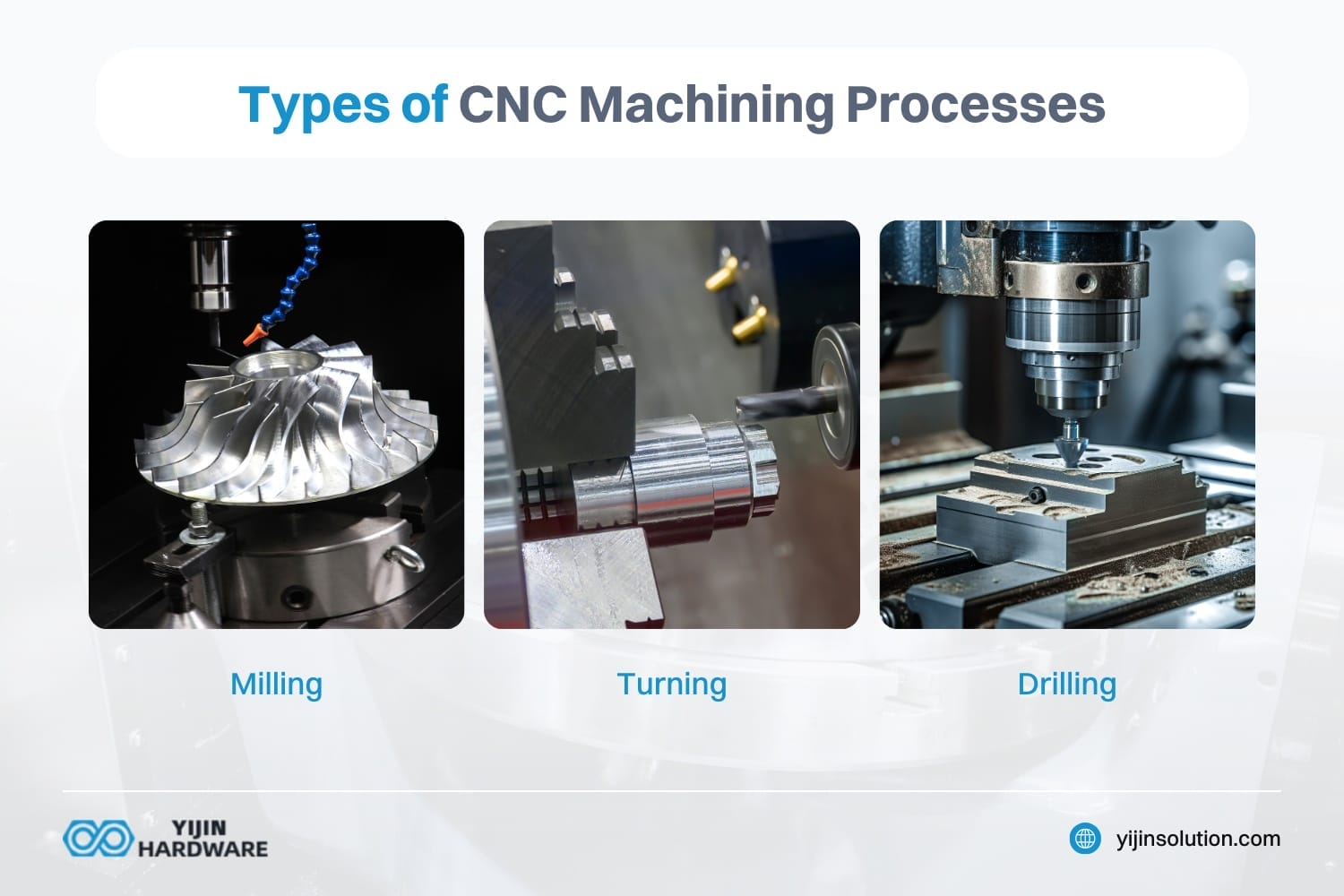
CNC machining uses computer numerical control to guide cutting tools that remove material from a solid block. The process starts with a digital design (CAD model) that’s converted to machine instructions (G-code) through CAM software. These instructions direct the movement of cutting tools to shape the material through operations like milling, turning, drilling, and boring.
Types of CNC Machines
- CNC Mills: Remove material using rotating tools (3 to 5+ axes)
- CNC Lathes: Rotate the workpiece against stationary tools
- Multi-tasking machines: Combine milling and turning operations
Using CNC machining for prototyping offers significant advantages over traditional methods. A CNC mill can produce complex parts with exceptional precision from a wide range of materials. When comparing CNC machining vs. casting for prototype development, CNC machining is ideal for quick iterations without expensive tooling investment.
Which Process Offers Better Precision and Accuracy?
CNC machining delivers significantly higher precision than casting for most applications. CNC machining routinely achieves tolerances as tight as ±0.025 mm (0.001″), making it ideal for parts requiring exact specifications. Casting typically achieves tolerances of ±0.1 mm per 25 mm, though precision varies by method.
Precision Capabilities Comparison
| Manufacturing Method | Typical Tolerance | Best Applications |
|---|---|---|
| CNC Machining | ±0.025 mm (0.001″) | Precision components, medical devices |
| Precision CNC Machining | ±0.0002″ | Aerospace, semiconductor parts |
| Investment Casting | ±0.1 mm per 25 mm | Complex shapes with moderate precision |
| Die Casting | ±0.1 mm per 25 mm | High-volume parts with good precision |
| Sand Casting | ±0.2 mm or more | Large parts with lower precision need |
How do Material Options Compare Between Processes?
CNC machining offers vastly superior material compatibility compared to casting. Virtually all metals and many non-metals can be CNC machined, including all aluminum alloys, steel, titanium, copper, plastics, wood, and composites.
Casting is more limited, with primarily non-ferrous metals like aluminum, zinc, and copper alloys being common, though iron and some steel alloys can be cast through specific methods like sand casting.
Material Compatibility Table
| Material Category | CNC Machinability | Casting Suitability |
|---|---|---|
| Aluminum Alloys | Excellent | Very Good |
| Steel | Very Good | Limited |
| Titanium | Good | Poor |
| Copper Alloys | Good | Good |
| Thermoplastics | Excellent | N/A (Injection molding used) |
| Composites | Good | Limited |
For specialized applications that require alternative processes, we can also advise on other methods like 3D printing or urethane casting, depending on project needs.
Which Process is Better for Complex Geometries?
Casting excels at producing parts with complex internal geometries that would be impossible to machine. Internal cavities, hollow sections, and intricate channels are easily formed during casting as the liquid metal flows around cores in the mold.
CNC machining excels at external geometries with sharp corners, exact dimensions, and fine details, but cannot create completely enclosed internal features without assembling multiple pieces.
Geometry Capability Comparison
- Casting geometric advantages: Internal cavities, uniform thin walls, complex curved surfaces
- CNC machining geometric advantages: Precise external features, sharp corners, tight tolerance features
For external complexity, CNC machining provides superior detail resolution and dimensional accuracy. The 5-axis CNC machines at Yijin Hardware can produce highly complex external features with undercuts and sophisticated surface profiles. When comparing die casting vs CNC machining for complex parts, each method has distinct advantages depending on whether the complexity is internal or external.
How does Production Volume Affect Manufacturing Costs?
Casting becomes increasingly economical at higher volumes due to spreading initial mold costs across many parts. CNC machining is more cost-effective for low to medium production volumes since it requires no tooling investment.
The crossover point where casting becomes more economical typically ranges from 500 to 1000 units, depending on part complexity. Production volume dramatically influences which manufacturing method is most cost-effective.
Production Volume Cost Analysis
| Production Volume | Most Cost-Effective Method | Key Cost Factors |
|---|---|---|
| 1 to 50 units | CNC Machining | No tooling investment |
| 50 to 500 units | Generally CNC Machining | Depends on part’s complexity |
| 500 to 1000 units | Crossover Point | Evaluate case-by-case |
| 1000+ units | Usually Casting | Tooling cost amortization |
| 10,000+ units | Casting | Significant per-unit savings |
For prototype and small batch production under 500 units, CNC machining almost always provides better value. The initial casting setup requires a significant investment before making a single part. Die casting may be required for high-volume production runs to achieve optimal cost efficiency.
What are the Time Considerations for Each Process?
CNC machining delivers faster turnaround for low-volume production and prototypes. The CNC machining process requires only programming and material preparation before production begins.
Casting requires significant lead time for mold design and fabrication, typically taking weeks before the first part can be produced. However, once molds are ready, casting can produce parts more quickly in high volumes than CNC machining.
At Yijin Hardware, our rapid CNC machining services can deliver prototype parts in as little as 3-5 business days, while casting projects typically require 2 to 4 weeks for initial setup. When machining vs. casting is evaluated for timeline considerations, machining is the better choice for quick-turn projects.
How do Surface Finish Capabilities Compare?
CNC machining produces excellent surface finishes directly from the machine, typically 0.8-1.6 μm Ra (roughness average) without secondary operations. Standard casting surface finishes are generally rougher at 3.2-6.3 μm Ra, often requiring additional finishing operations to achieve comparable smoothness. Surface finish quality varies significantly between processes.
| Process | As-Produced Finish | Achievable with Secondary Operations |
|---|---|---|
| CNC Machining | 0.8-1.6 μm Ra | Down to 0.1 μm Ra |
| Die Casting | 1.6-3.2 μm Ra | 0.8-1.6 μm Ra |
| Investment Casting | 1.6-3.2 μm Ra | 0.8-1.6 μm Ra |
| Sand Casting | 6.3-12.5 μm Ra | 1.6-3.2 μm Ra |
CNC machining allows for precise control of surface texture, while casting offers less precision in surface control. At Yijin Hardware, we provide comprehensive secondary finishing services for both CNC-machined and cast parts to achieve your exact surface finish requirements.
When Should You Choose Casting Over CNC Machining?
Casting is the better choice when your project involves high-volume production, complex internal geometries, or very large parts. Choose casting when producing thousands of identical parts, as per-unit costs decrease dramatically at scale. Parts with intricate internal features, like cooling channels or hollow sections, are often only possible through casting.
Optimal Applications for Casting
- High-volume production (1000+ identical parts)
- Complex internal geometries (cooling channels, hollow sections)
- Very large components that exceed typical CNC work envelopes
- Thin-walled structures (under 1 mm thickness)
For thin-walled structures (under 1 mm), casting often provides advantages over machining, which can cause material distortion. Many different metal casting techniques exist to address specific material and design requirements.
What About Waste Management and Sustainability?
Additionally, according to Zetwerk, die casting produces less material waste in comparison to CNC machining, making it the better choice in CNC vs casting for environmental concerns. CNC machining is inherently subtractive, removing up to 90% of the original stock material in some cases. Casting uses only the metal needed for the part, plus gates and runners, which can be recycled.
Manufacturing sustainability is increasingly important in production decisions. At Yijin Hardware, we implement comprehensive material recycling systems for our CNC operations, collecting and sorting metal chips for recycling to minimize environmental impact.
Can You Combine Casting and CNC Machining for Better Results?
Yes, hybrid manufacturing approaches combining casting and machining frequently deliver optimal results for complex projects. Cast parts provide the basic shape with internal features, while selective CNC machining adds precision to critical dimensions, improves surface finish, or creates features requiring tight tolerances. Machining and die casting together can create components that neither process could achieve alone.
At Yijin Hardware, we coordinate between casting suppliers and our in-house CNC machining facilities to deliver finished parts that meet exact specifications. Casting and CNC machining together provide the ultimate performance breakdown for manufacturing complex components.
How do you Choose the Right Process for Your Project?
Consider production volume first—low volume generally favors CNC machining, while high volume favors casting. Evaluate precision requirements, as high-precision applications typically require CNC machining. Assess material requirements, geometry complexity, and timeline needs as additional deciding factors.
Decision-Making Framework
| Factor | Favors Casting | Favors CNC Machining |
|---|---|---|
| Quantity | 1000+ parts | 1 to 500 parts |
| Precision | ±0.1 mm acceptable | ±0.025 mm required |
| Complexity | Internal features needed | External features only |
| Timeline | Longer lead time is acceptable | Quick turnaround needed |
| Budget | Higher tooling, lower unit cost | No tooling, higher unit cost |
| Material | Non-ferrous metals | Any machinable material |
When deciding between CNC machining and die casting for your project, many successful manufacturing strategies involve both processes, either as alternatives for different parts or in combination for the same component. The volume of parts required often becomes the determining factor in choosing between these manufacturing processes.
Why Choose Yijin Hardware for Your Manufacturing Needs?
Yijin Hardware offers comprehensive manufacturing solutions with expertise in both CNC machining and casting process management. Our state-of-the-art CNC machining center features advanced multi-axis machines capable of producing complex parts with exceptional precision. We maintain strong partnerships with qualified casting suppliers to provide complete manufacturing solutions.
Our Manufacturing Advantages
- Technical Expertise: Our engineering team averages 12+ years of manufacturing experience
- Equipment Capabilities: The Latest 5-axis CNC machines with micron-level precision
- Quality Assurance: ISO 9001 certified processes with comprehensive inspection capabilities
- Material Knowledge: Expertise across hundreds of alloys and material grades
- Design Support: Manufacturing optimization consultation for cost and quality improvements
- Hybrid Manufacturing: Specialized capabilities combining casting and precision machining
With over 15 years of experience serving clients worldwide, our engineering team can help determine the optimal manufacturing approach for your specific requirements. We specialize in industries including automotive, aerospace, medical, and industrial equipment, delivering precision parts that meet the most demanding specifications. Contact us to learn more about our CNC machining and casting services.
CNC Machining vs Casting FAQs
What materials work best for CNC machining versus casting?
Aluminum alloys, steel, titanium, copper, and plastics excel in CNC machining due to their machinability characteristics. For casting, aluminum alloys (356, A380), zinc alloys, brass, and bronze are preferred for their flow properties and lower melting points for machined parts. Some materials, like certain stainless steels, can be challenging to cast but machine well. The selection of an appropriate alloy depends on the mechanical properties required for the application.
How do casting and CNC machining compare for design iterations and modifications?
CNC machining offers superior flexibility for design changes, requiring only programming adjustments. Casting necessitates expensive mold modifications or completely new molds for significant design changes, making it less adaptable to evolving designs during development. For projects requiring multiple design iterations, CNC machining provides cost and time advantages, especially in the prototyping and early production phases.
How do die casting and CNC machining compare in terms of cost at different production volumes?
At low volumes (1-500 units), CNC machining is generally more economical due to minimal setup costs. For medium volumes (500-5,000), the crossover point occurs where die casting becomes more cost-effective due to spreading tooling costs across more parts. At high volumes (5,000+), die casting is substantially more economical, with the cost per part often being a fraction of machining costs. Die casting may be required for truly high-volume production runs, where the relatively low per-unit cost justifies the initial tooling investment.
Casting would be the preferred manufacturing process that allows mass production, while machining has the advantage of flexibility when you need to create a part quickly. Though at low quantities, CNC machining is a better way to produce, and machining may still suit custom runs.
Back to Top: Casting vs. CNC Machining




 EN
EN  ES
ES  RU
RU  DE
DE  FR
FR